Estratégia de acompanhamento de tendência RSI


Data de criação: 2023-11-16 15:33:40 última modificação: 2023-11-16 15:33:40
cópia: 2 Cliques: 832
1
focar em
1617
Seguidores

Estratégia de acompanhamento de tendência RSI

Visão geral

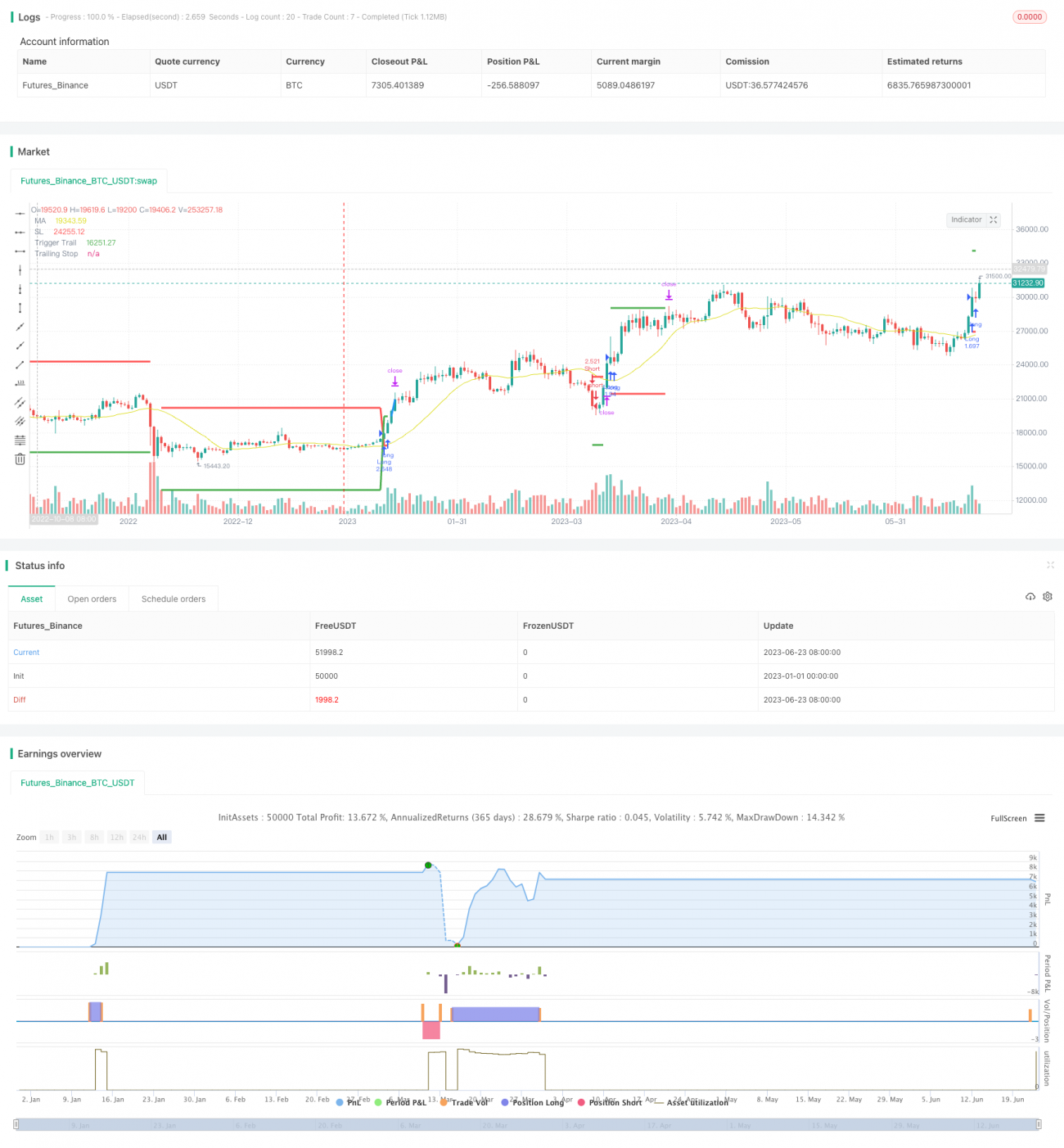
A estratégia combina o indicador RSI e a média móvel ponderada para realizar operações de acompanhamento de tendências. A estratégia exige que a média móvel atenda às condições de tendência quando a RSI é superior a 60 e baixa quando a RSI é inferior a 40. A estratégia usa o RSI de 40 ciclos como indicador de acompanhamento de tendências.

Princípio da estratégia

A estratégia calcula primeiro o RSI e a média móvel ponderada. O RSI tem 20 ciclos e a média móvel ponderada tem 20 ciclos, com pesos maiores para reduzir o impacto das flutuações de curto prazo.

Depois de fazer mais shorting, será simultaneamente configurado um stop loss e um stop move. O stop loss está a 3 vezes o ATR do preço atual; o stop move inicia a ativação do preço a 4 vezes o ATR do preço atual, depois é movido a uma amplitude de 3%. Quando o preço toca o stop loss ou o stop move a ativação do preço, será fechada a posição correspondente.

A estratégia também adiciona regras de gerenciamento de capital, ajustando a posição através da lei da proporção fixa. Cada vez que os lucros ou perdas atingem um valor fixo, aumenta ou diminui o volume de negociação de um número fixo.

Análise de vantagens

  • Usar o RSI para avaliar tendências, permitindo um acompanhamento eficaz das tendências
  • As médias móveis ponderadas reduzem os efeitos das flutuações de curto prazo por meio de diferentes pesos, evitando a fixação
  • A utilização de travões móveis para maximizar os lucros
  • Gestão de fundos em proporções fixas e controle de riscos

A vantagem geral da estratégia é a capacidade de acompanhar a tendência, ao mesmo tempo em que se tomam medidas de stop loss e de stop motion para controlar o risco e, assim, obter melhores retornos em situações fortes.

Análise de Riscos

  • Indicadores RSI emitem sinais errados que podem levar a negociações desnecessárias
  • A ruptura de um stop loss ou a movimentação de um stop loss pode ser forçada a um stop loss e não pode continuar a seguir a tendência
  • As regras de gestão de fundos podem ser demasiado radicais e levar a grandes perdas

O principal risco da estratégia é a confiabilidade do indicador RSI e se a parada de parada móvel é razoável. Se os parâmetros forem mal configurados, pode resultar em perda de posições desnecessariamente baixas ou acima da capacidade de suporte. Além disso, pode ser forçado a parar quando a parada ou o preço de parada for rompido, perdendo a oportunidade de continuar a seguir a tendência.

Pode-se considerar otimizar os parâmetros do RSI, ou usar outros indicadores para auxiliar o julgamento. Ajustar os parâmetros de stop loss e stop loss móveis para adaptar-se a diferentes variedades e situações de volatilidade. Finalmente, é preciso ter cuidado ao definir as regras de gerenciamento de fundos, que não devem ser demasiado radicais para evitar excedentes de capacidade de tolerância ao risco.

Direção de otimização

  • Tente outros indicadores em combinação com o RSI para confirmação de sinal, como KD, MACD, etc.
  • Parâmetros de travagem móvel de parada de perda optimizados de acordo com diferentes características de variedade e amplitude de oscilação
  • Tente outros métodos de gestão de fundos, como a negociação de volumes fixos, a fórmula de Kelly, etc.
  • Adição de condições de abertura de posição, como quebrar a linha de Brin, desvio do RSI, etc.
  • Considere adicionar preços de saída para adicionar posições em uma forte tendência

A estratégia pode ser otimizada de várias maneiras. Primeiro, procurar outros indicadores técnicos que possam auxiliar ou confirmar o RSI, aumentando a confiabilidade do sinal. Em segundo lugar, otimizar o parâmetro de parada móvel de stop loss de acordo com as características específicas da variedade é muito importante.

Resumir

A estratégia de acompanhamento de tendências do RSI tem uma visão geral clara. O núcleo está no uso do RSI para determinar a direção da tendência e auxiliar a aumentar a precisão do julgamento com o peso da média móvel. A vantagem da estratégia está na capacidade de acompanhar a tendência e maximizar o lucro, além de configurar o stop loss e o gerenciamento de fundos para controlar o risco.

||

Overview

This strategy combines the RSI indicator and weighted moving average for trend following trading. It goes long when RSI is above 60 and goes short when RSI is below 40, with the moving average verifying the trend condition. The 40-period RSI acts as a trend following indicator. The weighted moving average uses different weights to reduce the impact of short-term fluctuations. The strategy also employs stop loss and trailing take profit to control risks.

Strategy Logic

The strategy firstly calculates the RSI and weighted moving average. The RSI length is 20 periods and the weighted MA length is 20 with higher weights that reduce the impact of short-term volatility. It goes long when RSI is above 60 and weighted MA rate of change is below -1%. It goes short when RSI is below 40 and weighted MA rate of change is above 1%.

After opening long or short, stop loss and trailing take profit orders are placed simultaneously. The stop loss is set at 3 ATR from the current price. The initial trailing take profit activation is 4 ATR away, and trails in 3% increments. When price hits either stop loss or trailing take profit activation, the position will be closed.

The strategy also incorporates money management rules based on the fixed fractional position sizing approach. Whenever PNL hits a fixed amount, the order size is increased or decreased by a fixed amount.

Advantage Analysis

  • RSI indicator can effectively track trends
  • Weighted MA reduces the impact of short-term fluctuations, avoiding whipsaws
  • Trailing take profit allows profits to be maximized
  • Fixed fraction position sizing controls risk effectively

The overall edge is the ability to follow trends, while taking stop loss and trailing take profit measures to control risks, thus capturing significant gains in strong trends.

Risk Analysis

  • False signals from RSI may cause unnecessary trades
  • Forced to stop out when price breaches stop or trailing take profit levels, unable to keep following trends
  • Aggressive money management rules may lead to large losses

The main risks come from the reliability of RSI signals and the stop loss/trailing take profit settings. Incorrect parameters may result in unnecessary closing of trades or losses beyond risk appetite. Breaking stop loss/take profit may also force unwarranted stop outs, losing the chance to continue trend trading.

Solutions include optimizing RSI parameters or adding other indicators for signal confirmation. Adjust stop/trailing take profit levels based on different products and volatility conditions. Also be prudent with money management rules to avoid excessive risks.

Optimization Directions

  • Test other indicators together with RSI for signal confirmation, e.g. KD, MACD etc
  • Optimize stop loss and trailing take profit parameters based on product characteristics and volatility range
  • Try other money management techniques like fixed size trading, Kelly formula etc
  • Add entry conditions like Bollinger breakouts, RSI divergences etc
  • Consider adding positions on strong trends

There are many aspects to optimize. First is identifying other indicators to supplement RSI signals. Next critical step is optimizing stop loss/trailing take profit parameters based on historical performance. Money management can also switch to other types. Finally, entry, add-on conditions can be enhanced to pyramiding positions in strong trends.

Summary

The RSI trend following strategy has clear logic, using RSI for trend direction and weighted MA for confirmation. Its strength lies in trend trading, maximizing profits with stops/money management controlling risks. But RSI reliability and parameter optimization need improvement. We can look into enhancing signal indicators, stop/trailing parameters, money management methods etc to make the strategy more robust across different products.

[/trans]

Código-fonte da estratégia
/*backtest
start: 2023-01-01 00:00:00
end: 2023-06-24 00:00:00
period: 1d
basePeriod: 1h
exchanges: [{"eid":"Futures_Binance","currency":"BTC_USDT"}]
*/

// This source code is subject to the terms of the Mozilla Public License 2.0 at https://mozilla.org/MPL/2.0/
// © gsanson66


//This code is based on RSI and a backed weighted MA
//@version=5
strategy("RSI + MA BACKTESTING", overlay=true, initial_capital=1000, default_qty_type=strategy.fixed, commission_type=strategy.commission.percent, commission_value=0.18)


//------------------------FUNCTIONS---------------------------//

//@function which calculate a retro weighted moving average to minimize the impact of short term reversal
rwma(source, length) =>
    sum = 0.0
    denominator = 0.0
    weight = 0.0
    weight_x = 100/(4+(length-4)*1.30)
    weight_y = 1.30*weight_x
    for i=0 to length - 1
        if i <= 3
            weight := weight_x
        else
            weight := weight_y
        sum := sum + source[i] * weight
        denominator := denominator + weight
    rwma = sum/denominator

//@function which permits the user to choose a moving average type
ma(source, length, type) =>
    switch type
        "SMA" => ta.sma(source, length)
        "RWMA" => rwma(source, length)

//@function Displays text passed to `txt` when called.
debugLabel(txt, color) =>
    label.new(bar_index, high, text = txt, color=color, style = label.style_label_lower_right, textcolor = color.black, size = size.small)

//@function which looks if the close date of the current bar falls inside the date range
inBacktestPeriod(start, end) => (time >= start) and (time <= end)


//--------------------------------USER INPUTS-------------------------------//

//Technical parameters
rsiLengthInput = input.int(20, minval=1, title="RSI Length", group="RSI Settings")
maTypeInput = input.string("RWMA", title="MA Type", options=["SMA", "RWMA"], group="MA Settings", inline="1")
maLenghtInput = input.int(20, minval=1, title="MA Length", group="MA Settings", inline="1")
rsiLongSignalValue = input.int(60, minval=1, maxval=99, title="RSI Long Signal", group="Strategy parameters", inline="3")
rsiShortSignalValue = input.int(40, minval=1, maxval=99, title="RSI Short Signal", group="Strategy parameters", inline="3")
rocMovAverLongSignalValue = input.float(-1, maxval=0, title="ROC MA Long Signal", group="Strategy parameters", inline="4")
rocMovAverShortSignalValue = input.float(1, minval=0, title="ROC MA Short Signal", group="Strategy parameters", inline="4")
//TP Activation and Trailing TP
takeProfitActivationInput = input.float(4, minval=1.0, title="TP activation in multiple of ATR", group="Strategy parameters")
trailingStopInput = input.float(3, minval=0, title="Trailing TP in percentage", group="Strategy parameters")
//Money Management
fixedRatio = input.int(defval=400, minval=1, title="Fixed Ratio Value ($)", group="Money Management")
increasingOrderAmount = input.int(defval=200, minval=1, title="Increasing Order Amount ($)", group="Money Management")
//Backtesting period
startDate = input(title="Start Date", defval=timestamp("1 Jan 2018 00:00:00"), group="Backtesting Period")
endDate = input(title="End Date", defval=timestamp("1 July 2024 00:00:00"), group="Backtesting Period")

strategy.initial_capital = 50000

//------------------------------VARIABLES INITIALISATION-----------------------------//

float rsi = ta.rsi(close, rsiLengthInput)
float ma = ma(close, maLenghtInput, maTypeInput)
float roc_ma = ((ma/ma[maLenghtInput]) - 1)*100
float atr = ta.atr(20)
var float trailingStopOffset = na
var float trailingStopActivation = na
var float trailingStop = na
var float stopLoss = na
var bool long = na
var bool short = na
var bool bufferTrailingStopDrawing = na
float theoreticalStopPrice = na
bool inRange = na
equity = strategy.equity - strategy.openprofit
var float capital_ref = strategy.initial_capital
var float cashOrder = strategy.initial_capital * 0.95


//------------------------------CHECKING SOME CONDITIONS ON EACH SCRIPT EXECUTION-------------------------------//

//Checking if the date belong to the range
inRange := true

//Checking performances of the strategy
if equity > capital_ref + fixedRatio
    spread = (equity - capital_ref)/fixedRatio
    nb_level = int(spread)
    increasingOrder = nb_level * increasingOrderAmount
    cashOrder := cashOrder + increasingOrder
    capital_ref := capital_ref + nb_level*fixedRatio
if equity < capital_ref - fixedRatio
    spread = (capital_ref - equity)/fixedRatio
    nb_level = int(spread)
    decreasingOrder = nb_level * increasingOrderAmount
    cashOrder := cashOrder - decreasingOrder
    capital_ref := capital_ref - nb_level*fixedRatio

//Checking if we close all trades in case where we exit the backtesting period
if strategy.position_size!=0 and not inRange
    debugLabel("END OF BACKTESTING PERIOD : we close the trade", color=color.rgb(116, 116, 116))
    strategy.close_all()
    bufferTrailingStopDrawing := false
    stopLoss := na
    trailingStopActivation := na
    trailingStop := na
    short := false
    long := false


//------------------------------STOP LOSS AND TRAILING STOP ACTIVATION----------------------------//

// We handle the stop loss and trailing stop activation 
if (low <= stopLoss or high >= trailingStopActivation) and long
    if high >= trailingStopActivation
        bufferTrailingStopDrawing := true
    else if low <= stopLoss
        long := false
    stopLoss := na
    trailingStopActivation := na
if (low <= trailingStopActivation or high >= stopLoss) and short
    if low <= trailingStopActivation
        bufferTrailingStopDrawing := true
    else if high >= stopLoss
        short := false
    stopLoss := na
    trailingStopActivation := na


//-------------------------------------TRAILING STOP--------------------------------------//

// If the traling stop is activated, we manage its plotting with the bufferTrailingStopDrawing
if bufferTrailingStopDrawing and long
    theoreticalStopPrice := high - trailingStopOffset * syminfo.mintick
    if na(trailingStop)
        trailingStop := theoreticalStopPrice
    else if theoreticalStopPrice > trailingStop
        trailingStop := theoreticalStopPrice
    else if low <= trailingStop
        trailingStop := na
        bufferTrailingStopDrawing := false
        long := false
if bufferTrailingStopDrawing and short
    theoreticalStopPrice := low + trailingStopOffset * syminfo.mintick
    if na(trailingStop)
        trailingStop := theoreticalStopPrice
    else if theoreticalStopPrice < trailingStop
        trailingStop := theoreticalStopPrice
    else if high >= trailingStop
        trailingStop := na
        bufferTrailingStopDrawing := false
        short := false


//---------------------------------LONG CONDITION--------------------------//

if rsi >= 60 and roc_ma <= rocMovAverLongSignalValue and inRange and not long
    if short
        bufferTrailingStopDrawing := false
        stopLoss := na
        trailingStopActivation := na
        trailingStop := na
        short := false
    trailingStopActivation := close + takeProfitActivationInput*atr
    trailingStopOffset := (trailingStopActivation * trailingStopInput/100) / syminfo.mintick
    stopLoss := close - 3*atr
    long := true
    qty = cashOrder/close
    strategy.entry("Long", strategy.long, qty)
    strategy.exit("Exit Long", "Long", stop = stopLoss, trail_price = trailingStopActivation,
                 trail_offset = trailingStopOffset)


//--------------------------------SHORT CONDITION-------------------------------//

if rsi <= 40 and roc_ma >= rocMovAverShortSignalValue and inRange and not short
    if long
        bufferTrailingStopDrawing := false
        stopLoss := na
        trailingStopActivation := na
        trailingStop := na
        long := false
    trailingStopActivation := close - takeProfitActivationInput*atr
    trailingStopOffset := (trailingStopActivation * trailingStopInput/100) / syminfo.mintick
    stopLoss := close + 3*atr
    short := true
    qty = cashOrder/close
    strategy.entry("Short", strategy.short, qty)
    strategy.exit("Exit Short", "Short", stop = stopLoss, trail_price = trailingStopActivation,
                 trail_offset = trailingStopOffset)


//--------------------------------PLOTTING ELEMENT---------------------------------//

// Plotting of element in the graph
plotchar(rsi, "RSI", "", location.top, color.rgb(0, 214, 243))
plot(ma, "MA", color.rgb(219, 219, 18))
plotchar(roc_ma, "ROC MA", "", location.top, color=color.orange)
// Visualizer trailing stop and stop loss movement
plot(stopLoss, "SL", color.red, 3, plot.style_linebr)
plot(trailingStopActivation, "Trigger Trail", color.green, 3, plot.style_linebr)
plot(trailingStop, "Trailing Stop",  color.blue, 3, plot.style_linebr)