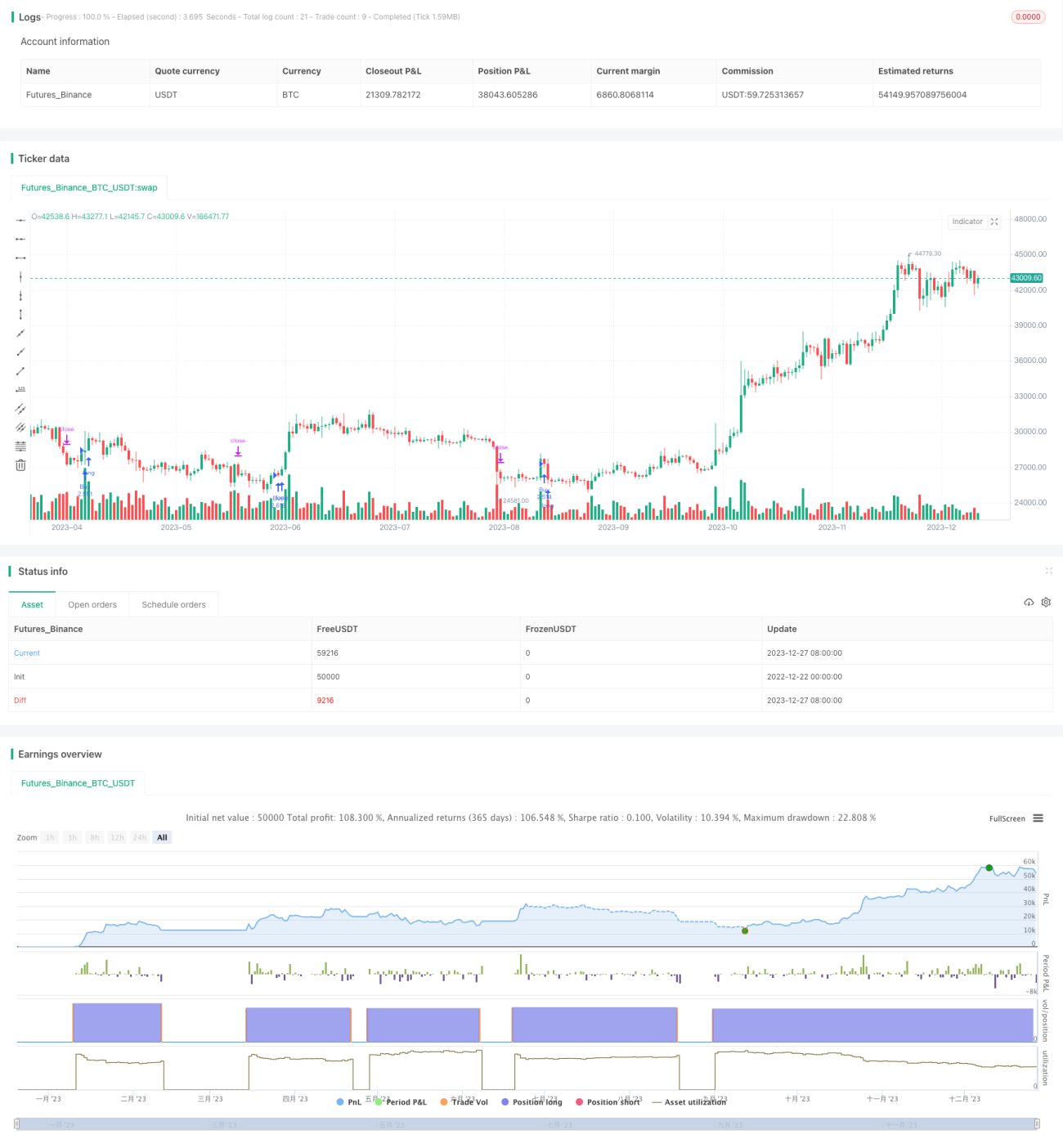
A estratégia de negociação de alta compra e baixa venda, combinada com o princípio da linha divisória do ouro, determina a direção da tendência, calculando pontos de apoio em diferentes períodos de tempo como áreas de preço-chave.
Calcular os pontos de apoio para o preço de fechamento, o preço máximo e o preço mínimo em diferentes períodos de tempo. Incluindo o apoio clássico e o apoio de divisão do ouro.
De acordo com a subida e descida do preço, julgue a região de preço atual. Divida em 5 áreas de compra e 5 áreas de venda.
Emite um sinal de compra na área de compra, emite um sinal de venda na área de venda, adota uma estratégia de compra alta e venda baixa.
A utilização de múltiplos períodos de tempo para avaliar tendências e evitar ser enganado pelo ruído do mercado.
Ao mesmo tempo, a combinação de suporte clássico e suporte de divisão em ouro aumenta a confiabilidade do suporte.
A partir da região de preço, julgue o momento de entrar no mercado, evitando o máximo de risco de perda.
Adotar estratégias de compra e venda de alta e baixa, de acordo com as regras de negociação de tendência, evitando negociação de contrapartida.
Os pontos de apoio podem falhar, e é preciso ter cuidado com a sua ruptura.
A prevenção do rastreamento de perdas pode ser prejudicial e agravar os prejuízos.
As taxas de transação também afetam os lucros finais.
Pode-se testar diferentes parâmetros, como parâmetros de período de tempo, parâmetros de direção de negociação, etc., para otimizar a estratégia.
Os indicadores podem ser combinados com outros para identificar tendências e evitar falsas rupturas.
Pode ser adicionado um mecanismo de stop loss para controlar os perdas individuais.
A estratégia integra métodos clássicos de análise técnica com estratégias de negociação de tendências, usando a região de apoio para determinar o momento de entrada no mercado e adotando o princípio de compra alta e venda baixa, que pode controlar o risco de negociação de forma eficaz e vale a pena ser verificado e otimizado no mercado.
/*backtest
start: 2022-12-22 00:00:00
end: 2023-12-28 00:00:00
period: 1d
basePeriod: 1h
exchanges: [{"eid":"Futures_Binance","currency":"BTC_USDT"}]
*/
// This source code is subject to the terms of the Mozilla Public License 2.0 at https://mozilla.org/MPL/2.0/
// © HeWhoMustNotBeNamed
//@version=4
strategy("BuyHighSellLow - Pivot points", overlay=true, initial_capital = 100000, default_qty_type = strategy.percent_of_equity, default_qty_value = 100, commission_type = strategy.commission.percent, pyramiding = 1, commission_value = 0.01, calc_on_order_fills = true)
Source = input(close)
resolution = input("4D", type=input.resolution)
HTFMultiplier = input(4, title="Higher Timeframe multiplier (Used when resolution is set to Same as Symbol)", minval=2, step=1)
//ppType = input(title="Pivot points type", defval="classic", options=["classic", "fib"])
ppType = "fib"
tradeDirection = input(title="Trade Direction", defval=strategy.direction.long, options=[strategy.direction.all, strategy.direction.long, strategy.direction.short])
backtestBars = input(title="Backtest from ", defval=10, minval=1, maxval=30)
backtestFrom = input(title="Timeframe", defval="years", options=["days", "months", "years"])
hideBands = input(true)
f_multiple_resolution(HTFMultiplier) =>
target_Res_In_Min = timeframe.multiplier * HTFMultiplier * (
timeframe.isseconds ? 1. / 60. :
timeframe.isminutes ? 1. :
timeframe.isdaily ? 1440. :
timeframe.isweekly ? 7. * 24. * 60. :
timeframe.ismonthly ? 30.417 * 24. * 60. : na)
target_Res_In_Min <= 0.0417 ? "1S" :
target_Res_In_Min <= 0.167 ? "5S" :
target_Res_In_Min <= 0.376 ? "15S" :
target_Res_In_Min <= 0.751 ? "30S" :
target_Res_In_Min <= 1440 ? tostring(round(target_Res_In_Min)) :
tostring(round(min(target_Res_In_Min / 1440, 365))) + "D"
f_getBackTestTimeFrom(backtestFrom, backtestBars)=>
byDate = backtestFrom == "days"
byMonth = backtestFrom == "months"
byYear = backtestFrom == "years"
date = dayofmonth(timenow)
mth = month(timenow)
yr = year(timenow)
leapYearDaysInMonth = array.new_int(12,0)
array.set(leapYearDaysInMonth,0,31)
array.set(leapYearDaysInMonth,1,29)
nonleapYearDaysInMonth = array.new_int(12,0)
array.set(leapYearDaysInMonth,0,31)
array.set(leapYearDaysInMonth,1,28)
restMonths = array.new_int(10,0)
array.set(leapYearDaysInMonth,0,31)
array.set(leapYearDaysInMonth,1,30)
array.set(leapYearDaysInMonth,2,31)
array.set(leapYearDaysInMonth,3,30)
array.set(leapYearDaysInMonth,4,31)
array.set(leapYearDaysInMonth,5,31)
array.set(leapYearDaysInMonth,6,30)
array.set(leapYearDaysInMonth,7,31)
array.set(leapYearDaysInMonth,8,30)
array.set(leapYearDaysInMonth,9,31)
array.concat(leapYearDaysInMonth,restMonths)
array.concat(nonleapYearDaysInMonth,restMonths)
isLeapYear = yr % 4 == 0 and (year%100 != 0 or year%400 == 0)
numberOfDaysInCurrentMonth = isLeapYear ? array.get(leapYearDaysInMonth, mth-2) : array.get(nonleapYearDaysInMonth, mth-2)
if(byDate)
mth := (date - backtestBars) < 0 ? mth - 1 : mth
yr := mth < 1 ? yr - 1 : yr
mth := mth < 1 ? 1 : mth
date := (date - backtestBars) < 0 ? numberOfDaysInCurrentMonth - backtestBars + date + 1 : date - backtestBars + 1
if(byMonth)
date := 1
yr := (mth - (backtestBars%12)) < 0 ? yr - int(backtestBars/12) - 1 : yr - int(backtestBars/12)
mth := mth - (backtestBars%12) + 1
if(byYear)
date := 1
mth := 1
yr := yr - backtestBars
[date, mth, yr]
f_secureSecurity(_symbol, _res, _src) => security(_symbol, _res, _src[1], lookahead = barmerge.lookahead_on)
f_getClassicPivots(HIGHprev, LOWprev, CLOSEprev)=>
PP = (HIGHprev + LOWprev + CLOSEprev) / 3
R1 = PP * 2 - LOWprev
S1 = PP * 2 - HIGHprev
R2 = PP + (HIGHprev - LOWprev)
S2 = PP - (HIGHprev - LOWprev)
R3 = PP * 2 + (HIGHprev - 2 * LOWprev)
S3 = PP * 2 - (2 * HIGHprev - LOWprev)
R4 = PP * 3 + (HIGHprev - 3 * LOWprev)
S4 = PP * 3 - (3 * HIGHprev - LOWprev)
R5 = PP * 4 + (HIGHprev - 4 * LOWprev)
S5 = PP * 4 - (4 * HIGHprev - LOWprev)
[R5, R4, R3, R2, R1, PP, S1, S2, S3, S4, S5]
f_getFibPivots(HIGHprev, LOWprev, CLOSEprev)=>
PP = (HIGHprev + LOWprev + CLOSEprev) / 3
R1 = PP + 0.382 * (HIGHprev - LOWprev)
S1 = PP - 0.382 * (HIGHprev - LOWprev)
R2 = PP + 0.618 * (HIGHprev - LOWprev)
S2 = PP - 0.618 * (HIGHprev - LOWprev)
R3 = PP + (HIGHprev - LOWprev)
S3 = PP - (HIGHprev - LOWprev)
R4 = PP + 1.41 * (HIGHprev - LOWprev)
S4 = PP - 1.41 * (HIGHprev - LOWprev)
R5 = PP + 1.65 * (HIGHprev - LOWprev)
S5 = PP - 1.65 * (HIGHprev - LOWprev)
[R5, R4, R3, R2, R1, PP, S1, S2, S3, S4, S5]
f_getPivotPoints(HTFMultiplier, resolution, ppType)=>
derivedResolution = resolution == ""? f_multiple_resolution(HTFMultiplier) : resolution
HIGHprev = f_secureSecurity(syminfo.tickerid, derivedResolution, high)
LOWprev = f_secureSecurity(syminfo.tickerid, derivedResolution, low)
CLOSEprev = f_secureSecurity(syminfo.tickerid, derivedResolution, close)
[R5, R4, R3, R2, R1, PP, S1, S2, S3, S4, S5] = f_getClassicPivots(HIGHprev, LOWprev, CLOSEprev)
[Rf5, Rf4, Rf3, Rf2, Rf1, PPf, Sf1, Sf2, Sf3, Sf4, Sf5] = f_getFibPivots(HIGHprev, LOWprev, CLOSEprev)
[R5, R4, R3, R2, R1, PP, S1, S2, S3, S4, S5]
f_getState(Source, R5, R4, R3, R2, R1, PP, S1, S2, S3, S4, S5)=>
state =
Source > R5 ? 5 :
Source > R4 ? 4 :
Source > R3 ? 3 :
Source > R2 ? 2 :
Source > R1 ? 1 :
Source > PP ? 0 :
Source > S1 ? -1 :
Source > S2 ? -2 :
Source > S3 ? -3 :
Source > S4 ? -4 :
Source > S5 ? -5 : -6
state
[R5, R4, R3, R2, R1, PP, S1, S2, S3, S4, S5] = f_getPivotPoints(HTFMultiplier, resolution, ppType)
[date, mth, yr] = f_getBackTestTimeFrom(backtestFrom, backtestBars)
inDateRange = time >= timestamp(syminfo.timezone, yr, mth, date, 0, 0)
BBU5 = plot(not hideBands ? R5: na, title="R5", color=color.orange, linewidth=1, transp=50, style=plot.style_linebr)
BBU4 = plot(not hideBands ? R4: na, title="R4", color=color.yellow, linewidth=1, transp=50, style=plot.style_linebr)
BBU3 = plot(not hideBands ? R3: na, title="R3", color=color.navy, linewidth=1, transp=50, style=plot.style_linebr)
BBU2 = plot(not hideBands ? R2: na, title="R2", color=color.olive, linewidth=1, transp=50, style=plot.style_linebr)
BBU1 = plot(not hideBands ? R1: na, title="R1", color=color.lime, linewidth=1, transp=50, style=plot.style_linebr)
BBM4 = plot(not hideBands ? PP:na, title="PP", color=color.black, linewidth=2, style=plot.style_linebr)
BBL1 = plot(not hideBands ? S1: na, title="S1", color=color.lime, linewidth=1, transp=50, style=plot.style_linebr)
BBL2 = plot(not hideBands ? S2: na, title="S2", color=color.olive, linewidth=1, transp=50, style=plot.style_linebr)
BBL3 = plot(not hideBands ? S3: na, title="S3", color=color.navy, linewidth=1, transp=50, style=plot.style_linebr)
BBL4 = plot(not hideBands ? S4: na, title="S4", color=color.yellow, linewidth=1, transp=50, style=plot.style_linebr)
BBL5 = plot(not hideBands ? S5: na, title="S5", color=color.orange, linewidth=1, transp=50, style=plot.style_linebr)
fill(BBU5, BBU4, title="RZ5", color=color.green, transp=90)
fill(BBU4, BBU3, title="RZ4", color=color.lime, transp=90)
fill(BBU3, BBU2, title="RZ3", color=color.olive, transp=90)
fill(BBU2, BBU1, title="RZ2", color=color.navy, transp=90)
fill(BBU1, BBM4, title="RZ1", color=color.yellow, transp=90)
fill(BBM4, BBL1, title="SZ1", color=color.orange, transp=90)
fill(BBL1, BBL2, title="SZ2", color=color.red, transp=90)
fill(BBL2, BBL3, title="SZ3", color=color.maroon, transp=90)
fill(BBL3, BBL4, title="SZ4", color=color.maroon, transp=90)
fill(BBL4, BBL5, title="SZ5", color=color.maroon, transp=90)
strategy.risk.allow_entry_in(tradeDirection)
longCondition = crossover(Source[1],R1) and inDateRange
shortCondition = crossunder(Source[1], S2) and inDateRange
strategy.entry("Buy", strategy.long, when=longCondition, oca_name="oca")
strategy.entry("Sell", strategy.short, when=shortCondition, oca_name="oca")