Estratégia de Seguimento de Tendência com Média Móvel Adaptativa de Kaufman

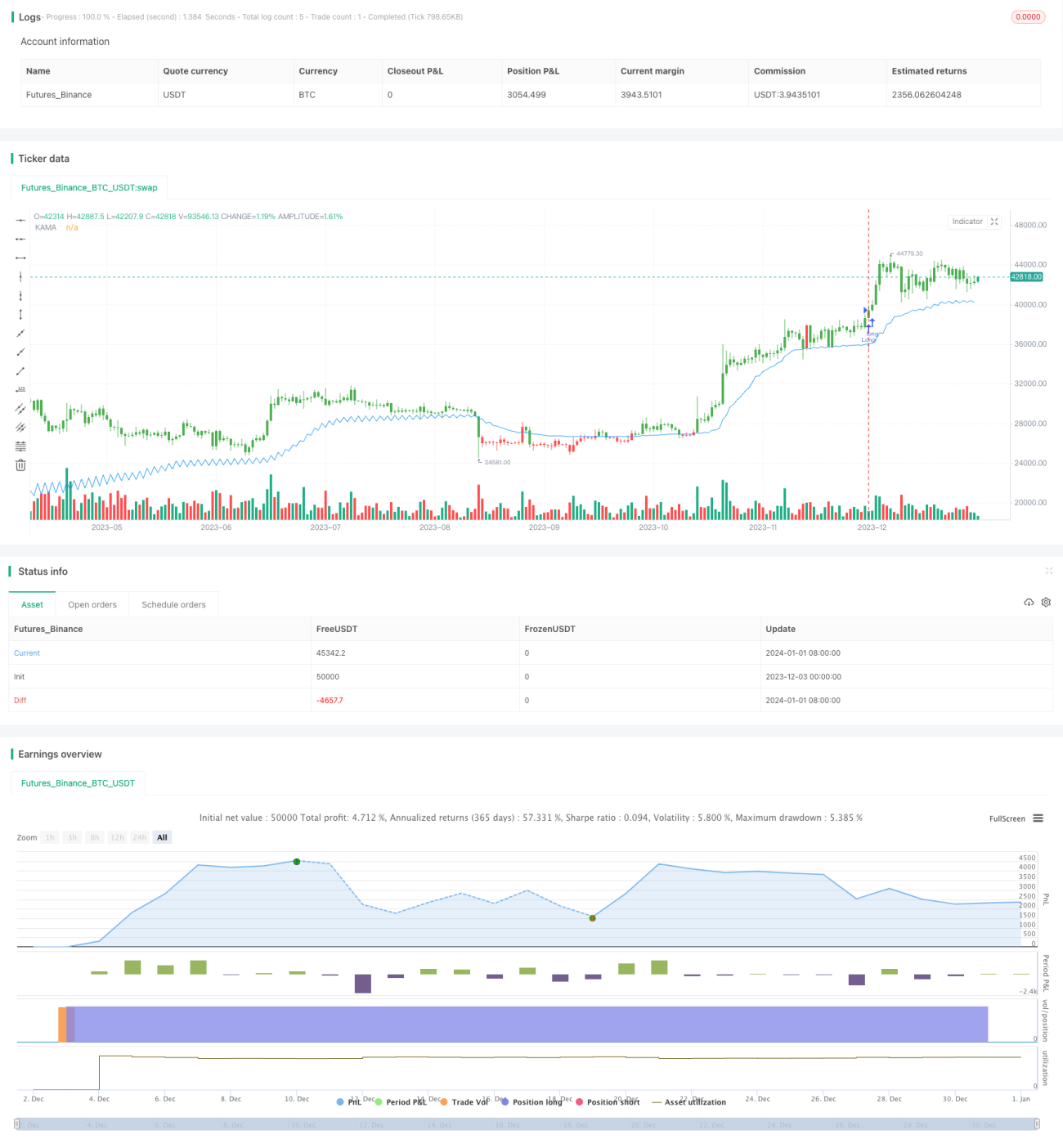
Visão Geral
Esta estratégia utiliza o indicador de média móvel adaptativa de Kaufman (KAMA) para acompanhar a tendência de preços, realizando compras na baixa e vendas na alta para obter lucros.
Princípio da Estratégia
A fórmula de cálculo do indicador Kaufman Adaptive Moving Average (KAMA) é:
nAMA = nz(nAMA[1]) + nsmooth * (Close - nz(nAMA[1]))
onde:
nsmooth = (nefratio * (nfastend - nslowend) + nslowend)^2
nefratio = nsignal / nnoise
nsignal = |Close - Close[Length]|
nnoise = sum(|Close - Close[1]|, Length)
nfastend = 0.666
nslowend = 0.0645
Este indicador considera a volatilidade do mercado e a tendência de variação de preços, permitindo acompanhar a tendência mais rapidamente. Especificamente:
- Quando a volatilidade do mercado é baixa, nsmooth se aproxima de nslowend, e a linha KAMA muda lentamente, suprimindo o ruído do mercado.
- Quando a volatilidade do mercado aumenta e surge uma tendência, nsmooth se aproxima de nfastend, e a linha KAMA muda rapidamente para acompanhar a tendência.
Ao comparar a relação entre o preço e o KAMA, é possível determinar a direção da tendência do preço e, assim, decidir entre posições compradas ou vendidas.
Vantagens da Estratégia
A maior vantagem desta estratégia é utilizar o indicador de média móvel adaptativa para acompanhar as mudanças na tendência de preços, reduzindo efetivamente o ruído e obtendo um bom acompanhamento. As vantagens específicas são:
- O indicador KAMA suprime o ruído do mercado, reduzindo o número de negociações desnecessárias.
- O indicador KAMA responde rapidamente às mudanças na tendência de preços, com bom efeito de rastreamento.
- As regras de decisão da estratégia são simples e claras, fáceis de entender e implementar.
- Permite configurar negociações reversas para se adaptar a diferentes condições de mercado.
Riscos da Estratégia
Esta estratégia também apresenta alguns riscos:
- Em mercados sem tendência definida (laterais/ruidosos), o indicador KAMA pode gerar sinais falsos. Isso pode ser otimizado ajustando os parâmetros.
- Existe um atraso no rastreamento, que pode fazer com que se percam reversões de curto prazo. Pode-se considerar combiná-lo com outros indicadores para diagnóstico.
- Não são consideradas taxas de negociação e slippage, portanto o desempenho real pode ser inferior ao do backtest.
Direções de Otimização da Estratégia
A estratégia pode ser otimizada nos seguintes aspectos:
- Otimizar os parâmetros do KAMA para aumentar a sensibilidade do rastreamento.
- Adicionar mecanismo de stop loss para controlar a perda máxima por negociação.
- Combinar com outros indicadores para filtrar sinais, melhorando a precisão das decisões.
- Adicionar mecanismo de reentrada para acompanhar ainda mais a tendência.
Resumo
Esta estratégia utiliza o indicador de média móvel adaptativa de Kaufman para acompanhar a tendência de preços. As regras de decisão são simples e claras, fáceis de operar no mercado real. O indicador suprime o ruído e, ao mesmo tempo, responde rapidamente às mudanças de preço, com um bom efeito de rastreamento. É uma estratégia de acompanhamento de tendência recomendável.
/*backtest
start: 2023-12-03 00:00:00
end: 2024-01-02 00:00:00
period: 1d
basePeriod: 1h
exchanges: [{"eid":"Futures_Binance","currency":"BTC_USDT"}]
*/

//@version=2
////////////////////////////////////////////////////////////
//  Copyright by HPotter v1.0 25/08/2017
// Everyone wants a short-term, fast trading trend that works without large- 1