Estratégia de rompimento baseada em sentimentos integrando vários indicadores


Data de criação: 2024-01-17 17:53:55 última modificação: 2024-01-17 17:53:55
cópia: 0 Cliques: 745
1
focar em
1617
Seguidores

Estratégia de rompimento baseada em sentimentos integrando vários indicadores

Visão geral

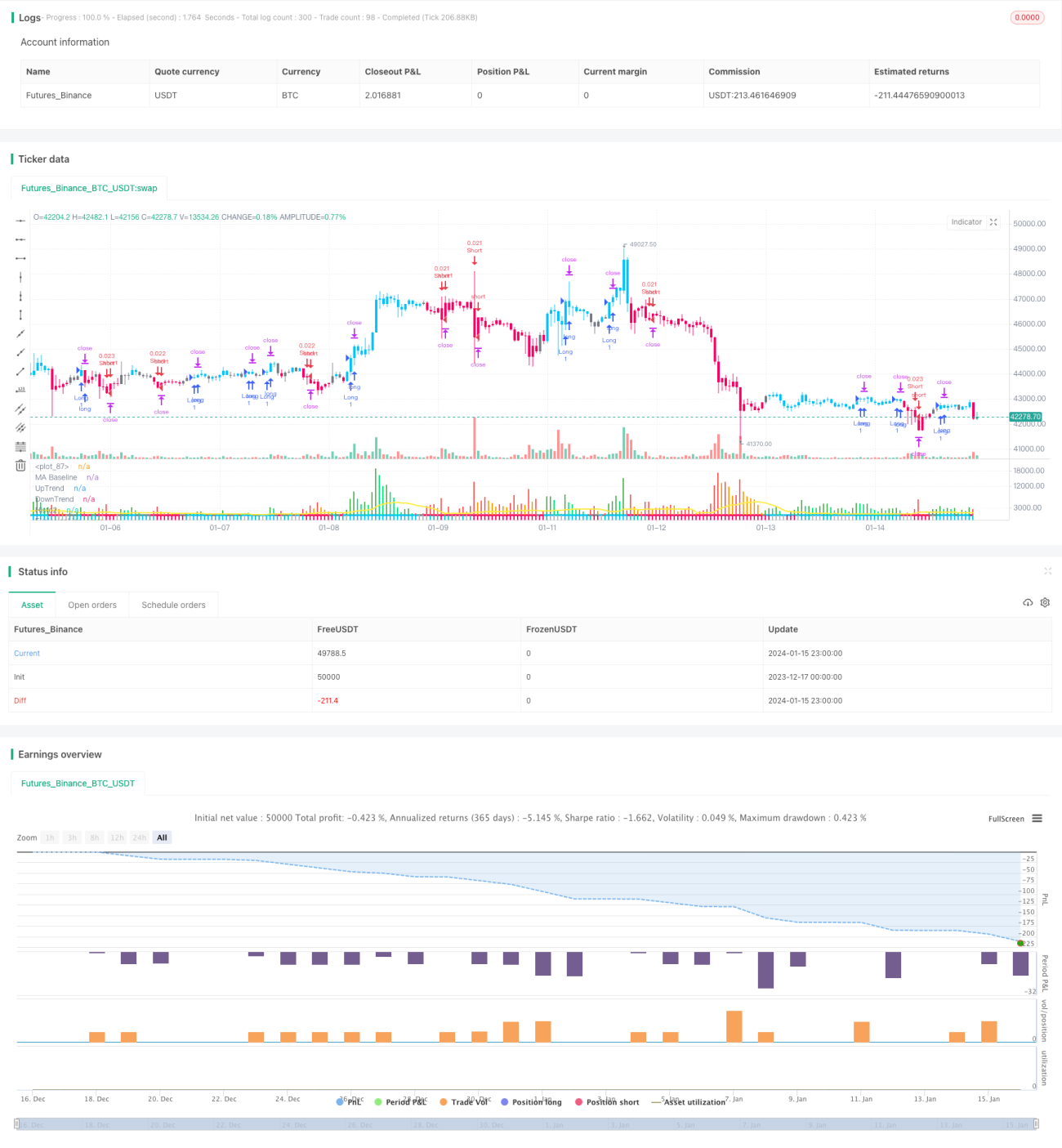
Esta estratégia combina o indicador de QQE, o indicador de híbrido SSL e o indicador de ruptura de Waddah Attar, três indicadores de emoções, formando sinais de negociação, pertencentes a estratégias de ruptura de emoções impulsionadas por múltiplos indicadores. Pode julgar a emoção do mercado antes da ruptura e evitar falsas rupturas, pertencentes a estratégias de ruptura de qualidade.

Princípio da estratégia

A lógica central desta estratégia baseia-se em três indicadores para tomar decisões de negociação:

Indicadores de melhoria do QQEEste indicador é uma melhoria do RSI, tornando-o mais sensível para avaliar a alta e baixa do sentimento do mercado. Esta estratégia usa este indicador para avaliar os sinais de reversão inferior e superior.

Indicadores de hibridação SSLEste indicador considera, de forma integrada, as rupturas de várias médias móveis para determinar os sinais de mercado. Esta estratégia usa este indicador para determinar a forma de ruptura do canal.

O índice de explosão de Waddah AttarEste indicador determina a intensidade da ruptura de preços dentro do canal. Esta estratégia usa este indicador para determinar o momento em que a ruptura é suficiente.

A estratégia gera uma decisão de compra quando o indicador QQE emite um sinal de inversão de fundo, o indicador SSL mostra uma ruptura no topo do canal e o indicador Waddah Attar julga uma explosão de impulso. Quando os três indicadores emitem sinais opostos simultaneamente, uma decisão de venda é tomada.

Esta estratégia, que simultaneamente define pontos de saída de precisão de stop-loss e stop-loss, maximiza o bloqueio de lucro e é uma estratégia de ruptura impulsionada pela emoção de alta qualidade.

Análise de vantagens

A estratégia tem as seguintes vantagens:

  1. Combinação de múltiplos indicadores para avaliar o sentimento do mercado e evitar o risco de falsas rupturas
  2. Ao mesmo tempo, considerar os indicadores de reversão, indicadores de canal e indicadores de dinâmica, garantindo uma alta confirmação do mercado no momento da ruptura
  3. A utilização de alto grau de precisão de stop loss móvel para limitar riscos, rastrear e bloquear lucros
  4. Os parâmetros foram testados com muita otimização, com boa estabilidade, adequados para a posse de linhas médias a longas
  5. Parâmetros de indicadores configuráveis para ajustar o estilo de estratégia de forma autônoma para um contexto de mercado mais amplo

Análise de Riscos

Os principais riscos desta estratégia são:

  1. A tendência é para que haja uma perda menor quando o mercado está em baixa.
  2. Exigir que se baseie em vários indicadores ao mesmo tempo, o que pode não funcionar adequadamente em alguns mercados
  3. Indicadores múltiplos, como os indicadores de QQE, apresentam risco de otimização excessiva de parâmetros e devem ser configurados com cuidado
  4. A paragem móvel pode ser mais difícil de funcionar normalmente em situações especiais

Para os riscos acima, é recomendável ajustar os parâmetros do indicador para torná-lo mais estável, aumentando adequadamente o ciclo de posse para obter uma taxa de retorno mais alta.

Direção de otimização

Esta estratégia pode ser melhorada nos seguintes aspectos:

  1. Ajustar os parâmetros dos indicadores para torná-los mais estáveis ou mais sensíveis
  2. Adição de módulo de otimização de tamanho de posição baseado na volatilidade
  3. Adição de módulos de aprendizagem de máquina para o controle de vento e avaliação de mercado em tempo real
  4. Modelos de aprendizagem profunda para a previsão de padrões e melhoria da precisão de tomada de decisão
  5. Introdução de análises de períodos de tempo para reduzir a probabilidade de falsas brechas

Resumir

Esta estratégia combina os benefícios de múltiplos indicadores de emoção dominantes para construir uma estratégia de ruptura impulsionada pela emoção altamente eficiente. Ela consegue evitar os riscos de muitas rupturas de baixa qualidade e, ao mesmo tempo, tem uma filosofia de stop loss de alta precisão para travar o lucro. É um conjunto de estratégias de ruptura bem-sucedidas e confiáveis que vale a pena aprender e aplicar.

Código-fonte da estratégia
/*backtest
start: 2023-12-17 00:00:00
end: 2024-01-16 00:00:00
period: 1h
basePeriod: 15m
exchanges: [{"eid":"Futures_Binance","currency":"BTC_USDT"}]
*/

// Strategy based on the 3 indicators:
//  - QQE MOD
//  - SSL Hybrid
//  - Waddah Attar Explosion
//
// Strategy was designed for the purpose of back testing. 
// See strategy documentation for info on trade entry logic.
// 
// Credits:
//  - QQE MOD: Mihkel00 (https://www.tradingview.com/u/Mihkel00/)
//  - SSL Hybrid: Mihkel00 (https://www.tradingview.com/u/Mihkel00/)
//  - Waddah Attar Explosion: shayankm (https://www.tradingview.com/u/shayankm/)

//@version=5
strategy("QQE MOD + SSL Hybrid + Waddah Attar Explosion", overlay=false)

// =============================================================================
// STRATEGY INPUT SETTINGS
// =============================================================================

// ---------------
// Risk Management
// ---------------
swingLength = input.int(10, "Swing High/Low Lookback Length", group='Strategy: Risk Management', tooltip='Stop Loss is calculated by the swing high or low over the previous X candles')
accountRiskPercent = input.float(2, "Account percent loss per trade", step=0.1, group='Strategy: Risk Management', tooltip='Each trade will risk X% of the account balance')

// ----------
// Date Range
// ----------
start_year = input.int(title='Start Date', defval=2022, minval=2010, maxval=3000, group='Strategy: Date Range', inline='1')
start_month = input.int(title='', defval=1, group='Strategy: Date Range', inline='1', options = [1, 2, 3, 4, 5, 6, 7, 8, 9, 10, 11, 12])
start_date = input.int(title='', defval=1, group='Strategy: Date Range', inline='1', options = [1, 2, 3, 4, 5, 6, 7, 8, 9, 10, 11, 12, 13, 14, 15, 16, 17, 18, 19, 20, 21, 22, 23, 24, 25, 26, 27, 28, 29, 30, 31])
end_year = input.int(title='End Date', defval=2023, minval=1800, maxval=3000, group='Strategy: Date Range', inline='2')
end_month = input.int(title='', defval=1, group='Strategy: Date Range', inline='2', options = [1, 2, 3, 4, 5, 6, 7, 8, 9, 10, 11, 12])
end_date = input.int(title='', defval=1, group='Strategy: Date Range', inline='2', options = [1, 2, 3, 4, 5, 6, 7, 8, 9, 10, 11, 12, 13, 14, 15, 16, 17, 18, 19, 20, 21, 22, 23, 24, 25, 26, 27, 28, 29, 30, 31])
in_date_range = true
// =============================================================================
// INDICATORS
// =============================================================================

// -------
// QQE MOD
// -------
RSI_Period = input.int(6, title='RSI Length', group='Indicators: QQE Mod Settings')
SF = input.int(6, title='RSI Smoothing', group='Indicators: QQE Mod Settings')
QQE = input.int(3, title='Fast QQE Factor', group='Indicators: QQE Mod Settings')
ThreshHold = input.int(3, title='Thresh-hold', group='Indicators: QQE Mod Settings')
qqeSrc = input(close, title='RSI Source', group='Indicators: QQE Mod Settings')
Wilders_Period = RSI_Period * 2 - 1

Rsi = ta.rsi(qqeSrc, RSI_Period)
RsiMa = ta.ema(Rsi, SF)
AtrRsi = math.abs(RsiMa[1] - RsiMa)
MaAtrRsi = ta.ema(AtrRsi, Wilders_Period)
dar = ta.ema(MaAtrRsi, Wilders_Period) * QQE

longband = 0.0
shortband = 0.0
trend = 0

DeltaFastAtrRsi = dar
RSIndex = RsiMa
newshortband = RSIndex + DeltaFastAtrRsi
newlongband = RSIndex - DeltaFastAtrRsi
longband := RSIndex[1] > longband[1] and RSIndex > longband[1] ? math.max(longband[1], newlongband) : newlongband
shortband := RSIndex[1] < shortband[1] and RSIndex < shortband[1] ? math.min(shortband[1], newshortband) : newshortband
cross_1 = ta.cross(longband[1], RSIndex)
trend := ta.cross(RSIndex, shortband[1]) ? 1 : cross_1 ? -1 : nz(trend[1], 1)
FastAtrRsiTL = trend == 1 ? longband : shortband

length = input.int(50, minval=1, title='Bollinger Length', group='Indicators: QQE Mod Settings')
qqeMult = input.float(0.35, minval=0.001, maxval=5, step=0.1, title='BB Multiplier', group='Indicators: QQE Mod Settings')
basis = ta.sma(FastAtrRsiTL - 50, length)
dev = qqeMult * ta.stdev(FastAtrRsiTL - 50, length)
upper = basis + dev
lower = basis - dev
//qqe_color_bar = RsiMa - 50 > upper ? #00c3ff : RsiMa - 50 < lower ? #ff0062 : color.gray

// Zero cross
QQEzlong = 0
QQEzlong := nz(QQEzlong[1])
QQEzshort = 0
QQEzshort := nz(QQEzshort[1])
QQEzlong := RSIndex >= 50 ? QQEzlong + 1 : 0
QQEzshort := RSIndex < 50 ? QQEzshort + 1 : 0

Zero = hline(0, color=color.white, linestyle=hline.style_dotted, linewidth=1, display=display.none)

RSI_Period2 = input.int(6, title='RSI Length', group='Indicators: QQE Mod Settings')
SF2 = input.int(5, title='RSI Smoothing', group='Indicators: QQE Mod Settings')
QQE2 = input.float(1.61, title='Fast QQE2 Factor', group='Indicators: QQE Mod Settings')
ThreshHold2 = input.int(3, title='Thresh-hold', group='Indicators: QQE Mod Settings')
src2 = input(close, title='RSI Source', group='Indicators: QQE Mod Settings')
Wilders_Period2 = RSI_Period2 * 2 - 1

Rsi2 = ta.rsi(src2, RSI_Period2)
RsiMa2 = ta.ema(Rsi2, SF2)
AtrRsi2 = math.abs(RsiMa2[1] - RsiMa2)
MaAtrRsi2 = ta.ema(AtrRsi2, Wilders_Period2)
dar2 = ta.ema(MaAtrRsi2, Wilders_Period2) * QQE2
longband2 = 0.0
shortband2 = 0.0
trend2 = 0

DeltaFastAtrRsi2 = dar2
RSIndex2 = RsiMa2
newshortband2 = RSIndex2 + DeltaFastAtrRsi2
newlongband2 = RSIndex2 - DeltaFastAtrRsi2
longband2 := RSIndex2[1] > longband2[1] and RSIndex2 > longband2[1] ? math.max(longband2[1], newlongband2) : newlongband2
shortband2 := RSIndex2[1] < shortband2[1] and RSIndex2 < shortband2[1] ? math.min(shortband2[1], newshortband2) : newshortband2
cross_2 = ta.cross(longband2[1], RSIndex2)
trend2 := ta.cross(RSIndex2, shortband2[1]) ? 1 : cross_2 ? -1 : nz(trend2[1], 1)
FastAtrRsi2TL = trend2 == 1 ? longband2 : shortband2

// Zero cross
QQE2zlong = 0
QQE2zlong := nz(QQE2zlong[1])
QQE2zshort = 0
QQE2zshort := nz(QQE2zshort[1])
QQE2zlong := RSIndex2 >= 50 ? QQE2zlong + 1 : 0
QQE2zshort := RSIndex2 < 50 ? QQE2zshort + 1 : 0

hcolor2 = RsiMa2 - 50 > ThreshHold2 ? color.silver : RsiMa2 - 50 < 0 - ThreshHold2 ? color.silver : na
plot(RsiMa2 - 50, color=hcolor2, title='Histo2', style=plot.style_columns, transp=50)

Greenbar1 = RsiMa2 - 50 > ThreshHold2
Greenbar2 = RsiMa - 50 > upper
Redbar1 = RsiMa2 - 50 < 0 - ThreshHold2
Redbar2 = RsiMa - 50 < lower

plot(Greenbar1 and Greenbar2 == 1 ? RsiMa2 - 50 : na, title='QQE Up', style=plot.style_columns, color=color.new(#00c3ff, 0))
plot(Redbar1 and Redbar2 == 1 ? RsiMa2 - 50 : na, title='QQE Down', style=plot.style_columns, color=color.new(#ff0062, 0))

// ----------
// SSL HYBRID
// ----------
show_Baseline = input(title='Show Baseline', defval=true)
show_SSL1 = input(title='Show SSL1', defval=false)
show_atr = input(title='Show ATR bands', defval=true)
//ATR
atrlen = input(14, 'ATR Period')
mult = input.float(1, 'ATR Multi', step=0.1)
smoothing = input.string(title='ATR Smoothing', defval='WMA', options=['RMA', 'SMA', 'EMA', 'WMA'])

ma_function(source, atrlen) =>
    if smoothing == 'RMA'
        ta.rma(source, atrlen)
    else
        if smoothing == 'SMA'
            ta.sma(source, atrlen)
        else
            if smoothing == 'EMA'
                ta.ema(source, atrlen)
            else
                ta.wma(source, atrlen)
atr_slen = ma_function(ta.tr(true), atrlen)
////ATR Up/Low Bands
upper_band = atr_slen * mult + close
lower_band = close - atr_slen * mult

////BASELINE / SSL1 / SSL2 / EXIT MOVING AVERAGE VALUES
maType = input.string(title='SSL1 / Baseline Type', defval='HMA', options=['SMA', 'EMA', 'DEMA', 'TEMA', 'LSMA', 'WMA', 'MF', 'VAMA', 'TMA', 'HMA', 'JMA', 'Kijun v2', 'EDSMA', 'McGinley'])
len = input(title='SSL1 / Baseline Length', defval=60)

SSL2Type = input.string(title='SSL2 / Continuation Type', defval='JMA', options=['SMA', 'EMA', 'DEMA', 'TEMA', 'WMA', 'MF', 'VAMA', 'TMA', 'HMA', 'JMA', 'McGinley'])
len2 = input(title='SSL 2 Length', defval=5)
SSL3Type = input.string(title='EXIT Type', defval='HMA', options=['DEMA', 'TEMA', 'LSMA', 'VAMA', 'TMA', 'HMA', 'JMA', 'Kijun v2', 'McGinley', 'MF'])
len3 = input(title='EXIT Length', defval=15)
src = input(title='Source', defval=close)

tema(src, len) =>
    ema1 = ta.ema(src, len)
    ema2 = ta.ema(ema1, len)
    ema3 = ta.ema(ema2, len)
    3 * ema1 - 3 * ema2 + ema3
kidiv = input.int(defval=1, maxval=4, title='Kijun MOD Divider')

jurik_phase = input(title='* Jurik (JMA) Only - Phase', defval=3)
jurik_power = input(title='* Jurik (JMA) Only - Power', defval=1)
volatility_lookback = input(10, title='* Volatility Adjusted (VAMA) Only - Volatility lookback length')
//MF
beta = input.float(0.8, minval=0, maxval=1, step=0.1, title='Modular Filter, General Filter Only - Beta')
feedback = input(false, title='Modular Filter Only - Feedback')
z = input.float(0.5, title='Modular Filter Only - Feedback Weighting', step=0.1, minval=0, maxval=1)
//EDSMA
ssfLength = input.int(title='EDSMA - Super Smoother Filter Length', minval=1, defval=20)
ssfPoles = input.int(title='EDSMA - Super Smoother Filter Poles', defval=2, options=[2, 3])

//EDSMA
get2PoleSSF(src, length) =>
    PI = 2 * math.asin(1)
    arg = math.sqrt(2) * PI / length
    a1 = math.exp(-arg)
    b1 = 2 * a1 * math.cos(arg)
    c2 = b1
    c3 = -math.pow(a1, 2)
    c1 = 1 - c2 - c3

    ssf = 0.0
    ssf := c1 * src + c2 * nz(ssf[1]) + c3 * nz(ssf[2])
    ssf

get3PoleSSF(src, length) =>
    PI = 2 * math.asin(1)

    arg = PI / length
    a1 = math.exp(-arg)
    b1 = 2 * a1 * math.cos(1.738 * arg)
    c1 = math.pow(a1, 2)

    coef2 = b1 + c1
    coef3 = -(c1 + b1 * c1)
    coef4 = math.pow(c1, 2)
    coef1 = 1 - coef2 - coef3 - coef4

    ssf = 0.0
    ssf := coef1 * src + coef2 * nz(ssf[1]) + coef3 * nz(ssf[2]) + coef4 * nz(ssf[3])
    ssf

ma(type, src, len) =>
    float result = 0
    if type == 'TMA'
        result := ta.sma(ta.sma(src, math.ceil(len / 2)), math.floor(len / 2) + 1)
        result
    if type == 'MF'
        ts = 0.
        b = 0.
        c = 0.
        os = 0.
        //----
        alpha = 2 / (len + 1)
        a = feedback ? z * src + (1 - z) * nz(ts[1], src) : src
        //----
        b := a > alpha * a + (1 - alpha) * nz(b[1], a) ? a : alpha * a + (1 - alpha) * nz(b[1], a)
        c := a < alpha * a + (1 - alpha) * nz(c[1], a) ? a : alpha * a + (1 - alpha) * nz(c[1], a)
        os := a == b ? 1 : a == c ? 0 : os[1]
        //----
        upper = beta * b + (1 - beta) * c
        lower = beta * c + (1 - beta) * b
        ts := os * upper + (1 - os) * lower
        result := ts
        result
    if type == 'LSMA'
        result := ta.linreg(src, len, 0)
        result
    if type == 'SMA'  // Simple
        result := ta.sma(src, len)
        result
    if type == 'EMA'  // Exponential
        result := ta.ema(src, len)
        result
    if type == 'DEMA'  // Double Exponential
        e = ta.ema(src, len)
        result := 2 * e - ta.ema(e, len)
        result
    if type == 'TEMA'  // Triple Exponential
        e = ta.ema(src, len)
        result := 3 * (e - ta.ema(e, len)) + ta.ema(ta.ema(e, len), len)
        result
    if type == 'WMA'  // Weighted
        result := ta.wma(src, len)
        result
    if type == 'VAMA'  // Volatility Adjusted
        /// Copyright © 2019 to present, Joris Duyck (JD)
        mid = ta.ema(src, len)
        dev = src - mid
        vol_up = ta.highest(dev, volatility_lookback)
        vol_down = ta.lowest(dev, volatility_lookback)
        result := mid + math.avg(vol_up, vol_down)
        result
    if type == 'HMA'  // Hull
        result := ta.wma(2 * ta.wma(src, len / 2) - ta.wma(src, len), math.round(math.sqrt(len)))
        result
    if type == 'JMA'  // Jurik
        /// Copyright © 2018 Alex Orekhov (everget)
        /// Copyright © 2017 Jurik Research and Consulting.
        phaseRatio = jurik_phase < -100 ? 0.5 : jurik_phase > 100 ? 2.5 : jurik_phase / 100 + 1.5
        beta = 0.45 * (len - 1) / (0.45 * (len - 1) + 2)
        alpha = math.pow(beta, jurik_power)
        jma = 0.0
        e0 = 0.0
        e0 := (1 - alpha) * src + alpha * nz(e0[1])
        e1 = 0.0
        e1 := (src - e0) * (1 - beta) + beta * nz(e1[1])
        e2 = 0.0
        e2 := (e0 + phaseRatio * e1 - nz(jma[1])) * math.pow(1 - alpha, 2) + math.pow(alpha, 2) * nz(e2[1])
        jma := e2 + nz(jma[1])
        result := jma
        result
    if type == 'Kijun v2'
        kijun = math.avg(ta.lowest(len), ta.highest(len))  //, (open + close)/2)
        conversionLine = math.avg(ta.lowest(len / kidiv), ta.highest(len / kidiv))
        delta = (kijun + conversionLine) / 2
        result := delta
        result
    if type == 'McGinley'
        mg = 0.0
        mg := na(mg[1]) ? ta.ema(src, len) : mg[1] + (src - mg[1]) / (len * math.pow(src / mg[1], 4))
        result := mg
        result
    if type == 'EDSMA'

        zeros = src - nz(src[2])
        avgZeros = (zeros + zeros[1]) / 2

        // Ehlers Super Smoother Filter 
        ssf = ssfPoles == 2 ? get2PoleSSF(avgZeros, ssfLength) : get3PoleSSF(avgZeros, ssfLength)

        // Rescale filter in terms of Standard Deviations
        stdev = ta.stdev(ssf, len)
        scaledFilter = stdev != 0 ? ssf / stdev : 0

        alpha = 5 * math.abs(scaledFilter) / len

        edsma = 0.0
        edsma := alpha * src + (1 - alpha) * nz(edsma[1])
        result := edsma
        result
    result

///SSL 1 and SSL2
emaHigh = ma(maType, high, len)
emaLow = ma(maType, low, len)

maHigh = ma(SSL2Type, high, len2)
maLow = ma(SSL2Type, low, len2)

///EXIT
ExitHigh = ma(SSL3Type, high, len3)
ExitLow = ma(SSL3Type, low, len3)

///Keltner Baseline Channel
BBMC = ma(maType, close, len)
useTrueRange = input(true)
multy = input.float(0.2, step=0.05, title='Base Channel Multiplier')
Keltma = ma(maType, src, len)
range_1 = useTrueRange ? ta.tr : high - low
rangema = ta.ema(range_1, len)
upperk = Keltma + rangema * multy
lowerk = Keltma - rangema * multy

//Baseline Violation Candle
open_pos = open * 1
close_pos = close * 1
difference = math.abs(close_pos - open_pos)
atr_violation = difference > atr_slen
InRange = upper_band > BBMC and lower_band < BBMC

//SSL1 VALUES
Hlv = int(na)
Hlv := close > emaHigh ? 1 : close < emaLow ? -1 : Hlv[1]
sslDown = Hlv < 0 ? emaHigh : emaLow

//EXIT VALUES
Hlv3 = int(na)
Hlv3 := close > ExitHigh ? 1 : close < ExitLow ? -1 : Hlv3[1]
sslExit = Hlv3 < 0 ? ExitHigh : ExitLow
base_cross_Long = ta.crossover(close, sslExit)
base_cross_Short = ta.crossover(sslExit, close)
codiff = base_cross_Long ? 1 : base_cross_Short ? -1 : na

//COLORS
show_color_bar = input(title='Color Bars', defval=true)
color_bar = close > upperk ? #00c3ff : close < lowerk ? #ff0062 : color.gray
color_ssl1 = close > sslDown ? #00c3ff : close < sslDown ? #ff0062 : na

//PLOTS
plotarrow(codiff, colorup=color.new(#00c3ff, 20), colordown=color.new(#ff0062, 20), title='Exit Arrows', maxheight=20, offset=0, display=display.none)
p1 = plot(0, color=color_bar, linewidth=3, title='MA Baseline', transp=0)
barcolor(show_color_bar ? color_bar : na)

// ---------------------
// WADDAH ATTAR EXPLOSION
// ---------------------
sensitivity = input.int(180, title="Sensitivity", group='Indicators: Waddah Attar Explosion')
fastLength=input.int(20, title="FastEMA Length", group='Indicators: Waddah Attar Explosion')
slowLength=input.int(40, title="SlowEMA Length", group='Indicators: Waddah Attar Explosion')
channelLength=input.int(20, title="BB Channel Length", group='Indicators: Waddah Attar Explosion')
waeMult=input.float(2.0, title="BB Stdev Multiplier", group='Indicators: Waddah Attar Explosion')

calc_macd(source, fastLength, slowLength) =>
	fastMA = ta.ema(source, fastLength)
	slowMA = ta.ema(source, slowLength)
	fastMA - slowMA

calc_BBUpper(source, length, mult) => 
	basis = ta.sma(source, length)
	dev = mult * ta.stdev(source, length)
	basis + dev

calc_BBLower(source, length, mult) => 
	basis = ta.sma(source, length)
	dev = mult * ta.stdev(source, length)
	basis - dev

t1 = (calc_macd(close, fastLength, slowLength) - calc_macd(close[1], fastLength, slowLength))*sensitivity

e1 = (calc_BBUpper(close, channelLength, waeMult) - calc_BBLower(close, channelLength, waeMult))

trendUp = (t1 >= 0) ? t1 : 0
trendDown = (t1 < 0) ? (-1*t1) : 0

plot(trendUp, style=plot.style_columns, linewidth=1, color=(trendUp<trendUp[1]) ? color.lime : color.green, transp=45, title="UpTrend", display=display.none)
plot(trendDown, style=plot.style_columns, linewidth=1, color=(trendDown<trendDown[1]) ? color.orange : color.red, transp=45, title="DownTrend", display=display.none)
plot(e1, style=plot.style_line, linewidth=2, color=color.yellow, title="ExplosionLine", display=display.none)

// =============================================================================
// STRATEGY LOGIC
// =============================================================================

// QQE Mod
qqeGreenBar = Greenbar1 and Greenbar2
qqeRedBar = Redbar1 and Redbar2
qqeBuy = qqeGreenBar and not qqeGreenBar[1]
qqeSell = qqeRedBar and not qqeRedBar[1]

// SSL Hybrid
sslBuy = close > upperk and close > BBMC
sslSell = close < lowerk and close < BBMC

// Waddah Attar Explosion
waeBuy = trendUp > 0 and trendUp > e1
waeSell = trendDown > 0 and trendDown > e1

inLong = strategy.position_size > 0
inShort = strategy.position_size < 0

longCondition = qqeBuy and sslBuy and waeBuy and in_date_range
shortCondition = qqeSell and sslSell and waeSell and in_date_range

swingLow = ta.lowest(source=low, length=swingLength)
swingHigh = ta.highest(source=high, length=swingLength)

longStopPercent = math.abs((1 - (swingLow / close)) * 100)
shortStopPercent = math.abs((1 - (swingHigh / close)) * 100)

// Position sizing (default risk 2% per trade)
riskAmt = strategy.equity * accountRiskPercent / 100
longQty = math.abs(riskAmt / longStopPercent * 100) / close
shortQty = math.abs(riskAmt / shortStopPercent * 100) / close

if (longCondition and not inShort and not inLong)
    strategy.entry("Long", strategy.long, qty=longQty)
    strategy.exit("Long  SL/TP", from_entry="Long", stop=swingLow, alert_message='Long SL Hit')
    buyLabel = label.new(x=bar_index, y=high[1], color=color.green, style=label.style_label_up)
    label.set_y(id=buyLabel, y=0)
    label.set_tooltip(id=buyLabel, tooltip="Risk Amt: " + str.tostring(riskAmt) + " Qty: " + str.tostring(longQty) + " Swing low: " + str.tostring(swingLow) + " Stop Percent: " + str.tostring(longStopPercent))

if (shortCondition and not inLong and not inShort)
    strategy.entry("Short", strategy.short, qty=shortQty)
    strategy.exit("Short  SL/TP", from_entry="Short", stop=swingHigh, alert_message='Short SL Hit')
    sellLabel = label.new(x=bar_index, y=high[1], color=color.red, style=label.style_label_up)
    label.set_y(id=sellLabel, y=0)
    label.set_tooltip(id=sellLabel, tooltip="Risk Amt: " + str.tostring(riskAmt) + " Qty: " + str.tostring(shortQty) + " Swing high: " + str.tostring(swingHigh) + " Stop Percent: " + str.tostring(shortStopPercent))

openTradesInProfit() =>
    result = 0.
    for i = 0 to strategy.opentrades-1
        result += strategy.opentrades.profit(i)
    result > 0

exitLong = inLong and base_cross_Short and openTradesInProfit()
strategy.close(id = "Long", when = exitLong, comment = "Closing Long", alert_message="Long TP Hit")

exitShort = inShort and base_cross_Long and openTradesInProfit()
strategy.close(id = "Short", when = exitShort, comment = "Closing Short", alert_message="Short TP Hit")

// =============================================================================
// DATA WINDOW PLOTTING
// =============================================================================

plotchar(0, "===========", "", location = location.top, color=#141823)
plotchar(0, "BUY SIGNALS:", "", location = location.top, color=#141823)
plotchar(0, "===========", "", location = location.top, color=#141823)

plotchar(qqeBuy, "QQE Mod: Buy Signal", "", location = location.top, color=qqeBuy ? color.green : color.orange)
plotchar(sslBuy, "SSL Hybrid: Buy Signal", "", location = location.top, color=sslBuy ? color.green : color.orange)
plotchar(waeBuy, "Waddah Attar Explosion: Buy Signal", "", location = location.top, color=waeBuy ? color.green : color.orange)
plotchar(inLong, "inLong", "", location = location.top, color=inLong ? color.green : color.orange)
plotchar(exitLong, "Exit Long", "", location = location.top, color=exitLong ? color.green : color.orange)

plotchar(0, "============", "", location = location.top, color=#141823)
plotchar(0, "SELL SIGNALS:", "", location = location.top, color=#141823)
plotchar(0, "============", "", location = location.top, color=#141823)

plotchar(qqeSell, "QQE Mod: Sell Signal", "", location = location.top, color=qqeSell ? color.red : color.orange)
plotchar(sslSell, "SSL Hybrid: Sell Signal", "", location = location.top, color=sslSell ? color.red : color.orange)
plotchar(waeSell, "Waddah Attar Explosion: Sell Signal", "", location = location.top, color=waeSell ? color.red : color.orange)
plotchar(inShort, "inShort", "", location = location.top, color=inShort ? color.red : color.orange)
plotchar(exitShort, "Exit Short", "", location = location.top, color=exitShort ? color.red : color.orange)