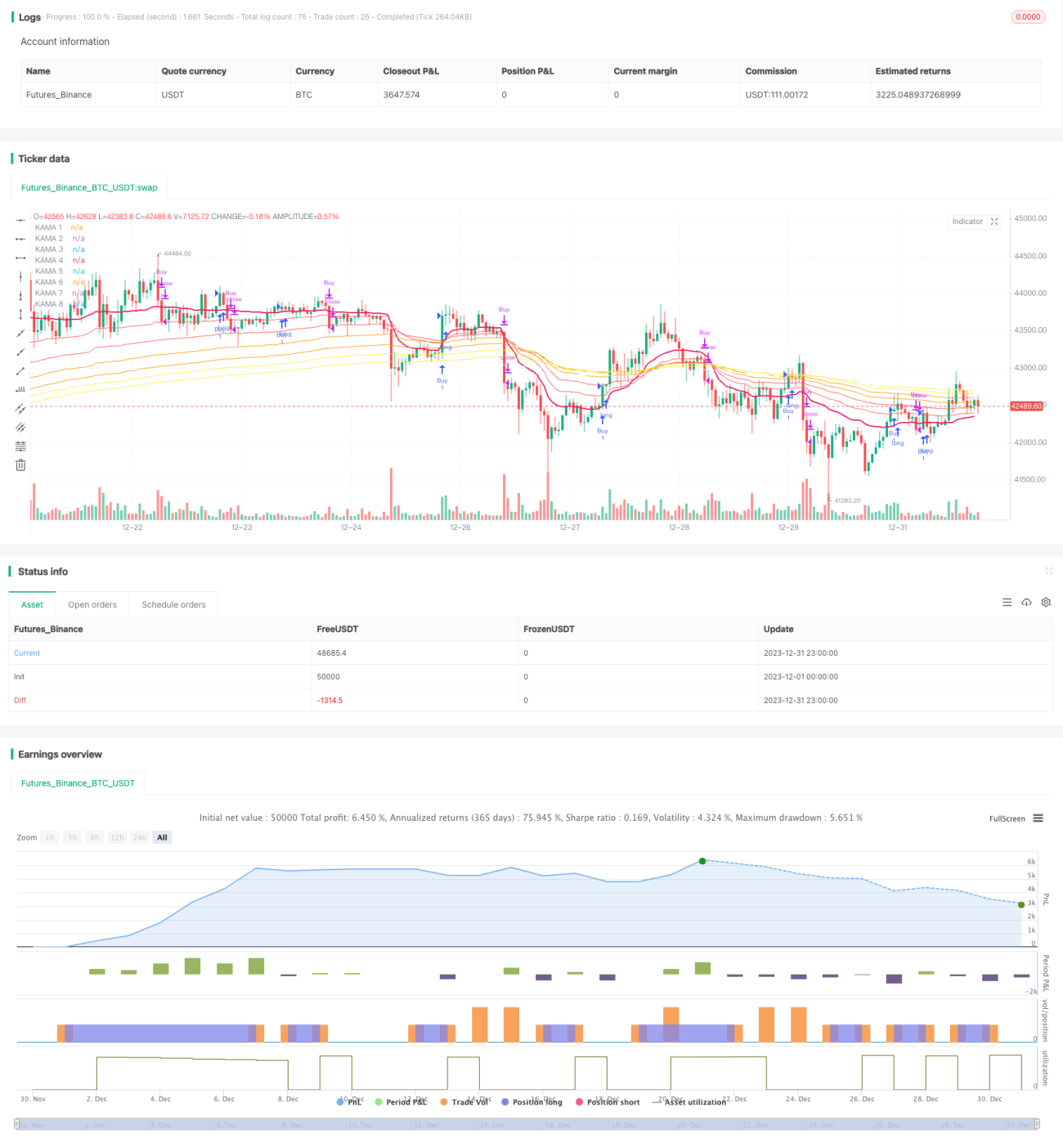
Estratégia de acompanhamento de tendências com base na média móvel adaptável


Data de criação: 2024-01-30 16:30:20 última modificação: 2024-01-30 16:30:20
cópia: 0 Cliques: 846
1
focar em
1617
Seguidores

Estratégia de acompanhamento de tendências com base na média móvel adaptável

Visão geral

Esta estratégia usa um sistema de negociação de rastreamento de tendências adaptado ao indicador Kaufman Moving Averages (KAMA). O sistema pode rastrear a tendência rapidamente quando uma tendência se forma e filtrar o ruído em situações de turbulência.

Princípio da estratégia

  • O comprimento do indicador KAMA é ajustado de acordo com a dinâmica da volatilidade do mercado em um período recente. A janela EMA fica mais curta quando a mudança de preço é maior do que o ruído recente; a janela EMA fica mais longa quando a mudança de preço é menor do que o ruído recente. Isso permite ao KAMA acompanhar rapidamente as tendências e filtrar o ruído em situações de turbulência.

  • O sistema julga a direção da tendência com base no KAMA 1 mais rápido. O KAMA 1 faz mais quando está acima e deixa vazio quando está abaixo. Para filtrar brechas falsas, o filtro KAMA é configurado. O sinal de negociação é gerado somente quando a mudança do KAMA 1 ultrapassa uma diferença padrão da oscilação recente.

  • Em termos de stop loss, o sistema oferece três opções de stop loss: reversão baseada em KAMA, reversão PSAR e stop loss móvel ATR. Os investidores podem escolher individualmente uma ou mais combinações.

Análise de vantagens

  • O design exclusivo do indicador KAMA permite ao sistema capturar rapidamente tendências emergentes, interromper a negociação em situações de turbulência, controlar efetivamente a frequência de negociação e reduzir desvios desnecessários e a perda de taxas.

  • O sistema incorpora vários mecanismos de suspensão de perdas. Os investidores podem escolher o plano de suspensão apropriado de acordo com as preferências de risco pessoais, controlando fortemente as perdas individuais.

  • O sistema baseia-se exclusivamente em indicadores e linhas de stop loss, evitando o problema comum de erro de entrada de transações de deslocamento.

  • A configuração de múltiplos parâmetros e combinação de condições oferece um grande espaço para a personalização do sistema. O usuário pode ser adaptado ao local e otimizado para diferentes variedades e períodos.

Análise de Riscos

  • O sistema não leva em conta riscos sistemáticos e não consegue controlar efetivamente os prejuízos em situações extremas.

  • Os PARAMETROS do sistema podem precisar de ser ajustados de acordo com diferentes ciclos de diferentes variedades, o que pode resultar em resultados demasiado radicais ou demasiado conservadores.

  • Se depender apenas do indicador KAMA como um impedimento, é fácil ser preso em situações de tremor. Isso precisa ser resolvido em combinação com o impedimento móvel do PSAR ou ATR.

Direção de otimização

  • Adicionar indicadores de filtragem de tendência, como o ADX ou indicadores de volatilidade oculta, para evitar a produção de sinais errados durante oscilações e transições de tendência.

  • Optimizar e testar PARAMETERS para variedades individuais e ciclos fixos, aumentando a estabilidade. As dimensões de otimização incluem combinações de parâmetros KAMA, parâmetros de parada, etc.

  • Experimente modelos de aprendizagem de máquina em vez de otimização de parâmetros. Use uma grande quantidade de treinamento de dados históricos para determinar o tempo de compra e venda e a parada de perdas em uma rede neural ou modelo de árvore de decisão.

  • Tente transferir a estratégia para outras variedades, como moedas digitais. Isso pode exigir o ajuste de PARAMETROS ou a adição de outros indicadores auxiliares.

Resumir

A estratégia integra o julgamento de tendências KAMA e vários meios de parada, permitindo um acompanhamento efetivo da direção da tendência e o controle do risco. A singularidade do indicador KAMA permite que a estratégia determine rapidamente a direção da tendência nascente, evitando problemas de falsas rupturas.

Código-fonte da estratégia
/*backtest
start: 2023-12-01 00:00:00
end: 2023-12-31 23:59:59
period: 1h
basePeriod: 15m
exchanges: [{"eid":"Futures_Binance","currency":"BTC_USDT"}]
*/

// This source code is subject to the terms of the Mozilla Public License 2.0 at https://mozilla.org/MPL/2.0/
// © BenHampson
// @version=4
// Credit to:
// - ChuckBanger for much of the KAMA code
// - cheatcountry for the KAMA Filter code
// - millerrh for much of the ATR Stop code
// - racer8 for much of the Position Sizing code

// I have combined aspects of their work and built upon it to form a strategy I like. 
// The KAMA, with its filter, is used for entry.
// An ATR trailing stop loss, PSAR, and the KAMA can all optionally be used as exits, or you can use a combination of the three.

strategy(title="KAMA Strategy - Kaufman's Adaptive Moving Average", shorttitle="KAMA Strategy", overlay=true)

src = input(title="Source", type=input.source, defval=close)

// Exits
KAMA1SL = input(title = 'KAMA 1 Stop Loss', type = input.bool, defval = true)
ATRTSL = input(title = 'ATR Trailing Stop Loss', type = input.bool, defval = false)
PSARSL = input(title = 'PSAR Stop Loss', type = input.bool, defval = false)

// KAMA 1 (Fastest)
length1 = input(title="KAMA 1: Length", type=input.integer, defval=14)
fastLength1 = input(title="KAMA 1: Fast KAMA Length", type=input.integer, defval=2)
slowLength1 = input(title="KAMA 1: Slow KAMA Length", type=input.integer, defval=20)

length2 = input(title="KAMA 2: Length 2", type=input.integer, defval=15)
fastLength2 = input(title="KAMA 2: Fast KAMA Length", type=input.integer, defval=3)
slowLength2 = input(title="KAMA 2: Slow KAMA Length", type=input.integer, defval=22)

length3 = input(title="KAMA 3: Length 3", type=input.integer, defval=16)
fastLength3 = input(title="KAMA 3: Fast KAMA Length", type=input.integer, defval=4)
slowLength3 = input(title="KAMA 3: Slow KAMA Length", type=input.integer, defval=24)

length4 = input(title="KAMA 4: Length", type=input.integer, defval=17)
fastLength4 = input(title="KAMA 4: Fast KAMA Length", type=input.integer, defval=5)
slowLength4 = input(title="KAMA 4: Slow KAMA Length", type=input.integer, defval=26)

// KAMA 5 (Medium)
length5 = input(title="KAMA 5: Length", type=input.integer, defval=18)
fastLength5 = input(title="KAMA 5: Fast KAMA Length", type=input.integer, defval=6)
slowLength5 = input(title="KAMA 5: Slow KAMA Length", type=input.integer, defval=28)

length6 = input(title="KAMA 6: Length", type=input.integer, defval=19)
fastLength6 = input(title="KAMA 6: Fast KAMA Length", type=input.integer, defval=7)
slowLength6 = input(title="KAMA 6: Slow KAMA Length", type=input.integer, defval=30)

length7 = input(title="KAMA 7: Length", type=input.integer, defval=20)
fastLength7 = input(title="KAMA 7: Fast KAMA Length", type=input.integer, defval=8)
slowLength7 = input(title="KAMA 7: Slow KAMA Length", type=input.integer, defval=32)

// KAMA 8 (Slowest)
length8 = input(title="KAMA 8: Length", type=input.integer, defval=21)
fastLength8 = input(title="KAMA 8: Fast KAMA Length", type=input.integer, defval=9)
slowLength8 = input(title="KAMA 8: Slow KAMA Length", type=input.integer, defval=34)

// Kaufman's Adaptive Moving Average
getKAMA(src, length1, fastLength1, slowLength1) =>
    mom = abs(change(src, length1))
    volatility = sum(abs(change(src)), length1)
    
    // Efficiency Ratio
    er = volatility != 0 ? mom / volatility : 0
    
    fastAlpha = 2 / (fastLength1 + 1)
    slowAlpha = 2 / (slowLength1 + 1)
    
    // KAMA Alpha
    sc = pow((er * (fastAlpha - slowAlpha)) + slowAlpha, 2)
    
    kama = 0.0
    kama := sc * src + (1 - sc) * nz(kama[1])
    kama

kama1 = getKAMA(src, length1, fastLength1, slowLength1)
kama2 = getKAMA(src, length2, fastLength2, slowLength2)
kama3 = getKAMA(src, length3, fastLength3, slowLength3)
kama4 = getKAMA(src, length4, fastLength4, slowLength4)
kama5 = getKAMA(src, length5, fastLength5, slowLength5)
kama6 = getKAMA(src, length6, fastLength6, slowLength6)
kama7 = getKAMA(src, length7, fastLength7, slowLength7)
kama8 = getKAMA(src, length8, fastLength8, slowLength8)

//If the kama1 has increased...
kama1delta = kama1[0] - kama1[1]
kama3delta = kama3[0] - kama3[1]
kama8delta = kama8[0] - kama8[1]

// KAMA Plots
plot(kama1, title="KAMA 1", color=#e91e63, display=display.all, linewidth=2)
plot(kama2, title="KAMA 2", color=color.red, display=display.all)
plot(kama3, title="KAMA 3", color=color.red, display=display.all)
plot(kama4, title="KAMA 4", color=color.orange, display=display.all)
plot(kama5, title="KAMA 5", color=color.orange, display=display.all)
plot(kama6, title="KAMA 6", color=color.yellow, display=display.all)
plot(kama7, title="KAMA 7", color=color.yellow, display=display.all)
plot(kama8, title="KAMA 8", color=color.white, display=display.all)


//========================================= KAMA FILTER ===========================================

// Copyright (c) 2019-present, Franklin Moormann (cheatcountry)
// Moving Average Adaptive Filter [CC] script may be freely distributed under the MIT license.

entryFilter = input(title="KAMA Entry Filter", type=input.float, defval=1, minval=0.01)
exitFilter = input(title="KAMA Exit Filter", type=input.float, defval=0.5, minval=0.01)

entryMAAF = entryFilter * stdev(kama1delta, length1)
exitMAAF = exitFilter * stdev(kama1delta, length1)
srcEma = ema(src, length1)


//========================================= TRAILING ATR STOP ====================================

// The following is an adaptation of Trailing ATR Stops by @millerrh
// He based it on scripts by @garethyeo & @SimpleCryptoLife

// Inputs

atrLookback = input(defval=14,title="Trailing ATR Lookback Period",type=input.integer)
multiplier = input(defval=3,title="Trailing ATR Multiplier",type=input.float, step=0.1, minval=0.5, maxval=4)
trailMode = input(title="Trail Mode", defval="Trailing", options=["Running", "Trailing"])
trigInput = input(title="Trigger Trailing Stop On", defval="Wick", options=["Close","Wick"]) 

// Calculate ATR
atrValue = atr(atrLookback)
atrMultiplied = atrValue * multiplier

// Plot the price minus the ATR
atrLow = low - atrMultiplied

// Calculate the low trailing ATRs every time. The trailing stop loss never goes down.
// Set them to something to start with
trailAtrLow = atrLow

// If the ATR Low has gone up AND it has gone above the trail, the low trailing ATR should also go up. If the ATR Low has gone up or down, but not below the trail, the ATR trail stays where it is
trailAtrLow := na(trailAtrLow[1]) ? trailAtrLow : atrLow >= trailAtrLow[1] ? atrLow : trailAtrLow[1]

// Trigger stop based on candle close or low
trigSupport = trigInput == "Close" ? close : trigInput == "Wick" ? low : na

// Determine if price is below support
supportHit = trigSupport <= trailAtrLow

// If price is below support, reset the trailing ATR
trailAtrLow := supportHit ? atrLow : trailAtrLow

// Plot Lines
plotLow = ATRTSL ? trailAtrLow : na
plot(plotLow, title="ATR Low", color=color.white, transp=50, style=plot.style_linebr, linewidth=1, display=display.all)


//====================================== PSAR STOP ==========================================

start = input(0.02, "PSAR Start")
increment = input(0.02, "PSAR Increment")
maximum = input(0.2, "PSAR Max Value")
psar = sar(start, increment, maximum)
psarPlot  = PSARSL ? psar : na
plot(psarPlot, "Parabolic SAR", style=plot.style_cross, color=#3A6CA8, display=display.all)


//========================================= ENTRY & EXITS =====================================================

// Entry
long = kama1delta > 0 and kama1delta > entryMAAF
strategy.entry("Buy", true, when = long) 

// Close
longClose = (PSARSL ? crossunder(close, psar) : na) or (KAMA1SL ? kama1delta < 0 and abs(kama1delta) > exitMAAF : na) or (ATRTSL ? supportHit : na)
strategy.close("Buy", when = longClose, comment = "Sell")