Estratégia de convergência de direção de momentum para negociação quantitativa

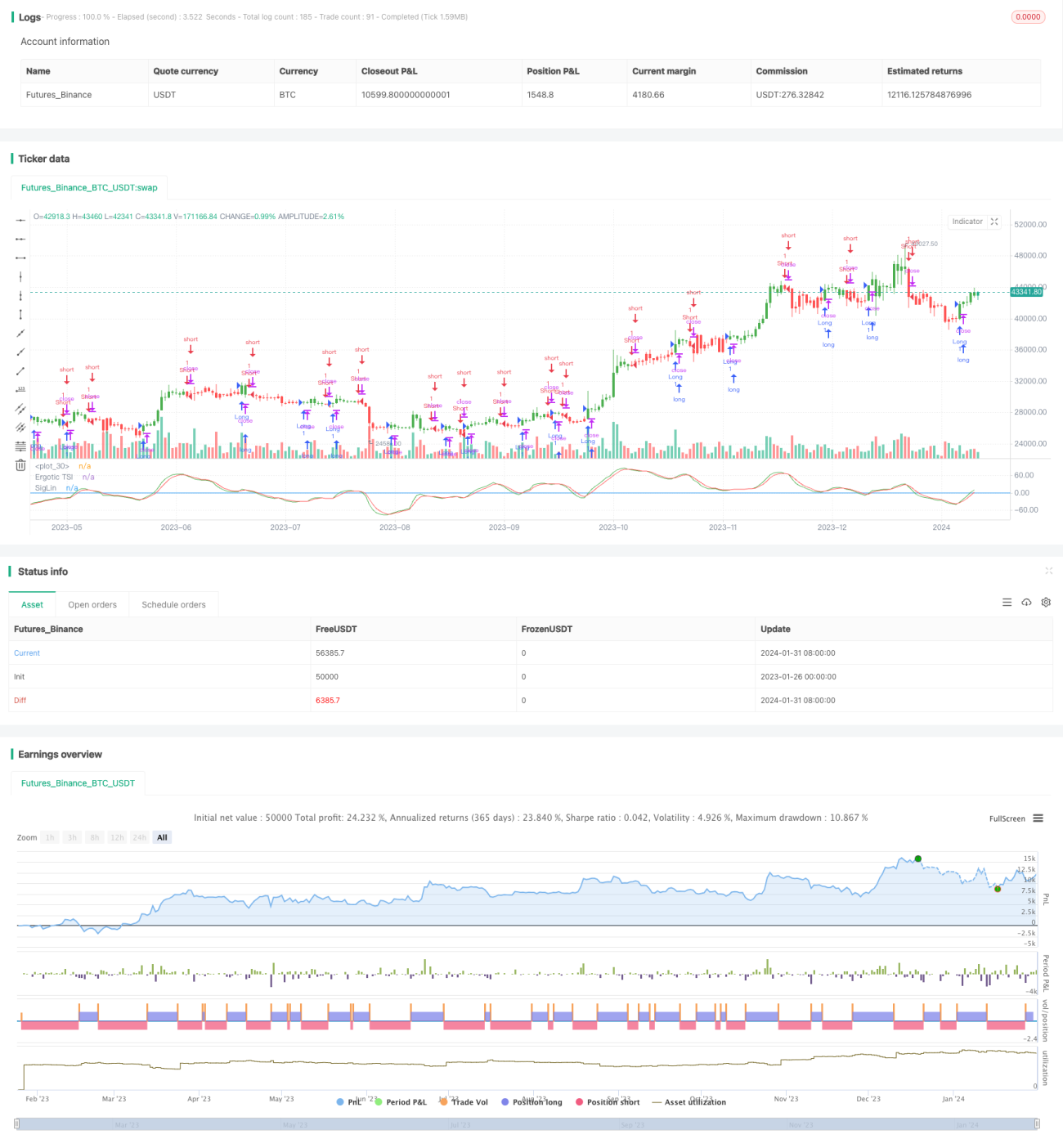
Visão Geral
Esta estratégia, denominada "Estratégia de Convergência de Direção de Momentum para Negociação Quantitativa", é uma estratégia de negociação quantitativa projetada com base nos indicadores técnicos descritos por William Blau em seu livro Momentum, Direction and Divergence. A estratégia concentra-se nos três aspectos principais: momentum, direção e divergência. Ela calcula indicadores de momentum dos preços das ações, determina a direção da tendência do mercado e busca divergências entre preços e indicadores para obter oportunidades de negociação.
Princípio da Estratégia
O principal indicador desta estratégia é o Índice de Momentum Ergótico (Ergotic TSI), calculado da seguinte forma:
Val1 = 100 * EMA(EMA(EMA(variação de preço, r), s), u)
Val2 = EMA(EMA(EMA(valor absoluto da variação de preço, r), s), u)
Ergotic TSI = se Val2 != 0, então Val1/Val2, senão 0
Onde r, s e u são parâmetros de suavização. Este indicador reflete a proporção da variação de preço em relação ao valor absoluto da variação de preço, sendo um oscilador de momentum. Em seguida, calculamos a média móvel exponencial (EMA) suavizada do Ergotic TSI como linha de sinal. Quando o TSI cruza acima da linha de sinal, é gerada uma posição comprada; quando cruza abaixo, é gerada uma posição vendida.
Análise de Vantagens
As principais vantagens desta estratégia são:
- Forte capacidade de capturar a tendência das variações de preço.
- Boa filtragem de oscilações de preço.
- Boas características de divergência.
- Parâmetros flexíveis, permitindo ajuste da suavidade.
Análise de Riscos
Esta estratégia também apresenta alguns riscos:
- Pode gerar sinais falsos em pontos de reversão de tendência.
- Parâmetros mal ajustados podem perder oportunidades de negociação ou aumentar sinais falsos.
- Requer ajuste adequado dos parâmetros para diferentes ativos e ambientes de negociação.
Riscos podem ser controlados por meio de otimização de parâmetros, combinação com outros indicadores para confirmação e definição de stops.
Direções de Otimização
Esta estratégia pode ser otimizada nos seguintes aspectos:
- Testar diferentes entradas de preço, como preço de abertura, fechamento, ponto médio, etc.
- Ajustar os valores dos parâmetros de suavização r, s e u em busca da melhor combinação.
- Adicionar outros indicadores ou condições de filtro para confirmação adicional de sinais.
- Definir pontos de stop loss e mecanismos de saída.
Resumo
Esta estratégia combina variações de momentum, julgamento de tendência e características de divergência, permitindo capturar oportunidades de tendência de forma eficaz. Através da otimização de parâmetros, filtragem de sinais e controle de risco, é possível obter um bom desempenho da estratégia. No geral, a estratégia é bem projetada e merece estudos e práticas adicionais.
/*backtest
start: 2023-01-26 00:00:00
end: 2024-02-01 00:00:00
period: 1d
basePeriod: 1h
exchanges: [{"eid":"Futures_Binance","currency":"BTC_USDT"}]
*/

//@version = 2
////////////////////////////////////////////////////////////
//  Copyright by HPotter v1.0 13/12/2016
// r - Length of first EMA smoothing of 1 day momentum 4- 1