Estratégia de média de custo em dólar BTC baseada na banda BEAM

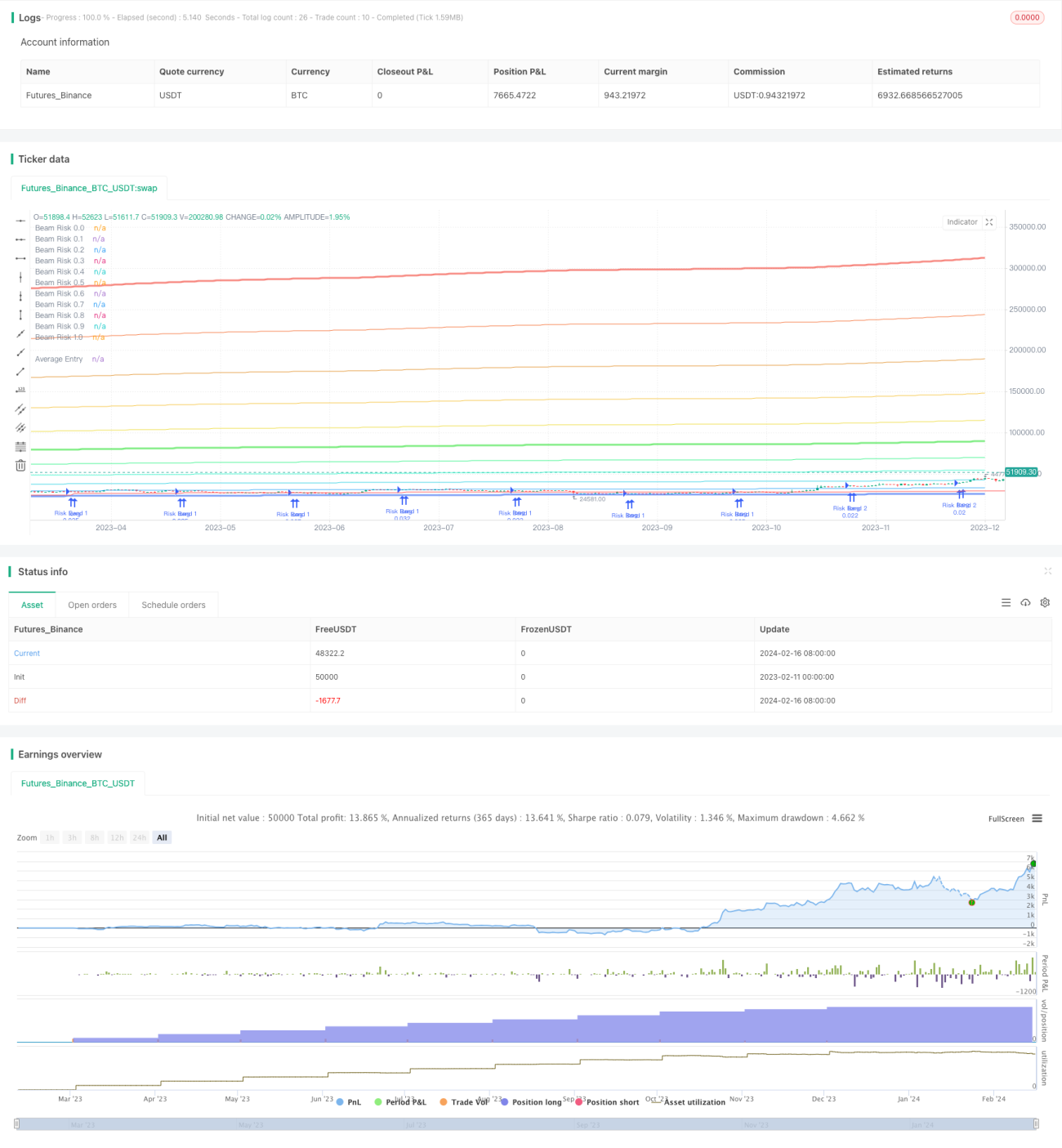
Visão Geral
Esta estratégia é baseada na teoria de níveis de risco de Ben Cowen, com o objetivo de utilizar as bandas BEAM para implementar um método semelhante. O limite superior das bandas BEAM é a média móvel de 200 semanas após o logaritmo, e o limite inferior é a própria média móvel de 200 semanas. Isso nos dá um intervalo de 0 a 1. Quando o preço está abaixo da banda 0,5, é emitida uma ordem de compra; quando o preço está acima da banda 0,5, é emitida uma ordem de venda.
Princípio da Estratégia
A estratégia depende principalmente da teoria das bandas BEAM proposta por Ben Cowen. Com base nas variações de preço do BTC, o preço pode ser dividido em 10 regiões entre 0 e 1, que representam 10 níveis de risco diferentes. O nível 0 indica que o preço está próximo da média móvel de 200 semanas, com risco mínimo; o nível 5 indica que o preço está na região mediana; o nível 10 indica que o preço está próximo do limite superior, com risco máximo.
Quando o preço cai para níveis baixos, a estratégia aumenta gradualmente a posição de compra. Especificamente, se o preço estiver na banda entre 0 e 0,5, uma ordem de compra é emitida em um determinado dia do mês definido pela estratégia. O valor da compra aumenta à medida que o número da banda diminui. Por exemplo, na banda 5, o valor da compra é 20% do valor total mensal do DCA; na banda 1, o valor da compra aumenta para 100% do valor total mensal do DCA.
Quando o preço sobe para níveis elevados, a estratégia reduz gradualmente a posição. Especificamente, se o preço ultrapassar a banda 0,5, ordens de venda são emitidas proporcionalmente, e a posição vendida aumenta à medida que o número da banda aumenta. Por exemplo, na banda 6, vende-se 6,67%; na banda 10, vende-se toda a posição.
Análise de Vantagens
A maior vantagem desta estratégia de média de custo (DCA) com bandas BEAM é que ela aproveita ao máximo as características de negociação volátil do BTC, comprando quando o preço do BTC cai a fundos e realizando lucros quando o preço sobe a picos. Essa abordagem não perde nenhuma oportunidade de compra ou venda. As vantagens específicas podem ser resumidas da seguinte forma:
- Utiliza a teoria BEAM para avaliar o grau de desvalorização do ativo, evitando riscos de forma científica;
- Aproveita ao máximo as características de volatilidade do BTC, capturando com precisão as melhores oportunidades de compra e venda;
- Adota o método de média de custo, controlando efetivamente o custo do investimento e obtendo retornos estáveis a longo prazo;
- Executa automaticamente as transações de compra e venda, sem necessidade de intervenção manual, reduzindo o risco operacional;
- Permite personalizar parâmetros, ajustando a estratégia de forma flexível para se adaptar às mudanças do mercado.
Em resumo, trata-se de uma estratégia de ajuste refinado de parâmetros que pode obter retornos estáveis a longo prazo em cenários de oscilação do BTC.
Análise de Riscos
Embora a estratégia DCA com bandas BEAM tenha muitas vantagens, também existem alguns riscos potenciais que exigem atenção. Os principais pontos de risco podem ser resumidos da seguinte forma:
- A teoria BEAM e a definição de parâmetros dependem de julgamento subjetivo, havendo a probabilidade de erro de avaliação;
- A tendência do BTC é difícil de prever, existindo o risco de perdas;
- As negociações automáticas são suscetíveis a falhas no sistema e efeitos adversos de manipulação de parâmetros (Parameter Hacking);
- A volatilidade excessiva pode levar a perdas ampliadas.
Para reduzir os riscos, podem ser tomadas as seguintes medidas:
- Otimizar a definição de parâmetros para melhorar a precisão do julgamento da teoria BEAM;
- Reduzir adequadamente o tamanho da posição, diminuindo o valor da perda por operação;
- Aumentar a redundância e a capacidade de tolerância a falhas, reduzindo o risco operacional das negociações automáticas;
- Definir pontos de stop loss para evitar perdas excessivas em uma única operação.
Direções de Otimização
Considerando os pontos de risco acima, a estratégia pode ser otimizada principalmente nos seguintes aspectos:
- Otimizar os parâmetros da teoria BEAM: ajustar os parâmetros do método logarítmico, o período de backtest, etc., para melhorar a precisão do julgamento do modelo;
- Otimizar o controle de posição: ajustar o valor total mensal do DCA, as proporções de compra e venda, etc., para controlar o risco de perda por operação;
- Adicionar módulo de segurança para negociação automática: configurar servidores redundantes, processamento local, etc., para melhorar a capacidade de tolerância a falhas;
- Adicionar módulo de stop loss: definir pontos de stop loss razoáveis com base na volatilidade histórica para controlar perdas de forma eficaz.
Por meio dessas medidas, a estabilidade e a segurança da estratégia podem ser significativamente melhoradas.
Conclusão
A estratégia DCA com bandas BEAM é uma estratégia quantitativa de grande valor prático. Ela utiliza com sucesso a teoria BEAM para orientar decisões de negociação, complementada pelo modelo de média de custo para controlar o custo de compra. Ao mesmo tempo, também presta atenção à gestão de riscos, definindo pontos de stop loss para evitar a ampliação de perdas. Por meio da otimização de parâmetros e da adição de módulos, essa estratégia pode se tornar uma ferramenta importante para negociação quantitativa, obtendo retornos estáveis a longo prazo no mercado de BTC. Vale a pena ser estudada e aplicada por profissionais de negociação quantitativa.
/*backtest
start: 2023-02-11 00:00:00
end: 2024-02-17 00:00:00
period: 1d
basePeriod: 1h
exchanges: [{"eid":"Futures_Binance","currency":"BTC_USDT"}]
*/

// © gjfsdrtytru - BEAM DCA Strategy {
// Based on Ben Cowen's risk level strategy, this aims to copy that method but with BEAM band levels.
// Upper BEAM level is derived from ln(price/200W MA)/2.5, while the 200W MA is the floor price. This is our 0-1 range.
// Buy limit orders are set at the < 0.5 levels and sell orders are set at the > 0.5 level.- 1