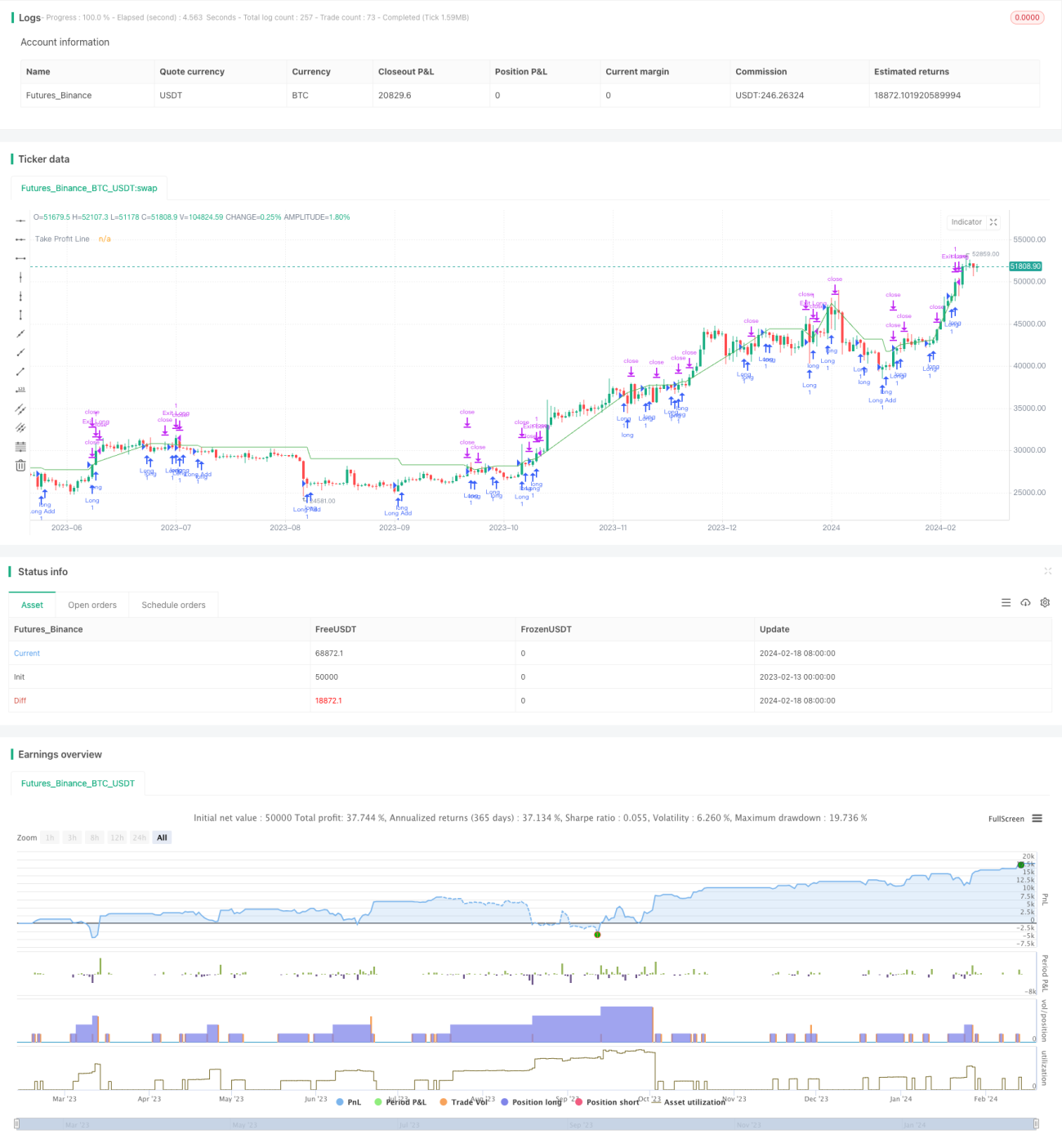
A estratégia utiliza um conjunto de indicadores técnicos, como RSI, MACD, OBV, CCI, CMF, MFI e VWMACD, para detectar desvios entre o preço e o volume de transação para identificar potenciais oportunidades de entrada. A estratégia também combina com o indicador de detecção de user dip, que emite um sinal de negociação quando as condições de alta volatilidade e profundidade ou VFI são satisfeitas. A estratégia apenas faz mais, usando o rastreamento de stop loss para aumentar gradualmente a posição para criar posições.
Calcule os indicadores RSI, MACD, OBV, CCI, CMF, MFI e VWMACD e detecte o desvio entre cada indicador e o preço histórico por meio de um método de regressão linear adaptativa. Quando o indicador inova baixo e o preço não segue a inovação baixa, emite um sinal de compra.
Os limites de taxa de flutuação e os limites percentuais de profundidade baseados na entrada do usuário, combinados com a filtragem do indicador VFI, emitem um sinal na linha K que corresponde ao teste de alta flutuação e profundidade.
Depois de fazer um longo prazo inicial, se o preço cair abaixo de uma certa proporção do preço do último longo prazo (configurável), você pode fazer um longo prazo novamente.
Use o tracking stop loss para fechar a posição quando a proporção de stop loss da configuração for atingida.
A combinação de vários fatores, o uso integrado de preços e indicadores de volume de transação, aumenta a confiabilidade do sinal.
O método de regressão linear auto-adaptativa detecta desvios e evita a subjetividade do julgamento humano.
A combinação da taxa de flutuação com os indicadores de detecção de profundidade/VFI ajuda a identificar oportunidades de reversão.
A construção de um depósito com várias adições pode aproveitar ao máximo a correção de preços e rastrear o lucro de bloqueio de benefícios de bloqueio.
A combinação de múltiplos fatores é mais complexa, e a otimização de parâmetros e o desvio do efeito de identificação podem afetar a performance real.
O risco de uma posição unilateral é alto e pode causar um grande prejuízo com erros de julgamento.
A perda de posição pode aumentar com a repetição de uma posição, e é preciso controlar cuidadosamente a posição.
O impacto das comissões sobre os lucros reais deve ser observado.
Teste a eficácia de diferentes combinações de parâmetros e indicadores.
Adição de estratégias de stop loss, controle de liquidação e perda máxima.
Considere oportunidades de negociação bidirecionais para dispersar o risco.
Parâmetros de otimização automática combinados com métodos de aprendizagem de máquina.
A estratégia integra vários indicadores técnicos para identificar o momento de entrada, ao mesmo tempo que utiliza os termos definidos pelo usuário e o indicador VFI para filtrar o falso sinal. A estratégia utiliza a retracção de preços para aumentar a posição, o que é favorável para aproveitar a oportunidade na tendência. Mas também enfrenta o risco de erro de julgamento e posicionamento unilateral.
/*backtest
start: 2023-02-13 00:00:00
end: 2024-02-19 00:00:00
period: 1d
basePeriod: 1h
exchanges: [{"eid":"Futures_Binance","currency":"BTC_USDT"}]
*/
// This Pine Script™ code is subject to the terms of the Mozilla Public License 2.0 at https://mozilla.org/MPL/2.0/
// © mkose81
//@version=5
strategy("RSI ve MACD Uyumsuzluğu Stratejisi (Sadece Long)", overlay=true, max_bars_back=4000,use_bar_magnifier= true,pyramiding=40)
// RSI Hesaplama
rsi = ta.rsi(close, 14)
float botRSI = na
botRSI := ta.pivotlow(5, 5)
botcRSI = 0
botcRSI := botRSI ? 5 : nz(botcRSI[1]) + 1
newbotRSI = ta.pivotlow(5, 0)
emptylRSI = true
if not na(newbotRSI) and newbotRSI < low[botcRSI]
diffRSI = (newbotRSI - low[botcRSI]) / botcRSI
llineRSI = newbotRSI - diffRSI
for x = 1 to botcRSI - 1 by 1
if close[x] < llineRSI
emptylRSI := false
break
llineRSI -= diffRSI
emptylRSI
// Pozitif Uyumsuzluk Alım Sinyali - RSI
alRSI = 0
if emptylRSI and not na(newbotRSI)
if rsi[botcRSI] < rsi
alRSI := 1
// MACD Hesaplama
[macd, signal, _] = ta.macd(close, 21, 55, 8)
float botMACD = na
botMACD := ta.pivotlow(5, 5)
botcMACD = 0
botcMACD := botMACD ? 5 : nz(botcMACD[1]) + 1
newbotMACD = ta.pivotlow(5, 0)
emptylMACD = true
if not na(newbotMACD) and newbotMACD < low[botcMACD]
diffMACD = (newbotMACD - low[botcMACD]) / botcMACD
llineMACD = newbotMACD - diffMACD
for x = 1 to botcMACD - 1 by 1
if close[x] < llineMACD
emptylMACD := false
break
llineMACD -= diffMACD
emptylMACD
// Pozitif Uyumsuzluk Alım Sinyali - MACD
alMACD = 0
if emptylMACD and not na(newbotMACD)
if macd[botcMACD] < macd
alMACD := 1
// OBV Hesaplama ve Uyumsuzluk Tespiti
obv = ta.cum(ta.change(close) > 0 ? volume : ta.change(close) < 0 ? -volume : 0)
float botOBV = na
botOBV := ta.pivotlow(5, 5)
botcOBV = 0
botcOBV := botOBV ? 5 : nz(botcOBV[1]) + 1
newbotOBV = ta.pivotlow(5, 0)
emptylOBV = true
if not na(newbotOBV) and newbotOBV < obv[botcOBV]
diffOBV = (newbotOBV - obv[botcOBV]) / botcOBV
llineOBV = newbotOBV - diffOBV
for x = 1 to botcOBV - 1 by 1
if obv[x] < llineOBV
emptylOBV := false
break
llineOBV -= diffOBV
emptylOBV
// Pozitif Uyumsuzluk Alım Sinyali - OBV
alOBV = 0
if emptylOBV and not na(newbotOBV)
if obv[botcOBV] < obv
alOBV := 1
// CCI Hesaplama ve Uyumsuzluk Tespiti
cci = ta.cci(close, 20)
float botCCI = na
botCCI := ta.pivotlow(5, 5)
botcCCI = 0
botcCCI := botCCI ? 5 : nz(botcCCI[1]) + 1
newbotCCI = ta.pivotlow(5, 0)
emptylCCI = true
if not na(newbotCCI) and newbotCCI < cci[botcCCI]
diffCCI = (newbotCCI - cci[botcCCI]) / botcCCI
llineCCI = newbotCCI - diffCCI
for x = 1 to botcCCI - 1 by 1
if cci[x] < llineCCI
emptylCCI := false
break
llineCCI -= diffCCI
emptylCCI
// Pozitif Uyumsuzluk Alım Sinyali - CCI
alCCI = 0
if emptylCCI and not na(newbotCCI)
if cci[botcCCI] < cci
alCCI := 1
// CMF Hesaplama
length = 20
mfm = ((close - low) - (high - close)) / (high - low)
mfv = mfm * volume
cmf = ta.sma(mfv, length) / ta.sma(volume, length)
float botCMF = na
botCMF := ta.pivotlow(5, 5)
botcCMF = 0
botcCMF := botCMF ? 5 : nz(botcCMF[1]) + 1
newbotCMF = ta.pivotlow(5, 0)
emptylCMF = true
if not na(newbotCMF) and newbotCMF < cmf[botcCMF]
diffCMF = (newbotCMF - cmf[botcCMF]) / botcCMF
llineCMF = newbotCMF - diffCMF
for x = 1 to botcCMF - 1 by 1
if cmf[x] < llineCMF
emptylCMF := false
break
llineCMF -= diffCMF
emptylCMF
// Pozitif Uyumsuzluk Alım Sinyali - CMF
alCMF = 0
if emptylCMF and not na(newbotCMF)
if cmf[botcCMF] < cmf
alCMF := 1
// MFI Hesaplama
lengthMFI = 14
mfi = ta.mfi(close, lengthMFI)
float botMFI = na
botMFI := ta.pivotlow(mfi, 5, 5)
botcMFI = 0
botcMFI := botMFI ? 5 : nz(botcMFI[1]) + 1
newbotMFI = ta.pivotlow(mfi, 5, 0)
emptylMFI = true
if not na(newbotMFI) and newbotMFI < mfi[botcMFI]
diffMFI = (newbotMFI - mfi[botcMFI]) / botcMFI
llineMFI = newbotMFI - diffMFI
for x = 1 to botcMFI - 1 by 1
if mfi[x] < llineMFI
emptylMFI := false
break
llineMFI -= diffMFI
emptylMFI
// Pozitif Uyumsuzluk Alım Sinyali - MFI
alMFI = 0
if emptylMFI and not na(newbotMFI)
if mfi[botcMFI] < mfi
alMFI := 1
// VWMACD Hesaplama
fastLength = 12
slowLength = 26
signalSmoothing = 9
vwmacd = ta.ema(close, fastLength) - ta.ema(close, slowLength)
signalLine = ta.ema(vwmacd, signalSmoothing)
histogram = vwmacd - signalLine
// VWMACD Uyumsuzluk Tespiti
float botVWMACD = na
botVWMACD := ta.pivotlow(histogram, 5, 5)
botcVWMACD = 0
botcVWMACD := botVWMACD ? 5 : nz(botcVWMACD[1]) + 1
newbotVWMACD = ta.pivotlow(histogram, 5, 0)
emptylVWMACD = true
if not na(newbotVWMACD) and newbotVWMACD < histogram[botcVWMACD]
diffVWMACD = (newbotVWMACD - histogram[botcVWMACD]) / botcVWMACD
llineVWMACD = newbotVWMACD - diffVWMACD
for x = 1 to botcVWMACD - 1 by 1
if histogram[x] < llineVWMACD
emptylVWMACD := false
break
llineVWMACD -= diffVWMACD
emptylVWMACD
// Pozitif Uyumsuzluk Alım Sinyali - VWMACD
alVWMACD = 0
if emptylVWMACD and not na(newbotVWMACD)
if histogram[botcVWMACD] < histogram
alVWMACD := 1
//Dipci indikator
lengthd= 130
coef = 0.2
vcoef = 2.5
signalLength = 5
smoothVFI = false
ma(x, y) =>
smoothVFI ? ta.sma(x, y) : x
typical = hlc3
inter = math.log(typical) - math.log(typical[1])
vinter = ta.stdev(inter, 30)
cutoff = coef * vinter * close
vave = ta.sma(volume, lengthd)[1]
vmax = vave * vcoef
vc = volume < vmax ? volume : vmax //min( volume, vmax )
mf = typical - typical[1]
iff_4 = mf < -cutoff ? -vc : 0
vcp = mf > cutoff ? vc : iff_4
vfi = ma(math.sum(vcp, lengthd) / vave, 3)
vfima = ta.ema(vfi, signalLength)
d = vfi - vfima
// Kullanıcı girdileri
volatilityThreshold = input.float(1.005, title="Volume Percentage Threshold")
pinThreshold = input.float(1.005, title="Deep Percentage Threshold")
// Hesaplamalar
volatilityPercentage = (high - low) / open
pinPercentage = close > open ? (high - close) / open : (close - low) / open
// Volatilite koşulu ve VFI ile filtreleme
voldip = volatilityPercentage >= volatilityThreshold or pinPercentage >= pinThreshold
volCondition = voldip and vfi< 0 // VFI değeri 0'dan küçükse volCondition aktif olacak
threeCommasEntryComment = input.string(title="3Commas Entry Comment", defval="")
threeCommasExitComment = input.string(title="3Commas Exit Comment", defval="")
takeProfitPerc = input.float(1, title="Take Profit Percentage (%)") / 100
fallPerc = input.float(5, title="Percentage for Additional Buy (%)") / 100
// Değişkenlerin tanımlanması
var float lastBuyPrice = na
var float tpPrice = na
var int lastTpBar = na
// Alım koşulları
longCondition = alRSI or alMACD or alOBV or alCCI or alCMF or alMFI or alVWMACD or volCondition
// Son alım fiyatını saklamak için değişken
// İlk alım stratejisi
if (longCondition and strategy.position_size == 0)
strategy.entry("Long", strategy.long,comment=threeCommasEntryComment)
lastBuyPrice := open
// İkinci ve sonraki alım koşulları (son alım fiyatının belirlenen yüzde altında)
if (open < lastBuyPrice * (1 - fallPerc) and strategy.position_size > 0)
strategy.entry("Long Add", strategy.long,comment=threeCommasEntryComment)
lastBuyPrice := open
// Kar alma fiyatını hesaplama ve strateji çıkışı
tp_price = strategy.position_avg_price * (1 + takeProfitPerc)
if strategy.position_size > 0
strategy.exit("Exit Long", "Long", limit=tp_price,comment=threeCommasExitComment)
strategy.exit("Exit Long Add", "Long Add", limit=tp_price,comment=threeCommasExitComment)
tpPrice := na // Pozisyon kapandığında TP çizgisini sıfırla
// Kar alma seviyesi çizgisi çizme
plot(strategy.position_size > 0 ? tp_price : na, color=color.green, title="Take Profit Line")