Ajuste de volatilidade do canal Double Vegas SuperTrend Estratégia de negociação quantitativa

ATR SMA STD HLC3
Data de criação: 2024-06-03 11:16:38 última modificação: 2024-06-03 11:16:38
cópia: 0 Cliques: 709
1
focar em
1617
Seguidores

Ajuste de volatilidade do canal Double Vegas SuperTrend Estratégia de negociação quantitativa

Visão geral

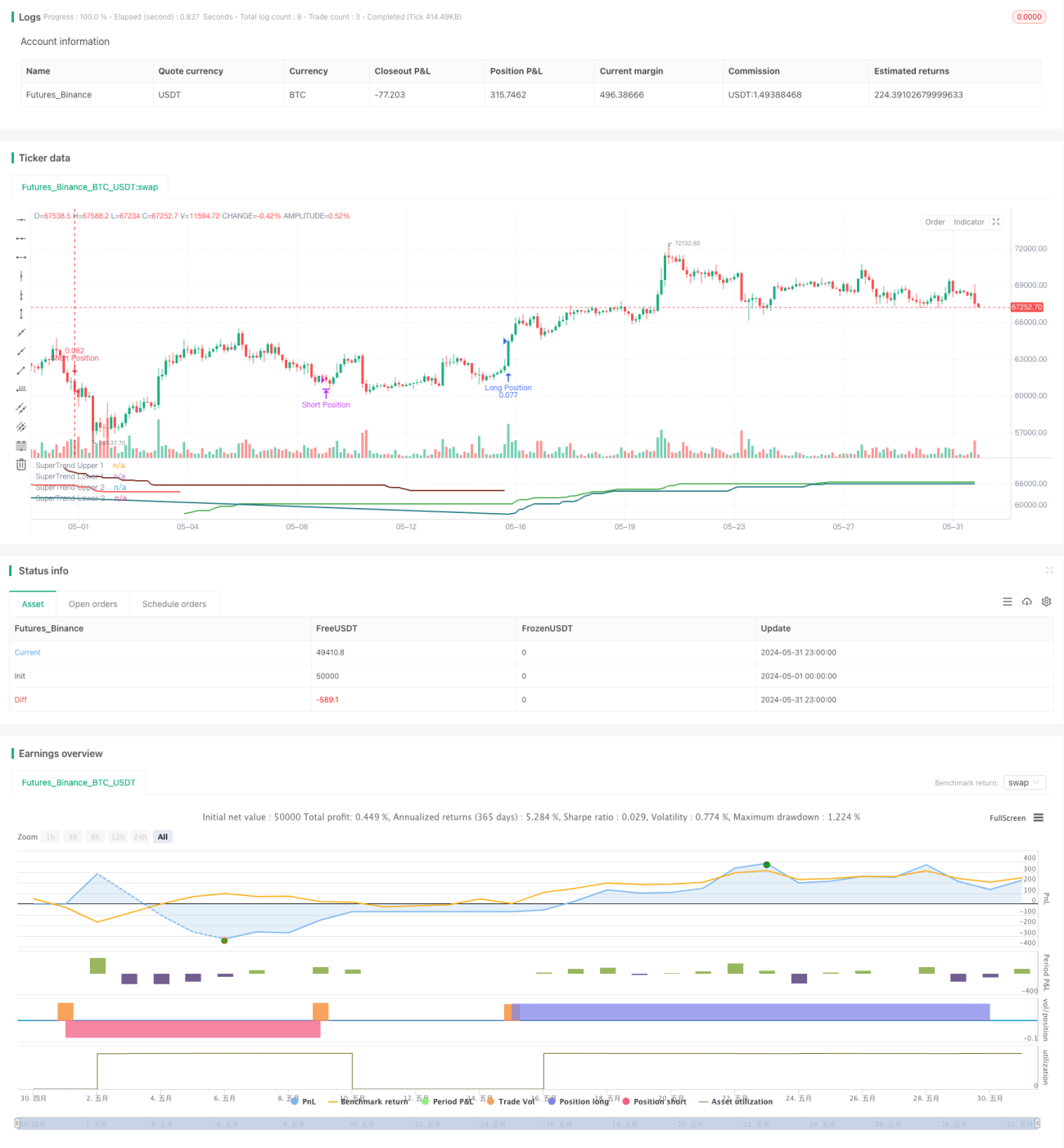
A estratégia de negociação quantitativa SuperTrend com ajuste de volatilidade do canal Vegas duplo é um sistema de negociação quantitativa avançado que combina dois indicadores de SuperTrend com ajuste de volatilidade do canal Vegas com diferentes configurações de parâmetros, com o objetivo de capturar com maior precisão as tendências do mercado e gerar sinais de negociação que estejam em consonância com a direção do mercado geral. A estratégia cria um sistema de negociação dinâmico e responsivo, otimizando a computação do SuperTrend, integrando o ajuste de volatilidade e aproveitando a largura do canal Vegas.

Princípio da estratégia

A estratégia calcula primeiro o canal de Vegas, que é derivado da média móvel simples (SMA) e do diferencial padrão (STD) do preço de fechamento dentro de uma determinada extensão de janela. O canal ajuda a medir a volatilidade do mercado e estabelece a base para o ajuste do indicador SuperTrend.

Vantagens estratégicas

O principal benefício da estratégia de negociação quantitativa SuperTrend de ajuste de volatilidade do canal Vegas duplo é a capacidade de ajustar dinamicamente os indicadores do SuperTrend para se adaptar a condições de mercado em constante mudança. Ao integrar a largura do canal Vegas, a estratégia pode responder melhor às flutuações do mercado e aumentar a precisão da identificação de tendências. Além disso, o uso de dois indicadores do SuperTrend com diferentes configurações de parâmetros pode fornecer uma visão mais abrangente do mercado, ajudando a identificar tendências e filtrar sinais errados.

Risco estratégico

Embora a estratégia seja destinada a melhorar a precisão da identificação de tendências, existem ainda alguns riscos. Primeiro, a estratégia pode gerar sinais de negociação errados em situações de extrema volatilidade ou de incerteza na direção do mercado. Segundo, negociações muito frequentes podem levar a custos de negociação elevados, afetando o desempenho geral da estratégia.

Direção de otimização da estratégia

A estratégia de negociação quantitativa SuperTrend de ajuste de volatilidade do canal de dupla Vegas pode ser otimizada de várias maneiras. Uma direção de otimização potencial é a combinação de outros indicadores técnicos, como o índice de força relativa (RSI) ou a média móvel convergente (MACD), para aumentar a confiabilidade da confirmação de tendências. Outra direção de otimização é a introdução de mecanismos de auto-adaptação, que ajusta os parâmetros da estratégia de acordo com a dinâmica das condições de mercado.

Resumir

Em geral, a estratégia de negociação de SuperTrend de Ajuste de Volatilidade do Canal Duplo de Vegas é um sistema de negociação robusto que aumenta a precisão de identificação de tendências através da integração de ajustes de volatilidade e do uso da largura do canal de Vegas. A estratégia usa dois indicadores de SuperTrend com diferentes configurações de parâmetros para obter uma visão mais abrangente do mercado.

Código-fonte da estratégia
/*backtest
start: 2024-05-01 00:00:00
end: 2024-05-31 23:59:59
period: 3h
basePeriod: 15m
exchanges: [{"eid":"Futures_Binance","currency":"BTC_USDT"}]
*/

// This Pine Script™ code is subject to the terms of the Mozilla Public License 2.0 at https://mozilla.org/MPL/2.0/
// © PresentTrading

// The "Double Vegas SuperTrend Enhanced" strategy uses two SuperTrend indicators with different ATR and Vegas Channel settings 
// to identify market trends and generate trades. Trades are executed only when both SuperTrends align in the same direction. 
// The strategy includes configurable take-profit and stop-loss levels, and plots the SuperTrend levels on the chart.

//@version=5
strategy("Double Vegas SuperTrend Enhanced - Strategy [presentTrading]", shorttitle="Double Vegas SuperTrend Enhanced - Strategy [presentTrading]", overlay=true, overlay = false, 
 precision=3, commission_value= 0.1, commission_type=strategy.commission.percent, slippage= 1, currency=currency.USD, default_qty_type = strategy.percent_of_equity, 
 default_qty_value = 10, initial_capital= 10000)


// Input settings allow the user to customize the strategy's parameters.
tradeDirectionChoice = input.string(title="Trade Direction", defval="Both", options=["Long", "Short", "Both"]) // Option to select the trading direction

// Settings for the first Vegas SuperTrend
atrPeriod1 = input(10, "ATR Period for SuperTrend 1") // Length of the ATR for volatility measurement
vegasWindow1 = input(100, "Vegas Window Length 1") // Length of the moving average for the Vegas Channel
superTrendMultiplier1 = input(5, "SuperTrend Multiplier Base 1") // Base multiplier for the SuperTrend calculation
volatilityAdjustment1 = input.float(5, "Volatility Adjustment Factor 1") // Factor to adjust the SuperTrend sensitivity to the Vegas Channel width

// Settings for the second Vegas SuperTrend
atrPeriod2 = input(5, "ATR Period for SuperTrend 2") // Length of the ATR for volatility measurement
vegasWindow2 = input(200, "Vegas Window Length 2") // Length of the moving average for the Vegas Channel
superTrendMultiplier2 = input(7, "SuperTrend Multiplier Base 2") // Base multiplier for the SuperTrend calculation
volatilityAdjustment2 = input.float(7, "Volatility Adjustment Factor 2") // Factor to adjust the SuperTrend sensitivity to the Vegas Channel width

// Settings for Hold Days and TPSL Conditions
useHoldDays = input.bool(true, title="Use Hold Days")
holdDays = input.int(5, title="Hold Days", minval=1, maxval=60, step=1)
TPSLCondition = input.string("None", "TPSL Condition", options=["TP", "SL", "Both", "None"])
takeProfitPerc = input(30.0, title="Take Profit (%)")
stopLossPerc = input(20.0, title="Stop Loss (%)")

// Calculate the first Vegas Channel using a simple moving average and standard deviation.
vegasMovingAverage1 = ta.sma(close, vegasWindow1)
vegasChannelStdDev1 = ta.stdev(close, vegasWindow1)
vegasChannelUpper1 = vegasMovingAverage1 + vegasChannelStdDev1
vegasChannelLower1 = vegasMovingAverage1 - vegasChannelStdDev1

// Adjust the first SuperTrend multiplier based on the width of the Vegas Channel.
channelVolatilityWidth1 = vegasChannelUpper1 - vegasChannelLower1
adjustedMultiplier1 = superTrendMultiplier1 + volatilityAdjustment1 * (channelVolatilityWidth1 / vegasMovingAverage1)

// Calculate the first SuperTrend indicator values.
averageTrueRange1 = ta.atr(atrPeriod1)
superTrendUpper1 = hlc3 - (adjustedMultiplier1 * averageTrueRange1)
superTrendLower1 = hlc3 + (adjustedMultiplier1 * averageTrueRange1)
var float superTrendPrevUpper1 = na
var float superTrendPrevLower1 = na
var int marketTrend1 = 1

// Update SuperTrend values and determine the current trend direction for the first SuperTrend.
superTrendPrevUpper1 := nz(superTrendPrevUpper1[1], superTrendUpper1)
superTrendPrevLower1 := nz(superTrendPrevLower1[1], superTrendLower1)
marketTrend1 := close > superTrendPrevLower1 ? 1 : close < superTrendPrevUpper1 ? -1 : nz(marketTrend1[1], 1)
superTrendUpper1 := marketTrend1 == 1 ? math.max(superTrendUpper1, superTrendPrevUpper1) : superTrendUpper1
superTrendLower1 := marketTrend1 == -1 ? math.min(superTrendLower1, superTrendPrevLower1) : superTrendLower1
superTrendPrevUpper1 := superTrendUpper1
superTrendPrevLower1 := superTrendLower1

// Calculate the second Vegas Channel using a simple moving average and standard deviation.
vegasMovingAverage2 = ta.sma(close, vegasWindow2)
vegasChannelStdDev2 = ta.stdev(close, vegasWindow2)
vegasChannelUpper2 = vegasMovingAverage2 + vegasChannelStdDev2
vegasChannelLower2 = vegasMovingAverage2 - vegasChannelStdDev2

// Adjust the second SuperTrend multiplier based on the width of the Vegas Channel.
channelVolatilityWidth2 = vegasChannelUpper2 - vegasChannelLower2
adjustedMultiplier2 = superTrendMultiplier2 + volatilityAdjustment2 * (channelVolatilityWidth2 / vegasMovingAverage2)

// Calculate the second SuperTrend indicator values.
averageTrueRange2 = ta.atr(atrPeriod2)
superTrendUpper2 = hlc3 - (adjustedMultiplier2 * averageTrueRange2)
superTrendLower2 = hlc3 + (adjustedMultiplier2 * averageTrueRange2)
var float superTrendPrevUpper2 = na
var float superTrendPrevLower2 = na
var int marketTrend2 = 1

// Update SuperTrend values and determine the current trend direction for the second SuperTrend.
superTrendPrevUpper2 := nz(superTrendPrevUpper2[1], superTrendUpper2)
superTrendPrevLower2 := nz(superTrendPrevLower2[1], superTrendLower2)
marketTrend2 := close > superTrendPrevLower2 ? 1 : close < superTrendPrevUpper2 ? -1 : nz(marketTrend2[1], 1)
superTrendUpper2 := marketTrend2 == 1 ? math.max(superTrendUpper2, superTrendPrevUpper2) : superTrendUpper2
superTrendLower2 := marketTrend2 == -1 ? math.min(superTrendLower2, superTrendPrevLower2) : superTrendLower2
superTrendPrevUpper2 := superTrendUpper2
superTrendPrevLower2 := superTrendLower2

// Enhanced Visualization
// Plot the SuperTrend and Vegas Channel for visual analysis for both lengths.
plot(marketTrend1 == 1 ? superTrendUpper1 : na, "SuperTrend Upper 1", color=color.green, linewidth=2)
plot(marketTrend1 == -1 ? superTrendLower1 : na, "SuperTrend Lower 1", color=color.red, linewidth=2)

plot(marketTrend2 == 1 ? superTrendUpper2 : na, "SuperTrend Upper 2", color=color.rgb(31, 119, 130), linewidth=2)
plot(marketTrend2 == -1 ? superTrendLower2 : na, "SuperTrend Lower 2", color=color.rgb(120, 42, 26), linewidth=2)

// Detect trend direction changes and plot entry/exit signals for both lengths.
trendShiftToBullish1 = marketTrend1 == 1 and marketTrend1[1] == -1
trendShiftToBearish1 = marketTrend1 == -1 and marketTrend1[1] == 1

trendShiftToBullish2 = marketTrend2 == 1 and marketTrend2[1] == -1
trendShiftToBearish2 = marketTrend2 == -1 and marketTrend2[1] == 1

// Define conditions for entering long or short positions, and execute trades based on these conditions for both lengths.
enterLongCondition1 = marketTrend1 == 1
enterShortCondition1 = marketTrend1 == -1

enterLongCondition2 = marketTrend2 == 1
enterShortCondition2 = marketTrend2 == -1

// Entry conditions: Both conditions must be met for a trade to be executed.
enterLongCondition = enterLongCondition1 and enterLongCondition2 and not na(superTrendPrevUpper1[1]) and not na(superTrendPrevUpper2[1])
enterShortCondition = enterShortCondition1 and enterShortCondition2 and not na(superTrendPrevLower1[1]) and not na(superTrendPrevLower2[1])

// Variables to track entry times
var float longEntryTime = na
var float shortEntryTime = na

// Variables to track whether we have recently exited a trade to prevent re-entry in the same trend
var bool recentlyExitedLong = false
var bool recentlyExitedShort = false

// Check trade direction choice before executing trade entries.
if (enterLongCondition and (tradeDirectionChoice == "Long" or tradeDirectionChoice == "Both"))
    if (strategy.position_size < 0)
        strategy.close("Short Position")
    strategy.entry("Long Position", strategy.long)
    longEntryTime := time
    recentlyExitedLong := false
    recentlyExitedShort := false

if (enterShortCondition and (tradeDirectionChoice == "Short" or tradeDirectionChoice == "Both"))
    if (strategy.position_size > 0)
        strategy.close("Long Position")
    strategy.entry("Short Position", strategy.short)
    shortEntryTime := time
    recentlyExitedShort := false
    recentlyExitedLong := false

// Exit conditions: Either condition being met will trigger an exit.
exitLongCondition = marketTrend1 == -1 or marketTrend2 == -1
exitShortCondition = marketTrend1 == 1 or marketTrend2 == 1

// Close positions based on exit conditions or hold days.
if (useHoldDays and not na(longEntryTime) and (time >= longEntryTime + holdDays * 86400000) and strategy.position_size > 0)
    strategy.close("Long Position")
    longEntryTime := na
    recentlyExitedLong := true

if (useHoldDays and not na(shortEntryTime) and (time >= shortEntryTime + holdDays * 86400000) and strategy.position_size < 0)
    strategy.close("Short Position")
    shortEntryTime := na
    recentlyExitedShort := true

if (not useHoldDays and exitLongCondition and strategy.position_size > 0)
    strategy.close("Long Position")
    longEntryTime := na
    recentlyExitedLong := true

if (not useHoldDays and exitShortCondition and strategy.position_size < 0)
    strategy.close("Short Position")
    shortEntryTime := na
    recentlyExitedShort := true

// Reset recently exited flags on trend change to allow re-entry on a new trend
if (trendShiftToBullish1 or trendShiftToBullish2)
    recentlyExitedLong := false

if (trendShiftToBearish1 or trendShiftToBearish2)
    recentlyExitedShort := false

// Conditional Profit and Loss Management
if (TPSLCondition == "TP" or TPSLCondition == "Both") 
    // Apply take profit conditions
    strategy.exit("TakeProfit_Long", "Long Position", limit=close * (1 + takeProfitPerc / 100))
    strategy.exit("TakeProfit_Short", "Short Position", limit=close * (1 - takeProfitPerc / 100))

if (TPSLCondition == "SL" or TPSLCondition == "Both") 
    // Apply stop loss conditions
    strategy.exit("StopLoss_Long", "Long Position", stop=close * (1 - stopLossPerc / 100))
    strategy.exit("StopLoss_Short", "Short Position", stop=close * (1 + stopLossPerc / 100))

// Ensure that new entry signals can override the hold days condition
if (enterLongCondition and (tradeDirectionChoice == "Long" or tradeDirectionChoice == "Both"))
    if (strategy.position_size < 0)
        strategy.close("Short Position")
    strategy.entry("Long Position", strategy.long)
    longEntryTime := time
    recentlyExitedLong := false
    recentlyExitedShort := false

if (enterShortCondition and (tradeDirectionChoice == "Short" or tradeDirectionChoice == "Both"))
    if (strategy.position_size > 0)
        strategy.close("Long Position")
    strategy.entry("Short Position", strategy.short)
    shortEntryTime := time
    recentlyExitedShort := false
    recentlyExitedLong := false