
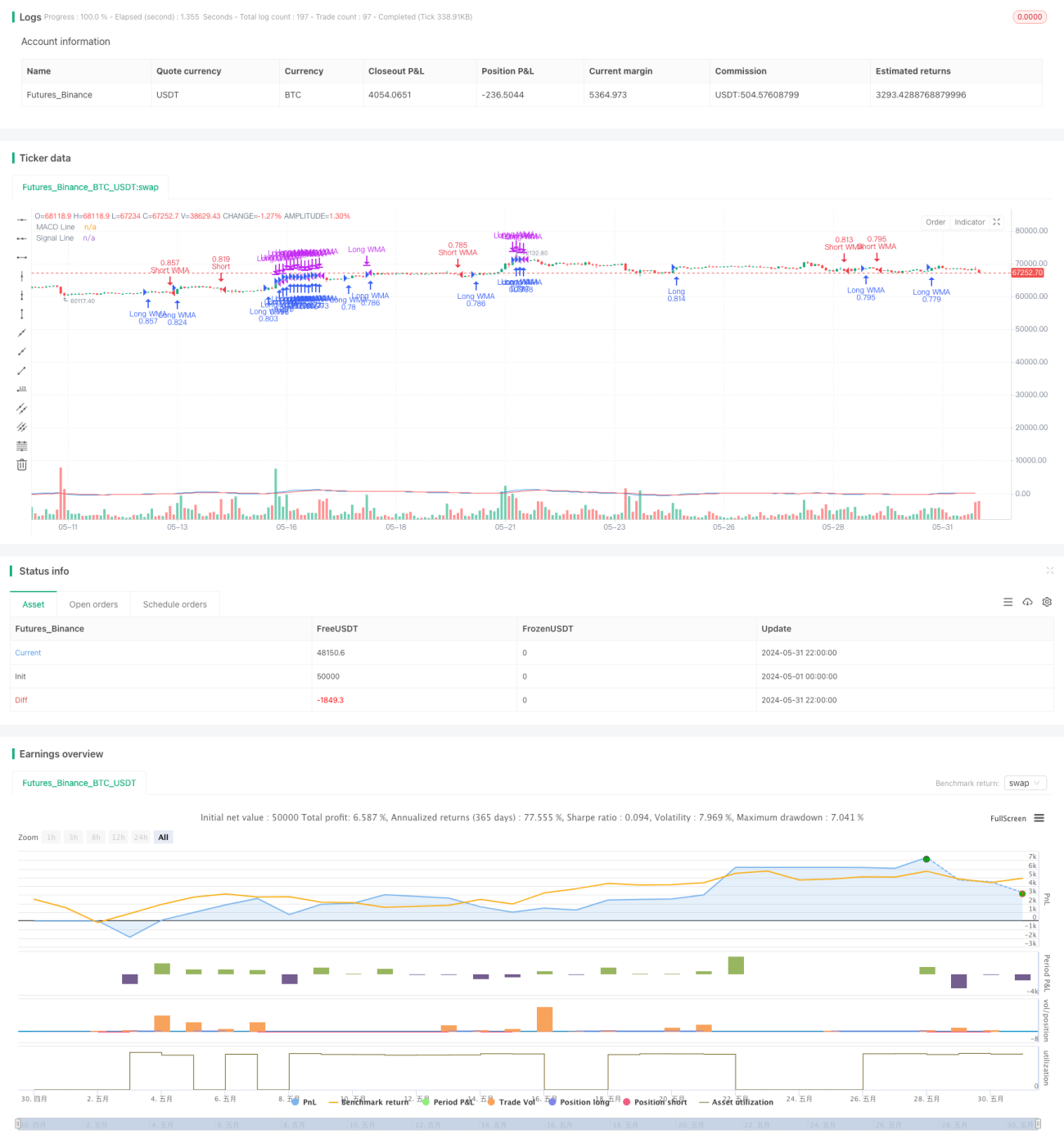
Visão Geral
Esta estratégia combina dois indicadores técnicos, MACD e RSI, utilizando sinais de cruzamento do MACD e sinais de sobrecompra/sobrevenda do RSI para determinar momentos de negociação. Além disso, a estratégia incorpora a Média Móvel Ponderada (WMA) como suporte auxiliar para aumentar a confiabilidade. Ela opera no timeframe de 1 hora e abre posições longas quando o MACD apresenta um cruzamento de alta (golden cross) e o RSI está acima de 50, e posições curtas quando há um cruzamento de baixa (death cross) e o RSI está abaixo de 50. Além disso, fecha posições longas quando o RSI ultrapassa 70 e posições curtas quando o RSI cai abaixo de 30. A estratégia também utiliza variáveis de múltiplos timeframes para avaliar mudanças de tendência em diferentes escalas temporais.
Princípio da Estratégia
O núcleo da estratégia é a combinação dos indicadores MACD e RSI. O MACD é composto pela diferença entre a linha rápida (média móvel de curto prazo) e a linha lenta (média móvel de longo prazo), refletindo mudanças na tendência do mercado. Quando a linha rápida cruza acima da linha lenta, forma-se um cruzamento de alta (golden cross), indicando tendência de alta; já um cruzamento abaixo forma um cruzamento de baixa (death cross), indicando tendência de queda. O RSI mede as condições de sobrecompra e sobrevenda do mercado. Valores acima de 70 sugerem sobrecompra, com possível risco de correção; valores abaixo de 30 sugerem sobrevenda, com possível oportunidade de recuperação.
A estratégia combina MACD e RSI, utilizando a identificação de tendência do MACD e as condições de sobrecompra/sobrevenda do RSI para determinar com mais precisão os momentos de negociação. Além disso, incorpora a Média Móvel Ponderada (WMA) como suporte auxiliar. Comparada à média móvel simples, a WMA dá maior peso aos preços recentes, respondendo de forma mais sensível às variações de preço.
A estratégia também utiliza variáveis de múltiplos timeframes (por exemplo, 15 minutos, 30 minutos, 1 hora, 2 horas, etc.) para avaliar mudanças de tendência em diferentes escalas. Essa abordagem de análise multi-timeframe ajuda a estratégia a compreender mais completamente as tendências do mercado, aumentando a precisão das decisões.
Análise de Vantagens
- Combina dois indicadores técnicos eficazes, MACD e RSI, permitindo capturar tendências e condições de sobrecompra/sobrevenda, melhorando a precisão das decisões de negociação.
- Incorpora a Média Móvel Ponderada (WMA) como suporte auxiliar; a WMA dá mais peso aos preços recentes, respondendo de forma mais sensível às mudanças de preço e aumentando a adaptabilidade da estratégia.
- Utiliza variáveis de múltiplos timeframes, realizando análise conjunta em diferentes escalas, o que proporciona uma compreensão mais abrangente das tendências do mercado e aumenta a confiabilidade das decisões.
- Opera no timeframe de 1 hora, com uma frequência de negociação moderada, equilibrando adequadamente custos e retornos.
- Define condições claras de abertura e fechamento de posições, como cruzamentos do MACD e condições de sobrecompra/sobrevenda do RSI, facilitando o entendimento e a implementação.
Análise de Riscos
- Tanto o MACD quanto o RSI são indicadores defasados. Em mercados que mudam rapidamente, os sinais podem ficar dessincronizados dos preços, gerando sinais falsos.
- A estratégia opera em um único timeframe (1 hora), o que pode não capturar completamente as mudanças de tendência em diferentes escalas temporais, representando uma limitação.
- A estratégia carece de medidas de controle de risco, como stops e gerenciamento de posição, podendo sofrer grandes drawdowns durante forte volatilidade do mercado.
- Os parâmetros da estratégia (como períodos das linhas rápida/lenta do MACD e período do RSI) podem precisar de ajustes conforme as condições do mercado, havendo subjetividade e incerteza na escolha.
Direções de Otimização
- Introduzir mais indicadores técnicos, como Bandas de Bollinger e ATR, para construir sinais de negociação mais robustos e aumentar a confiabilidade.
- Otimizar a escolha de timeframes, incluindo níveis mais altos (como diário) para capturar tendências principais e usar timeframes mais baixos (como 15 minutos, 5 minutos) para pontos de entrada mais precisos, aumentando a exatidão.
- Adicionar medidas de controle de risco, como stops adequados e limitação de posições, para controlar drawdowns.
- Otimizar parâmetros da estratégia utilizando métodos como aprendizado de máquina para encontrar automaticamente a combinação ideal de parâmetros com base em dados históricos, reduzindo a subjetividade.
- Considerar incorporar fatores adicionais como volume de negociação e open interest, para compreender as condições de mercado de forma mais completa e aumentar a adaptabilidade.
Resumo
Esta estratégia combina os indicadores técnicos MACD e RSI, além de utilizar a WMA como suporte auxiliar, operando no timeframe de 1 hora. Sua lógica é clara, fácil de entender e implementar, capturando razoavelmente bem tendências e condições de sobrecompra/sobrevenda, sendo viável. No entanto, possui limitações e riscos, como defasagem, timeframe único e falta de controle de risco. Futuramente, pode ser aprimorada com a inclusão de mais indicadores, otimização de timeframes, reforço do controle de risco e ajuste de parâmetros, aumentando sua robustez e lucratividade. Em suma, a estratégia oferece uma abordagem para o trading quantitativo, mas precisa ser continuamente otimizada e refinada na prática.
/*backtest
start: 2024-05-01 00:00:00
end: 2024-05-31 23:59:59
period: 2h
basePeriod: 15m
exchanges: [{"eid":"Futures_Binance","currency":"BTC_USDT"}]
*/

//@version=5
strategy("Improved MACD and RSI Trading Strategy", overlay=true, initial_capital=10000, commission_type=strategy.commission.percent, commission_value=0.01, default_qty_type=strategy.percent_of_equity, default_qty_value=100)

// MACD 設置- 1