Sistema de Negociação de Rastreamento de Média Móvel com Momentum Híbrido de Dupla Cadeia

Visão Geral
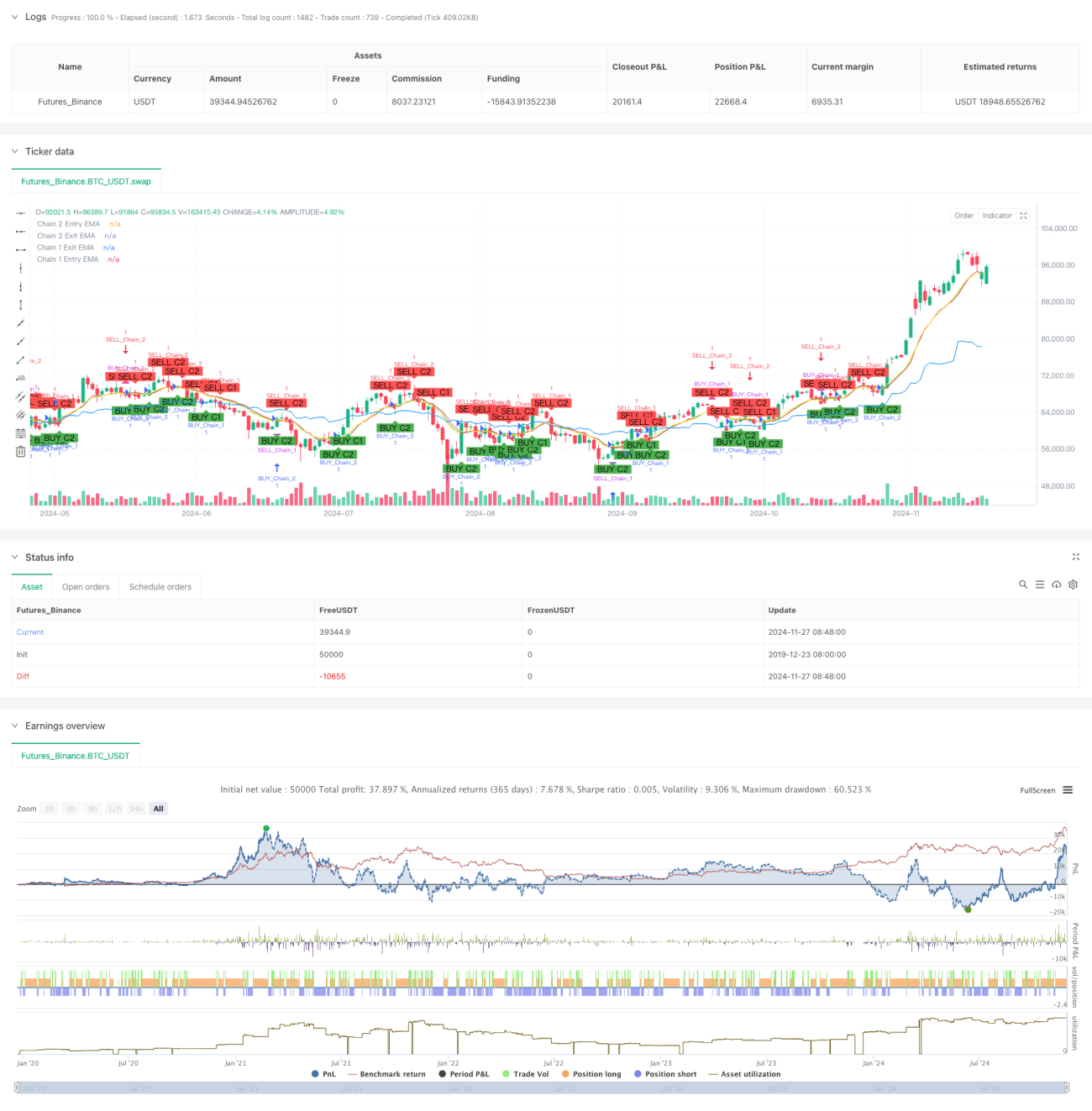
Esta estratégia é um sistema de negociação inovador baseado em Médias Móveis Exponenciais (EMA), que captura oportunidades de mercado através de duas cadeias de negociação independentes configuradas em diferentes períodos de tempo. A estratégia integra as vantagens do acompanhamento de tendência de longo prazo e do momentum de curto prazo, gerando sinais de negociação a partir de cruzamentos de EMA em múltiplos períodos de tempo, como semanal, diário, 12 horas e 9 horas, permitindo uma análise e compreensão multidimensional do mercado.
Princípio da Estratégia
A estratégia utiliza um design de cadeia dupla, cada uma com sua lógica de entrada e saída específica:
Cadeia 1 (Tendência de Longo Prazo) utiliza períodos semanal e diário:
- Sinal de entrada: Quando o preço de fechamento cruza acima da EMA no período semanal, gera um sinal de compra.
- Sinal de saída: Quando o preço de fechamento cruza abaixo da EMA no período diário, gera um sinal de encerramento.
- Período padrão da EMA: 10 (ajustável conforme necessário).
Cadeia 2 (Momentum de Curto Prazo) utiliza períodos de 12 horas e 9 horas:
- Sinal de entrada: Quando o preço de fechamento cruza acima da EMA no período de 12 horas, gera um sinal de compra.
- Sinal de saída: Quando o preço de fechamento cruza abaixo da EMA no período de 9 horas, gera um sinal de encerramento.
- Período padrão da EMA: 9 (ajustável conforme necessário).
Vantagens da Estratégia
- Análise multidimensional do mercado: Através da combinação de diferentes períodos de tempo, compreende de forma abrangente os movimentos do mercado.
- Alta flexibilidade: As duas cadeias podem ser ativadas ou desativadas independentemente, adaptando-se a diferentes estilos de negociação.
- Controle de risco aprimorado: Utiliza confirmação em múltiplos períodos de tempo para reduzir o risco de sinais falsos.
- Parâmetros altamente ajustáveis: Tanto os períodos da EMA quanto os períodos de tempo podem ser modificados conforme necessário.
- Funcionalidade completa de backtest: Possui configuração de período para backtest integrada, facilitando a validação e otimização da estratégia.
Riscos da Estratégia
- Risco de reversão de tendência: Em mercados voláteis, pode haver atraso nos sinais.
- Risco de configuração de períodos de tempo: Diferentes mercados podem exigir combinações distintas de períodos de tempo.
- Risco de otimização de parâmetros: Otimização excessiva pode levar ao sobreajuste.
- Risco de sobreposição de sinais: Quando ambas as cadeias disparam simultaneamente, pode aumentar o risco da posição.
Recomendações de controle de risco:
- Definir stops razoáveis.
- Ajustar parâmetros com base nas características do mercado.
- Realizar backtests completos antes de operar ao vivo.
- Controlar a proporção de capital por operação.
Direções de Otimização da Estratégia
-
Otimização de filtragem de sinais:
- Adicionar mecanismo de confirmação de volume.
- Introduzir indicadores de volatilidade para filtrar sinais.
- Aumentar confirmação de força da tendência.
-
Otimização do controle de risco:
- Desenvolver mecanismos de stop dinâmico.
- Projetar sistema de gerenciamento de posição.
- Adicionar controle de drawdown.
-
Otimização dos períodos de tempo:
- Estudar combinações ótimas de períodos de tempo.
- Desenvolver mecanismos de período de tempo adaptativo.
- Adicionar reconhecimento de estado do mercado.
Resumo
O Sistema de Negociação de Média Móvel com Momentum de Cadeia Dupla, ao combinar inovadoramente estratégias de médias móveis de curto e longo prazo, realiza uma análise e compreensão multidimensional do mercado. O sistema possui design flexível, podendo ser ajustado conforme diferentes condições de mercado e estilo do trader, apresentando alta praticabilidade. Com controle de risco adequado e otimização contínua, a estratégia tem potencial para obter lucros consistentes em negociações reais. Recomenda-se que os traders realizem backtests completos e otimização de parâmetros antes de utilizar em ambiente real, a fim de alcançar o melhor desempenho de negociação.
- 1