Estratégia de negociação EMA-Squeeze com Stop Loss dinâmico para vários períodos de tempo

EMA SQM CMF KC SL TP MTF
Data de criação: 2024-12-11 15:50:38 última modificação: 2024-12-11 15:50:38
cópia: 0 Cliques: 435
1
focar em
1617
Seguidores

Estratégia de negociação EMA-Squeeze com Stop Loss dinâmico para vários períodos de tempo

Visão geral

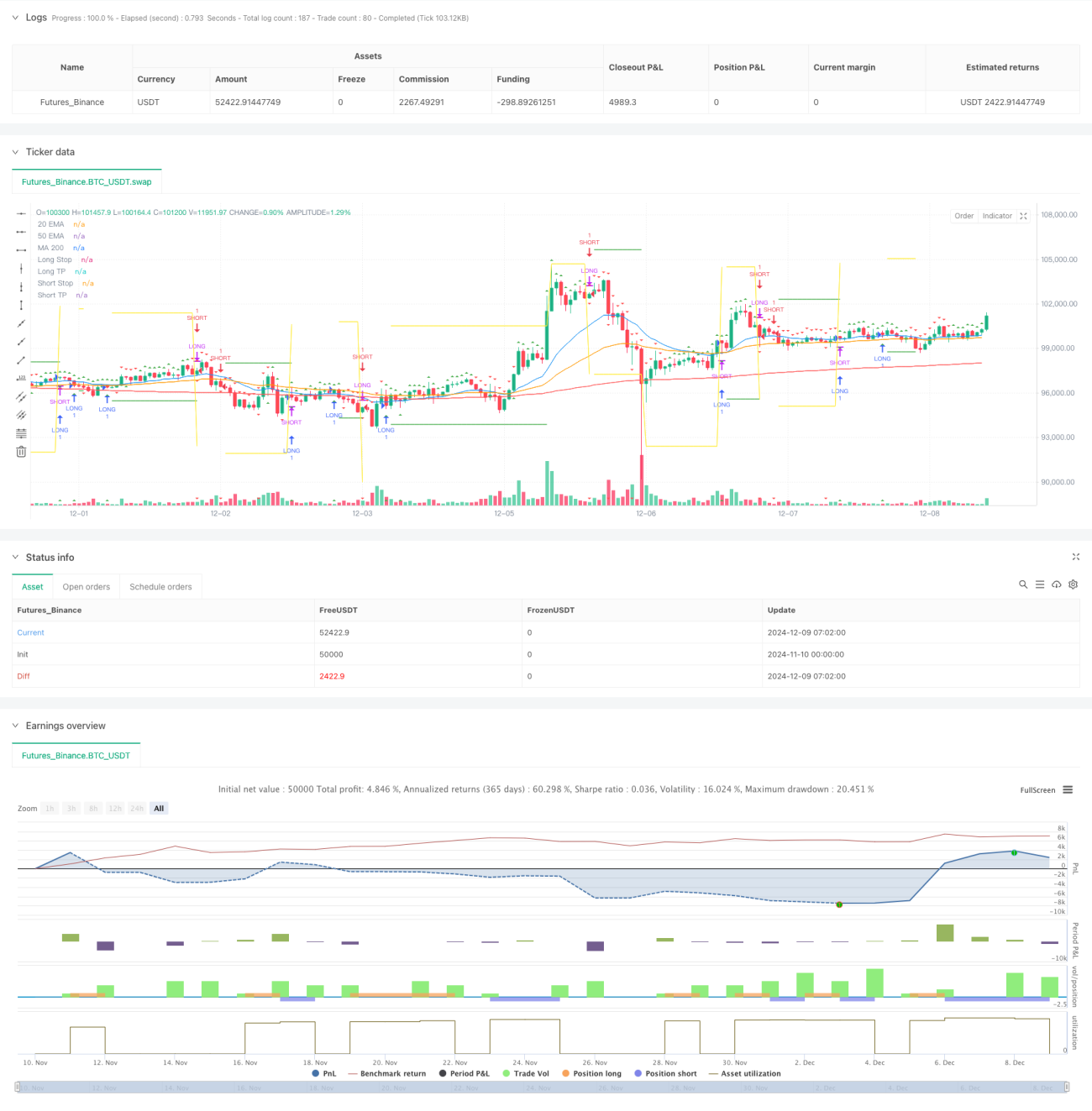
A estratégia é um sistema de negociação dinâmico baseado em análise de múltiplos períodos de tempo, combinando a geração de sinais de negociação com o índice de média móvel (EMA), o Squeeze Moving Average (SQM) e o Capital Flow Indicator (CMF). O núcleo da estratégia é a confirmação de tendências por meio da análise de múltiplos períodos de tempo e o uso de stop loss dinâmico para otimizar o gerenciamento de risco. A estratégia usa um programa de stop loss e gain adaptável que pode ajustar automaticamente os parâmetros de negociação de acordo com a volatilidade do mercado.

Princípio da estratégia

A estratégia usa três principais combinações de indicadores técnicos para identificar oportunidades de negociação. Primeiro, determina a direção da tendência do mercado por meio de EMAs de 11 e 34 ciclos. Em seguida, usa a versão modificada do indicador Squeeze Momentum para detectar pressões de mercado e potenciais oportunidades de ruptura, que calcula o desvio de preço por meio do método de regressão linear.

Vantagens estratégicas

  1. Confirmação de sinais multidimensionais: reduz significativamente o risco de falsos sinais através da combinação de vários indicadores técnicos e análise de períodos de tempo.
  2. Gerenciamento de risco inteligente: o sistema de stop loss dinâmico pode ajustar automaticamente as flutuações do mercado, evitando a saída prematura, protegendo os lucros.
  3. Adaptabilidade: Os parâmetros da estratégia podem ser ajustados de acordo com diferentes condições de mercado, com boa adaptabilidade.
  4. O ciclo de fechamento de transações completo: há regras claras desde o sinal de entrada até o gerenciamento da saída, reduzindo a influência do julgamento subjetivo.
  5. Confirmação de fluxo de capital: aumenta a confiabilidade das transações, verificando a movimentação dos preços, monitorando o fluxo de capital.

Risco estratégico

  1. Sensibilidade de parâmetros: A configuração de parâmetros de vários indicadores técnicos requer otimização cuidadosa, e os parâmetros inadequados podem causar queda de desempenho.
  2. Dependência do cenário de mercado: a qualidade do sinal pode ser afetada em um cenário de mercado altamente volátil ou de baixa liquidez.
  3. Complexidade do cálculo: o cálculo de períodos de tempo múltiplos pode causar atrasos no sinal, afetando a eficácia real da negociação.
  4. Risco de ajuste de stop loss: o stop loss dinâmico pode ser muito radical ou conservador em certas condições de mercado.
  5. Requisitos de gestão de fundos: A estratégia requer uma gestão de fundos razoável para equilibrar riscos e ganhos.

Direção de otimização da estratégia

  1. Introdução da adaptabilidade da volatilidade: os parâmetros podem ser ajustados dinamicamente com base no ATR ou em outros indicadores de volatilidade, aumentando a adaptabilidade da estratégia.
  2. Filtragem de sinal de otimização: pode ser adicionado o aumento do volume de transação ou filtragem de tempo para melhorar a qualidade do sinal.
  3. Melhoria do mecanismo de suspensão: pode ser combinado com a posição de apoio e resistência para otimizar a configuração do ponto de suspensão.
  4. Aumentar a análise do cenário de mercado: introdução de indicadores de intensidade de tendências de mercado, usando diferentes configurações de parâmetros em diferentes cenários de mercado.
  5. Melhorar a gestão de fundos: Introdução de algoritmos de gestão de posições, ajustando a proporção de posições de acordo com a intensidade do sinal e as flutuações do mercado.

Resumir

A estratégia oferece aos comerciantes um programa de negociação sistematizado por meio de análise técnica multidimensional e gerenciamento inteligente de risco. Sua vantagem central é a combinação de acompanhamento de tendências e gerenciamento dinâmico de riscos, capaz de capturar oportunidades de mercado enquanto protege os lucros. Embora existam alguns aspectos da estratégia que precisam ser otimizados, ela ainda pode ser uma ferramenta de negociação eficaz com a configuração razoável de parâmetros e controle de risco.

Código-fonte da estratégia
/*backtest
start: 2024-11-10 00:00:00
end: 2024-12-09 08:00:00
period: 1h
basePeriod: 1h
exchanges: [{"eid":"Futures_Binance","currency":"BTC_USDT"}]
*/

//@version=5
strategy("LL Crypto - SUI", overlay=true)

// Parâmetros de tempo para criptomoedas
fast_ema_len = input.int(11, minval=5, title="Fast EMA")
slow_ema_len = input.int(34, minval=20, title="Slow EMA")
sqm_lengthKC = input.int(20, title="SQM KC Length")
kauf_period = input.int(20, title="Kauf Period")
kauf_mult = input.float(2, title="Kauf Mult factor")
min_profit_sl = input.float(5, minval=0.01, maxval=100.0, title="Min profit to start moving SL [%]")
longest_sl = input.float(10, minval=0.01, maxval=100.0, title="Maximum possible of SL [%]")
sl_step = input.float(0.5, minval=0.0, maxval=1.0, title="Take profit factor")

// Parâmetros adaptados para criptomoedas
CMF_length = input.int(11, minval=1, title="CMF length")
show_plots = input.bool(true, title="Show plots")

// Definir intervalos de tempo para criptomoedas
selected_timeframe = input.string(defval="15", title="Intervalo de Tempo", options=["1", "15", "60"])

lower_resolution = timeframe.period == '1' ? '1' :
                   timeframe.period == '5' ? '15' :
                   timeframe.period == '15' ? '60' :
                   timeframe.period == '60' ? '240' :
                   timeframe.period == '240' ? 'D' :
                   timeframe.period == 'D' ? 'W' : 'M'

sp_close = close[barstate.isrealtime ? 1 : 0]
sp_high = high[barstate.isrealtime ? 1 : 0]
sp_low = low[barstate.isrealtime ? 1 : 0]
sp_volume = volume[barstate.isrealtime ? 1 : 0]

// Calcular Squeeze Momentum ajustado para criptomoedas
sqm_val = ta.linreg(sp_close - math.avg(math.avg(ta.highest(sp_high, sqm_lengthKC), ta.lowest(sp_low, sqm_lengthKC)), ta.sma(sp_close, sqm_lengthKC)), sqm_lengthKC, 0)
close_low = request.security(syminfo.tickerid, lower_resolution, sp_close, lookahead=barmerge.lookahead_on)
high_low = request.security(syminfo.tickerid, lower_resolution, sp_high, lookahead=barmerge.lookahead_on)
low_low = request.security(syminfo.tickerid, lower_resolution, sp_low, lookahead=barmerge.lookahead_on)
sqm_val_low = ta.linreg(close_low - math.avg(math.avg(ta.highest(high_low, sqm_lengthKC), ta.lowest(low_low, sqm_lengthKC)), ta.sma(close_low, sqm_lengthKC)), sqm_lengthKC, 0)

// CMF adaptado para criptomoedas
ad = sp_close == sp_high and sp_close == sp_low or sp_high == sp_low ? 0 : ((2 * sp_close - sp_low - sp_high) / (sp_high - sp_low)) * sp_volume
money_flow = math.sum(ad, CMF_length) / math.sum(sp_volume, CMF_length)

// Condições de entrada para criptomoedas
low_condition_long = (sqm_val_low > sqm_val_low[1])
low_condition_short = (sqm_val_low < sqm_val_low[1])
money_flow_min = (money_flow[4] > money_flow[2]) and (money_flow[3] > money_flow[2]) and (money_flow[2] < money_flow[1]) and (money_flow[2] < money_flow)
money_flow_max = (money_flow[4] < money_flow[2]) and (money_flow[3] < money_flow[2]) and (money_flow[2] > money_flow[1]) and (money_flow[2] > money_flow)
condition_long = ((sqm_val > sqm_val[1])) and money_flow_min and ta.lowest(sqm_val, 5) < 0
condition_short = ((sqm_val < sqm_val[1])) and money_flow_max and ta.highest(sqm_val, 5) > 0
enter_long = low_condition_long and condition_long
enter_short = low_condition_short and condition_short

// Stop conditions
var float current_target_price = na
var float current_sl_price = na
var float current_target_per = na
var float current_profit_per = na

set_targets(isLong, min_profit, current_target_per, current_profit_per) =>
    float target = na
    float sl = na
    if isLong
        target := sp_close * (1.0 + current_target_per)
        sl := sp_close * (1.0 - (longest_sl / 100.0))
    else
        target := sp_close * (1.0 - current_target_per)
        sl := sp_close * (1.0 + (longest_sl / 100.0))
    [target, sl]

target_reached(isLong, min_profit, current_target_per, current_profit_per) =>
    float target = na
    float sl = na
    float profit_per = na
    float target_per = na
    if current_profit_per == na
        profit_per := (min_profit * sl_step) / 100.0
    else
        profit_per := current_profit_per + ((min_profit * sl_step) / 100.0)
    target_per := current_target_per + (min_profit / 100.0)
    if isLong
        target := strategy.position_avg_price * (1.0 + target_per)
        sl := strategy.position_avg_price * (1.0 + profit_per)
    else
        target := strategy.position_avg_price * (1.0 - target_per)
        sl := strategy.position_avg_price * (1.0 - profit_per)
    [target, sl, profit_per, target_per]

hl_diff = ta.sma(sp_high - sp_low, kauf_period)
stop_condition_long = 0.0
new_stop_condition_long = sp_low - (hl_diff * kauf_mult)
if (strategy.position_size > 0)
    if (sp_close > current_target_price)
        [target, sl, profit_per, target_per] = target_reached(true, min_profit_sl, current_target_per, current_profit_per)
        current_target_price := target
        current_sl_price := sl
        current_profit_per := profit_per
        current_target_per := target_per
    stop_condition_long := math.max(stop_condition_long[1], current_sl_price)
else
    stop_condition_long := new_stop_condition_long

stop_condition_short = 99999999.9
new_stop_condition_short = sp_high + (hl_diff * kauf_mult)
if (strategy.position_size < 0)
    if (sp_close < current_target_price)
        [target, sl, profit_per, target_per] = target_reached(false, min_profit_sl, current_target_per, current_profit_per)
        current_target_price := target
        current_sl_price := sl
        current_profit_per := profit_per
        current_target_per := target_per
    stop_condition_short := math.min(stop_condition_short[1], current_sl_price)
else
    stop_condition_short := new_stop_condition_short

// Submit entry orders
if (enter_long and (strategy.position_size <= 0))
    if (strategy.position_size < 0)
        strategy.close(id="SHORT")
    current_target_per := (min_profit_sl / 100.0)
    current_profit_per := na
    [target, sl] = set_targets(true, min_profit_sl, current_target_per, current_profit_per)
    current_target_price := target
    current_sl_price := sl
    strategy.entry(id="LONG", direction=strategy.long)

    if show_plots
        label.new(bar_index, sp_high, text="LONG\nSL: " + str.tostring(stop_condition_long), style=label.style_label_down, color=color.green)


if (enter_short and (strategy.position_size >= 0))
    if (strategy.position_size > 0)
        strategy.close(id="LONG")
    current_target_per := (min_profit_sl / 100.0)
    current_profit_per := na
    [target, sl] = set_targets(false, min_profit_sl, current_target_per, current_profit_per)
    current_target_price := target
    current_sl_price := sl
    strategy.entry(id="SHORT", direction=strategy.short)
    if show_plots
        label.new(bar_index, sp_high, text="SHORT\nSL: " + str.tostring(stop_condition_short), style=label.style_label_down, color=color.red)

if (strategy.position_size > 0)
    strategy.exit(id="EXIT LONG", stop=stop_condition_long)

if (strategy.position_size < 0)
    strategy.exit(id="EXIT SHORT", stop=stop_condition_short)

// Plot anchor trend
plotshape(low_condition_long, style=shape.triangleup, location=location.abovebar, color=color.green)
plotshape(low_condition_short, style=shape.triangledown, location=location.abovebar, color=color.red)

plotshape(condition_long, style=shape.triangleup, location=location.belowbar, color=color.green)
plotshape(condition_short, style=shape.triangledown, location=location.belowbar, color=color.red)

plotshape(enter_long, style=shape.triangleup, location=location.bottom, color=color.green)
plotshape(enter_short, style=shape.triangledown, location=location.bottom, color=color.red)

// Plot emas
plot(ta.ema(close, 20), color=color.blue, title="20 EMA")
plot(ta.ema(close, 50), color=color.orange, title="50 EMA")
plot(ta.sma(close, 200), color=color.red, title="MA 200")

// Plot stop loss values for confirmation
plot(series=(strategy.position_size > 0) and show_plots ? stop_condition_long : na, color=color.green, style=plot.style_linebr, title="Long Stop")
plot(series=(strategy.position_size < 0) and show_plots ? stop_condition_short : na, color=color.green, style=plot.style_linebr, title="Short Stop")
plot(series=(strategy.position_size < 0) and show_plots ? current_target_price : na, color=color.yellow, style=plot.style_linebr, title="Short TP")
plot(series=(strategy.position_size > 0) and show_plots ? current_target_price : na, color=color.yellow, style=plot.style_linebr, title="Long TP")