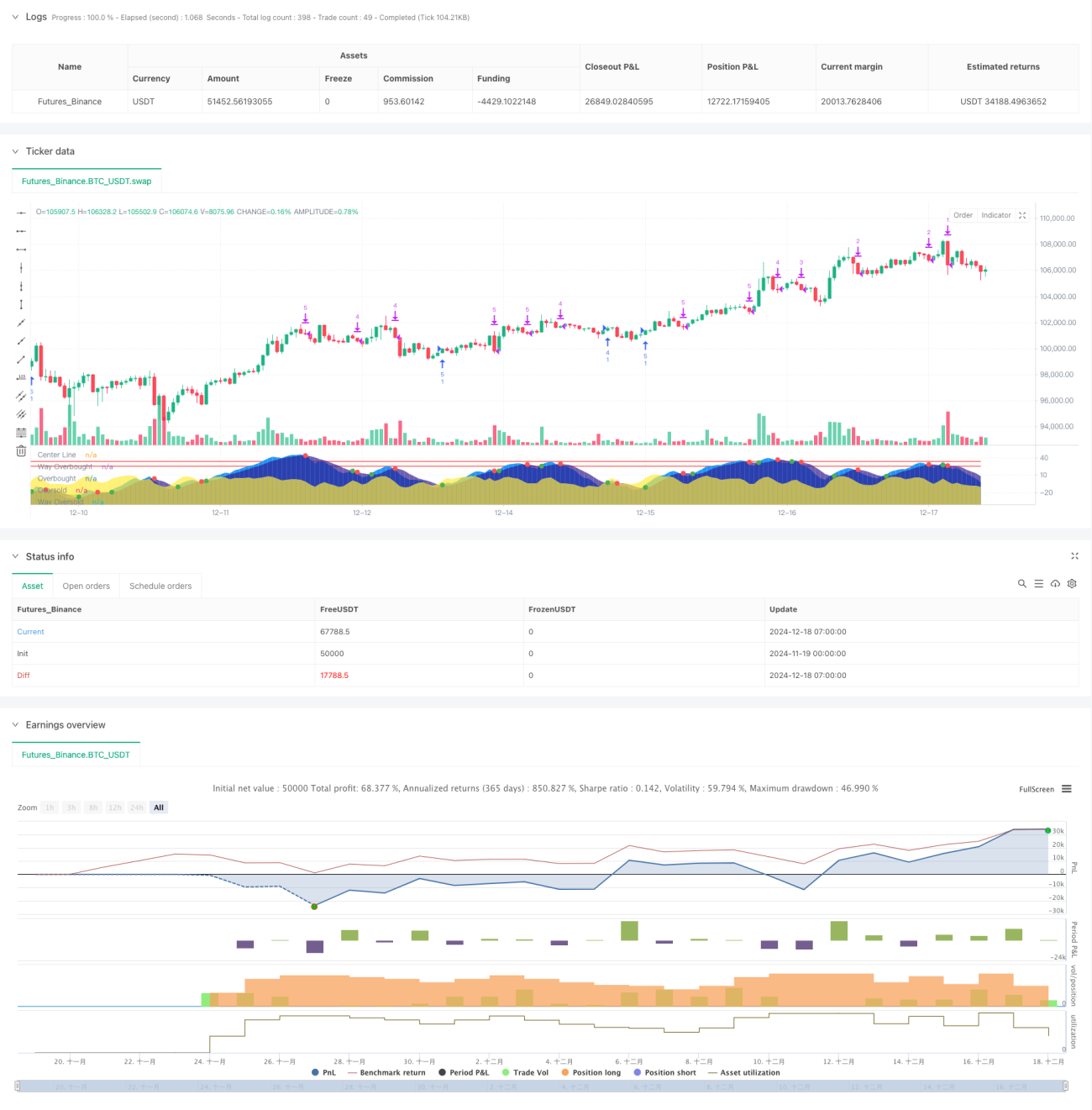
Estratégia de negociação de ciclo inteligente baseada em tendência de onda e investimento diversificado

WT DCA AO ESA EMA SMA CI VOL
Data de criação: 2024-12-20 16:42:45 última modificação: 2024-12-20 16:42:45
cópia: 0 Cliques: 473
1
focar em
1617
Seguidores

Estratégia de negociação de ciclo inteligente baseada em tendência de onda e investimento diversificado

Visão geral da estratégia

A estratégia é um sistema de negociação inteligente baseado no indicador de tendência de ondas (Wave Trend) e no investimento descentralizado (Dollar Cost Averaging). A estratégia analisa as tendências de flutuação do mercado, construindo gradualmente posições quando o mercado está em uma área de superalimento e ganhando gradualmente quando o mercado é confirmado. A estratégia combina os benefícios da análise técnica e do gerenciamento de risco, podendo acumular posições de forma consistente e obter ganhos durante o ciclo do mercado.

Princípio da estratégia

A lógica central da estratégia inclui os seguintes elementos-chave:

  1. O indicador de tendência de ondas é calculado usando a média de preços do HLC3 e a média móvel do índice (EMA) para identificar o estado de sobrecompra e sobrevenda do mercado
  2. O Awesome Oscillator determina a tendência do grande ciclo e determina a situação do mercado de ações
  3. Durante a fase de baixa, quando os preços estão na zona de sobrevenda, os estoques são construídos em lotes e a proporção de estoques é ajustada dinamicamente de acordo com o nível de sobrevenda
  4. No início do mercado de ações, o sistema emite um sinal de “compra de ouro”, aumentando a intensidade da construção de posições
  5. Durante um mercado de alta, quando os preços entram na zona de sobrecompra, o sistema diminui os lucros da posição de acordo com o grau de sobrecompra
  6. Quando surgem sinais de baixa ou de topo do mercado, o sistema esvazia todas as posições para bloquear os lucros

Vantagens estratégicas

  1. Redução dos custos de construção de armazéns por meio de investimentos diversificados, evitando riscos de recuperação
  2. Vários indicadores técnicos são validados de forma cruzada para melhorar a confiabilidade dos sinais de negociação
  3. Gerenciamento de posições flexível, ajustando a quantidade de compra e venda de acordo com a dinâmica do mercado
  4. Com uma forte defesa, a paragem de prejuízos no momento do surgimento de um sinal de mercado de baixa
  5. Estratégias com lógica clara, com parâmetros ajustáveis e adaptáveis a diferentes cenários de mercado

Risco estratégico

  1. A frequência de transações pode aumentar os custos de transação em mercados turbulentos.
  2. A estratégia de construção de depósitos distribuídos pode perder o melhor ponto de compra em um cenário de alta rápida unilateral
  3. Indicadores técnicos estão atrasados e podem não reagir em tempo hábil em situações de forte volatilidade do mercado
  4. Parâmetros de configuração incorreta pode levar ao tempo de criação ou redução de estoque não é exato

Direção de otimização da estratégia

  1. Introdução de indicadores de volatilidade, otimização do cálculo do número de construção e redução de posições
  2. Adição de mais indicadores de sentimento de mercado para melhorar a precisão de julgamento de tendências
  3. Desenvolver um sistema de parâmetros adaptáveis, ajustando os parâmetros de acordo com a dinâmica de diferentes ciclos de mercado
  4. Adição de módulos de gestão de fundos para um controlo mais preciso das posições

Resumir

Trata-se de uma estratégia de negociação inteligente que combina organicamente a análise técnica com o gerenciamento de riscos. Através de indicadores de tendências ondulatórias e métodos de investimento descentralizados, é possível obter um crescimento estável de receita, protegendo a segurança dos fundos. O principal benefício da estratégia reside na sua adaptabilidade a diferentes ambientes de mercado, bem como na lógica de negociação clara e no mecanismo de controle de risco.

Código-fonte da estratégia
/*backtest
start: 2024-11-19 00:00:00
end: 2024-12-18 08:00:00
period: 1h
basePeriod: 1h
exchanges: [{"eid":"Futures_Binance","currency":"BTC_USDT"}]
*/

//@version=5

// Copyright (c) 2024 Seth Ethington.
// All rights reserved.
//
// If this script provides you Bread then share the Dough!
// BTC (God's Money) Address: bc1qrpxvea8ze4ayj2vtr0slp774rulm898gyhe3ss
//
// Redistribution and use in source and binary forms, 
// whether you tweak it or not, is totally fine, 
// but only if you swear on your life that BTC is God's Money! 
// 
// If you're redistributing the source code, 
// you must keep the above copyright notice and, 
// more importantly, the sacred BTC address!
//


strategy(title="Cipher DCA Strategy", shorttitle="Cipher DCA", overlay=false, initial_capital=100, pyramiding=30, currency=currency.USD,  slippage=1, commission_type=strategy.commission.percent, commission_value=0.1, default_qty_type=strategy.percent_of_equity, process_orders_on_close=true)

// Input parameters for the starting date
startDate = input(timestamp("2019-01-01 00:00:00"), title="Start Date (YYYY-MM-DD HH:MM:SS)")


// Input parameters for the indicator
fastLength = input.int(4, title="Fast Wave Length", group="Wave Calculator")  // Length for EMA smoothing of the price channel
slowLength = input.int(33, title="Slow Wave Length", group="Wave Calculator")  // Length for EMA smoothing of the trend channel
wayOverBoughtLevel = input.float(33, title="Way OverBought Level", group="Wave Calculator")
overBoughtLevel = input.float(25, title="Over Bought Level", group="Wave Calculator")
wayOverSoldLevel = input.float(-33, title="Way Over Sold Level", group="Wave Calculator")
overSoldLevel = input.float(-25, title="Over Sold Level", group="Wave Calculator")
accumulatingLevel = input.float(0, title="Accumulating Level", group="Wave Calculator")


// Calculate the average price (HLC3 = (High + Low + Close) / 3)
averagePrice = hlc3

// Compute the smoothed average price (ESA: Exponential Smoothing Average)
exponentialSmoothingAverage = ta.ema(averagePrice, fastLength)

// Compute the deviation (D) between the price and the smoothed average
priceDeviation = ta.ema(math.abs(averagePrice - exponentialSmoothingAverage), fastLength)

// Compute the commodity index (CI) which is normalized price movement
commodityIndex = (averagePrice - exponentialSmoothingAverage) / (0.015 * priceDeviation)

// Smooth the commodity index to create Wave Trend 1 (WT1)
fastWaveTrend = ta.ema(commodityIndex, slowLength)
// //log.info("fastWaveTrend= " + str.tostring(fastWaveTrend))

// Further smooth WT1 using a simple moving average to create Wave Trend 2 (WT2)
slowWaveTrend = ta.sma(fastWaveTrend, 5)
// //log.info("slowWaveTrend= " + str.tostring(slowWaveTrend))


// Plot the center line (0) for reference
plot(0, color=color.white, title="Center Line")

// Plot overbought and oversold levels
plot(wayOverBoughtLevel, color=color.red, title="Way Overbought")
plot(overBoughtLevel, color=color.red, title="Overbought")
plot(overSoldLevel, color=color.green, title="Oversold")
plot(wayOverSoldLevel, color=color.green, title="Way Oversold")

// Plot WT1 and WT2 as filled areas for better visibility
plot(fastWaveTrend, style=plot.style_area, color=color.new(color.blue, 0), title="Fast Wave")
plot(slowWaveTrend, style=plot.style_area, color=color.new(color.navy, 30), title="Slow Wave")

// Highlight the difference between fastWave vs slowWave
waveTrendDifference = fastWaveTrend - slowWaveTrend

// //log.info("waveTrendDifference=" + str.tostring(waveTrendDifference))
plot(waveTrendDifference, color=color.new(color.yellow, 30),style=plot.style_area, title="WT1 - WT2 Difference") //No transparency

// Plot buy and sell signals at crossovers
isCrossover = ta.cross(fastWaveTrend, slowWaveTrend)
// //log.info("isCrossover=" + str.tostring(isCrossover))
plot(isCrossover ? slowWaveTrend : na, color=(slowWaveTrend - fastWaveTrend > 0 ? color.red : color.green), style=plot.style_circles, linewidth=4, title="Crossover Signals")

float waveTrend = na
if (slowWaveTrend > 0 and fastWaveTrend > 0) 
    waveTrend := math.max(slowWaveTrend, fastWaveTrend)
    // //log.info("Both trends are positive. waveTrend set to max value: " + str.tostring(waveTrend))
else if (slowWaveTrend < 0 and fastWaveTrend < 0)
    waveTrend := math.min(slowWaveTrend, fastWaveTrend)
    // //log.info("Both trends are negative. waveTrend set to min value: " + str.tostring(waveTrend))
else 
    waveTrend := 0
    // //log.info("Trends are mixed. waveTrend set to 0.")

// Time to Sell
isCrossingDown = waveTrendDifference < 0

// Time to Buy
isCrossingUp = waveTrendDifference > 0


//-----------------------------------------------------------


// Detect Bull Market and Bear Market using the Awesome Oscillator
// User input for AO thresholds
ao_threshold = input.float(-10, "AO Bull Market Threshold", minval=-50, maxval=50, step=1, group = "Bear and Bull Thresholds")
ao_cycletop_threshold = input.float(5, "AO Bear Market Threshold", minval=0, maxval=200, step=1, group = "Bear and Bull Thresholds")

// Define the Awesome Oscillator
ao = ta.sma(hl2, fastLength) - ta.sma(hl2, slowLength)

// Convert current bar time to the first day of the month for monthly calculations
currentMonthStart = timestamp(year, month, 1, 0, 0)
prevMonthStart = time - (time - currentMonthStart)

// Calculate AO for the start of the month and previous month
aoCurrentMonth = request.security(syminfo.tickerid, 'M', ao[0])
aoPrevMonth1    = request.security(syminfo.tickerid, 'M', ao[1])
aoPrevMonth2    = request.security(syminfo.tickerid, 'M', ao[2])

// Detect bull market based on monthly AO
isBullMarket = aoCurrentMonth > aoPrevMonth1 and aoPrevMonth1 > aoPrevMonth2 and aoCurrentMonth > ao_threshold

// Detect cycle top based on monthly AO
isBearMarket = aoCurrentMonth > ao_cycletop_threshold and aoPrevMonth1 > aoCurrentMonth

// Detect when a bull market is starting
var bool isBullMarketStarting = na
if (not isBullMarket[1] and isBullMarket)
    isBullMarketStarting := true
else
    isBullMarketStarting := false

// Logging
//log.info("isBullMarket is " + str.tostring(isBullMarket))
//log.info("isCycleTop is " + str.tostring(isBearMarket))

// Plot transparent overlays for Bull Market and Cycle Top
overlayColor = isBullMarket ? color.new(color.green, 80) : isBearMarket ? color.new(color.red, 60) : na
bgcolor(overlayColor, title="Market Condition Overlay")


//----------------------------------------------------------


// Calculate Potential Liquidations and Golden Buy Zones
volLength = input.int(20, "Volume Length", minval=1, group="Golden Buy Indicator")
volStdDevThreshold = input.float(2.0, "Volume Standard Diviation Threshold", step=0.1, group="Golden Buy Indicator")
aoWeeklyThreshold = input.int(0, "Awesome Oscillator Oversold Threshold", step=1, group="Golden Buy Indicator")


// Start Accumulating when the price is oversold or price action is flat
isStartAccumulating = waveTrend <= accumulatingLevel and not isBearMarket

// Start Selling when we are now in a Bull Market
isStartSelling = waveTrend > accumulatingLevel

// Calculate Overbought and Oversold Levels
isOverSold = waveTrend < overSoldLevel
isWayOverSold = waveTrend < wayOverSoldLevel
isOverBought = waveTrend > overBoughtLevel
isWayOverBought = waveTrend > wayOverBoughtLevel
//log.info("isOverSold= " + str.tostring(isOverSold) + " isWayOverSold= " + str.tostring(isWayOverSold) + " isOverBought= " + str.tostring(isOverBought) + " isWayOverBought= " + str.tostring(isWayOverBought))

//Weekly Awesome Oscillator to detect oversold levels
aoWeekly = request.security(syminfo.tickerid, "W", ao)

// Get standard deviation of volume over last 20 bars
volumeStDev = ta.stdev(volume, volLength)

// Detect volume spikes
volumeSpike = volume > (ta.sma(volume, volLength) + volStdDevThreshold * volumeStDev)

isGoldenBuyZone = volumeSpike and aoWeekly < aoWeeklyThreshold and not isBearMarket
plotshape(series=isGoldenBuyZone ? -60 : na, style=shape.triangleup, location=location.absolute, color=color.yellow, size=size.tiny, offset=0, title="Golden Buy Zone")

isMarketTop = volumeSpike and aoWeekly > -aoWeeklyThreshold and isBullMarket
plotshape(series=isMarketTop ? 60 : na, style=shape.triangledown, location=location.absolute, color=color.purple, size=size.tiny, offset=0, title="Market Top")


//---------------------------------------------------------

// Buying and Selling Input parameters for the indicator
isBullMarketStartingPercent = input.float(1.0, title="Starting a Bull Market Percent", step=0.01, group="Buy and Sell")
goldenBuyPercent = input.float(0.00006, title="Golden Buy Percent", step=0.01, group="Buy and Sell")
wayOverSoldPercent = input.float(0.00004, title="Way Over Sold Percent", step=0.01, group="Buy and Sell") 
overSoldPercent = input.float(0.00002, title="Over Sold Percent", step=0.01, group="Buy and Sell")
crossOverPercent = input.float(0.00002, title="Cross Over Percent", step=0.01, group="Buy and Sell")
overBoughtPercent = input.float(0.00005, title="Over Bought Percent", step=0.01, group="Buy and Sell")
wayOverBoughtPercent = input.float(0.00006, title="Way Over Bought Percent", step=0.01, group="Buy and Sell")

//Execute Buy and Sell Strategy
// Execute only if the bar's time is after the start date
if (true)
    if ((isCrossover and isCrossingUp and isStartAccumulating) or isGoldenBuyZone or isBullMarketStarting)
        if (isGoldenBuyZone) 
            strategy.entry("Golden Buy", strategy.long, qty = goldenBuyPercent * strategy.initial_capital)
            //log.info("Golden Buy " + str.tostring(goldenBuyPercent))
        else if (isBullMarketStarting)
            strategy.entry("Bull Buy", strategy.long, qty = isBullMarketStartingPercent * strategy.initial_capital)
            //log.info("Way Over Sold Buy " + str.tostring(wayOverSoldPercent))    
        else if (isWayOverSold) 
            strategy.entry(str.tostring(strategy.opentrades), strategy.long, qty = wayOverSoldPercent * strategy.initial_capital)
            //log.info("Way Over Sold Buy " + str.tostring(wayOverSoldPercent))
        else if (isOverSold)  
            strategy.entry(str.tostring(strategy.opentrades), strategy.long, qty = overSoldPercent * strategy.initial_capital)
            //log.info("Over Sold Buy " + str.tostring(overSoldPercent))
        else if (isCrossover)  
            strategy.entry(str.tostring(strategy.opentrades), strategy.long, qty = crossOverPercent * strategy.initial_capital)
            //log.info("Crossover Buy " + str.tostring(crossOverPercent))
    else if (isCrossover and isCrossingDown and isStartSelling) or isBearMarket or isMarketTop
        if (isBearMarket)
            strategy.close_all("Close all")
            //log.info("Closing All Open Positions")
        else if (isWayOverBought or isMarketTop) 
            int openTrades = strategy.opentrades  // Get the number of open trades
            int tradesToClose = math.floor(openTrades * wayOverBoughtPercent)
            //log.info("# of tradesToClose= " + str.tostring(tradesToClose))
    
            // Loop through and close 100% of the open trades determined
            for i = 0 to tradesToClose
                // Close the trade by referencing the correct index
                strategy.close(str.tostring(openTrades - 1 - i), qty_percent = 100)
                //log.info("Sell 100%: Closed trade # " + str.tostring(openTrades - 1 - i))
        else if (isOverBought) 
            int openTrades = strategy.opentrades  // Get the number of open trades
            int tradesToClose = math.floor(openTrades * overBoughtPercent) 
            //log.info("# of tradesToClose= " + str.tostring(tradesToClose))
    
            // Loop through and close 100% of the open trades determined
            for i = 0 to tradesToClose
                // Close the trade by referencing the correct index
                strategy.close(str.tostring(openTrades - 1 - i), qty_percent = 100)
                //log.info("Sell 100%: Closed trade # " + str.tostring(openTrades - 1 - i))
        else if (isStartSelling)
            strategy.close(str.tostring(strategy.opentrades - 1), qty_percent =50)
            //log.info("Sell 100% of Last Trade: Closed trade # " + str.tostring(strategy.opentrades - 1))