Estratégia de negociação de tartaruga adaptável multicanal combinada com estratégia de stop loss dinâmica

DC Donchian Channel ATR Turtle-trading
Data de criação: 2025-03-04 10:15:33 última modificação: 2025-03-04 10:16:07
cópia: 0 Cliques: 866
2
focar em
319
Seguidores

Estratégia de negociação de tartaruga adaptável multicanal combinada com estratégia de stop loss dinâmica Estratégia de negociação de tartaruga adaptável multicanal combinada com estratégia de stop loss dinâmica

Visão geral

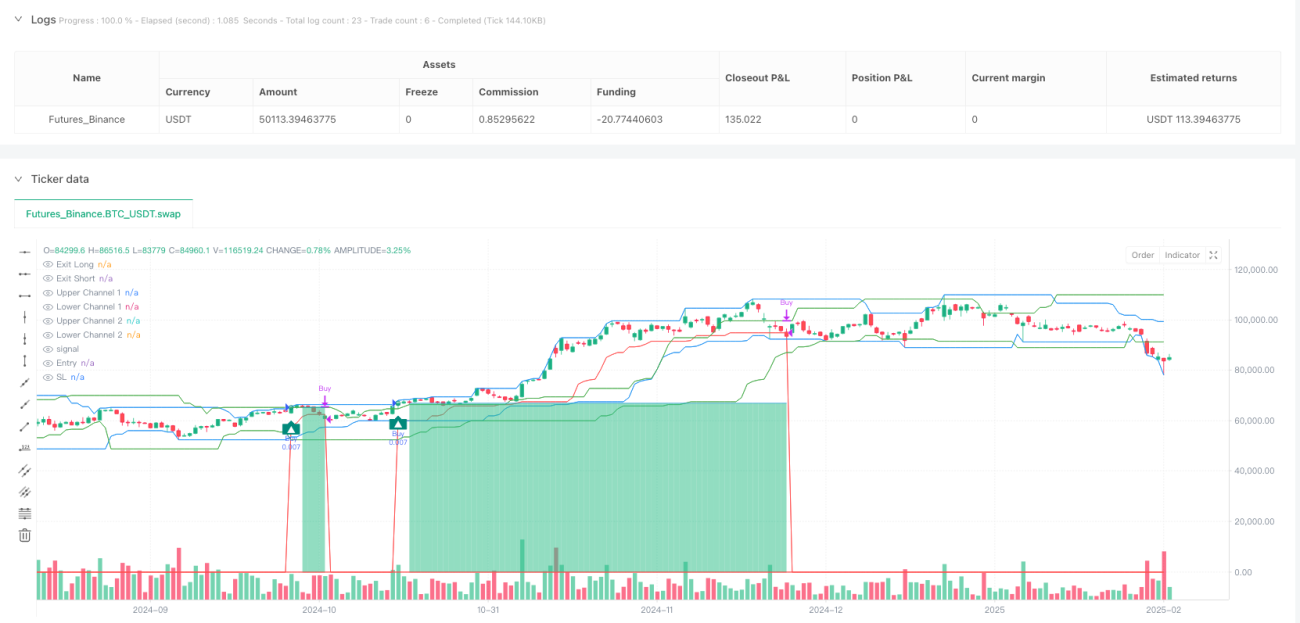
A estratégia multi-canal de negociação de torres de venda auto-adaptáveis é um sistema moderno de rastreamento de tendências, totalmente otimizado e ampliado com base nas regras clássicas de negociação de torres de venda. O núcleo da estratégia usa o sistema duplo de canais de Donchian para identificar pontos de ruptura do mercado e fornecer uma posição de parada precisa por meio de canais de saída ajustados dinamicamente. A estratégia projetou um mecanismo de confirmação duplo: o canal 1 é usado para capturar brechas de preços de curto prazo e o canal 2 como filtro de confirmação para reduzir os falsos sinais.

Princípio da estratégia

A estratégia baseia-se nos princípios centrais do sistema de negociação clássico de criptomoedas, mas adiciona mecanismos modernos de confirmação de dois canais e um sistema de stop loss dinâmico:

  1. Sistema de confirmação de ruptura de dois canais

    • Canal 1 ((default 20 period): calcula o preço máximo e mínimo de um determinado período, formando uma fronteira superior e inferior.
    • Canal 2 ((Default 20 cycles, offset 20): Como a segunda camada de confirmação, reduz o falso sinal por desvio para a direita.
    • Só se produz um sinal válido quando o preço ultrapassa a fronteira do canal 1 e é confirmado pelo canal 2.
  2. Dinâmica de saída do canal

    • O uso de um canal de tangjian com um ciclo mais curto (default 10) como perda dinâmica.
    • No caso de posições com várias cabeças, o ponto de saída é o ponto mais baixo da passagem; no caso de posições com cabeças vazias, o ponto de saída é o ponto mais alto da passagem.
    • Requer a confirmação completa do fechamento da linha K antes de executar a retirada, para evitar a saída prematura causada pelo ruído de preços.
  3. Entradas e saídas lógicas

    • Entrada múltipla: quando o preço de fechamento supera o máximo anterior do canal 1 e é superior ao máximo anterior do canal 2.
    • Entrada em branco: quando o preço de fechamento cai abaixo do mínimo anterior do canal 1 e está abaixo do mínimo anterior do canal 2.
    • Saída múltipla: o preço quebra o preço mínimo de saída ou atinge a porcentagem de parada opcional.
    • Saída de cabeça vazia: o preço quebra o preço mais alto do canal de saída ou atinge a porcentagem de parada opcional.
  4. Gestão de fundos

    • Por padrão, 1% dos fundos da conta são usados em cada transação, mas podem ser ajustados de acordo com os resultados do teste.
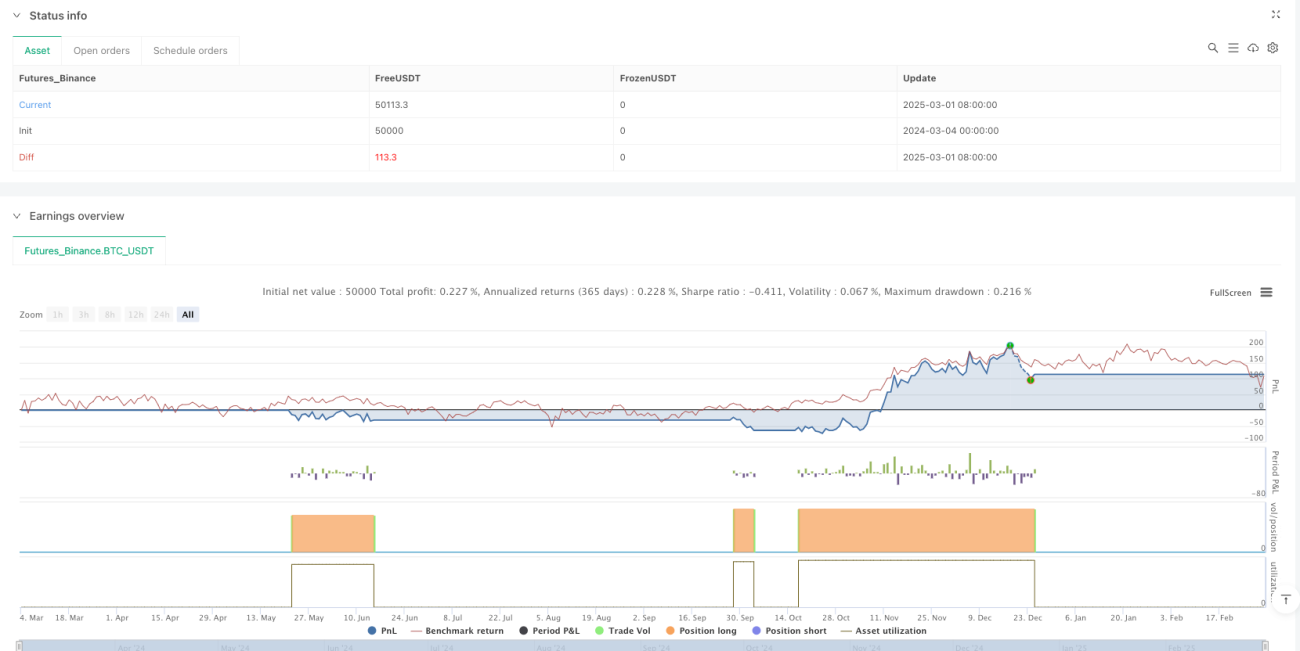
    • Assegurar que a retirada máxima não exceda 10% para manter o controle do risco.
    • Considere a comissão (default 0.1%) e o slippage (default 5), para se aproximar do ambiente de negociação real.

Vantagens estratégicas

  1. Qualidade de sinal melhoradaO mecanismo de confirmação de dois canais reduziu significativamente as falsas brechas e aumentou a qualidade e a precisão do sinal.buy = buy_fast and close > upper_slow[1]esel = sel_fast and close < lower_slow[1]O que é que isso quer dizer?

  2. Gestão de Riscos DinâmicosA estratégia usa um canal de saída adaptável, ajustando a posição de parada de acordo com a dinâmica da estrutura do mercado. Quando o mercado se move de forma favorável, o ponto de parada segue automaticamente, bloqueando parte dos lucros. Isso é feito através do códigoexit_buy_level:= math.max(nz(exit_buy_level,10e-10), lower_exit)concluir.

  3. Um sistema completo de gestão de fundosA estratégia inclui regras profissionais de gerenciamento de fundos, que controlam a margem de risco de cada transação por meio de um sistema de distribuição de porcentagens.

  4. Gestão de transações visuaisAs estratégias são marcadas claramente nos gráficos como pontos de entrada, pontos de parada e pontos de parada, ajudando o comerciante a entender intuitivamente a lógica de negociação e a escala de risco.

Risco estratégico

  1. Mercado de turbulência não funciona bemComo estratégia de acompanhamento de tendências, pode-se gerar uma série de falsos sinais durante a fase de classificação horizontal. O código de análise mostra que, embora o sistema de dupla canalização tenha reduzido os falsos sinais, ele ainda pode desencadear pequenas perdas em mercados sem uma tendência clara.

  2. Sensibilidade do parâmetroO desempenho da estratégia é altamente dependente da configuração do ciclo de canalização e do desvio. Diferentes mercados e prazos de tempo requerem diferentes combinações de parâmetros, exigindo um bom retorno e otimização. Os parâmetros são inseridos no código_period_dc1_period_dc2e_period_offA partir de agora, o Google está criando uma nova ferramenta para controlar essas variáveis cruciais.

  3. Risco de atraso: O canal de stop loss dinâmico pode não reagir com rapidez suficiente em mercados com forte flutuação, levando à ampliação da retirada. Em particular, solicite a confirmação do fechamento da linha K.barstate.isconfirmedO que pode ser um bom momento de saída em um ambiente de alta volatilidade.

  4. Excesso de dependência de modelos históricosA estratégia assume que o modelo de ruptura histórica continuará a funcionar no futuro, mas as características do mercado podem mudar com o tempo, afetando a performance da estratégia.

Direção de otimização da estratégia

  1. Adicionar filtro de tendênciaAnálise de código: A análise de código mostra que a estratégia atual carece de julgamento sobre a tendência do mercado em geral. Recomenda-se o aumento de indicadores de tendência, como médias móveis, ADX ou MACD, para ativar a estratégia em um ambiente de tendência forte e reduzir a sensibilidade em mercados de tendência fraca ou turbulenta.

  2. Ciclo de condução adaptativaAtualmente, a estratégia usa valores de ciclo fixo. A direção de otimização é introduzir um ciclo de canal de adaptação baseado no ATR ou na volatilidade do mercado, para que a estratégia possa se adaptar melhor a diferentes ambientes de mercado. Isso pode ser modificado_period_dc1e_period_dc2A forma como os cálculos são realizados.

  3. Otimizar o mecanismo de saída: A lógica de saída do código depende apenas do canal de Dongjian. Recomenda-se a implementação de estratégias de saída por etapas, como a liquidação de uma parte da posição depois de atingir um determinado lucro e a configuração de um stop loss mais flexível para o restante.

  4. Filtro de tempoAumentar o filtro de tempo de negociação, evitando períodos de baixa liquidez ou alta volatilidade do mercado. Em particular, para o mercado de criptomoedas que opera 24 horas, certos períodos podem ser mais adequados para a execução de negociações.

  5. Integração dos indicadores emocionaisIntegração de indicadores de sentimento de mercado, como volume de transações, volatilidade ou fluxo de capital, para reforçar a decisão de entrada e saída. Por exemplo, aumentar o peso em sinais de ruptura de alto volume de transações ou reduzir a frequência de negociação em ambientes de volatilidade anormalmente baixa.

Resumir

A estratégia multi-canal auto-adaptável de negociação da praia é um sistema moderno e abrangente de acompanhamento de tendências que resolve muitos dos desafios das regras tradicionais de negociação da praia por meio de mecanismos de confirmação de duplo canal e paradas dinâmicas. A estratégia é especialmente adequada para traders de tendências de médio e longo prazo, com desempenho mais estável em quadros de tempo mais elevados, como H4 ou linha do dia. A integração bem-sucedida de 3 Commas na estratégia pode torná-la ideal para negociação automatizada, reduzindo a interferência emocional humana.

Embora possa ter um fraco desempenho em mercados turbulentos, o seu desempenho geral pode ser significativamente melhorado com a otimização de parâmetros apropriados e filtros de tendência adicionais. O módulo de gerenciamento de fundos da estratégia garante que os riscos sejam controlados de forma eficaz, enquanto o sistema de parada de perdas dinâmico ajuda a proteger os lucros obtidos.

Esta é uma estratégia que vale a pena considerar para os comerciantes que desejam capturar tendências em várias condições de mercado, especialmente quando usadas em combinação com outras ferramentas de análise de mercado. Lembre-se de que qualquer estratégia precisa ser ajustada à tolerância individual ao risco e aos objetivos de negociação, e que há um bom feedback e simulação de negociação antes de investir dinheiro real.

Código-fonte da estratégia
/*backtest
start: 2024-03-04 00:00:00
end: 2025-03-02 08:00:00
period: 1d
basePeriod: 1d
exchanges: [{"eid":"Futures_Binance","currency":"BTC_USDT"}]
*/

// This Pine Script™ code is subject to the terms of the Mozilla Public License 2.0 at https://mozilla.org/MPL/2.0/
// © 3Commas

//@version=6
// Strategy configuration: sets properties for the strategy like title, overlay, pyramiding, calculation mode, and risk parameters.
strategy(title                        = "[3Commas] Turtle Strategy"
       , overlay                      = true
       , pyramiding                   = 0  
       , calc_on_order_fills          = false
       , calc_on_every_tick           = true
       , default_qty_type             = strategy.percent_of_equity
       , default_qty_value            = 1
       , initial_capital              = 10000
       , slippage                     = 5
       , commission_type              = strategy.commission.percent
       , commission_value             = 0.1
       , use_bar_magnifier            = true
       , fill_orders_on_standard_ohlc = true
     )

// ――――――――――――――――――――――――――――――――――――――――――――――――――――――――――――――――――――――――――――――――――――――――――――――――――――――――――――――――――――
// 🟦 Inputs
// ――――――――――――――――――――――――――――――――――――――――――――――――――――――――――――――――――――――――――――――――――――――――――――――――――――――――――――――――――――

// Define menu options for strategy testing
var menu_buy       = "🟢 Long"
var menu_sel       = "🔴 Short"
var menu_buy_sell  = "🟢 Long & 🔴 Short"  
var menu_none      = "🟤 None"
var group_settings = '🟦 Settings'
var group_test     = '🟦 Strategy Tester'

// Input parameters for the channels and exit period
_period_dc1  = input.int(20, "Period Channel 1"    , group = group_settings, inline = '' , display = display.none, tooltip ='Channel 1 Period.')
_period_dc2  = input.int(20, "Period Channel 2    ", group = group_settings, inline = '2', display = display.none, tooltip ='Channel 2 Period and offset to the right.')
_period_off  = input.int(20, "Offset"              , group = group_settings, inline = '2', display = display.none)
_period_exit = input.int(10, "Period Exit"         , group = group_settings, inline = '' , display = display.none, tooltip ='Exit Period (Trailing).')

// Input parameters for strategy testing options
_test_pos_type  = input.string(       title= 'Strategy          '    , group=group_test, inline = 'o' , defval  = menu_buy_sell, options=[menu_buy_sell, menu_buy, menu_sel, menu_none], tooltip = 'Order Type direction in which trades are executed.')
_tp_use         = input.bool  (false, title= "Take Profit %"         , group=group_test, inline = 'tp', tooltip = 'When activated, the entered value will be used as the Take Profit in percentage from the entry price level.')
_tp_percent     = input.float (20   , title= ""                      , group=group_test, inline = 'tp', display = display.none)


// ――――――――――――――――――――――――――――――――――――――――――――――――――――――――――――――――――――――――――――――――――――――――――――――――――――――――――――――――――――
// 🟦 Logic
// ――――――――――――――――――――――――――――――――――――――――――――――――――――――――――――――――――――――――――――――――――――――――――――――――――――――――――――――――――――

// Calculate take profit levels if enabled; otherwise set to not available (na)
tp_buy = _tp_use?close * (1 + _tp_percent / 100) : na 
tp_sel = _tp_use?close * (1 - _tp_percent / 100) : na

// Calculate fast and slow channel extremes and exit levels
upper_fast = ta.highest(high, _period_dc1)
lower_fast = ta.lowest (low , _period_dc1)
upper_slow = ta.highest(high, _period_dc2)[_period_off]
lower_slow = ta.lowest (low , _period_dc2)[_period_off]
upper_exit = ta.highest(high, _period_exit)
lower_exit = ta.lowest (low , _period_exit)

// Determine if there is a crossover or crossunder for fast and slow channels
buy_fast = ta.crossover (close, upper_fast[1]) and barstate.isconfirmed
sel_fast = ta.crossunder(close, lower_fast[1]) and barstate.isconfirmed
buy_slow = ta.crossover (close, upper_slow[1]) and barstate.isconfirmed
sel_slow = ta.crossunder(close, lower_slow[1]) and barstate.isconfirmed

// Initialize variables to track if we are in a long or short position
var inbuy  = false
var insel  = false

// Conditions to enter long or short positions based on fast signals and slow channel confirmation
buy  = buy_fast and close>upper_slow[1] and not inbuy
sel  = sel_fast and close<lower_slow[1] and not insel

// Update position flags if a trade is executed
inbuy := buy? true:inbuy
insel := sel? true:insel

// Plot shapes on the chart for long and short signals using circles and labels
plotshape(buy ?close:na, title="Label Long" , style=shape.circle   , location= location.absolute, color=color.new(color.teal, 0), text='' , textcolor=color.white, size= size.auto, offset=0, editable=true)
plotshape(sel ?close:na, title="Label Short", style=shape.circle   , location= location.absolute, color=color.new(color.red , 0), text='' , textcolor=color.white, size= size.auto, offset=0, editable=true)
plotshape(buy ?close:na, title="Label Long" , style=shape.labelup  , location= location.belowbar, color=color.new(color.teal, 0), text='▲', textcolor=color.white, size= size.auto, offset=0, editable=true)
plotshape(sel ?close:na, title="Label Short", style=shape.labeldown, location= location.abovebar, color=color.new(color.red , 0), text='▼', textcolor=color.white, size= size.auto, offset=0, editable=true)

// Initialize take profit, stop loss, and exit levels for both long and short positions
var tp = float(na)
var sl = float(na)
var exit_buy_level = float(na)
var exit_sel_level = float(na)

// Set take profit levels when a new long or short signal is triggered
if buy
    tp := tp_buy

if sel
    tp := tp_sel

// For long positions, update the exit level based on the lowest exit channel
if inbuy
    exit_buy_level:= math.max(nz(exit_buy_level,10e-10), lower_exit)
    sl:= exit_buy_level

// For short positions, update the exit level based on the highest exit channel
if insel 
    exit_sel_level:= math.min(nz(exit_sel_level,10e+10), upper_exit)
    sl:= exit_sel_level    

// Check for exit conditions when price crosses the exit levels
exit_buy_pos = ta.crossunder(close,exit_buy_level) 
exit_sel_pos = ta.crossover (close,exit_sel_level)        

// Confirm exit conditions when in a position
exit_buy_close = inbuy and exit_buy_pos and barstate.isconfirmed
exit_sel_close = insel and exit_sel_pos and barstate.isconfirmed

// Check for take profit exit conditions for long and short positions
buy_tp_exit = (inbuy[1]  and high>= tp and not buy)
sel_tp_exit = (insel[1]  and low <= tp and not sel)

// Plot channel bands and exit levels on the chart (set to not display by default)
plot(upper_fast    , title="Upper Channel 1", color=color.blue , display = display.none)
plot(lower_fast    , title="Lower Channel 1", color=color.blue , display = display.none)
plot(upper_slow    , title="Upper Channel 2", color=color.green, display = display.none)
plot(lower_slow    , title="Lower Channel 2", color=color.green, display = display.none)
plot(exit_buy_level, title="Exit Long"      , color=color.red  , display = display.none, style = plot.style_linebr)
plot(exit_sel_level, title="Exit Short"     , color=color.red  , display = display.none, style = plot.style_linebr)

// ――――――――――――――――――――――――――――――――――――――――――――――――――――――――――――――――――――――――――――――――――――――――――――――――――――――――――――――――――――
// 🟦 Strategy Tester
// ――――――――――――――――――――――――――――――――――――――――――――――――――――――――――――――――――――――――――――――――――――――――――――――――――――――――――――――――――――


// Conditions for testing buy and sell signals
test_buy =  buy
test_sel = sel
test_tp  = tp
test_sl  = sl

// Track the average entry price for the current position
test_en = strategy.position_avg_price

// Determine if the stop loss should be adjusted based on the current position and entry price
savestop = (strategy.position_size>0 and test_sl>test_en) or (strategy.position_size<0 and test_sl<test_en)

// Execute strategy entries based on the test conditions and selected position type
if test_buy and _test_pos_type != menu_sel and _test_pos_type != menu_none
    strategy.entry ("Buy" , strategy.long)
if test_sel and _test_pos_type != menu_buy and _test_pos_type != menu_none
    strategy.entry ("Sell", strategy.short)

// Close positions based on exit signals
if exit_buy_close
    strategy.close("Buy") 

if exit_sel_close
    strategy.close("Sell")

// Set strategy exits using take profit conditions; stop loss is not used in these exits
strategy.exit("Exit Buy" , "Buy" , limit= test_tp, stop = na)
strategy.exit("Exit Sell", "Sell", limit= test_tp, stop = na)

// Define colors for plotting stop loss lines based on the savestop condition
test_sl_col = savestop?color.new(color.teal,50 ):color.new(color.red ,50)
// Check if there is no trade, based on changes in entry price or if entry price is not available
notrade = test_en!=test_en[1] or na(test_en)

// Plot entry price, stop loss, and take profit on the chart
plot_en = plot(notrade?na:test_en, title = 'Entry', color = color.new(color.blue,50 ), style = plot.style_linebr)
plot_sl = plot(notrade?na:test_sl, title = 'SL'   , color = test_sl_col                , style = plot.style_linebr)
plot_tp = plot(notrade?na:test_tp, title = 'TP'   , color = color.new(color.teal,100), style = plot.style_linebr)

// Fill the background between the take profit and entry lines
fill(plot_tp, plot_en, test_tp, test_en, notrade?na:color.new(color.teal,50 ), notrade?na:color.new(color.teal,100), fillgaps = false, title = 'Trade Background')
// Fill the background between the entry and stop loss lines
fill(plot_en, plot_sl, test_en, test_sl, notrade?na:savestop?color.new(color.teal ,100):color.new(color.red ,100), notrade?na:savestop?color.new(color.teal ,50):color.new(color.red ,50 ), fillgaps = false, title = 'Trade Background')

// Reset variables when an exit condition is met for a long position
if exit_buy_close or buy_tp_exit
    exit_buy_level:= float(na)
    tp            := float(na)
    sl            := float(na) 
    inbuy         := false

// Reset variables when an exit condition is met for a short position
if exit_sel_close or sel_tp_exit
    exit_sel_level:= float(na)
    tp            := float(na)
    sl            := float(na) 
    insel         := false  

// ――――――――――――――――――――――――――――――――――――――――――――――――――――――――――――――――――――――――――――――――――――――――――――――――――――――――――――――――――――
// 🟦 3Commas Integration  
// ――――――――――――――――――――――――――――――――――――――――――――――――――――――――――――――――――――――――――――――――――――――――――――――――――――――――――――――――――――

// This section integrates the strategy with 3Commas DCA Bot signals.

// Tutorial text for integration instructions
var c3_tuto =  "Here you can enable the table to review the messages to be sent to the bot, as well as change the background color and text color."
              +'\n\n🤖 𝗛𝗼𝘄 𝘁𝗼 𝘂𝘀𝗲 𝗗𝗖𝗔 𝗕𝗼𝘁 𝗦𝗶𝗴𝗻𝗮𝗹𝘀'
              +'\n      ¯¯¯¯¯¯¯¯¯¯¯¯¯¯¯¯¯¯¯¯¯¯¯¯'
              +  '\n🔹Verify Messages: Ensure the message matches the one specified by the DCA Bot.'
              +'\n\n🔹Multi-Pair Configuration: For multi-pair setups, enable the option to add the symbol in the correct format.'
              +'\n\n🔹Signal Settings: Enable whether you want to receive long or short signals (Entry | TP | SL), copy and paste the the messages for the DCA Bots configured in 3Commas.'        
              +'\n\n🔹Alert Setup:'         
              +'\n\n- When creating an alert, set the condition to the indicator and choose "alert() function call only."'                  
              +'\n\n- Enter any desired Alert Name.'                                           
              +'\n\n- Open the Notifications tab, enable Webhook URL, and paste the Webhook URL from 3Commas.'                         
              +'\n\n- For more details, refer to the 3Commas section: "How to use TradingView Custom Signals."'  
              +"\n\n🔹Finalize Alerts: Click Create, you're done! Alerts will now be sent automatically in the correct format to 3Commas."

// Predefined JSON messages for bot signals for both entry and exit in long and short positions
var c3_text_buy_entry = '{  "message_type": "bot",  "bot_id": 15743097,  "email_token": "b9ed9d7d-7777-42ed-a0a6-608f4ecedf82",  "delay_seconds": 0}'
var c3_text_sel_entry = '{  "message_type": "bot",  "bot_id": 15743017,  "email_token": "b9ed9d7d-7777-42ed-a0a6-608f4ecedf82",  "delay_seconds": 0}'
var c3_text_buy_exit  = '{  "action": "close_at_market_price",  "message_type": "bot",  "bot_id": 15743097,  "email_token": "b9ed9d7d-7777-42ed-a0a6-608f4ecedf82",  "delay_seconds": 0}'
var c3_text_sel_exit  = '{  "action": "close_at_market_price",  "message_type": "bot",  "bot_id": 15743017,  "email_token": "b9ed9d7d-7777-42ed-a0a6-608f4ecedf82",  "delay_seconds": 0}'

// Define emojis for visual signals
var emog  = '🟢'
var emor  = '🔴'
var emof  = '🏁'
var read = 'Check Messages, Please Read 👉'

// Input settings for the integration table and signal customization
group_c3            = '🟦 DCA Bot Signals'  
_c3_tuto            = input.bool  (false            , title=  read                    , group=group_c3, inline='h', display = display.none, tooltip = c3_tuto)
_c3_size            = input.string('Normal'         , title= ' ↳ Size'                , group=group_c3, inline='' , display = display.none, options=['Tiny','Small','Normal','Large','Huge'])
_c3_pos             = input.string('Bottom Center'  , title= ' ↳ Position'            , group=group_c3, inline='' , display = display.none, options=['Top Left','Top Center','Top Right','Middle Left','Middle Center','Middle Right','Bottom Left','Bottom Center','Bottom Right'])
_c3_col1            = input.color(#1F1F1F         , title= ' ↳ Colors    '          , group=group_c3, inline='c', display = display.none)
_c3_col2            = input.color(color.white     , title= ''                       , group=group_c3, inline='c', display = display.none)
_c3_buy_entry       = input.bool  (true             , title= emog+' Buy Entry       ' , group=group_c3, inline='b', display = display.none, tooltip= 'Enable this options to send Buy Entry, Take Profit (TP), and Stop Loss (SL) signals to 3Commas.')
_c3_buy_tp          = input.bool  (true             , title=      'TP'                , group=group_c3, inline='b', display = display.none)
_c3_buy_sl          = input.bool  (true             , title=      'SL'                , group=group_c3, inline='b', display = display.none)
_c3_text_buy_entry  = input.string(c3_text_buy_entry, title= ' ↳ Deal Entry'          , group=group_c3, inline= '', display = display.none, tooltip= 'Long DCA Bot: Copy and paste the message for the deal start signal of the DCA Bot you created in 3Commas.')
_c3_text_buy_exit   = input.string(c3_text_buy_exit , title= ' ↳ Deal Exit'           , group=group_c3, inline= '', display = display.none, tooltip= 'Long DCA Bot: Copy and paste the message to close order at Market Price of the DCA Bot you created in 3Commas.')
_c3_sel_entry       = input.bool  (true             , title= emor+' Sell Entry       ', group=group_c3, inline='s', display = display.none, tooltip= 'Enable this options to send Sell Entry, Take Profit (TP), and Stop Loss (SL) signals to 3Commas.')
_c3_sel_tp          = input.bool  (true             , title=      'TP'                , group=group_c3, inline='s', display = display.none)
_c3_sel_sl          = input.bool  (true             , title=      'SL'                , group=group_c3, inline='s', display = display.none)
_c3_text_sel_entry  = input.string(c3_text_sel_entry, title= ' ↳ Deal Entry'          , group=group_c3, inline= '', display = display.none, tooltip= 'Short DCA Bot: Copy and paste the message for the deal start signal of the DCA Bot you created in 3Commas.')
_c3_text_sel_exit   = input.string(c3_text_sel_exit , title= ' ↳ Deal Exit'           , group=group_c3, inline= '', display = display.none, tooltip= 'Short DCA Bot: Copy and paste the message to close order at Market Price of the DCA Bot you created in 3Commas.')
_c3_entry_bot_use   = input.bool  (false            , title= 'DCA Bot Multi-Pair'     , group=group_c3, inline= '', display = display.none, tooltip = 'You must activate it if you want to use the signals in a DCA Bot Multi-pair \n\nIn the text box you must enter (using the 3Commas format) the symbol in which you are creating the alert, you can check the format of each symbol when you create the bot.\n\nBefore creating the alert, verify that the message is the same as the one specified in the DCA bot, using the summary option.')
_c3_entry_bot_mult  = input.string('USDT_BTC'       , title= ' ↳ Symbol'              , group=group_c3, inline= '', display = display.none)

// Function to determine label size based on the selected menu option
LabelSize (size_menu_)=>
    switch size_menu_
        'Auto'   => size.auto
        'Tiny'   => size.tiny
        'Small'  => size.small
        'Normal' => size.normal
        'Large'  => size.large
        'Huge'   => size.huge

// Function to determine table position based on the selected menu option
TablePosition (pos_menu_)=>
    switch pos_menu_ 
        'Top Left'      => position.top_left      
        'Top Center'    => position.top_center    
        'Top Right'     => position.top_right     
        'Middle Left'   => position.middle_left   
        'Middle Center' => position.middle_center 
        'Middle Right'  => position.middle_right  
        'Bottom Left'   => position.bottom_left    
        'Bottom Center' => position.bottom_center  
        'Bottom Right'  => position.bottom_right

// Function to trim the JSON message and add the pair if multi-pair is enabled
TrimPair(txt_, multipair_, pair_) =>
    trim  = txt_
    check =  str.contains(trim,'delay_seconds') and 
             str.contains(trim,'email_token'  ) and 
             str.contains(trim,'bot_id'       ) and 
             str.contains(trim,'message_type' )
    if check
        del   = array.get(str.split(trim, '"delay_seconds": 0'), 1)
        trim := str.replace(trim, del, '', 0)
        pair  = ', "pair": '+ '"' + str.replace_all(pair_, ' ', '')+ '"'
        trim := trim + (multipair_? pair: '') + '}'  
    trim 

// Function to format JSON for a nicer display by adding new lines and spacing
JsonFormat(json_)=>
    nice  = json_
    check =  str.contains(nice,'delay_seconds') and 
             str.contains(nice,'email_token'  ) and 
             str.contains(nice,'bot_id'       ) and 
             str.contains(nice,'message_type' )
    if check 
        nice := str.replace_all(nice, ' ', ''    )
        nice := str.replace_all(nice, ',', ',\n ')
        nice := str.replace_all(nice, '{', '{\n ')
        nice := str.replace_all(nice, '}', '\n}' )
        nice := str.replace_all(nice, ':', ': '  )
    nice    

// Define conditions to send signals based on entry and exit signals
c3_en_buy =  _c3_buy_entry and buy
c3_ex_buy = (_c3_buy_tp and buy_tp_exit) or (_c3_buy_sl and exit_buy_close)

c3_en_sel =  _c3_sel_entry and sel
c3_ex_sel = (_c3_sel_tp and sel_tp_exit) or (_c3_sel_sl and exit_sel_close)

// Format the messages for both entry and exit, applying multi-pair configuration if enabled
var c3_buy_dealstart   = JsonFormat(TrimPair(_c3_text_buy_entry, _c3_entry_bot_use, _c3_entry_bot_mult))
var c3_buy_closemarket = JsonFormat(TrimPair(_c3_text_buy_exit , _c3_entry_bot_use, _c3_entry_bot_mult))
var c3_sel_dealstart   = JsonFormat(TrimPair(_c3_text_sel_entry, _c3_entry_bot_use, _c3_entry_bot_mult))
var c3_sel_closemarket = JsonFormat(TrimPair(_c3_text_sel_exit , _c3_entry_bot_use, _c3_entry_bot_mult))

// Send alerts for buy and sell entries and exits based on conditions
switch
    c3_en_buy => alert(c3_buy_dealstart  , alert.freq_once_per_bar)
    c3_ex_buy => alert(c3_buy_closemarket, alert.freq_once_per_bar)

switch
    c3_en_sel => alert(c3_sel_dealstart  , alert.freq_once_per_bar)
    c3_ex_sel => alert(c3_sel_closemarket, alert.freq_once_per_bar)  
 
// Create a table with the signal messages for user review
if barstate.isfirst and _c3_tuto 
    var bg =  _c3_col1
    var tx =  _c3_col2
    var gr = color.green
    var re = color.red 
    var hw = 'How to use 3Commas DCA Bot Signals 🤖'
    var ms = '🤖 DCA Bot Signals Messages '
    var ds = 'Deal start signal'
    var me = 'Close order at Market Price'
    var c3_table = table.new(TablePosition (_c3_pos), 6, 6, border_width=1, frame_width=1,border_color = color.new(color.black,0), frame_color = color.new(color.black,0))  
    table.cell(c3_table, 1, 1, ms                  , text_color=tx, text_halign=text.align_center, text_size = LabelSize(_c3_size), bgcolor = bg)
    table.cell(c3_table, 1, 2, ds                  , text_color=tx, text_halign=text.align_center, text_size = LabelSize(_c3_size), bgcolor = bg, width=0)
    table.cell(c3_table, 1, 3, me                  , text_color=tx, text_halign=text.align_center, text_size = LabelSize(_c3_size), bgcolor = bg, width=0)
    table.cell(c3_table, 2, 1, 'Long Bot Messages' , text_color=gr, text_halign=text.align_center, text_size = LabelSize(_c3_size), bgcolor = bg)
    table.cell(c3_table, 2, 2, c3_buy_dealstart    , text_color=tx, text_halign=text.align_left  , text_size = LabelSize(_c3_size), bgcolor = bg, text_font_family= font.family_monospace)
    table.cell(c3_table, 2, 3, c3_buy_closemarket  , text_color=tx, text_halign=text.align_left  , text_size = LabelSize(_c3_size), bgcolor = bg, text_font_family= font.family_monospace)
    table.cell(c3_table, 3, 1, 'Short Bot Messages', text_color=re, text_halign=text.align_center, text_size = LabelSize(_c3_size), bgcolor = bg)
    table.cell(c3_table, 3, 2, c3_sel_dealstart    , text_color=tx, text_halign=text.align_left  , text_size = LabelSize(_c3_size), bgcolor = bg, text_font_family= font.family_monospace)
    table.cell(c3_table, 3, 3, c3_sel_closemarket  , text_color=tx, text_halign=text.align_left  , text_size = LabelSize(_c3_size), bgcolor = bg, text_font_family= font.family_monospace)