Estratégia de Momentum Adaptativo de Tendências da Teoria Dow

DTTAS HH/HL LH/LL SL/TP TTS
Data de criação: 2025-04-03 13:05:17 última modificação: 2025-04-03 13:05:17
cópia: 0 Cliques: 359
2
focar em
319
Seguidores

Estratégia de Momentum Adaptativo de Tendências da Teoria Dow Estratégia de Momentum Adaptativo de Tendências da Teoria Dow

Visão geral

A estratégia de dinâmica de adaptação da teoria da Dow é uma estratégia de negociação avançada baseada nos princípios da teoria da Dow clássica para orientar a decisão de negociação através da identificação de pontos de inflexão críticos na tendência do mercado. A estratégia se concentra na detecção e confirmação da dinâmica básica da tendência dos preços, usando altos mais altos (Higher Highs) e baixos mais altos (Higher Lows) para definir a tendência ascendente e baixos (Lower Highs) para definir a tendência descendente.

Princípio da estratégia

O princípio central da estratégia é baseado no método clássico de identificação de tendências da teoria de Dow. A estratégia detecta os pontos de inflexão críticos usando as funções ta.pivothigh () e ta.pivotlow (). A implementação concreta inclui os seguintes passos-chave:

  1. Detecção de ponto de viragem: Determine o número de colunas de ambos os lados, para identificar pontos altos e baixos, usando o parâmetro pivotLookback.
  2. Confirmação de tendência: a tendência ascendente só é confirmada quando simultaneamente são satisfeitas as condições de um alto mais alto e de um baixo mais alto; da mesma forma, a tendência descendente só é confirmada quando simultaneamente são satisfeitas as condições de um alto mais baixo e de um baixo mais baixo.
  3. Continuidade de tendência: se as condições de conversão de tendência não forem atendidas, a estratégia manterá o estado de tendência anterior, permitindo um acompanhamento de tendência mais suave.

Vantagens estratégicas

  1. Identificação de tendências dinâmicas: a estratégia é capaz de capturar as mudanças nas tendências do mercado através da análise contínua dos pontos de inflexão.
  2. Modos de negociação flexíveis: oferece três modos de negociação automáticos, apenas fazer mais e apenas fazer menos, para atender às necessidades de diferentes comerciantes.
  3. Gerenciamento de riscos: mecanismos de stop loss e stop-loss incorporados para controlar eficazmente o risco de uma única transação.
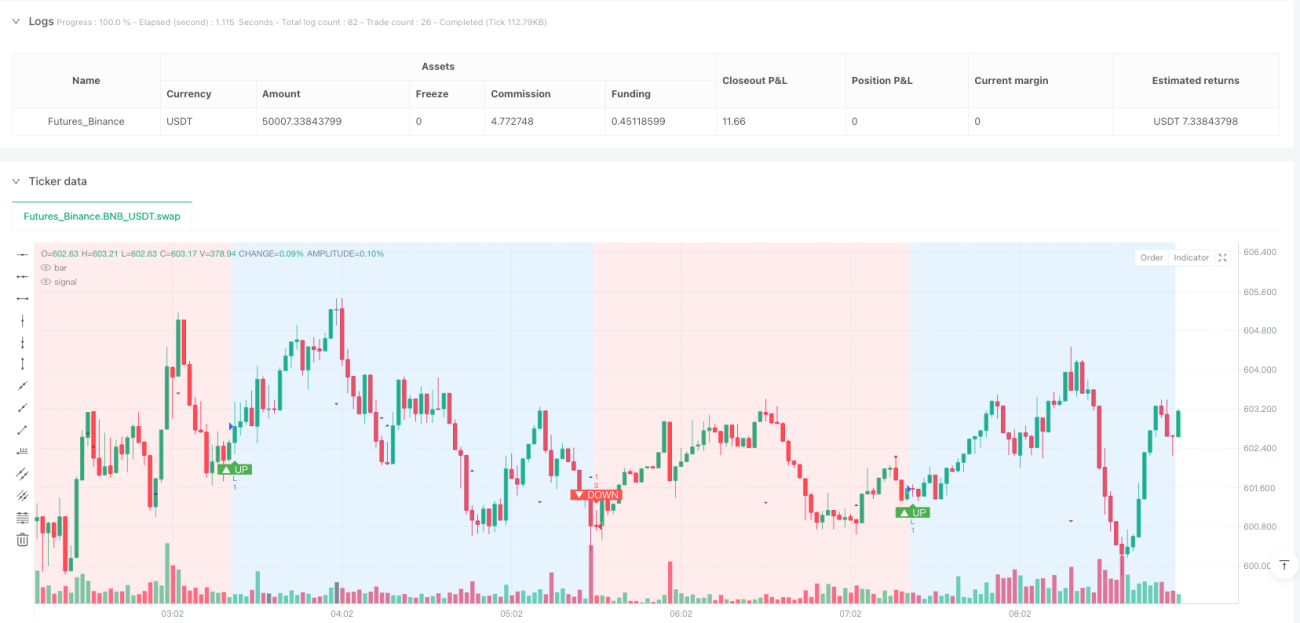
  4. Visualização de tendências: mostra intuitivamente a direção da tendência por meio de cores de fundo e marcas, facilitando a compreensão rápida do estado do mercado pelos traders.
  5. Baixa latência: O método responde mais rapidamente às mudanças de tendência do que as estratégias tradicionais de médias móveis.

Risco estratégico

  1. Risco de atraso: devido ao uso de detecção de ponto de inflexão, há um risco inerente de atraso na estratégia, que pode não ser capaz de capturar os primeiros sinais de tendência.
  2. Risco de mercado de turbulência: em mercados onde a volatilidade não é visível, pequenas variações frequentes de preços podem levar a transações desnecessárias.
  3. Sensibilidade de parâmetros: a escolha do parâmetro pivotLookback tem um grande impacto no desempenho da estratégia e precisa ser ajustada para diferentes mercados e prazos.
  4. Custos de transação: transações frequentes podem resultar em custos de transação mais elevados, especialmente em casos de comissões mais elevadas.

Direção de otimização da estratégia

  1. Introdução de filtros adicionais: combinação de indicadores de força de tendência (como ATR) para filtrar os sinais de tendência fraca.
  2. Ajuste de parâmetros dinâmicos: desenvolvimento de um mecanismo de parâmetros de pivot Lookback auto-adaptável com base na volatilidade do mercado.
  3. Verificação de múltiplos prazos: Verificação cruzada de sinais de tendência em diferentes prazos, aumentando a confiabilidade do sinal.
  4. Aprendizagem de máquina: explorar o uso de algoritmos de aprendizagem de máquina para otimizar a identificação de tendências e o tempo de entrada.
  5. Optimização do gerenciamento de risco: ajuste de stop loss e stop loss distância de acordo com a dinâmica de volatilidade do mercado.

Resumir

A estratégia de dinâmica de adaptação da teoria da Dow é um poderoso método de acompanhamento de tendências que fornece aos comerciantes uma ferramenta sistematizada de identificação de tendências por meio de uma inovadora técnica de análise de pontos de inflexão. Apesar de alguns riscos inerentes, sua flexibilidade e dinâmica tornam-na uma abordagem valiosa em estratégias modernas de negociação quantitativa. A aplicação bem-sucedida da estratégia requer uma compreensão profunda de como ela funciona e é constantemente otimizada e ajustada de acordo com as condições específicas do mercado.

Overview

The Dow Theory Trend Adaptive Momentum Strategy is an advanced trading approach based on classic Dow Theory principles, designed to guide trading decisions by identifying key turning points in market trends. The strategy focuses on detecting and confirming the fundamental dynamics of price trends, using Higher Highs and Higher Lows to define uptrends, and Lower Highs and Lower Lows to define downtrends. This method aims to provide a systematic approach to capturing market trends and responding promptly when trends change.

Strategy Principles

The core principle of this strategy is based on the classic Dow Theory trend identification method. The strategy detects key turning points using ta.pivothigh() and ta.pivotlow() functions. Specific implementation includes the following key steps:

  1. Turning Point Detection: Use the pivotLookback parameter to determine the number of bars on both sides for identifying highs and lows.
  2. Trend Confirmation: An uptrend is confirmed only when both Higher Highs and Higher Lows conditions are met; similarly, a downtrend is confirmed only when both Lower Highs and Lower Lows conditions are satisfied.
  3. Trend Persistence: If trend conversion conditions are not met, the strategy maintains the previous trend state, achieving smoother trend tracking.

Strategy Advantages

  1. Dynamic Trend Identification: By continuously analyzing key turning points, the strategy can dynamically capture market trend changes.
  2. Flexible Trading Modes: Provides three trading modes - automatic, long-only, and short-only - to meet different traders’ needs.
  3. Risk Management: Built-in stop-loss and take-profit mechanisms effectively control the risk of individual trades.
  4. Trend Visualization: Intuitively displays trend direction through background colors and markers, making it easy for traders to understand market conditions.
  5. Low Latency: Compared to traditional moving average strategies, this method can respond to trend changes more quickly.

Strategy Risks

  1. Lag Risk: Due to using pivot point detection, the strategy inherently carries a lag risk and may not capture the earliest trend signals.
  2. Ranging Market Risk: In markets with unclear fluctuations, frequent small price changes may lead to unnecessary trades.
  3. Parameter Sensitivity: The choice of pivotLookback parameter significantly impacts strategy performance and requires adjustment for different markets and timeframes.
  4. Trading Costs: Frequent trading may result in high transaction costs, especially with higher commission rates.

Strategy Optimization Directions

  1. Introduce Additional Filters: Combine trend strength indicators (such as ATR) to filter weak trend signals.
  2. Dynamic Parameter Adjustment: Develop an adaptive pivotLookback parameter mechanism based on market volatility.
  3. Multi-Timeframe Verification: Cross-verify trend signals across different timeframes to improve signal reliability.
  4. Machine Learning Enhancement: Explore using machine learning algorithms to optimize trend identification and entry timing.
  5. Risk Management Optimization: Dynamically adjust stop-loss and take-profit distances based on market volatility.

Conclusion

The Dow Theory Trend Adaptive Momentum Strategy is a powerful trend-following method that provides traders with a systematic trend identification tool through innovative turning point analysis techniques. Despite some inherent risks, its flexibility and dynamism make it a valuable approach in modern quantitative trading strategies. Successfully applying this strategy requires a deep understanding of its working principles and continuous optimization and adjustment based on specific market environments.

Código-fonte da estratégia
/*backtest
start: 2025-03-29 00:00:00
end: 2025-03-30 09:00:00
period: 2m
basePeriod: 2m
exchanges: [{"eid":"Futures_Binance","currency":"BNB_USDT"}]
*/

//@version=5
// strategy(title="Dow Theory Trend Strategy v3", shorttitle="Dow Trend Strat v3", overlay=true,
//      initial_capital=10000, default_qty_type=strategy.percent_of_equity, default_qty_value=10,
//      commission_type=strategy.commission.percent, commission_value=0.1, // Example strategy settings with commission
//      process_orders_on_close=true) // Consider processing on bar close for more stable backtests
strategy(title="Dow Theory Trend Strategy v3", shorttitle="Dow Trend Strat v3", overlay=true) // Basic strategy settings

// --- 設定 ---
// Calculation Settings
pivotLookback = input.int(10, title="Pivot Lookback Period", minval=1, tooltip="ピボットハイ/ローを検出するための左右のバーの数", group="Calculation Settings")

// Display Settings
showPivotPoints = input.bool(true, title="Show Pivot Points", tooltip="ピボットハイ/ローのポイントを表示します", group="Display Settings")
showTrendChange = input.bool(true, title="Show Trend Change Signals", tooltip="トレンド転換のシグナル(エントリーポイント)を表示します", group="Display Settings")

// Strategy Settings
// --- Manual Trend Override (配列定義を input 内に変更) ---
manualTrendMode = input.string("Auto", title="Manual Trend Mode",
     options=["Auto", "Long Only", "Short Only"], // オプションをここで直接定義
     tooltip="手動でトレード方向を指定 (Auto: ダウ理論に従う, Long Only: ロングのみ, Short Only: ショートのみ)",
     group="Strategy Settings")

// Risk Management Settings
useStopLoss = input.bool(true, title="Use Stop Loss", group="Risk Management")
stopLossTicks = input.float(100, title="Stop Loss (Ticks)", minval=1, group="Risk Management", tooltip="エントリー価格からのストップロスまでのティック(最小値動き)数。例:EURUSDで20 pips (tick=0.00001)なら200。")
useTakeProfit = input.bool(true, title="Use Take Profit", group="Risk Management")
takeProfitTicks = input.float(200, title="Take Profit (Ticks)", minval=1, group="Risk Management", tooltip="エントリー価格からのテイクプロフィットまでのティック(最小値動き)数。例:EURUSDで40 pips (tick=0.00001)なら400。")

// --- ピボットハイ/ローの検出 ---
pivotHighPrice = ta.pivothigh(high, pivotLookback, pivotLookback)
pivotLowPrice = ta.pivotlow(low, pivotLookback, pivotLookback)

// --- ピボットポイントの値を保持するための変数 ---
var float lastPivotHigh = na
var float prevPivotHigh = na
var float lastPivotLow = na
var float prevPivotLow = na
var int lastPivotHighBar = na
var int prevPivotHighBar = na
var int lastPivotLowBar = na
var int prevPivotLowBar = na

// --- 新しいピボットが確定したかどうかの検出と値の更新 ---
if not na(pivotHighPrice)
    if na(lastPivotHigh) or pivotHighPrice != lastPivotHigh
        prevPivotHigh := lastPivotHigh
        prevPivotHighBar := lastPivotHighBar
        lastPivotHigh := pivotHighPrice
        lastPivotHighBar := bar_index - pivotLookback

if not na(pivotLowPrice)
    if na(lastPivotLow) or pivotLowPrice != lastPivotLow
        prevPivotLow := lastPivotLow
        prevPivotLowBar := lastPivotLowBar
        lastPivotLow := pivotLowPrice
        lastPivotLowBar := bar_index - pivotLookback

// --- ダウ理論に基づくトレンド判定 (改良版) ---
var int trendDirection = 0
bool hasEnoughPivots = not na(lastPivotHigh) and not na(prevPivotHigh) and not na(lastPivotLow) and not na(prevPivotLow)

if hasEnoughPivots
    isHigherHigh = lastPivotHigh > prevPivotHigh
    isHigherLow = lastPivotLow > prevPivotLow
    isUptrendConfirmed = isHigherHigh and isHigherLow

    isLowerHigh = lastPivotHigh < prevPivotHigh
    isLowerLow = lastPivotLow < prevPivotLow
    isDowntrendConfirmed = isLowerHigh and isLowerLow

    if isUptrendConfirmed
        trendDirection := 1
    else if isDowntrendConfirmed
        trendDirection := -1
    else
        trendDirection := trendDirection[1]

// --- トレンド転換の検出 ---
bool trendChanged = ta.change(trendDirection) != 0
bool changedToUp = trendChanged and trendDirection == 1
bool changedToDown = trendChanged and trendDirection == -1

// --- 描画処理 ---
bgcolor(trendDirection == 1 ? color.new(color.blue, 85) : trendDirection == -1 ? color.new(color.red, 85) : color.new(color.gray, 90), title="Trend Background")
plotshape(showPivotPoints and not na(pivotHighPrice), title="Pivot High", location=location.abovebar, color=color.new(color.maroon, 20), style=shape.triangledown, size=size.tiny, offset=-pivotLookback)
plotshape(showPivotPoints and not na(pivotLowPrice), title="Pivot Low", location=location.belowbar, color=color.new(color.navy, 20), style=shape.triangleup, size=size.tiny, offset=-pivotLookback)
plotshape(showTrendChange and changedToUp, title="Uptrend Start Signal", location=location.belowbar, color=color.new(color.green, 0), style=shape.labelup, text="▲ UP", textcolor=color.white, size=size.small)
plotshape(showTrendChange and changedToDown, title="Downtrend Start Signal", location=location.abovebar, color=color.new(color.red, 0), style=shape.labeldown, text="▼ DOWN", textcolor=color.white, size=size.small)

// --- ストラテジーロジック ---
bool allowLong = manualTrendMode == "Auto" or manualTrendMode == "Long Only"
bool allowShort = manualTrendMode == "Auto" or manualTrendMode == "Short Only"

if (changedToUp and allowLong)
    strategy.entry("L", strategy.long, comment="Go Long")
    if (useStopLoss or useTakeProfit)
        float slValue = useStopLoss and stopLossTicks > 0 ? stopLossTicks : na
        float tpValue = useTakeProfit and takeProfitTicks > 0 ? takeProfitTicks : na
        strategy.exit("LX", from_entry="L", loss=slValue, profit=tpValue, comment_loss="SL Long", comment_profit="TP Long")

if (changedToDown and allowShort)
    strategy.entry("S", strategy.short, comment="Go Short")
    if (useStopLoss or useTakeProfit)
        float slValue = useStopLoss and stopLossTicks > 0 ? stopLossTicks : na
        float tpValue = useTakeProfit and takeProfitTicks > 0 ? takeProfitTicks : na
        strategy.exit("SX", from_entry="S", loss=slValue, profit=tpValue, comment_loss="SL Short", comment_profit="TP Short")

// --- デバッグ用 ---
// plot(trendDirection, title="Trend Direction Value")