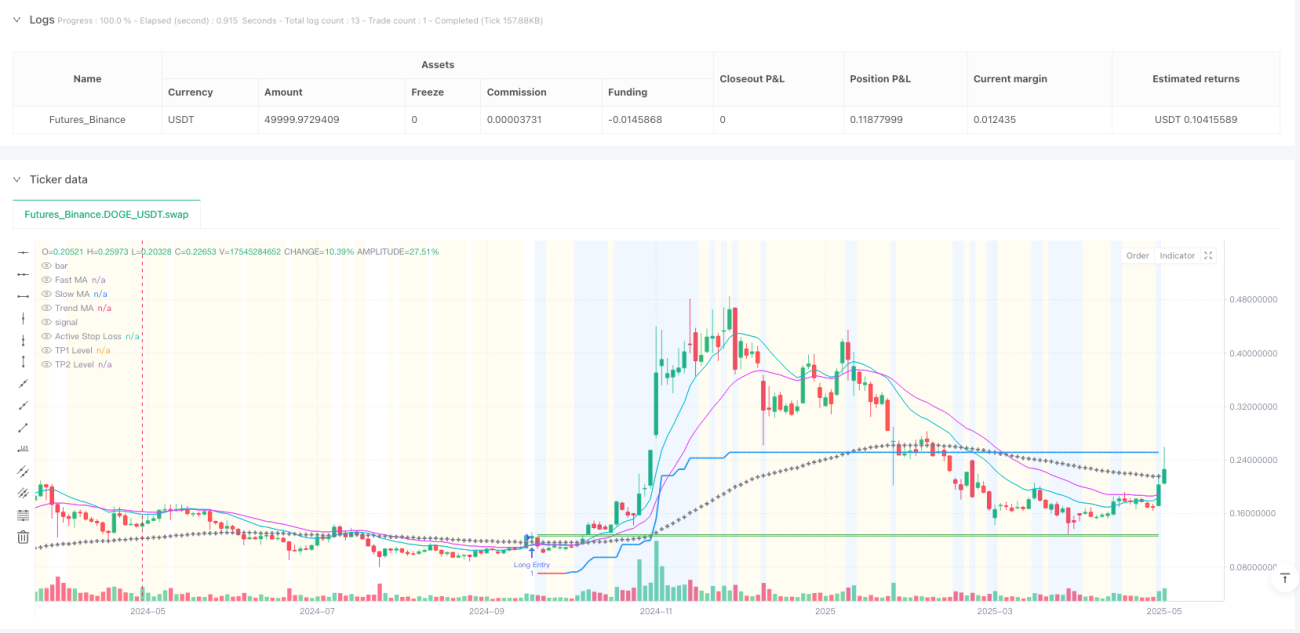
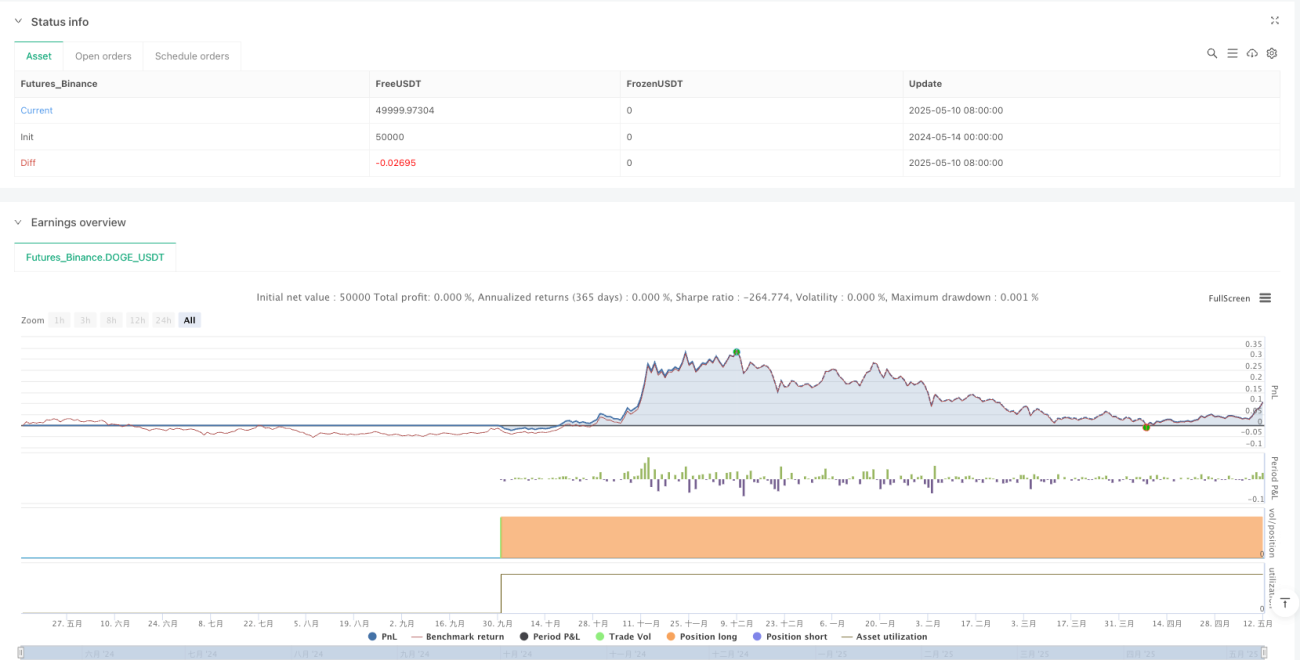
A estratégia de negociação quantitativa de rastreamento da taxa de flutuação da linha de equilíbrio auto-adaptável é uma estratégia sistematizada projetada especificamente para negociação de alta frequência e operações de linha curta. O núcleo da estratégia utiliza a linha de equilíbrio de movimentação rápida (MA) e a linha de equilíbrio de movimentação lenta (MA) como o principal ponto de partida do sinal, juntamente com vários filtros-chave e ferramentas precisas de gerenciamento de risco para capturar pequenas, mas rápidas, flutuações de preços. A estratégia é altamente configurável, permitindo ao usuário a flexibilidade de escolher o tipo de linha de equilíbrio (EMA, SMA, WMA, HMA, VWMA) e seus parâmetros de ciclo para se adaptar às necessidades de negociação de diferentes ritmos de mercado.
A lógica central da estratégia é dividida nas seguintes partes-chave:
Sinais de entrada: Principalmente através de cruzamento / travessia entre a média rápida e a média lenta como condições de entrada. Os usuários podem configurar flexivelmente o tipo de média (EMA, SMA, WMA, HMA, VWMA) e o comprimento do ciclo para ajustar a sensibilidade do sinal para adaptar-se a diferentes condições de mercado.
Filtragem de tendênciasA estratégia é seletivamente usar a média móvel de longo prazo como um filtro de grande tendência, garantindo que as negociações sejam feitas apenas na direção da grande tendência, evitando negociações de curta linha de contracorrente em mercados fortemente direcionais.
Verificar o filtro:
Kit de gestão de riscos:
Gestão de posiçõesA adoção de um número fixo de posições, permitindo um controle preciso do tamanho das posições em cada transação, é fundamental para a aplicação de risco consistente em ambientes de alta frequência e para a geração de ordens de API.
Ao analisar o código em profundidade, a estratégia tem as seguintes vantagens óbvias:
Altamente configurávelO usuário pode ajustar de forma flexível vários parâmetros, incluindo o tipo de linha média e o período, a configuração do filtro e os parâmetros de gerenciamento de risco, para que a estratégia se adapte a vários ambientes de mercado e estilos de negociação.
Mecanismos de filtragem em vários níveisA combinação de tendências, volatilidade e filtros de volume de transação reduz efetivamente os sinais errados e o ruído do mercado, melhorando a qualidade das transações.
Uma boa gestão de riscosA estratégia inclui múltiplos mecanismos de suspensão de perdas (inicial, de acompanhamento e de compensação de perdas) e objetivos de dupla lucratividade, permitindo um controle rigoroso de riscos e proteção de lucros.
Desenho amigável para APIA lógica de entrada e saída clara e clara gera um sinal inequívoco que facilita a integração com sistemas de negociação externos e permite a execução de ordens quase instantânea.
Controle de posição precisoO tamanho de um número fixo de posições simplifica a carga efetiva dos pontos terminais da API, tornando a execução da automação mais confiável.
Altamente adaptávelA estratégia pode mudar de um modelo de negociação de linha curta de alta frequência para um modelo de seguimento de tendências de longo prazo, adaptando-se a diferentes condições de mercado e preferências de negociação individuais.
Apesar da estratégia ser bem concebida, existem alguns riscos e desafios potenciais:
Riscos de otimização de parâmetrosUma vez que a estratégia contém muitos parâmetros configuráveis, a otimização excessiva pode levar a um bom resultado de feedback, mas a um desempenho real inferior (super-conformidade), e os investidores devem evitar esse risco com a verificação de dados fora da amostra ou com o teste de prospecção.
Impacto no custo de transaçãoA alta frequência de negociação significa que um grande número de negociações, comissões acumuladas e slippages podem afetar significativamente a capacidade de lucro líquido, sendo necessário calcular esses custos com precisão na configuração e no retrospecto antes de usá-los.
Oscilação da qualidade do sinalA confiabilidade do sinal de cruzamento equilátero pode variar em diferentes condições de mercado, especialmente em mercados com oscilação horizontal ou alta volatilidade.
Dependência tecnológicaComo uma estratégia API-ready, sua eficácia depende em parte da velocidade de execução e da estabilidade da tecnologia, e atrasos ou falhas no sistema podem levar a oportunidades perdidas ou a erros de execução.
Limitação do tamanho dos fundosA quantidade fixa de posições pode não ser adequada para o tamanho de todas as contas, e as pequenas contas podem estar sob risco, enquanto as grandes podem não ter o melhor aproveitamento dos fundos.
De acordo com a estratégia de design e os riscos potenciais, aqui estão algumas das possíveis direções de otimização:
Parâmetros de adaptação: conceber parâmetros-chave (como o ATR multiplicado e o ciclo da linha média) para ajustar-se automaticamente com base nas condições do mercado, aumentando a adaptabilidade da estratégia em diferentes fases do mercado.
Filtragem inteligente reforçada: Integração de indicadores adicionais de estado de mercado (como estrutura de mercado, identificação de padrões de flutuação ou relevância de ativos relevantes) para melhorar ainda mais a precisão do filtro.
Gestão de posições dinâmicasO principal objetivo é: substituir posições fixas por posições dinâmicas, com base no tamanho da conta, na volatilidade atual e no desempenho da estratégia recente, para uma gestão de fundos mais inteligente.
Confirmação do Multi-TemposVerificação de sinais em diferentes prazos de tempo para garantir que a direção das transações esteja em consonância com a estrutura do mercado maior e reduzir transações desnecessárias.
Integração de aprendizagem de máquinaO algoritmo de aprendizagem de máquina analisa o desempenho do sinal histórico, prevê a probabilidade de sucesso do sinal futuro e prioriza a execução de transações de alta taxa de sucesso.
Gerenciamento de Sessões de NegociaçãoO objetivo é criar um filtro de tempo de negociação, evitando períodos de baixa liquidez ou alta volatilidade e focando-se nas janelas de negociação mais eficientes do mercado.
Filtragem por relevânciaPara transações com vários ativos, adicionar análises de correlação com os mercados relevantes e evitar a exposição excessiva a fatores de risco específicos.
A estratégia de negociação quantitativa de rastreamento de taxa de flutuação de cruzamento de equilíbrio auto-adaptável é um sistema de negociação de alta frequência com funcionalidades completas, que aciona sinais através de cruzamentos de equilíbrio, combinando vários filtros-chave e ferramentas de gerenciamento de risco precisas, projetadas especificamente para capturar pequenas mas rápidas flutuações de preços. O poder da estratégia reside na sua estrutura de gerenciamento de risco altamente configurável e perfeita, que permite aos comerciantes ajustar os parâmetros de negociação de acordo com a tolerância individual ao risco e as condições do mercado.
Para os comerciantes de alta frequência, a estratégia fornece uma lógica clara de entrada e saída, bem como a capacidade de integração perfeita com plataformas de execução externas, o que é essencial para a tomada de decisões rápidas em mercados em constante mudança. No entanto, ao usar esta estratégia, deve-se ter especial atenção ao risco de acúmulo de custos de negociação e otimização excessiva, garantindo a manutenção da robustez e da lucratividade da estratégia nas negociações reais.
Em última análise, a estratégia representa uma abordagem equilibrada que aproveita o poder dos indicadores técnicos e das ferramentas de gestão de risco, mantendo a flexibilidade necessária para se adaptar a condições de mercado em constante mudança. Com um cuidadoso ajuste de parâmetros e melhorias contínuas na monitorização, a estratégia pode ser uma parte valiosa de um portfólio de negociação quantitativa.
/*backtest
start: 2024-05-14 00:00:00
end: 2025-05-12 08:00:00
period: 2d
basePeriod: 2d
exchanges: [{"eid":"Futures_Binance","currency":"DOGE_USDT"}]
*/
//@version=5
// © ArrowTrade x:ArrowTrade
// --- STRATEGY DEFINITION ---
strategy(
title="Arrow's Flexible MA Cross Strategy [API Ready]", // Added branding
shorttitle="ArrowFlex", // Added branding
overlay=true,
initial_capital=1000, // Example capital, user should adjust
commission_type=strategy.commission.percent,
commission_value=0.036, // Example commission, user MUST adjust to their broker/exchange
slippage=2, // Example slippage (in ticks), user should adjust based on asset/broker
process_orders_on_close=true, // Calculates/executes on bar close. Set to false for intrabar (use with caution & specific logic)
pyramiding=0, // No pyramiding allowed (one entry per direction)
default_qty_type=strategy.fixed // Defaulting to fixed quantity
// Removed default_qty_value from here
)
// ================================================================================
// Strategy Description (for TradingView Public Library & Users)
// ================================================================================
// © ArrowTrade
//
// A configurable Moving Average Crossover strategy designed for flexibility and
// API integration.
//
// Features:
// - MA Crossover Entries: Uses configurable Fast/Slow MA crossovers for signals.
// - Trend Filter: Optional longer-term MA filter to trade only with the trend.
// - Volatility Filter: Optional ATR filter to avoid low-volatility periods.
// - Volume Filter: Optional Volume filter to confirm entries with sufficient volume.
// - Stop Loss Options:
// - Initial Volatility Stop (ATR-based)
// - ATR Trailing Stop
// - Break-Even Stop (activated by TP1 hit or ATR distance)
// - Take Profit Options:
// - Two independent TP levels (percentage-based).
// - Configurable partial close percentage at TP1.
// - Position Sizing: Fixed quantity per trade (adjustable).
//
// Intended Use:
// While configurable for various styles (scalping to trend-following by adjusting
// parameters), this strategy is built with API automation in mind. The clear
// entry and exit logic facilitates integration with external execution platforms
// via webhooks or other methods. Parameters can be tightened (shorter MAs,
// tighter stops/TPs, specific filters) for higher-frequency signals suitable
// for scalping.
//
// Disclaimer:
// Backtesting results are hypothetical and do not guarantee future performance.
// Market conditions change constantly. Always perform your own due diligence,
// forward testing, and rigorous risk management before trading live with any
// strategy. Ensure you adjust inputs like commission, slippage, and position
// size to accurately reflect your specific broker/exchange and risk profile.
// ================================================================================
// === INPUTS (Grouped and Ordered by Importance/Function) ===
// --- 1. Core Signal & Trend Filter ---
grp_signal = "1. Core Signal & Trend Filter"
signalSource = input.source(high, title="Signal Source", group=grp_signal, tooltip="Price source for calculating the signal MAs (e.g., close, hl2, ohlc4). 'hlc3' or 'ohlc4' can provide smoother signals.")
signalMaType = input.string("EMA", title="Signal MA Type", options=["EMA", "SMA", "WMA", "HMA", "VWMA"], group=grp_signal, tooltip="Type of Moving Average used for the fast/slow signal lines (EMA reacts faster, SMA smoother, HMA reduces lag).")
signalFastLen = input.int(12, title="Fast MA Period", minval=2, maxval=100, step=1, group=grp_signal, tooltip="Period for the shorter-term signal MA. Shorter periods lead to more frequent signals (potentially more noise/scalping).")
signalSlowLen = input.int(25, title="Slow MA Period", minval=3, maxval=200, step=1, group=grp_signal, tooltip="Period for the longer-term signal MA. Must be greater than Fast MA Period. Defines the crossover signal.")
useTrendFilter = input.bool(true, title="Enable Trend Filter", group=grp_signal, tooltip="If enabled, entry signals are only taken in the direction of the longer-term trend defined by the Trend MA.")
trendMaType = input.string("EMA", title="Trend MA Type", options=["EMA", "SMA", "WMA", "HMA", "VWMA"], group=grp_signal, tooltip="Type of Moving Average used for the trend filter.")
trendMaLen = input.int(100, title="Trend MA Period", minval=50, maxval=500, step=10, group=grp_signal, tooltip="Period for the Trend MA. Significantly longer than signal MAs typically. Higher values filter more aggressively.")
trendMaSource = input.source(hl2, title="Trend MA Source", group=grp_signal, tooltip="Price source for the Trend MA calculation.")
// --- 2. Risk Management: Stop Loss ---
grp_stop = "2. Risk Management: Stop Loss"
useVolatilityStop = input.bool(true, title="Enable Initial Volatility Stop", group=grp_stop, tooltip="Sets the initial stop loss based on Average True Range (ATR) at the time of entry.")
volStopAtrPeriod = input.int(7, title=" Initial Stop ATR Period", minval=1, maxval=50, step=1, group=grp_stop, tooltip="ATR lookback period for calculating the initial stop distance.")
volStopAtrMultiplier = input.float(5, title=" Initial Stop ATR Multiplier", minval=0.5, maxval=10, step=0.1, group=grp_stop, tooltip="Multiplier for the ATR value to determine stop distance (Stop = Entry +/- ATR * Multiplier). Lower values = tighter initial stop.")
useTrailingStop = input.bool(true, title="Enable ATR Trailing Stop", group=grp_stop, tooltip="If enabled, the stop loss will trail behind price based on current ATR, potentially locking in profits. Can override the initial/BE stop if it moves favorably.")
trailAtrPeriod = input.int(15, title=" Trailing ATR Period", minval=1, maxval=50, step=1, group=grp_stop, tooltip="ATR lookback period for calculating the trailing distance.")
trailAtrMultiplier = input.float(4.0, title=" Trailing ATR Multiplier", minval=0.5, maxval=10, step=0.1, group=grp_stop, tooltip="Multiplier for the current ATR to determine trailing distance. Lower values trail tighter.")
useBreakEvenStop = input.bool(false, title="Enable Break-Even Stop", group=grp_stop, tooltip="If enabled, moves the stop loss to entry price (plus a small profit buffer) once a certain condition is met.")
beActivationChoice = input.string("TP1 Reached", title=" BE Activation Condition", options=["TP1 Reached", "ATR Distance Moved"], group=grp_stop, tooltip="When should the Break-Even Stop activate? When TP1 is hit, or when price moves a certain ATR distance from entry?")
beActivationAtrMult = input.float(1.5, title=" BE Activation ATR Multiplier", minval=0.1, maxval=5, step=0.1, group=grp_stop, tooltip="Used only if 'ATR Distance Moved' is selected. BE activates if price moves (Entry +/- ATR * Multiplier). Uses 'Initial Stop ATR Period'.")
beProfitTicks = input.int(2, title=" BE Profit Buffer (Ticks)", minval=0, maxval=50, step=1, group=grp_stop, tooltip="Moves the stop to Entry Price +/- this many ticks (e.g., to cover commissions). Set to 0 for exact entry price.")
// --- 3. Risk Management: Take Profit ---
grp_tp = "3. Risk Management: Take Profit (TP)"
useTp1 = input.bool(true, title="Enable TP1", group=grp_tp, tooltip="Enable the first Take Profit level.")
tp1Pct = input.float(1.5, title=" TP1 Target (%)", minval=0.1, maxval=20, step=0.1, group=grp_tp, tooltip="First TP target as a percentage distance from the entry price. Should be less than TP2 %.")
tp1QtyPercent = input.int(50, title=" TP1 Close Quantity (%)", minval=1, maxval=100, step=5, group=grp_tp, tooltip="Percentage of the original position size to close when TP1 is hit.")
useTp2 = input.bool(true, title="Enable TP2", group=grp_tp, tooltip="Enable the second (final) Take Profit level.")
tp2Pct = input.float(3.0, title=" TP2 Target (%)", minval=0.2, maxval=30, step=0.1, group=grp_tp, tooltip="Second TP target as a percentage distance from the entry price. Closes the remaining position.")
// --- 4. Additional Filters ---
grp_filters = "4. Additional Filters"
useAtrFilter = input.bool(true, title="Enable ATR Volatility Filter", group=grp_filters, tooltip="If enabled, avoids entries during periods of very low volatility (ATR below a moving average of ATR). Helps filter choppy/sideways markets.")
atrFilterPeriod = input.int(14, title=" ATR Filter Period", minval=1, maxval=50, step=1, group=grp_filters, tooltip="Lookback period for calculating the current ATR and its average for the filter.")
atrFilterMultiplier = input.float(0.5, title=" ATR Filter Threshold Multiplier", minval=0.1, maxval=5, step=0.1, group=grp_filters, tooltip="Entry requires current ATR to be >= (Average ATR * Multiplier). Lower values filter more aggressively.")
useVolumeFilter = input.bool(true, title="Enable Volume Filter", group=grp_filters, tooltip="If enabled, requires the volume of the entry bar to be above a moving average of volume. Acts as confirmation.")
volumeLookback = input.int(30, title=" Volume MA Period", minval=2, maxval=100, step=1, group=grp_filters, tooltip="Lookback period for calculating the average volume.")
volumeMultiplier = input.float(1.0, title=" Min Volume Ratio (vs Avg)", minval=0.1, maxval=5, step=0.1, group=grp_filters, tooltip="Entry requires current volume to be >= (Average Volume * Multiplier). Values >= 1 require above-average volume.")
// --- 5. Position Sizing ---
grp_size = "5. Position Sizing"
// Define the quantity input with its own default value
qtyValue = input.float(0.01, title="Position Size (Fixed Qty)", minval=0.0001, step=0.0001, group=grp_size, tooltip="Fixed quantity (contracts/shares/lots) per trade. Adjust based on your account size, risk tolerance, and the asset being traded. Can be overridden by API.")
// === FUNCTIONS ===
f_ma(maType, src, len) =>
float result = na
if maType == "SMA"
result := ta.sma(src, len)
else if maType == "EMA"
result := ta.ema(src, len)
else if maType == "WMA"
result := ta.wma(src, len)
else if maType == "HMA"
result := ta.hma(src, len)
else if maType == "VWMA"
result := ta.vwma(src, len)
result
// === CORE CALCULATIONS ===
// Parameter Sanity Check
if signalSlowLen <= signalFastLen and barstate.islast
runtime.error("Signal Slow MA Period must be greater than Fast MA Period!")
// 1. Moving Averages
float fastMA = f_ma(signalMaType, signalSource, signalFastLen)
float slowMA = f_ma(signalMaType, signalSource, signalSlowLen)
float trendMA = useTrendFilter ? f_ma(trendMaType, trendMaSource, trendMaLen) : na
// 2. ATR Values
float atrValueStop = ta.atr(volStopAtrPeriod)
float atrValueTrail = ta.atr(trailAtrPeriod)
float atrValueFilter = ta.atr(atrFilterPeriod)
float atrValueBE = ta.atr(volStopAtrPeriod)
// 3. Filter Conditions
bool trendFilterOK_L = not useTrendFilter or (not na(trendMA) and signalSource > trendMA)
bool trendFilterOK_S = not useTrendFilter or (not na(trendMA) and signalSource < trendMA)
float avgAtrFilter = ta.sma(atrValueFilter, atrFilterPeriod)
bool volatilityFilterOK = not useAtrFilter or (not na(atrValueFilter) and not na(avgAtrFilter) and atrValueFilter >= avgAtrFilter * atrFilterMultiplier)
float avgVolume = ta.sma(volume, volumeLookback)
bool volumeFilterOK = not useVolumeFilter or (not na(volume) and not na(avgVolume) and volume >= avgVolume * volumeMultiplier)
bool finalFilterOK_L = trendFilterOK_L and volatilityFilterOK and volumeFilterOK
bool finalFilterOK_S = trendFilterOK_S and volatilityFilterOK and volumeFilterOK
// 4. Entry Signals
bool longCross = not na(fastMA) and not na(slowMA) and ta.crossover(fastMA, slowMA)
bool shortCross = not na(fastMA) and not na(slowMA) and ta.crossunder(fastMA, slowMA)
bool longEntrySignal = longCross and finalFilterOK_L
bool shortEntrySignal = shortCross and finalFilterOK_S
// === STRATEGY EXECUTION LOGIC ===
// --- State Variables (persisted between bars) ---
var float entryPriceVar = na
var float initialStopPrice = na
var float currentStopPrice = na
var float trailStopLevel = na
var bool isBEActive = false
var bool tp1Reached = false
var float qtyToCloseTp1_Var = na
// --- Position Status ---
bool inLong = strategy.position_size > 0
bool inShort = strategy.position_size < 0
bool inTrade = strategy.position_size != 0
// --- Reset State Variables on Trade Exit ---
if not inTrade and inTrade[1]
entryPriceVar := na
initialStopPrice := na
currentStopPrice := na
trailStopLevel := na
isBEActive := false
tp1Reached := false
qtyToCloseTp1_Var := na
// --- Handle New Entries ---
if longEntrySignal and not inTrade
strategy.entry("Long Entry", strategy.long, qty=qtyValue) // Use qtyValue from input
if shortEntrySignal and not inTrade
strategy.entry("Short Entry", strategy.short, qty=qtyValue) // Use qtyValue from input
// --- Manage Stops and Take Profits for Open Positions ---
if inTrade
// Initialize state on the bar immediately AFTER entry
if na(entryPriceVar)
entryPriceVar := strategy.position_avg_price
float positionQty = strategy.position_size
if not na(positionQty) and tp1QtyPercent > 0 and useTp1
qtyToCloseTp1_Var := math.abs(positionQty * tp1QtyPercent / 100)
else
qtyToCloseTp1_Var := 0.0
if useVolatilityStop and not na(atrValueStop)
initialStopPrice := entryPriceVar + (inLong ? -1 : 1) * atrValueStop * volStopAtrMultiplier
currentStopPrice := initialStopPrice
else
initialStopPrice := na
currentStopPrice := na
if useTrailingStop and not na(atrValueTrail)
trailStopLevel := entryPriceVar + (inLong ? -1 : 1) * atrValueTrail * trailAtrMultiplier
else
trailStopLevel := na
isBEActive := false
tp1Reached := false
// --- Calculations within the trade (if entry price is set) ---
if not na(entryPriceVar)
// 1. Calculate TP Levels for the current bar
float tp1LevelL = na, float tp2LevelL = na, float tp1LevelS = na, float tp2LevelS = na
if useTp1
tp1LevelL := entryPriceVar * (1 + tp1Pct / 100)
tp1LevelS := entryPriceVar * (1 - tp1Pct / 100)
if useTp2
tp2LevelL := entryPriceVar * (1 + tp2Pct / 100)
tp2LevelS := entryPriceVar * (1 - tp2Pct / 100)
// 2. Check and Activate Break-Even Stop
if useBreakEvenStop and not isBEActive and not na(currentStopPrice)
float beTriggerL = na, float beTriggerS = na
if beActivationChoice == "TP1 Reached" and useTp1
if not na(tp1LevelL)
beTriggerL := tp1LevelL
if not na(tp1LevelS)
beTriggerS := tp1LevelS
else if beActivationChoice == "ATR Distance Moved" and not na(atrValueBE)
beTriggerL := entryPriceVar + atrValueBE * beActivationAtrMult
beTriggerS := entryPriceVar - atrValueBE * beActivationAtrMult
float beTargetLevel = entryPriceVar + (inLong ? 1 : -1) * beProfitTicks * syminfo.mintick
if not na(beTriggerL) and not na(beTargetLevel) and inLong and high >= beTriggerL and beTargetLevel > currentStopPrice
currentStopPrice := beTargetLevel
isBEActive := true
if not na(beTriggerS) and not na(beTargetLevel) and inShort and low <= beTriggerS and beTargetLevel < currentStopPrice
currentStopPrice := beTargetLevel
isBEActive := true
// 3. Update Trailing Stop
if useTrailingStop and not na(currentStopPrice) and not na(atrValueTrail)
float newTrailStopL = low - atrValueTrail * trailAtrMultiplier
float newTrailStopS = high + atrValueTrail * trailAtrMultiplier
float prevTrail = trailStopLevel[1]
float calculatedNewTrail = na
if inLong
calculatedNewTrail := na(prevTrail) ? newTrailStopL : math.max(prevTrail, newTrailStopL)
if not na(calculatedNewTrail)
trailStopLevel := calculatedNewTrail
if not na(trailStopLevel) and trailStopLevel > currentStopPrice
currentStopPrice := trailStopLevel
if inShort
calculatedNewTrail := na(prevTrail) ? newTrailStopS : math.min(prevTrail, newTrailStopS)
if not na(calculatedNewTrail)
trailStopLevel := calculatedNewTrail
if not na(trailStopLevel) and trailStopLevel < currentStopPrice
currentStopPrice := trailStopLevel
// --- Execute Exits ---
// 4. Apply Stop Loss Exit
if not na(currentStopPrice)
bool isTrailingActiveNow = useTrailingStop and not na(trailStopLevel) and currentStopPrice == trailStopLevel
string stop_comment = isBEActive ? "BE Stop" : (isTrailingActiveNow ? "Trail Stop" : "Vol Stop")
if inLong
strategy.exit("SL Exit L", from_entry="Long Entry", stop=currentStopPrice, comment=stop_comment + " L")
if inShort
strategy.exit("SL Exit S", from_entry="Short Entry", stop=currentStopPrice, comment=stop_comment + " S")
// 5. Apply Take Profit Exits
// TP1 Exit (Partial Quantity)
if useTp1 and not tp1Reached and not na(qtyToCloseTp1_Var) and qtyToCloseTp1_Var > 0
if inLong and not na(tp1LevelL)
strategy.exit("TP1 Exit L", from_entry="Long Entry", qty=qtyToCloseTp1_Var, limit=tp1LevelL, comment="TP1 Hit L")
if high >= tp1LevelL
tp1Reached := true
if inShort and not na(tp1LevelS)
strategy.exit("TP1 Exit S", from_entry="Short Entry", qty=qtyToCloseTp1_Var, limit=tp1LevelS, comment="TP1 Hit S")
if low <= tp1LevelS
tp1Reached := true
// TP2 Exit (Remaining Quantity)
if useTp2
if inLong and not na(tp2LevelL)
strategy.exit("TP2 Exit L", from_entry="Long Entry", limit=tp2LevelL, comment="TP2 Hit L")
if inShort and not na(tp2LevelS)
strategy.exit("TP2 Exit S", from_entry="Short Entry", limit=tp2LevelS, comment="TP2 Hit S")
// === PLOTTING ===
// 1. Moving Averages
plot(fastMA, "Fast MA", color=color.new(color.aqua, 0), linewidth=1)
plot(slowMA, "Slow MA", color=color.new(color.fuchsia, 0), linewidth=1)
plot(useTrendFilter and not na(trendMA) ? trendMA : na, "Trend MA", color=color.new(color.gray, 0), linewidth=2, style=plot.style_cross)
// 2. Active Stop Loss Level
color stopColor = color.new(color.red, 0)
bool isTrailingActivePlot = useTrailingStop and not na(trailStopLevel) and not na(currentStopPrice) and currentStopPrice == trailStopLevel
if isBEActive
stopColor := color.new(color.orange, 0)
else if isTrailingActivePlot
stopColor := color.new(color.blue, 0)
plot(inTrade and not na(currentStopPrice) ? currentStopPrice : na, "Active Stop Loss", stopColor, style=plot.style_linebr, linewidth=2)
// 3. Take Profit Levels
float plot_tp1LevelL = na, float plot_tp1LevelS = na, float plot_tp2LevelL = na, float plot_tp2LevelS = na
if not na(entryPriceVar)
if useTp1
plot_tp1LevelL := entryPriceVar * (1 + tp1Pct / 100)
plot_tp1LevelS := entryPriceVar * (1 - tp1Pct / 100)
if useTp2
plot_tp2LevelL := entryPriceVar * (1 + tp2Pct / 100)
plot_tp2LevelS := entryPriceVar * (1 - tp2Pct / 100)
plot(inTrade and useTp1 and not na(inLong ? plot_tp1LevelL : plot_tp1LevelS) ? (inLong ? plot_tp1LevelL : plot_tp1LevelS) : na, "TP1 Level", color=color.new(color.green, 30), style=plot.style_linebr, linewidth=1)
plot(inTrade and useTp2 and not na(inLong ? plot_tp2LevelL : plot_tp2LevelS) ? (inLong ? plot_tp2LevelL : plot_tp2LevelS) : na, "TP2 Level", color=color.new(color.green, 0), style=plot.style_linebr, linewidth=1)
// 4. Entry Signal Markers
plotshape(longEntrySignal, title="Long Entry Signal", location=location.belowbar, color=color.new(color.green, 0), style=shape.triangleup, size=size.small)
plotshape(shortEntrySignal, title="Short Entry Signal", location=location.abovebar, color=color.new(color.red, 0), style=shape.triangledown, size=size.small)
// 5. Background Color Filters
bgcolor(useTrendFilter and not na(trendMA) and inTrade ? (inLong ? color.new(color.blue, 90) : color.new(color.red, 90)) : na, title="Trend Filter Active")
bgcolor(useAtrFilter and not volatilityFilterOK ? color.new(color.gray, 85) : na, title="Low Volatility Filter Active")
bgcolor(useVolumeFilter and not volumeFilterOK ? color.new(color.yellow, 90) : na, title="Low Volume Filter Active")