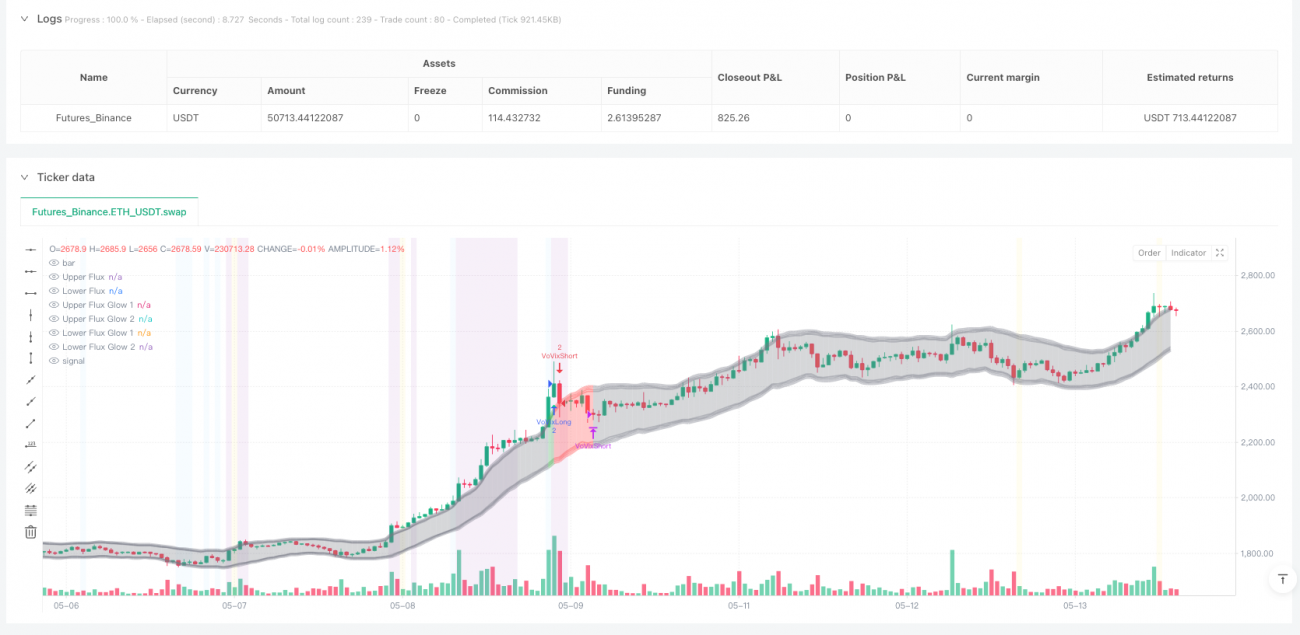
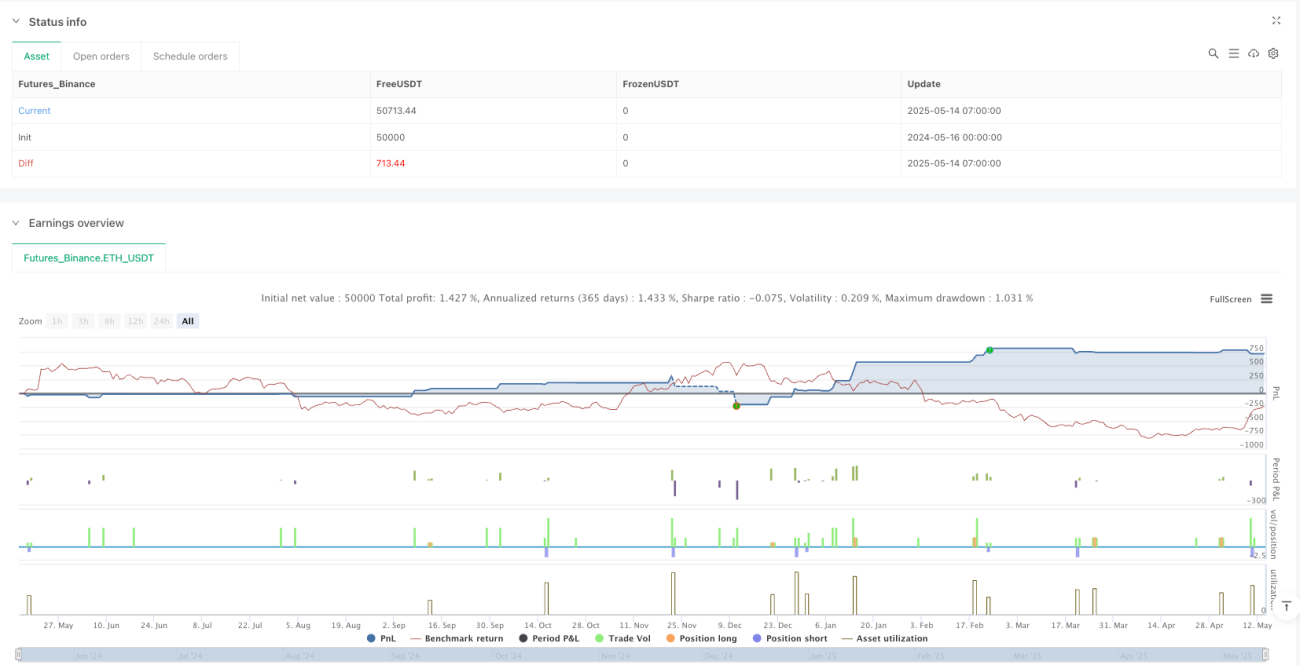
A estratégia utiliza a taxa de variação de flutuação de dois velocidades rápidas ATR, em combinação com a construção padronizada do indicador VoVix, após a detecção do sistema de flutuação real do sistema de conversão de sinal, também é necessário verificar o polinômio da estrutura de preço e confirmar o ponto-chave, e, finalmente, executar a transação em combinação com o gerenciamento de estoque adaptado e o mecanismo de filtragem por períodos. O sistema enfatiza especialmente o mecanismo de verificação de múltiplos fatores, que efetivamente separa a flutuação aleatória do sistema de conversão real, enquanto controla a frequência de negociação, garantindo a qualidade do sinal.
VoVix Core Engine:
Mecanismo de verificação dupla:
Gestão de posições dinâmicas:
Controle de tempo inteligente:
Risco de mudanças na estrutura do mercadoO parâmetro histórico pode não ser válido quando há uma mudança fundamental no mecanismo de geração da taxa de flutuação (por exemplo, uma mudança na política regulatória).
O impacto do Cisne NegroOs indicadores de volatilidade podem se diluir em situações extremas
Risco de dependência de tempoA restrição do horário pode ter deixado de lado a maior parte das atividades durante a noite
Risco de parâmetros de sobreajusteA curva de adequação é uma preocupação em sistemas com múltiplos parâmetros.
Aprendizagem de máquina:
Modelagem da taxa de flutuação:
Otimização de tempo dinâmico:
Controle de risco reforçado:
Esta estratégia, através da inovadora estrutura de quantificação VoVix, constrói um sistema de negociação em uma trinidade de detecção de mudança de sistema - verificação de estrutura de preço - gestão dinâmica de risco. O seu valor central reside na transformação da teoria de agregação de volatilidade acadêmica em sinais de negociação executáveis e no controle da tendência de negociação excessiva por meio de um rigoroso mecanismo de verificação multifatorial.
/*backtest
start: 2024-05-16 00:00:00
end: 2025-05-14 08:00:00
period: 1h
basePeriod: 1h
exchanges: [{"eid":"Futures_Binance","currency":"ETH_USDT"}]
*/
//@version=5
strategy("The VoVix Experiment", default_qty_type=strategy.fixed, initial_capital=10000, overlay=true, pyramiding=1)
// === VOLATILITY CLUSTERING ===
input_vol_cluster = input(true, '🌀 Enable Volatility Clustering', tooltip="Enable volatility clustering filter. Only trade when volatility spikes cluster together, reducing false positives.", group="Volatility Clustering")
vc_window = input.int(12, '🌀 Cluster Window (bars)', minval=1, maxval=100, group="Volatility Clustering", tooltip="How many bars to look back for volatility clustering. Lower = more sensitive, higher = only major clusters trigger.")
vc_spike_mult = input.float(1.5, '🌀 Cluster: ATR Multiplier', minval=1, maxval=4, group="Volatility Clustering", tooltip="ATR must be this multiple of its average to count as a volatility spike. Higher = only extreme events, lower = more signals.")
vc_spike_count = input.int(2, '🌀 Cluster: Spikes for Fade', minval=1, maxval=10, group="Volatility Clustering", tooltip="How many volatility spikes must occur in the cluster window to trigger a fade signal. Higher = rarer, stronger signals.")
// === CRITICAL POINT ===
input_crit_point = input(true, '🎯 Enable Critical Point Detector', tooltip="Enable critical point filter. Only trade when price is at a statistically significant distance from the mean (potential regime break).", group="Critical Point")
cp_window = input.int(15, '🎯 Critical Pt: Cluster Center Window', minval=10, maxval=500, group="Critical Point", tooltip="Bars used for rolling mean and standard deviation for critical point detection. Longer = smoother, shorter = more reactive.")
cp_distance_mult = input.float(2.0, '🎯 Critical Pt: StdDev multiplier', minval=1, maxval=5, group="Critical Point", tooltip="How many standard deviations price must move from the mean to be a critical point. Higher = only extreme moves, lower = more frequent signals.")
cp_volatility_mult = input.float(1.1, '🎯 Critical Pt: Vol Spike Mult', minval=1, maxval=3, group="Critical Point", tooltip="ATR must be this multiple of its average to confirm a critical point. Higher = stronger confirmation, lower = more trades.")
// === VOVIX REGIME ENGINE ===
input_vovix = input(true, '⚡ Enable VoVix Regime Execution', tooltip="Enable the VoVix anomaly detector. Only trade when a volatility-of-volatility spike is detected.", group="VoVix")
vovix_fast_len = input.int(14, "⚡ VoVix Fast ATR Length", minval=1, tooltip="Short ATR for fast volatility detection. Lower = more sensitive.", group="VoVix")
vovix_slow_len = input.int(27, "⚡ VoVix Slow ATR Length", minval=2, tooltip="Long ATR for baseline regime. Higher = more stable.", group="VoVix")
vovix_z_window = input.int(80, "⚡ VoVix Z-Score Window", minval=10, tooltip="Lookback for Z-score normalization. Higher = smoother, lower = more reactive.", group="VoVix")
vovix_entry_z = input.float(1.2, "⚡ VoVix Entry Z-Score", minval=0.5, tooltip="Minimum Z-score for a VoVix spike to trigger a trade.", group="VoVix")
vovix_exit_z = input.float(1.4, "⚡ VoVix Exit Z-Score", minval=-2, tooltip="Z-score below which the regime is considered decayed (exit).", group="VoVix")
vovix_local_max = input.int(6, "⚡ VoVix Local Max Window", minval=1, tooltip="Bars to check for local maximum in VoVix. Higher = stricter.", group="VoVix")
vovix_super_z = input.float(2.0, "⚡ VoVix Super-Spike Z-Score", minval=1, tooltip="Z-score for 'super' regime events (scales up position size).", group="VoVix")
// === TIME SESSION ===
session_start = input.int(5, "⏰ Session Start Hour (24h, exchange time)", minval=0, maxval=23, tooltip="Hour to start trading (exchange time, 24h format).", group="Session")
session_end = input.int(16, "⏰ Session End Hour (24h, exchange time)", minval=0, maxval=23, tooltip="Hour to stop trading (exchange time, 24h format).", group="Session")
allow_weekend = input(false, "📅 Allow Weekend Trading?", tooltip="Enable to allow trades on weekends.", group="Session")
session_timezone = input.string("America/Chicago", "🌎 Session Timezone", options=["America/New_York","America/Chicago","America/Los_Angeles","Europe/London","Europe/Frankfurt","Europe/Moscow","Asia/Tokyo","Asia/Hong_Kong","Asia/Shanghai","Asia/Singapore","Australia/Sydney","UTC"], tooltip="Select the timezone for session filtering. Choose the exchange location that matches your market (e.g., America/Chicago for CME, Europe/London for LSE, Asia/Tokyo for TSE, etc.).", group="Session")
// === SIZING ===
min_contracts = input.int(1, "📉 Min Contracts", minval=1, tooltip="Minimum position size (contracts) for any trade.", group="Adaptive Sizing")
max_contracts = input.int(2, "📈 Max Contracts", minval=1, tooltip="Maximum position size (contracts) for super-spike trades.", group="Adaptive Sizing")
// === VISUALS ===
show_labels = input(true, "🏷️ Show Trade Labels", tooltip="Show/hide entry/exit labels on chart.", group="Visuals")
glowOpacity = input.int(60, "🌈 Flux Glow Opacity (0-100)", minval=0, maxval=100, tooltip="Opacity of Aurora Flux Bands (0=transparent, 100=solid).", group="Visuals")
flux_ema_len = input.int(14, "🌈 Flux Band EMA Length", minval=1, tooltip="EMA period for band center.", group="Visuals")
flux_atr_mult = input.float(1.8, "🌈 Flux Band ATR Multiplier", minval=0.1, tooltip="Width of bands (higher = wider).", group="Visuals")
// === LOGIC ===
// --- VoVix Calculation --- //
fastATR = ta.atr(vovix_fast_len)
slowATR = ta.atr(vovix_slow_len)
voVix = fastATR / slowATR
voVix_avg = ta.sma(voVix, vovix_z_window)
voVix_std = ta.stdev(voVix, vovix_z_window)
voVix_z = voVix_std > 0 ? (voVix - voVix_avg) / voVix_std : 0
// VoVix regime logic
is_vovix_spike = voVix_z > vovix_entry_z and voVix == ta.highest(voVix, vovix_local_max)
is_vovix_super = voVix_z > vovix_super_z
is_vovix_exit = voVix_z < vovix_exit_z
// --- Adaptive Sizing (VoVix strength) --- //
adaptive_contracts = is_vovix_super ? max_contracts : min_contracts
// --- Cluster/Critical Point Logic --- //
atr = ta.atr(14)
spike = atr > (vc_spike_mult * ta.sma(atr, vc_window))
var float[] spike_vals = array.new_float(vc_window, 0)
if bar_index > vc_window
array.unshift(spike_vals, spike[1] ? 1.0 : 0.0)
if array.size(spike_vals) > vc_window
array.pop(spike_vals)
spike_count = array.sum(spike_vals)
clustered_chop = spike_count >= vc_spike_count and input_vol_cluster
cluster_mean = ta.sma(close, cp_window)
cluster_stddev = ta.stdev(close, cp_window)
dist_from_center = math.abs(close[1] - cluster_mean[1])
is_far = dist_from_center > (cp_distance_mult * cluster_stddev[1])
vol_break = atr[1] > (cp_volatility_mult * ta.sma(atr, cp_window)[1])
critical_point = is_far and vol_break and input_crit_point
// --- TIME BLOCK LOGIC --- //
bar_hour = hour(time, session_timezone)
bar_dow = dayofweek(time, session_timezone)
in_session = (session_start < session_end ? (bar_hour >= session_start and bar_hour < session_end) : (bar_hour >= session_start or bar_hour < session_end))
not_weekend = allow_weekend or (bar_dow != dayofweek.saturday and bar_dow != dayofweek.sunday)
trade_allowed = in_session and not_weekend
// --- CONFLUENCE LOGIC: Only trade when VoVix AND (Cluster OR Critical) agree AND in session --- //
confluence = input_vovix and is_vovix_spike and (critical_point or clustered_chop) and trade_allowed
// --- TRADE HANDLER --- //
long_signal = false
short_signal = false
trade_reason = ""
if confluence
long_signal := close > open
short_signal := close < open
trade_reason := "VoVix + " + (critical_point ? "Critical" : "Cluster")
// --- EXECUTION --- //
if long_signal
strategy.entry("VoVixLong", strategy.long, qty=adaptive_contracts, comment=trade_reason)
if short_signal
strategy.entry("VoVixShort", strategy.short, qty=adaptive_contracts, comment=trade_reason)
// VoVix regime exit
if input_vovix and is_vovix_exit
strategy.close("VoVixLong", comment="VoVix Regime Exit")
strategy.close("VoVixShort", comment="VoVix Regime Exit")
// --- REGIME DECAY ZONE AREA (Watermark) --- //
var float decay_zone_start = na
regime_decay_condition = is_vovix_exit
decay_confirmed = not is_vovix_exit
if regime_decay_condition and na(decay_zone_start)
decay_zone_start := bar_index
if decay_confirmed
decay_zone_start := na
show_decay_area = not na(decay_zone_start)
// === AURORA FLUX BANDS (Volatility/Divergence Bands) ===
basis = ta.ema(close, flux_ema_len)
flux_atr = ta.atr(14)
upperBand = basis + flux_atr * flux_atr_mult
lowerBand = basis - flux_atr * flux_atr_mult
color glowColor = na
if long_signal and not short_signal
glowColor := color.new(color.green, glowOpacity)
else if short_signal and not long_signal
glowColor := color.new(color.red, glowOpacity)
else if strategy.position_size > 0
glowColor := color.new(color.lime, math.max(0, glowOpacity * 0.8 + 10))
else if strategy.position_size < 0
glowColor := color.new(color.red, math.max(0, glowOpacity * 0.8 + 10))
else
glowColor := color.new(color.gray, glowOpacity)
upperPlot = plot(upperBand, 'Upper Flux', color=glowColor, linewidth=3, style=plot.style_line)
lowerPlot = plot(lowerBand, 'Lower Flux', color=glowColor, linewidth=3, style=plot.style_line)
plot(upperBand + flux_atr * 0.15, 'Upper Flux Glow 1', color=color.new(glowColor, math.max(0, glowOpacity * 0.7 + 15)), linewidth=4, style=plot.style_line)
plot(upperBand - flux_atr * 0.15, 'Upper Flux Glow 2', color=color.new(glowColor, math.max(0, glowOpacity * 0.7 + 15)), linewidth=2, style=plot.style_line)
plot(lowerBand + flux_atr * 0.15, 'Lower Flux Glow 1', color=color.new(glowColor, math.max(0, glowOpacity * 0.7 + 15)), linewidth=2, style=plot.style_line)
plot(lowerBand - flux_atr * 0.15, 'Lower Flux Glow 2', color=color.new(glowColor, math.max(0, glowOpacity * 0.7 + 15)), linewidth=4, style=plot.style_line)
fill(upperPlot, lowerPlot, color=color.new(glowColor, math.max(0, glowOpacity > 0 ? 85 : 0)), title='Volatility/Divergence Bands')
// --- VISUALS --- //
if show_labels and (long_signal or short_signal)
label.new(bar_index, high, trade_reason, color=color.new(long_signal ? color.green : color.red, 40), style=label.style_label_down)
bgcolor(
is_vovix_super ? color.new(color.purple, 90) :
is_vovix_spike ? color.new(color.blue, 95) :
critical_point ? color.new(color.yellow,90) :
clustered_chop ? color.new(color.orange,93) :
na)
plotshape(long_signal, style=shape.triangleup, location=location.belowbar, color=color.lime, size=size.small, title="Long")
plotshape(short_signal, style=shape.triangledown,location=location.abovebar, color=color.red, size=size.small, title="Short")
// --- REAL-TIME SHARPE / SORTINO CALCULATION ---
var float[] returns = array.new_float()
if strategy.closedtrades > nz(strategy.closedtrades[1])
profit = strategy.closedtrades > 0 ? (strategy.netprofit - nz(strategy.netprofit[1])) : na
if not na(profit)
array.unshift(returns, profit)
if array.size(returns) > 100
array.pop(returns)
float sharpe = na
float sortino = na
if array.size(returns) > 1
avg = array.avg(returns)
stdev = array.stdev(returns)
float[] downside_list = array.new_float()
for i = 0 to array.size(returns) - 1
val = array.get(returns, i)
if val < 0
array.push(downside_list, val)
downside_stdev = array.size(downside_list) > 0 ? array.stdev(downside_list) : na
sharpe := stdev != 0 ? avg / stdev : na
sortino := downside_stdev != 0 ? avg / downside_stdev : na