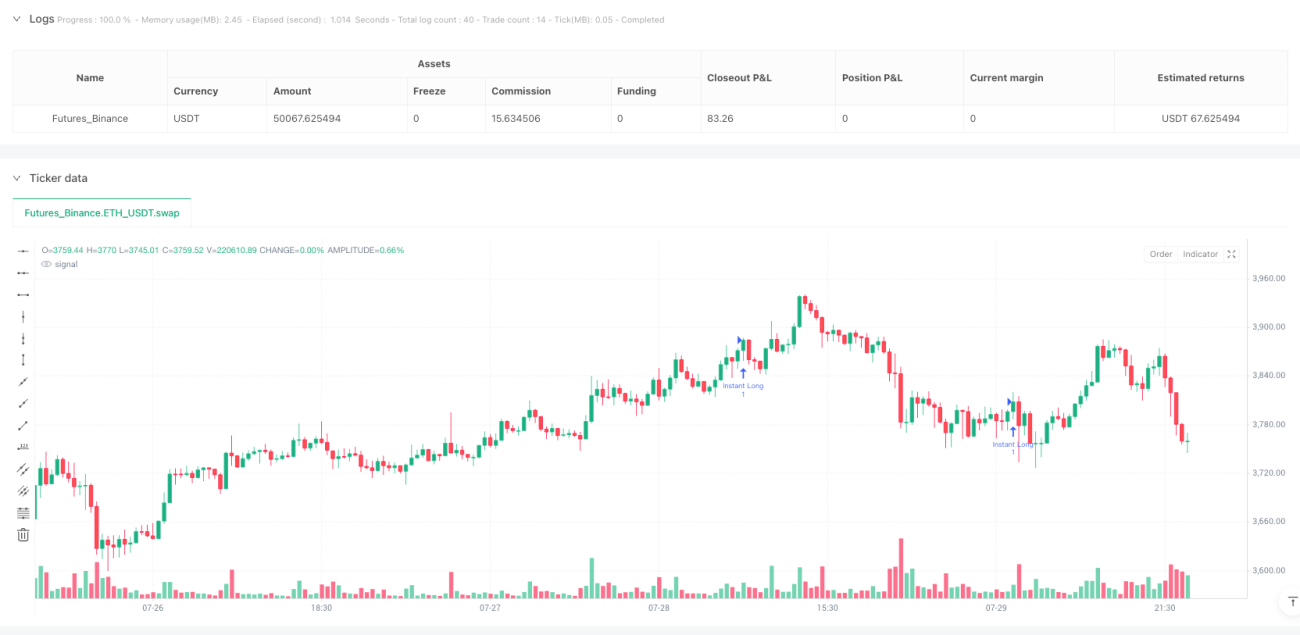
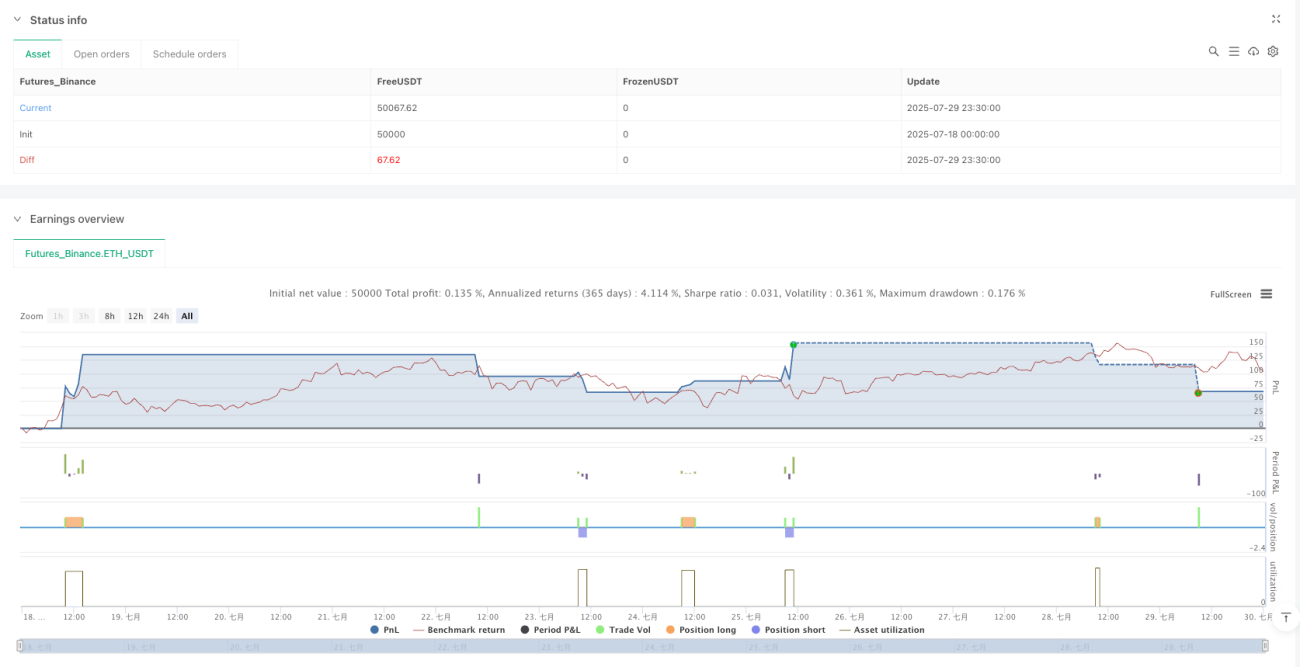
A estratégia ATR Breakout Tracking Stop Loss é um sistema de negociação quantitativa que combina o Opening Range Breakout com a análise inteligente do mercado Smart Money Concepts. A estratégia é focada em capturar breakouts em intervalos de preço que se formam 5 minutos após a abertura do mercado de ações e combina condições de filtragem múltiplas para garantir a qualidade do sinal de negociação.
A lógica central da estratégia de rastreamento de perdas ATR para quebrar o intervalo de abertura baseia-se na importância do intervalo de preços inicial após a abertura do mercado. A estratégia captura e registra os máximos e mínimos de preços em uma determinada janela de tempo (09:30-09:35 EST), formando o “intervalo de abertura” (Opening Range). O sistema monitora o comportamento de quebra de preços nesse intervalo, combinando os seguintes mecanismos fundamentais para garantir a qualidade de negociação:
Identificação e verificação de ruptura em intervalos abertosO sistema registra os pontos mais altos e mais baixos de preços dentro de uma determinada janela de tempo e, em seguida, monitora as rupturas. As rupturas devem ser verificadas através de um mecanismo de dupla filtragem:
Mecanismo de admissãoA estratégia suporta duas formas de entrada:
Configurações de paradaO sistema oferece dois tipos de stop loss:
Gestão de RiscosO sistema usa o Risk:Reward Multiplier para calcular automaticamente a posição de parada, permitindo o gerenciamento dinâmico do risco. Por exemplo, uma configuração de RRR de 2:1 significa que os lucros potenciais são o dobro dos perdas potenciais.
ATR rastreamento de perdaQuando os lucros atingem a taxa de retorno de risco predeterminada, o sistema ativa o tracking stop loss baseado no ATR, bloqueando parte dos lucros e permitindo a continuação da tendência.
Segunda oportunidade de negociaçãoO sistema pode automaticamente procurar oportunidades de ruptura no inverso do intervalo de abertura, possibilitando a negociação bidirecional no mesmo dia, quando a negociação inicial desencadeia uma parada ou falha.
Concentre-se em oportunidades de negócios de alta qualidadeA estratégia reduziu significativamente o número de falsas transações e aumentou a taxa de vitória através de mecanismos de verificação múltipla (filtragem de linhas de sombra e de distância).
Mecanismos flexíveis de admissão: Apoia entrada imediata ou de retorno, adaptando-se a diferentes estilos de negociação e condições de mercado. A entrada imediata é adequada para uma forte tendência, enquanto a entrada de retorno oferece um preço de entrada mais favorável.
Gestão de risco adaptativaA configuração do stop-loss dinâmico baseada na multiplicação do risco-retorno garante que cada transação tenha uma característica de risco consistente, permitindo uma gestão de fundos padronizada.
Maximizar os lucrosATR: A função de rastreamento de stop loss permite que a tendência forte se mantenha, evitando a saída prematura, enquanto protege os lucros obtidos.
Visualização de alta velocidadeO sistema oferece uma ampla gama de recursos de assistência visual, incluindo marcadores de intervalos, etiquetas de verificação de ruptura, indicações de status de negociação e marcadores de entrada / parada / parada, entre outros, para melhorar a intuição das decisões de negociação.
Desenho de retrospectiva sem preconceitosA estratégia é a seguinte:barstate.isconfirmedAssegurar que todas as decisões sejam baseadas em dados de preços confirmados, evitando desvios de previsão e correspondendo ao ambiente de negociação real.
Mecanismo de segunda oportunidadeA estratégia pode adaptar-se rapidamente às mudanças no mercado, capturar oportunidades de reversão e melhorar a eficiência do uso de fundos ao ativar a função de negociação de segunda oportunidade.
Otimização da gestão de sessõesA função de fechamento automático de sessão, que garante que as posições não sejam mantidas durante a noite, reduz o risco de overnight.
Risco de flutuação da fase de formação do intervaloNo período de formação do intervalo de abertura (09:30-09:35), o mercado pode ter flutuações anormais, resultando em intervalos muito largos ou muito estreitos. Intervalos muito largos podem levar a perdas excessivas, enquanto intervalos muito estreitos podem desencadear falsas rupturas com frequência. O que fazer?Pode-se considerar o aumento do filtro do tamanho do intervalo de abertura para excluir intervalos anormais; ou ajustar o filtro de data de negociação para evitar dias específicos de alta volatilidade (como os dias de divulgação de dados econômicos importantes).
Risco de retirada acentuada após a invasãoO mercado pode retroceder drasticamente após a ruptura efetiva, o que pode levar ao retorno do mercado após a ação do stop loss. O que fazer?Considere o uso de configurações de stop-loss mais flexíveis, como stop-loss paralelo; ou ajuste o mecanismo de entrada para reverter a entrada para obter um melhor preço de entrada e menor exposição ao risco.
A qualidade do sinal depende da configuração do filtroO filtro de linha de sombra e a configuração de parâmetros de filtro de distância verificados pela ruptura têm um impacto significativo na qualidade do sinal. Os parâmetros inadequados podem filtrar boas oportunidades de negociação ou receber sinais de baixa qualidade. O que fazer?Optimizar os parâmetros do filtro através da retrospectiva histórica para encontrar a melhor configuração para um determinado mercado e variedade; considerar o uso de parâmetros de adaptação para ajustar os padrões de filtragem de acordo com a dinâmica de volatilidade do mercado.
Sensibilidade do parâmetro de tracking stop lossATR: A configuração excessiva do parâmetro de rastreamento de stop loss pode levar a uma saída prematura em uma pequena retracção, enquanto a configuração excessiva pode levar a uma retracção excessiva de lucro. O que fazer?Ajustar o ciclo e a multiplicação do ATR com base nas características de flutuação histórica da variedade alvo; considerar a implementação de estratégias de liquidação em lotes, com paradas fixas em algumas posições e paradas de rastreamento em outras.
Limitação de frequência de transaçãoEstratégia: executar no máximo duas operações por dia (transações iniciais e transações de segunda oportunidade), podendo não aproveitar todas as oportunidades do dia. O que fazer?Considere estratégias de expansão, monitorando os principais intervalos de preços em outros períodos do dia; ou, combinando com outros indicadores técnicos, forme estratégias de combinação para aumentar a fonte de sinais de negociação.
Adaptação ao ciclo de intervalos de aberturaA estratégia atual usa um intervalo de abertura de 5 minutos fixo, mas o tempo do intervalo pode ser ajustado de acordo com a dinâmica de volatilidade do mercado. O intervalo pode ser reduzido para 3 minutos em mercados de baixa volatilidade e pode ser estendido para 10 minutos em mercados de alta volatilidade, para melhor se adaptar a diferentes condições de mercado.
Confirmação de volume de transação combinadaAumentar a quantidade de transações filtradas no mecanismo de verificação de ruptura, exigindo que o volume de transações no momento da ruptura seja significativamente maior do que o volume de transações médio dos ciclos anteriores, aumentando a eficácia da ruptura. Isso pode ser alcançado calculando a proporção entre o volume de transações da ruptura e o valor médio do volume de transações dos N ciclos anteriores.
Análise de Multi-Framas de TempoIntrodução de filtros de direção de tendência em quadros de tempo mais elevados, para entrar em jogo apenas quando a direção da tendência da linha do dia ou da linha da hora coincide com a direção da ruptura, aumentando a taxa de vitória das negociações. A tendência de quadros de tempo mais elevados pode ser determinada por meio de um simples gradiente de média móvel ou um indicador de tendência mais avançado.
Optimizar a gestão de fundosImplementação de mecanismos de ajustamento dinâmico do tamanho da posição, ajustando automaticamente o número de contratos com base na volatilidade histórica, tamanho da conta atual e desempenho recente, permitindo um controle de risco mais preciso. Por exemplo, aumentar gradualmente a posição após um lucro contínuo e reduzir a posição após um prejuízo contínuo.
Modelos de aprendizagem de máquina integradosIntrodução de modelos de aprendizagem de máquina para avaliar a qualidade das rupturas e identificação dos padrões de ruptura com maior probabilidade de sucesso por meio de modelos de treinamento de dados históricos. As características podem incluir o tamanho do intervalo de abertura, a volatilidade do mercado, a movimentação dos preços no dia de negociação anterior e padrões de tempo específicos.
Melhorar a lógica de negociação de segunda oportunidadeOptimizar as condições de disparo de transações de segunda oportunidade, não apenas com base no fracasso das transações iniciais, mas também levando em conta as mudanças na estrutura do mercado e os novos indicadores de dinâmica para aumentar a taxa de sucesso das transações de segunda oportunidade.
Parâmetros de variedades personalizadas: Desenvolver um conjunto de parâmetros otimizado para as diferentes variedades de negociação, levando em conta as características de flutuação e o comportamento de preços únicos de cada variedade. Por exemplo, variedades com maior flutuação podem necessitar de configurações de filtros mais flexíveis e uma relação de risco-retorno mais conservadora.
Integração de indicadores de sentimento de mercadoIntrodução do índice VIX ou outros indicadores de sentimento de mercado, ajuste de parâmetros estratégicos ou suspensão temporária de negociação durante períodos de sentimento de mercado extremo, evitando ambientes de alta incerteza.
A estratégia de tracking de perda ATR de breakout em intervalos de abertura é um sistema de negociação quantitativa bem estruturado, que combina habilmente breakouts em intervalos de abertura, mecanismos de filtragem inteligentes, opções de entrada flexíveis e funções avançadas de gerenciamento de risco. A estratégia é especialmente adequada para negociação intradiária de ações e futuros dos EUA.
O valor central da estratégia reside em seu mecanismo de verificação em vários níveis e sistema de gerenciamento de risco, reduzindo significativamente as falsas transações de ruptura por meio de filtros de linha de sombra e distância, enquanto o uso de multiplicação de risco e traçado de stop loss ATR garante exposição ao risco consistente e proteção de lucros. A função de negociação de segunda oportunidade acrescenta adaptabilidade e oportunidades de lucro adicional à estratégia.
Apesar das vantagens da estratégia, os usuários devem estar atentos à importância da otimização de parâmetros, que podem precisar de ajustes específicos para diferentes mercados e variedades para obter o melhor efeito. Além disso, é recomendado que os comerciantes usem a estratégia como parte de um sistema de negociação completo, em combinação com a análise de mercado mais ampla e os princípios de gerenciamento de risco.
A estratégia tem o potencial de melhorar ainda mais a sua estabilidade e rentabilidade, tornando-se uma ferramenta poderosa na caixa de ferramentas dos comerciantes profissionais, através da implementação de orientações de otimização das recomendações, especialmente os parâmetros adaptativos, a análise de múltiplos prazos e o sistema de gestão de fundos reforçado.
/*backtest
start: 2025-07-18 00:00:00
end: 2025-07-30 00:00:00
period: 30m
basePeriod: 30m
exchanges: [{"eid":"Futures_Binance","currency":"ETH_USDT"}]
*/
//@version=5
strategy("Casper SMC 5min ORB - Roboquant AI", overlay=true, default_qty_type=strategy.fixed, default_qty_value=1, max_bars_back=500, calc_on_order_fills=true, calc_on_every_tick=false, initial_capital=50000, currency=currency.USD)
// === STRATEGY SETTINGS ===
// Risk Management
contracts = input.int(1, "Contracts", minval=1, group="Risk Management")
risk_multiplier = input.float(2.0, "Risk:Reward Multiplier", minval=0.5, maxval=10.0, group="Risk Management")
sl_points = input.int(2, "Stop Loss Points Below/Above Breakout Candle", minval=1, group="Risk Management")
// Entry Settings
entry_type = input.string("Instant", "Entry Type", options=["Retracement", "Instant"], group="Entry Settings")
retracement_percent = input.float(50.0, "Retracement % of Breakout Candle Body", minval=10.0, maxval=90.0, group="Entry Settings")
// Stop Loss Settings
sl_type = input.string("Opposite Range", "Stop Loss Type", options=["Breakout Candle", "Opposite Range"], group="Stop Loss Settings")
// Second Chance Trade Settings
enable_second_chance = input.bool(false, "Enable Second Chance Trade", group="Second Chance Trade")
second_chance_info = input.string("If initial SL is hit, allow opposite breakout trade", "Info: Second Chance Logic", group="Second Chance Trade")
// Breakout Filter Settings
use_wick_filter = input.bool(false, "Use Wick Filter", group="Breakout Filter")
max_wick_percent = input.float(50.0, "Max Wick % of Candle Body", minval=10.0, maxval=200.0, group="Breakout Filter")
// Breakout Distance Filters
use_breakout_distance_filter = input.bool(true, "Use Breakout Distance Filter", group="Breakout Distance Filter")
min_breakout_multiplier = input.float(0.1, "Min Breakout Distance (OR Size * X)", minval=0.0, maxval=3.0, group="Breakout Distance Filter")
max_breakout_multiplier = input.float(1.6, "Max Breakout Distance (OR Size * X)", minval=0.5, maxval=5.0, group="Breakout Distance Filter")
// Trailing Stop Loss Settings
use_trailing_sl = input.bool(false, "Use Trailing Stop Loss", group="Trailing Stop Loss")
profit_r_multiplier = input.float(1.0, "Start Trailing After X R Profit", minval=0.5, maxval=5.0, group="Trailing Stop Loss")
atr_length = input.int(14, "ATR Length", minval=1, maxval=50, group="Trailing Stop Loss")
atr_multiplier = input.float(1.0, "ATR Multiplier for Trailing", minval=0.5, maxval=5.0, group="Trailing Stop Loss")
// Session Management
or_start_hour = input.int(9, "Opening Range Start Hour", minval=0, maxval=23, group="Session Management")
or_start_minute = input.int(30, "Opening Range Start Minute", minval=0, maxval=59, group="Session Management")
or_end_minute = input.int(35, "Opening Range End Minute", minval=0, maxval=59, group="Session Management")
session_timezone = input.string("America/New_York", "Session Timezone", group="Session Management")
force_session_close = input.bool(true, "Force Close at Session End", group="Session Management")
session_end_hour = input.int(16, "Session End Hour", minval=0, maxval=23, group="Session Management")
session_end_minute = input.int(0, "Session End Minute", minval=0, maxval=59, group="Session Management")
// Day of Week Trading Filters
trade_monday = input.bool(true, "Trade on Monday", group="Day of Week Filters")
trade_tuesday = input.bool(true, "Trade on Tuesday", group="Day of Week Filters")
trade_wednesday = input.bool(true, "Trade on Wednesday", group="Day of Week Filters")
trade_thursday = input.bool(true, "Trade on Thursday", group="Day of Week Filters")
trade_friday = input.bool(true, "Trade on Friday", group="Day of Week Filters")
// Visual Settings
high_line_color = input.color(color.green, title="Opening Range High Line Color", group="Visual Settings")
low_line_color = input.color(color.red, title="Opening Range Low Line Color", group="Visual Settings")
// Label Control Settings
show_trading_disabled_labels = input.bool(false, "Show Trading Disabled Labels", group="Label Controls")
show_breakout_validation_labels = input.bool(true, "Show Breakout Validation Labels", group="Label Controls")
show_second_chance_labels = input.bool(false, "Show Second Chance Labels", group="Label Controls")
show_trade_status_labels = input.bool(false, "Show Trade Status Labels", group="Label Controls")
show_entry_labels = input.bool(false, "Show Entry Labels", group="Label Controls")
show_sl_tp_labels = input.bool(false, "Show Stop Loss / Take Profit Labels", group="Label Controls")
// === VARIABLES ===
// ATR for trailing stop loss
atr = ta.atr(atr_length)
// === NYSE OPENING RANGE LOGIC ===
// FIXED: Using configurable hour/minute inputs with timezone
current_time = time(timeframe.period, "0000-2400:23456", session_timezone)
current_hour = hour(current_time, session_timezone)
current_minute = minute(current_time, session_timezone)
is_opening_range = current_hour == or_start_hour and current_minute >= or_start_minute and current_minute <= or_end_minute
// Check if we're at the start of a new trading day - FIXED: More reliable detection
is_new_day = ta.change(time("1D"))
// ADDED: Check if trading is allowed on current day of week (using session timezone)
current_day = dayofweek(current_time, session_timezone)
is_trading_day_allowed = (current_day == dayofweek.monday and trade_monday) or (current_day == dayofweek.tuesday and trade_tuesday) or (current_day == dayofweek.wednesday and trade_wednesday) or (current_day == dayofweek.thursday and trade_thursday) or (current_day == dayofweek.friday and trade_friday)
// Variables to store opening range high and low for current day
var float or_high = na
var float or_low = na
var bool lines_drawn = false
var bool breakout_occurred = false
var float breakout_candle_high = na
var float breakout_candle_low = na
var float breakout_price = na
var string breakout_direction = na
var int or_start_bar = na // ADDED: Store the bar index when opening range starts
// ADDED: Second chance trade variables
var bool first_trade_sl_hit = false
var string first_trade_direction = na
var bool second_chance_available = false
var bool second_trade_taken = false
var bool daily_trades_complete = false // ADDED: Prevent more than 2 trades per day
// Reset variables at the start of each trading day
if is_new_day
or_high := na
or_low := na
lines_drawn := false
breakout_occurred := false
breakout_candle_high := na
breakout_candle_low := na
breakout_price := na
breakout_direction := na
or_start_bar := na // ADDED: Reset opening range start bar
// ADDED: Reset second chance variables
first_trade_sl_hit := false
first_trade_direction := na
second_chance_available := false
second_trade_taken := false
daily_trades_complete := false // ADDED: Reset trade limit
// Capture opening range data during 09:30-09:35 EST
if is_opening_range
if na(or_high) or na(or_low)
or_high := high
or_low := low
or_start_bar := bar_index // ADDED: Store the bar index when opening range starts
else
or_high := math.max(or_high, high)
or_low := math.min(or_low, low)
// Draw lines when we're past the opening range and haven't drawn yet
if not is_opening_range and not na(or_high) and not na(or_low) and not na(or_start_bar) and not lines_drawn
// FIXED: Lines start from the actual opening range start time and extend forward
start_x = or_start_bar
end_x = bar_index + 50 // Extend lines forward for visibility
lines_drawn := true
// ADDED: Show visual indicator if trading is disabled for current day
if not is_trading_day_allowed and show_trading_disabled_labels
day_name = current_day == dayofweek.monday ? "Monday" :
current_day == dayofweek.tuesday ? "Tuesday" :
current_day == dayofweek.wednesday ? "Wednesday" :
current_day == dayofweek.thursday ? "Thursday" :
current_day == dayofweek.friday ? "Friday" : "Weekend"
label.new(x=bar_index, y=(or_high + or_low) / 2, text="Trading Disabled\n" + day_name, color=color.gray, textcolor=color.white, style=label.style_label_center, size=size.normal)
// Check for breakouts after opening range is complete (only first breakout of the day)
// FIXED: Added barstate.isconfirmed to avoid lookahead bias
if barstate.isconfirmed and not is_opening_range and not na(or_high) and not na(or_low) and lines_drawn and not breakout_occurred and not daily_trades_complete and is_trading_day_allowed
// Calculate candle body and wick percentages
candle_body = math.abs(close - open)
top_wick = high - math.max(open, close)
bottom_wick = math.min(open, close) - low
top_wick_percent = candle_body > 0 ? (top_wick / candle_body) * 100 : 0
bottom_wick_percent = candle_body > 0 ? (bottom_wick / candle_body) * 100 : 0
// ADDED: Calculate opening range size for distance filters
or_size = or_high - or_low
// Check for first breakout above opening range high
if close > or_high
// FIXED: Mark breakout as occurred FIRST (this is THE breakout candle)
breakout_occurred := true
breakout_candle_high := high
breakout_candle_low := low
breakout_price := close
breakout_direction := "long"
// ADDED: Validate this specific breakout candle against distance filter
breakout_distance_valid = true
if use_breakout_distance_filter
min_breakout_level = or_high + (or_size * min_breakout_multiplier)
max_breakout_level = or_high + (or_size * max_breakout_multiplier)
breakout_distance_valid := close >= min_breakout_level and close <= max_breakout_level
// Apply wick filter for long breakouts
wick_filter_valid = not use_wick_filter or top_wick_percent <= max_wick_percent
// Show appropriate label based on validation results
if show_breakout_validation_labels
if wick_filter_valid and breakout_distance_valid
label.new(x=bar_index, y=high, text="VALID", color=high_line_color, textcolor=color.white, style=label.style_label_down, size=size.tiny)
else
label.new(x=bar_index, y=high, text="INVALID", color=color.gray, textcolor=color.white, style=label.style_label_down, size=size.tiny)
// Mark breakout as invalid so no trade will be placed (regardless of label setting)
if not (wick_filter_valid and breakout_distance_valid)
breakout_direction := "invalid"
// Check for first breakout below opening range low
else if close < or_low
// FIXED: Mark breakout as occurred FIRST (this is THE breakout candle)
breakout_occurred := true
breakout_candle_high := high
breakout_candle_low := low
breakout_price := close
breakout_direction := "short"
// ADDED: Validate this specific breakout candle against distance filter
breakout_distance_valid = true
if use_breakout_distance_filter
min_breakout_level = or_low - (or_size * min_breakout_multiplier)
max_breakout_level = or_low - (or_size * max_breakout_multiplier)
breakout_distance_valid := close <= min_breakout_level and close >= max_breakout_level
// Apply wick filter for short breakouts
wick_filter_valid = not use_wick_filter or bottom_wick_percent <= max_wick_percent
// Show appropriate label based on validation results
if show_breakout_validation_labels
if wick_filter_valid and breakout_distance_valid
label.new(x=bar_index, y=low, text="VALID", color=low_line_color, textcolor=color.white, style=label.style_label_up, size=size.tiny)
else
label.new(x=bar_index, y=low, text="INVALID", color=color.gray, textcolor=color.white, style=label.style_label_up, size=size.tiny)
// Mark breakout as invalid so no trade will be placed (regardless of label setting)
if not (wick_filter_valid and breakout_distance_valid)
breakout_direction := "invalid"
// ADDED: Check for second chance breakout (opposite direction after initial SL hit)
// FIXED: Added barstate.isconfirmed to avoid lookahead bias
if barstate.isconfirmed and not is_opening_range and not na(or_high) and not na(or_low) and lines_drawn and second_chance_available and not second_trade_taken and not daily_trades_complete and is_trading_day_allowed
// Calculate candle body and wick percentages
candle_body = math.abs(close - open)
top_wick = high - math.max(open, close)
bottom_wick = math.min(open, close) - low
top_wick_percent = candle_body > 0 ? (top_wick / candle_body) * 100 : 0
bottom_wick_percent = candle_body > 0 ? (bottom_wick / candle_body) * 100 : 0
// ADDED: Calculate opening range size for distance filters
or_size = or_high - or_low
// If first trade was LONG and failed, look for SHORT breakout
if first_trade_direction == "long" and close < or_low
// FIXED: Mark second chance breakout as taken FIRST
second_trade_taken := true
second_chance_available := false
breakout_candle_high := high
breakout_candle_low := low
breakout_price := close
breakout_direction := "short"
// ADDED: Validate this specific breakout candle against distance filter
breakout_distance_valid = true
if use_breakout_distance_filter
min_breakout_level = or_low - (or_size * min_breakout_multiplier)
max_breakout_level = or_low - (or_size * max_breakout_multiplier)
breakout_distance_valid := close <= min_breakout_level and close >= max_breakout_level
// Apply wick filter for short breakouts
wick_filter_valid = not use_wick_filter or bottom_wick_percent <= max_wick_percent
// Show appropriate label based on validation results
if show_second_chance_labels
if wick_filter_valid and breakout_distance_valid
label.new(x=bar_index, y=low, text="2nd Chance\nOR Low Break\nVALID", color=color.orange, textcolor=color.white, style=label.style_label_up, size=size.tiny)
else
label.new(x=bar_index, y=low, text="2nd Chance\nOR Low Break\nINVALID", color=color.gray, textcolor=color.white, style=label.style_label_up, size=size.tiny)
// Mark breakout as invalid so no trade will be placed (regardless of label setting)
if not (wick_filter_valid and breakout_distance_valid)
breakout_direction := "invalid"
// If first trade was SHORT and failed, look for LONG breakout
else if first_trade_direction == "short" and close > or_high
// FIXED: Mark second chance breakout as taken FIRST
second_trade_taken := true
second_chance_available := false
breakout_candle_high := high
breakout_candle_low := low
breakout_price := close
breakout_direction := "long"
// ADDED: Validate this specific breakout candle against distance filter
breakout_distance_valid = true
if use_breakout_distance_filter
min_breakout_level = or_high + (or_size * min_breakout_multiplier)
max_breakout_level = or_high + (or_size * max_breakout_multiplier)
breakout_distance_valid := close >= min_breakout_level and close <= max_breakout_level
// Apply wick filter for long breakouts
wick_filter_valid = not use_wick_filter or top_wick_percent <= max_wick_percent
// Show appropriate label based on validation results
if show_second_chance_labels
if wick_filter_valid and breakout_distance_valid
label.new(x=bar_index, y=high, text="2nd Chance\nOR High Break\nVALID", color=color.orange, textcolor=color.white, style=label.style_label_down, size=size.tiny)
else
label.new(x=bar_index, y=high, text="2nd Chance\nOR High Break\nINVALID", color=color.gray, textcolor=color.white, style=label.style_label_down, size=size.tiny)
// Mark breakout as invalid so no trade will be placed (regardless of label setting)
if not (wick_filter_valid and breakout_distance_valid)
breakout_direction := "invalid"
// === STRATEGY LOGIC ===
// Check if we have a breakout and place retracement entry orders
var bool entry_placed = false
var bool second_entry_placed = false // ADDED: Track second trade entry separately
var float entry_price = na
var float stop_loss = na
var float take_profit = na
var float trailing_stop = na
var bool trailing_active = false
var float initial_risk = na
var bool trailing_started = false
var string current_entry_id = na // FIXED: Track which entry ID we're using
// Arrays to store historical trade boxes
var array<box> historical_trade_boxes = array.new<box>()
var array<box> historical_sl_boxes = array.new<box>()
var array<box> historical_tp_boxes = array.new<box>()
// Variables to track current active trade boxes for extending to exit
var box current_profit_box = na
var box current_sl_box = na
// ADDED: General position close detection for extending boxes - Handle timing issues
if barstate.isconfirmed and strategy.position_size == 0 and strategy.position_size[1] != 0
// Extend trade visualization boxes to exact exit point when any position closes
if not na(current_profit_box)
// Ensure minimum 8 bars width or extend to current bar, whichever is longer
box_left = box.get_left(current_profit_box)
min_right = box_left + 8
final_right = math.max(min_right, bar_index)
box.set_right(current_profit_box, final_right)
current_profit_box := na // Clear reference after extending
if not na(current_sl_box)
// Ensure minimum 8 bars width or extend to current bar, whichever is longer
box_left = box.get_left(current_sl_box)
min_right = box_left + 8
final_right = math.max(min_right, bar_index)
box.set_right(current_sl_box, final_right)
current_sl_box := na // Clear reference after extending
// ADDED: Backup safety check - extend boxes if position is closed but boxes still active
if not na(current_profit_box) and strategy.position_size == 0
box_left = box.get_left(current_profit_box)
min_right = box_left + 8
final_right = math.max(min_right, bar_index)
box.set_right(current_profit_box, final_right)
current_profit_box := na
if not na(current_sl_box) and strategy.position_size == 0
box_left = box.get_left(current_sl_box)
min_right = box_left + 8
final_right = math.max(min_right, bar_index)
box.set_right(current_sl_box, final_right)
current_sl_box := na
// Reset entry flag on new day
if is_new_day
entry_placed := false
second_entry_placed := false // ADDED: Reset second entry flag
entry_price := na
stop_loss := na
take_profit := na
trailing_stop := na
trailing_active := false
initial_risk := na
trailing_started := false
current_entry_id := na // FIXED: Reset entry ID
current_profit_box := na // ADDED: Reset current trade boxes
current_sl_box := na
// SIMPLIFIED: Detect when position closes to enable second chance (FIXED for lookahead bias)
if barstate.isconfirmed and strategy.position_size == 0 and strategy.position_size[1] != 0 and entry_placed and not first_trade_sl_hit
// A position just closed and we had an active trade
if enable_second_chance and not second_trade_taken
// Simplified logic - if position closed, enable second chance
first_trade_sl_hit := true
first_trade_direction := breakout_direction
second_chance_available := true
// Reset variables for potential second trade
entry_price := na
trailing_stop := na
trailing_active := false
initial_risk := na
trailing_started := false
current_entry_id := na
// Add visual marker
if show_trade_status_labels
label.new(x=bar_index, y=close, text="Trade Closed\nSecond Chance Available", color=color.yellow, textcolor=color.black, style=label.style_label_down, size=size.tiny)
else
// Second chance not enabled or already taken - mark day complete
daily_trades_complete := true
// ADDED: Handle case where first breakout was invalid (no trade placed)
if breakout_occurred and breakout_direction == "invalid" and enable_second_chance and not first_trade_sl_hit
// First breakout was invalid, enable second chance immediately
first_trade_sl_hit := true
// Determine what direction the invalid breakout was
first_trade_direction := breakout_price > or_high ? "long" : "short"
second_chance_available := true
if show_trade_status_labels
label.new(x=bar_index + 1, y=(or_high + or_low) / 2, text="First Breakout Invalid\nSecond Chance Available", color=color.yellow, textcolor=color.black, style=label.style_label_center, size=size.tiny)
// REMOVED: Complex historical box cleanup to avoid lookahead bias
// Historical boxes will be cleaned up automatically by Pine Script's runtime
// Place entry orders after breakout - FIXED: Add barstate.isconfirmed for consistency
if barstate.isconfirmed and not daily_trades_complete and is_trading_day_allowed and ((breakout_occurred and not entry_placed and not na(breakout_candle_high) and breakout_direction != "invalid") or (second_trade_taken and not second_entry_placed and not na(breakout_candle_high) and breakout_direction != "invalid"))
// For long breakout
if breakout_direction == "long"
// Calculate stop loss based on selected method
if sl_type == "Breakout Candle"
stop_loss := breakout_candle_low - (sl_points * syminfo.mintick)
else
// Use opposite side of opening range (below opening range low)
stop_loss := or_low - (sl_points * syminfo.mintick)
if entry_type == "Retracement"
// Calculate retracement entry price (x% of breakout candle body)
breakout_candle_body = breakout_candle_high - breakout_candle_low
retracement_amount = breakout_candle_body * (retracement_percent / 100)
entry_price := breakout_candle_high - retracement_amount
// FIXED: Store the entry ID we're using (differentiate first vs second chance)
current_entry_id := second_trade_taken ? "Long Retracement 2nd" : "Long Retracement"
// Place buy limit order at retracement level
strategy.entry(current_entry_id, strategy.long, limit=entry_price, qty=contracts)
// Add visual markers
if show_entry_labels
entry_label_text = second_trade_taken ? "BUY LIMIT (2nd)\n" + str.tostring(entry_price, "#.##") : "BUY LIMIT\n" + str.tostring(entry_price, "#.##")
label.new(x=bar_index, y=entry_price, text=entry_label_text, color=color.green, textcolor=color.white, style=label.style_label_up, size=size.tiny)
else
// Immediate entry at breakout candle close
entry_price := breakout_price
// FIXED: Store the entry ID we're using (differentiate first vs second chance)
current_entry_id := second_trade_taken ? "Instant Long 2nd" : "Instant Long"
// Place buy market order
strategy.entry(current_entry_id, strategy.long, qty=contracts)
// Add visual markers
if show_entry_labels
entry_label_text = second_trade_taken ? "BUY MARKET (2nd)\n" + str.tostring(entry_price, "#.##") : "BUY MARKET\n" + str.tostring(entry_price, "#.##")
label.new(x=bar_index, y=entry_price, text=entry_label_text, color=color.green, textcolor=color.white, style=label.style_label_up, size=size.tiny)
// Calculate take profit based on risk:reward
risk_size = entry_price - stop_loss
take_profit := entry_price + (risk_size * risk_multiplier)
// FIXED: Set exit orders with proper entry ID and always include initial stop loss
if use_trailing_sl
// Initialize trailing stop and calculate initial risk
trailing_stop := stop_loss
trailing_active := true
initial_risk := math.abs(entry_price - stop_loss)
trailing_started := false
// FIXED: Always set initial stop loss, even with trailing enabled
exit_id = second_trade_taken ? "Long Exit 2nd" : "Long Exit"
strategy.exit(exit_id, current_entry_id, stop=stop_loss, limit=take_profit)
else
// FIXED: Use stored entry ID
exit_id = second_trade_taken ? "Long Exit 2nd" : "Long Exit"
strategy.exit(exit_id, current_entry_id, stop=stop_loss, limit=take_profit)
// Create trade visualization boxes (TradingView style) - FIXED: Minimum 8 bars width
// Blue profit zone box (from entry to take profit)
// Store trade boxes for historical display - FIXED: Remove time usage
array.push(historical_trade_boxes, current_profit_box)
array.push(historical_sl_boxes, current_sl_box)
array.push(historical_tp_boxes, na) // No TP box for long trades
// Add stop loss and take profit markers
if show_sl_tp_labels
label.new(x=bar_index, y=stop_loss, text="SL\n" + str.tostring(stop_loss, "#.##"), color=color.red, textcolor=color.white, style=label.style_label_down, size=size.tiny)
label.new(x=bar_index, y=take_profit, text="TP\n" + str.tostring(take_profit, "#.##"), color=color.blue, textcolor=color.white, style=label.style_label_down, size=size.tiny)
// ADDED: Set the appropriate entry flag based on which trade this is
if second_trade_taken
second_entry_placed := true
daily_trades_complete := true
else
entry_placed := true
// For short breakout
else if breakout_direction == "short"
// Calculate stop loss based on selected method
if sl_type == "Breakout Candle"
stop_loss := breakout_candle_high + (sl_points * syminfo.mintick)
else
// Use opposite side of opening range (above opening range high)
stop_loss := or_high + (sl_points * syminfo.mintick)
if entry_type == "Retracement"
// Calculate retracement entry price (x% of breakout candle body)
breakout_candle_body = breakout_candle_high - breakout_candle_low
retracement_amount = breakout_candle_body * (retracement_percent / 100)
entry_price := breakout_candle_low + retracement_amount
// FIXED: Store the entry ID we're using (differentiate first vs second chance)
current_entry_id := second_trade_taken ? "Short Retracement 2nd" : "Short Retracement"
// Place sell limit order at retracement level
strategy.entry(current_entry_id, strategy.short, limit=entry_price, qty=contracts)
// Add visual markers
if show_entry_labels
entry_label_text = second_trade_taken ? "SELL LIMIT (2nd)\n" + str.tostring(entry_price, "#.##") : "SELL LIMIT\n" + str.tostring(entry_price, "#.##")
label.new(x=bar_index, y=entry_price, text=entry_label_text, color=color.red, textcolor=color.white, style=label.style_label_down, size=size.tiny)
else
// Immediate entry at breakout candle close
entry_price := breakout_price
// FIXED: Store the entry ID we're using (differentiate first vs second chance)
current_entry_id := second_trade_taken ? "Instant 2nd" : "Instant Short"
// Place sell market order
strategy.entry(current_entry_id, strategy.short, qty=contracts)
// Add visual markers
if show_entry_labels
entry_label_text = second_trade_taken ? "SELL MARKET (2nd)\n" + str.tostring(entry_price, "#.##") : "SELL MARKET\n" + str.tostring(entry_price, "#.##")
label.new(x=bar_index, y=entry_price, text=entry_label_text, color=color.red, textcolor=color.white, style=label.style_label_down, size=size.tiny)
// Calculate take profit based on risk:reward
risk_size = stop_loss - entry_price
take_profit := entry_price - (risk_size * risk_multiplier)
// FIXED: Set exit orders with proper entry ID and always include initial stop loss
if use_trailing_sl
// Initialize trailing stop and calculate initial risk
trailing_stop := stop_loss
trailing_active := true
initial_risk := math.abs(entry_price - stop_loss)
trailing_started := false
// FIXED: Always set initial stop loss, even with trailing enabled
exit_id = second_trade_taken ? "Short Exit 2nd" : "Short Exit"
strategy.exit(exit_id, current_entry_id, stop=stop_loss, limit=take_profit)
else
// FIXED: Use stored entry ID
exit_id = second_trade_taken ? "Short Exit 2nd" : "Short Exit"
strategy.exit(exit_id, current_entry_id, stop=stop_loss, limit=take_profit)
// Create trade visualization boxes (TradingView style) - FIXED: Minimum 8 bars width
// Store trade boxes for historical display - FIXED: Remove time usage
array.push(historical_trade_boxes, current_profit_box)
array.push(historical_sl_boxes, current_sl_box)
array.push(historical_tp_boxes, na) // No TP box for short trades
// Add stop loss and take profit markers
if show_sl_tp_labels
label.new(x=bar_index, y=stop_loss, text="SL\n" + str.tostring(stop_loss, "#.##"), color=color.red, textcolor=color.white, style=label.style_label_up, size=size.tiny)
label.new(x=bar_index, y=take_profit, text="TP\n" + str.tostring(take_profit, "#.##"), color=color.blue, textcolor=color.white, style=label.style_label_up, size=size.tiny)
// ADDED: Set the appropriate entry flag based on which trade this is
if second_trade_taken
second_entry_placed := true
daily_trades_complete := true
else
entry_placed := true
// === TRAILING STOP LOGIC ===
// FIXED: Proper trailing stop loss management
if use_trailing_sl and trailing_active and strategy.position_size != 0 and not na(current_entry_id)
if strategy.position_size > 0 // Long position
// Calculate current unrealized profit in points
current_profit = close - entry_price
profit_r = current_profit / initial_risk
// Check if we should start trailing (after X R profit)
if not trailing_started and profit_r >= profit_r_multiplier
trailing_started := true
// Start trailing from a level that's better than the initial stop
trailing_stop := math.max(trailing_stop, close - (atr * atr_multiplier))
// Update trailing stop if trailing has started
if trailing_started
// Calculate new trailing stop using ATR
potential_new_stop = close - (atr * atr_multiplier)
// Only move stop loss up (never down) and ensure it's better than initial SL
if potential_new_stop > trailing_stop and potential_new_stop > stop_loss
trailing_stop := potential_new_stop
// Update the exit order with new trailing stop
exit_id = second_trade_taken ? "Long Exit 2nd" : "Long Exit"
strategy.exit(exit_id, current_entry_id, stop=trailing_stop, limit=take_profit)
else if strategy.position_size < 0 // Short position
// Calculate current unrealized profit in points
current_profit = entry_price - close
profit_r = current_profit / initial_risk
// Check if we should start trailing (after X R profit)
if not trailing_started and profit_r >= profit_r_multiplier
trailing_started := true
// Start trailing from a level that's better than the initial stop
trailing_stop := math.min(trailing_stop, close + (atr * atr_multiplier))
// Update trailing stop if trailing has started
if trailing_started
// Calculate new trailing stop using ATR
potential_new_stop = close + (atr * atr_multiplier)
// Only move stop loss down (never up) and ensure it's better than initial SL
if potential_new_stop < trailing_stop and potential_new_stop < stop_loss
trailing_stop := potential_new_stop
// Update the exit order with new trailing stop
exit_id = second_trade_taken ? "Short Exit 2nd" : "Short Exit"
strategy.exit(exit_id, current_entry_id, stop=trailing_stop, limit=take_profit)
// === SESSION END CLOSE ===
// Force close all positions at configured session end time (optional)
// FIXED: Using configurable hour/minute with timezone
if force_session_close and current_hour == session_end_hour and current_minute == session_end_minute
// ADDED: Extend boxes immediately before session close to prevent timing issues
if not na(current_profit_box)
// Ensure minimum 8 bars width or extend to current bar, whichever is longer
box_left = box.get_left(current_profit_box)
min_right = box_left + 8
final_right = math.max(min_right, bar_index)
box.set_right(current_profit_box, final_right)
current_profit_box := na // Clear reference after extending
if not na(current_sl_box)
// Ensure minimum 8 bars width or extend to current bar, whichever is longer
box_left = box.get_left(current_sl_box)
min_right = box_left + 8
final_right = math.max(min_right, bar_index)
box.set_right(current_sl_box, final_right)
current_sl_box := na // Clear reference after extending
strategy.close_all(comment="Session End Close")
// === ALERTS ===
alert_once_long = (strategy.position_size > 0) and (strategy.position_size[1] == 0)
alert_once_short = (strategy.position_size < 0) and (strategy.position_size[1] == 0)
alertcondition(alert_once_long, title="Long Entry (Once)", message="Long Entry Signal")
alertcondition(alert_once_short, title="Short Entry (Once)", message="Short Entry Signal")