Estratégia de rompimento do momentum RSI do William Alligator

RSI SMA 威廉鳄鱼指标 Williams ALLIGATOR 动量突破 momentum BREAKOUT
Data de criação: 2025-08-19 09:40:27 última modificação: 2025-08-19 09:40:27
cópia: 0 Cliques: 243
2
focar em
319
Seguidores

Estratégia de rompimento do momentum RSI do William Alligator Estratégia de rompimento do momentum RSI do William Alligator

Visão geral

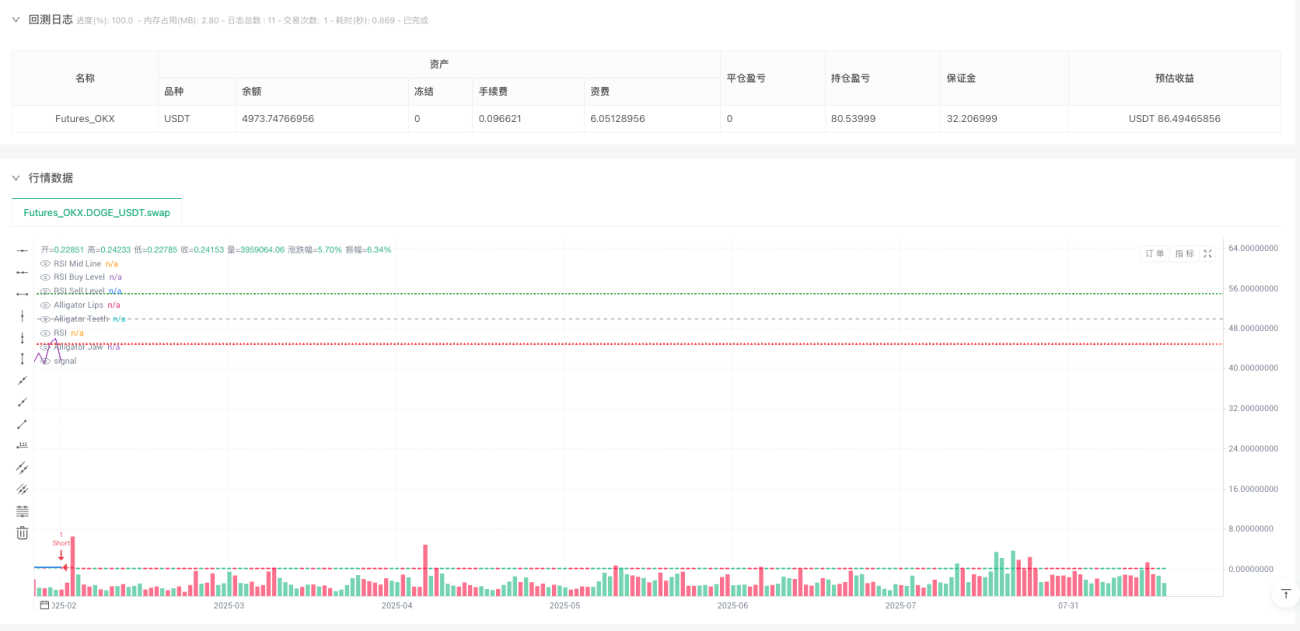
A estratégia de ruptura de momentum do RSI é uma estratégia de negociação quantitativa de vários quadros temporais que integra o William Alligator e o RSI, um indicador relativamente forte. A estratégia usa um ciclo de linha K de 15 minutos para determinar a direção da tendência do mercado através das três médias móveis do indicador do crocodilo (linha do lábio, linha da panturrilha e linha da panturrilha), enquanto combina o RSI para confirmar a intensidade do movimento, formando um sistema completo de sinais de entrada.

Princípio da estratégia

O princípio central da estratégia baseia-se na capacidade de reconhecimento de tendências do William Herschel e na função de confirmação de momentum do RSI. O William Herschel é composto por três médias móveis de três períodos diferentes: a linha de crescimento ((13 ciclos, desvio 8), a linha de crescimento ((8 ciclos, desvio 5), a linha de crescimento ((5 ciclos, desvio 3)). Quando essas três linhas são organizadas de acordo com a ordem da linha de crescimento> linha de crescimento> linha de crescimento, o mercado está em uma tendência ascendente; o contrário é uma tendência descendente.

O trigger de um sinal de compra precisa atender simultaneamente a quatro condições: o preço de fechamento é maior que o Lips, o Lips é maior que o Lips, o Lips é maior que o Lips, o RSI é maior que 55. Este mecanismo de filtragem múltipla garante que a posição seja aberta apenas quando a tendência é clara e com bastante dinâmica. O sinal de venda, ao contrário: o preço de fechamento é menor que o Lips, o Lips é menor que o Lips, o Lips é menor que o Lips, o RSI é menor que o 45.

O mecanismo de stop loss foi projetado para ter uma proteção tripla: RSI retrocedeu para abaixo de 50, o preço caiu abaixo da linha de queda, ou a linha de queda foi abaixo da linha de queda. O stop loss foi configurado para um valor fixo de 25 rupias, fornecendo um controle claro do risco-retorno.

Vantagens estratégicas

Em primeiro lugar, a fusão de vários indicadores oferece maior precisão de sinal. O William Herschel é bom em identificar o início e o fim de uma tendência, enquanto o RSI é capaz de medir eficazmente a dinâmica dos preços, o que, combinado, pode reduzir significativamente a probabilidade de falsos sinais. Em segundo lugar, a estratégia usa a verificação de condições progressivas, que gera sinais de negociação somente quando todas as condições são simultaneamente satisfeitas, aumentando significativamente a taxa de sucesso das negociações.

A estratégia possui boa adaptabilidade, adaptando-se a diferentes ambientes de mercado e variedades de negociação por meio de ajustes de parâmetros. O prazo de 15 minutos permite capturar flutuações de preços de curto e médio prazo e evita negociações excessivamente frequentes. O mecanismo de parada fixa simplifica o processo de decisão de negociação e ajuda a manter a disciplina de negociação.

A estratégia também possui um bom sistema de gerenciamento de riscos, com três condições de parada de perdas que garantem a retirada oportuna em situações adversas e o controle efetivo das perdas máximas de uma única transação. A identificação visual do sinal de negociação torna a execução da estratégia mais intuitiva e conveniente.

Risco estratégico

Os principais riscos para esta estratégia incluem o risco de reversão de tendência. Em caso de forte reversão de mercado, múltiplos indicadores podem falhar ao mesmo tempo, resultando em grandes perdas. Especialmente em mercados turbulentos, os indicadores de piratas podem produzir falsos sinais frequentes, e o RSI também é propenso a leituras enganosas na fase de composição horizontal.

O mecanismo de parada fixa, embora simplifique a operação, também pode limitar o potencial de lucro em uma forte tendência. Quando o mercado apresenta uma tendência unilateral contínua, uma parada prematura pode perder uma oportunidade de lucro maior. O atraso é outro problema a ser considerado, uma vez que o indicador William Herschel é baseado em médias móveis e possui uma característica de atraso natural, o que pode levar a uma entrada de tempo insuficiente.

A sensibilidade dos parâmetros também é um ponto de risco. Os valores críticos do RSI (55 e 45) e os parâmetros periódicos do indicador do peixe-boi precisam ser ajustados para diferentes cenários de mercado, e os parâmetros fixos podem não ser adequados para todas as condições de mercado. Além disso, as estratégias são mais sensíveis aos custos de negociação, e as entradas e saídas frequentes podem ser corroídas por comissões e deslizamentos.

Direção de otimização

O ajuste de parâmetros dinâmicos é uma direção de otimização importante. Pode-se introduzir um mecanismo de adaptação que ajuste automaticamente os limites do RSI e os parâmetros do indicador de piratas de acordo com a volatilidade do mercado. Por exemplo, aumentar os limites do RSI em ambientes de alta volatilidade e reduzir os limites em ambientes de baixa volatilidade para se adaptar a diferentes condições de mercado.

O mecanismo de stop-loss pode ser alterado de um stop-loss fixo para um stop-loss dinâmico, como o uso de múltiplos de ATR (Average True Range) como alvo de stop-loss, para melhor se adaptar às características de flutuação do mercado. Também pode ser considerado o uso de stop-loss de rastreamento, iniciando o stop-loss de rastreamento após a obtenção de um certo nível de lucro para capturar ganhos mais tendenciais.

O aumento do filtro de mercado é outra direção de otimização. Pode-se introduzir um indicador de intensidade do mercado ou um indicador de volatilidade para avaliar se o mercado atual é adequado para a estratégia e suspender a negociação em um ambiente de mercado desfavorável. O filtro de tempo também é importante para evitar a negociação em períodos de baixa liquidez.

O mecanismo de confirmação de sinais pode ser ainda mais intensificado. A confirmação de volume de transação pode ser adicionada, confirmando que o sinal só é eficaz se o volume de transação for maior. A análise de múltiplos períodos de tempo também pode ser considerada, após a confirmação da direção da tendência em períodos de tempo mais altos, para procurar pontos de entrada específicos em períodos de tempo mais baixos.

Resumir

A estratégia de ruptura de impulso RSI do indicador William Sharp é um sistema de negociação quantitativa relativamente bem concebido, com potencial para um bom desempenho em mercados de tendência, através da integração de vários indicadores e da filtragem de condições rigorosas. A principal vantagem da estratégia reside na sua gestão sistemática de riscos e no mecanismo de geração de sinais claro, capaz de fornecer uma estrutura de negociação relativamente estável para os comerciantes.

No entanto, a estratégia também tem algumas limitações, especialmente em mercados de turbulência, onde o desempenho pode não ser o ideal e as configurações de parâmetros fixos podem não se adaptar a todas as circunstâncias do mercado. A adaptabilidade e a lucratividade da estratégia podem ser melhoradas pela introdução de medidas de otimização, como o ajuste de parâmetros dinâmicos, o aprimoramento do mecanismo de suspensão e o aumento da filtragem do ambiente de mercado.

Para os comerciantes que utilizam esta estratégia, é recomendável fazer um bom teste de retorno e verificação em laboratório em diferentes ambientes de mercado e fazer o ajuste apropriado dos parâmetros de acordo com o desempenho real. Ao mesmo tempo, manter uma boa gestão de fundos e disciplina de negociação é um elemento-chave para a implementação bem sucedida da estratégia.

||

Overview

The Williams Alligator RSI Momentum Breakout Strategy is a comprehensive quantitative trading system that integrates the Williams Alligator indicator with the Relative Strength Index (RSI) across multiple timeframes. This strategy operates on 15-minute candlestick intervals, utilizing the Alligator indicator’s three moving average lines (Lips, Teeth, Jaw) to determine market trend direction while incorporating RSI to confirm momentum strength, creating a complete entry and exit signal framework. The strategy features clear stop-loss and take-profit mechanisms with multiple condition filtering to ensure signal reliability, making it particularly suitable for markets with distinct trending characteristics.

Strategy Logic

The core principle of this strategy is based on the Williams Alligator indicator’s trend identification capabilities combined with RSI’s momentum confirmation function. The Williams Alligator consists of three moving averages with different periods: Jaw (13-period, offset 8), Teeth (8-period, offset 5), and Lips (5-period, offset 3). When these three lines align in the sequence Lips > Teeth > Jaw, it indicates an uptrend; the reverse suggests a downtrend.

Long signals require four simultaneous conditions: closing price above Lips, Lips above Teeth, Teeth above Jaw, and RSI above 55. This multi-layer filtering mechanism ensures positions are only opened when both trend clarity and sufficient momentum are present. Short signals operate inversely: closing price below Lips, Lips below Teeth, Teeth below Jaw, and RSI below 45.

The stop-loss mechanism incorporates triple protection: RSI falling below 50, price crossing below Teeth, or Lips dropping below Teeth. The take-profit is set at a fixed amount (25 rupees), providing clear risk-reward ratio control.

Strategy Advantages

Firstly, the multi-indicator fusion provides enhanced signal accuracy. The Williams Alligator excels at identifying trend beginnings and endings, while RSI effectively measures price momentum; their combination significantly reduces false signal probability. Secondly, the strategy employs progressive condition verification, generating trading signals only when all conditions are simultaneously satisfied, substantially improving trade success rates.

The strategy demonstrates good adaptability, allowing parameter adjustments to suit different market environments and trading instruments. The 15-minute timeframe captures medium-term price fluctuations while avoiding excessive trading frequency. The fixed take-profit mechanism simplifies trading decisions and helps maintain trading discipline.

The strategy also features a comprehensive risk management system where triple stop-loss conditions ensure timely exits during adverse situations, effectively controlling maximum loss per trade. Visual trading signal identification makes strategy execution more intuitive and convenient.

Strategy Risks

The primary risks include trend reversal risk. During strong market reversals, multiple indicators may fail simultaneously, leading to significant losses. Particularly in oscillating markets, the Alligator indicator may generate frequent false signals, while RSI can produce misleading readings during sideways consolidation phases.

While the fixed take-profit mechanism simplifies operations, it may limit profit potential during strong trending moves. During sustained directional markets, premature profit-taking might miss larger profit opportunities. Lag is another concern, as the Williams Alligator’s moving average foundation creates natural delay characteristics, potentially causing suboptimal entry timing.

Parameter sensitivity presents additional risk. RSI threshold values (55 and 45) and Alligator period parameters require adjustment for different market environments; fixed parameters may not suit all market conditions. Furthermore, the strategy is sensitive to trading costs, where frequent entries and exits might erode returns through commissions and slippage.

Optimization Directions

Dynamic parameter adjustment represents a crucial optimization direction. Implementing adaptive mechanisms to automatically adjust RSI thresholds and Alligator parameters based on market volatility could improve performance. For instance, raising RSI thresholds in high-volatility environments while lowering them in low-volatility conditions would better adapt to varying market conditions.

The take-profit mechanism could evolve from fixed amounts to dynamic targets, such as using ATR (Average True Range) multiples as profit objectives, better accommodating market volatility characteristics. Implementing trailing take-profits could also be considered, activating trailing stops after reaching certain profit levels to capture larger trend-based gains.

Adding market environment filters represents another optimization avenue. Introducing market strength indicators or volatility measures to assess current market suitability for the strategy could pause trading during unfavorable conditions. Time filters are equally important, avoiding trades during low-liquidity periods.

Signal confirmation mechanisms warrant further strengthening. Volume confirmation could be added, validating signals only during volume expansion. Multi-timeframe analysis could also be considered, confirming trend direction on higher timeframes before seeking specific entry points on lower timeframes.

Summary

The Williams Alligator RSI Momentum Breakout Strategy is a relatively well-designed quantitative trading system that, through multi-indicator integration and strict condition filtering, demonstrates good performance potential in trending markets. The strategy’s main advantages lie in its systematic risk management and clear signal generation mechanisms, providing traders with a relatively stable trading framework.

However, the strategy has limitations, particularly potential underperformance in oscillating markets, where fixed parameter settings may not adapt to all market environments. Through dynamic parameter adjustment, improved take-profit mechanisms, and additional market environment filtering, the strategy’s adaptability and profitability can be further enhanced.

For traders implementing this strategy, thorough backtesting and live trading verification across different market environments is recommended, with appropriate parameter adjustments based on actual performance. Maintaining proper money management and trading discipline remains crucial for successful strategy implementation.[/trans]“`

Código-fonte da estratégia
/*backtest
start: 2025-01-01 00:00:00
end: 2025-08-18 00:00:00
period: 1d
basePeriod: 1d
exchanges: [{"eid":"Futures_OKX","currency":"DOGE_USDT","balance":5000}]
*/

//@version=5
strategy("Crude Oil Alligator RSI Strategy", overlay=true)

// =====================================
// INPUTS
// =====================================
// Williams Alligator Settings (default)
jaw_length = input.int(13, title="Jaw Length", minval=1)
jaw_offset = input.int(8, title="Jaw Offset", minval=0)
teeth_length = input.int(8, title="Teeth Length", minval=1)
teeth_offset = input.int(5, title="Teeth Offset", minval=0)
lips_length = input.int(5, title="Lips Length", minval=1)
lips_offset = input.int(3, title="Lips Offset", minval=0)

// RSI Settings (default)
rsi_length = input.int(14, title="RSI Length", minval=1)

// Crude Oil tick size (typically 0.01)
tick_size = input.float(0.01, title="Tick Size", minval=0.001, step=0.001)

// Take Profit in Rupees
take_profit_rupees = input.float(25.0, title="Take Profit (Rupees)", minval=0.1, step=0.1)

// =====================================
// INDICATORS
// =====================================
// Williams Alligator
jaw = ta.sma(hl2, jaw_length)[jaw_offset]
teeth = ta.sma(hl2, teeth_length)[teeth_offset]
lips = ta.sma(hl2, lips_length)[lips_offset]

// RSI
rsi = ta.rsi(close, rsi_length)

// =====================================
// PLOT INDICATORS
// =====================================
plot(jaw, "Alligator Jaw", color=color.blue, linewidth=2)
plot(teeth, "Alligator Teeth", color=color.red, linewidth=2)
plot(lips, "Alligator Lips", color=color.green, linewidth=2)

// RSI (plotted in separate pane)
hline(50, "RSI Mid Line", color=color.gray, linestyle=hline.style_dashed)
hline(55, "RSI Buy Level", color=color.green, linestyle=hline.style_dotted)
hline(45, "RSI Sell Level", color=color.red, linestyle=hline.style_dotted)
plot(rsi, "RSI", color=color.purple)

// =====================================
// STRATEGY CONDITIONS
// =====================================

// Buy Conditions
buy_condition_1 = close > lips
buy_condition_2 = lips > teeth
buy_condition_3 = teeth > jaw
buy_condition_4 = rsi > 55

buy_signal = buy_condition_1 and buy_condition_2 and buy_condition_3 and buy_condition_4

// Sell Conditions
sell_condition_1 = close < lips
sell_condition_2 = lips < teeth
sell_condition_3 = teeth < jaw
sell_condition_4 = rsi < 45

sell_signal = sell_condition_1 and sell_condition_2 and sell_condition_3 and sell_condition_4

// Stop Loss Conditions for Long Position
long_stop_condition_1 = rsi < 50
long_stop_condition_2 = ta.crossunder(close, teeth)
long_stop_condition_3 = lips < teeth

long_stop_loss = long_stop_condition_1 or long_stop_condition_2 or long_stop_condition_3

// Stop Loss Conditions for Short Position
short_stop_condition_1 = rsi > 50
short_stop_condition_2 = ta.crossover(close, teeth)
short_stop_condition_3 = lips > teeth

short_stop_loss = short_stop_condition_1 or short_stop_condition_2 or short_stop_condition_3

// =====================================
// STRATEGY EXECUTION
// =====================================

// Variables to track entry prices
var float long_entry_price = na
var float short_entry_price = na

// Long Entry
if buy_signal and strategy.position_size == 0
    strategy.entry("Long", strategy.long)
    long_entry_price := close
    alert("Buy Signal Generated - Crude Oil", alert.freq_once_per_bar)

// Short Entry
if sell_signal and strategy.position_size == 0
    strategy.entry("Short", strategy.short)
    short_entry_price := close
    alert("Sell Signal Generated - Crude Oil", alert.freq_once_per_bar)

// Long Exit Conditions
if strategy.position_size > 0
    // Take Profit: 25 Rupees above entry
    long_take_profit = long_entry_price + take_profit_rupees
    
    if close >= long_take_profit
        strategy.close("Long", comment="Take Profit")
        alert("Take Profit - Long Position Closed - Crude Oil", alert.freq_once_per_bar)
        long_entry_price := na
    
    // Stop Loss
    if long_stop_loss
        strategy.close("Long", comment="Stop Loss")
        alert("Stop Loss - Long Position Closed - Crude Oil", alert.freq_once_per_bar)
        long_entry_price := na

// Short Exit Conditions
if strategy.position_size < 0
    // Take Profit: 25 Rupees below entry
    short_take_profit = short_entry_price - take_profit_rupees
    
    if close <= short_take_profit
        strategy.close("Short", comment="Take Profit")
        alert("Take Profit - Short Position Closed - Crude Oil", alert.freq_once_per_bar)
        short_entry_price := na
    
    // Stop Loss
    if short_stop_loss
        strategy.close("Short", comment="Stop Loss")
        alert("Stop Loss - Short Position Closed - Crude Oil", alert.freq_once_per_bar)
        short_entry_price := na

// =====================================
// CHART LABELS AND ALERTS
// =====================================

// Buy Signal Label
if buy_signal and strategy.position_size == 0
    label.new(bar_index, low - (high - low) * 0.1, "BUY\nSIGNAL", color=color.green, style=label.style_label_up, textcolor=color.white, size=size.small)

// Sell Signal Label
if sell_signal and strategy.position_size == 0
    label.new(bar_index, high + (high - low) * 0.1, "SELL\nSIGNAL", color=color.red, style=label.style_label_down, textcolor=color.white, size=size.small)

// Stop Loss Labels
if strategy.position_size > 0 and long_stop_loss
    label.new(bar_index, high + (high - low) * 0.1, "STOP\nLOSS", color=color.orange, style=label.style_label_down, textcolor=color.white, size=size.small)

if strategy.position_size < 0 and short_stop_loss
    label.new(bar_index, low - (high - low) * 0.1, "STOP\nLOSS", color=color.orange, style=label.style_label_up, textcolor=color.white, size=size.small)

// Take Profit Labels
if strategy.position_size > 0 and not na(long_entry_price) and close >= (long_entry_price + take_profit_rupees)
    label.new(bar_index, high + (high - low) * 0.1, "TAKE\nPROFIT", color=color.blue, style=label.style_label_down, textcolor=color.white, size=size.small)

if strategy.position_size < 0 and not na(short_entry_price) and close <= (short_entry_price - take_profit_rupees)
    label.new(bar_index, low - (high - low) * 0.1, "TAKE\nPROFIT", color=color.blue, style=label.style_label_up, textcolor=color.white, size=size.small)

// =====================================
// TAKE PROFIT LEVEL LINES
// =====================================
// Plot take profit levels when in position
var line long_tp_line = na
var line short_tp_line = na

if strategy.position_size > 0 and not na(long_entry_price)
    if not na(long_tp_line)
        line.delete(long_tp_line)
    long_tp_line := line.new(bar_index - 10, long_entry_price + take_profit_rupees, bar_index + 10, long_entry_price + take_profit_rupees, color=color.blue, style=line.style_dashed, width=2)

if strategy.position_size < 0 and not na(short_entry_price)
    if not na(short_tp_line)
        line.delete(short_tp_line)
    short_tp_line := line.new(bar_index - 10, short_entry_price - take_profit_rupees, bar_index + 10, short_entry_price - take_profit_rupees, color=color.blue, style=line.style_dashed, width=2)

// Clean up lines when position is closed
if strategy.position_size == 0
    if not na(long_tp_line)
        line.delete(long_tp_line)
        long_tp_line := na
    if not na(short_tp_line)
        line.delete(short_tp_line)
        short_tp_line := na

// =====================================
// TABLE FOR CURRENT CONDITIONS
// =====================================
var table info_table = table.new(position.top_right, 2, 10, bgcolor=color.white, border_width=1)

if barstate.islast
    table.cell(info_table, 0, 0, "Condition", bgcolor=color.gray, text_color=color.white)
    table.cell(info_table, 1, 0, "Status", bgcolor=color.gray, text_color=color.white)
    
    table.cell(info_table, 0, 1, "Close > Lips", bgcolor=color.white)
    table.cell(info_table, 1, 1, buy_condition_1 ? "✓" : "✗", text_color=buy_condition_1 ? color.green : color.red)
    
    table.cell(info_table, 0, 2, "Lips > Teeth", bgcolor=color.white)
    table.cell(info_table, 1, 2, buy_condition_2 ? "✓" : "✗", text_color=buy_condition_2 ? color.green : color.red)
    
    table.cell(info_table, 0, 3, "Teeth > Jaw", bgcolor=color.white)
    table.cell(info_table, 1, 3, buy_condition_3 ? "✓" : "✗", text_color=buy_condition_3 ? color.green : color.red)
    
    table.cell(info_table, 0, 4, "RSI > 55", bgcolor=color.white)
    table.cell(info_table, 1, 4, buy_condition_4 ? "✓" : "✗", text_color=buy_condition_4 ? color.green : color.red)
    
    table.cell(info_table, 0, 5, "RSI < 45", bgcolor=color.white)
    table.cell(info_table, 1, 5, sell_condition_4 ? "✓" : "✗", text_color=sell_condition_4 ? color.red : color.green)
    
    table.cell(info_table, 0, 6, "Current RSI", bgcolor=color.white)
    table.cell(info_table, 1, 6, str.tostring(math.round(rsi, 2)), text_color=color.black)
    
    table.cell(info_table, 0, 7, "Position", bgcolor=color.white)
    position_text = strategy.position_size > 0 ? "LONG" : strategy.position_size < 0 ? "SHORT" : "NONE"
    position_color = strategy.position_size > 0 ? color.green : strategy.position_size < 0 ? color.red : color.gray
    table.cell(info_table, 1, 7, position_text, text_color=position_color)
    
    table.cell(info_table, 0, 8, "Entry Price", bgcolor=color.white)
    entry_text = strategy.position_size > 0 and not na(long_entry_price) ? str.tostring(long_entry_price, "#.##") : strategy.position_size < 0 and not na(short_entry_price) ? str.tostring(short_entry_price, "#.##") : "N/A"
    table.cell(info_table, 1, 8, entry_text, text_color=color.black)
    
    table.cell(info_table, 0, 9, "Take Profit", bgcolor=color.white)
    tp_text = strategy.position_size > 0 and not na(long_entry_price) ? str.tostring(long_entry_price + take_profit_rupees, "#.##") : strategy.position_size < 0 and not na(short_entry_price) ? str.tostring(short_entry_price - take_profit_rupees, "#.##") : "N/A"
    table.cell(info_table, 1, 9, tp_text, text_color=color.blue)