Estratégia de Retração do Rio Trend

EMA RSI ATR CHANDELIER
Data de criação: 2025-09-05 09:02:58 última modificação: 2025-09-05 09:02:58
cópia: 0 Cliques: 274
2
focar em
319
Seguidores

Estratégia de Retração do Rio Trend Estratégia de Retração do Rio Trend

O que é um rio de tendência?

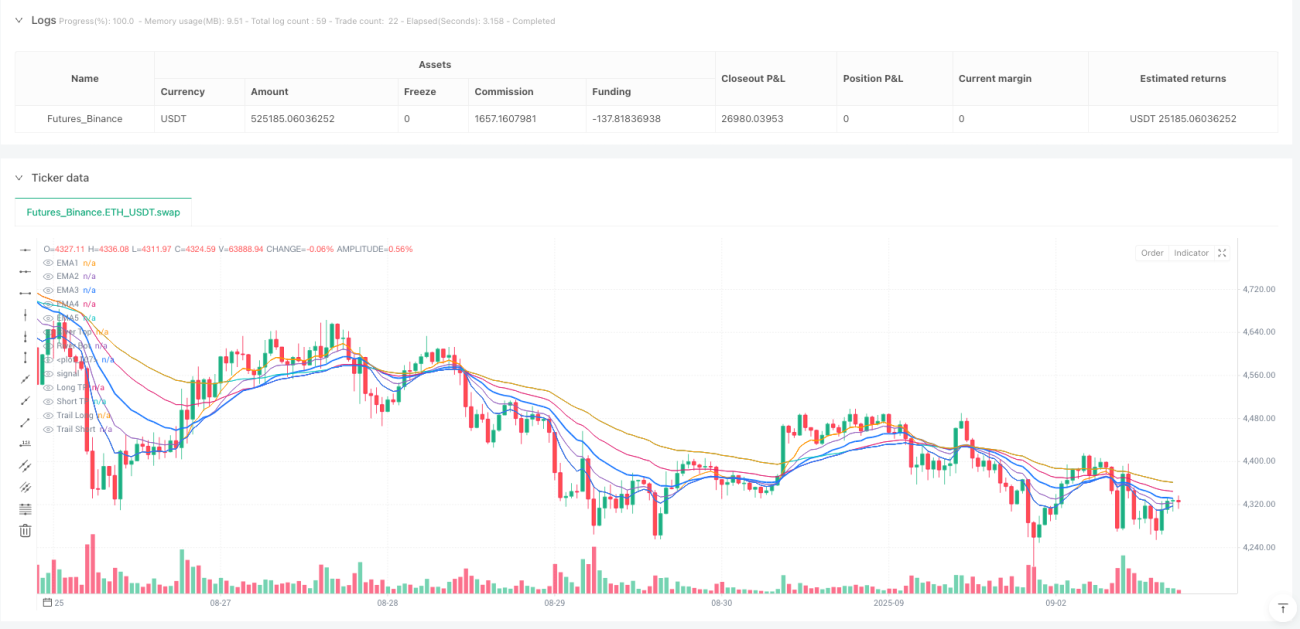
Esta estratégia imagina cinco EMAs como um “rio”. Assim como os rios reais têm um leito e uma margem, quando os cinco EMAs estão alinhados, a área que se forma entre eles é o nosso “rio de tendência”.

É tão simples como ver a direção do rio - para onde o rio vai, nós vamos.

A estratégia central: esperar que os peixes voltem para o rio e lancem as redes

O que é mais inteligente nesta estratégia? Não é subir quando os preços estão em alta, mas esperar pacientemente por um “reajuste”!

Como funciona isso?

  • Sinais múltiplos: tendência ascendente + RSI≥60 + retorno do preço para a profundidade de 40% do rio + retomada da EMA rápida
  • Sinal de cabeça vazia: tendência para baixo + RSI ≤ 40 + preço rebota para a altura do rio 40% + re-queda abaixo da EMA rápida

É como um tubarão, não desmaiar quando está no auge, mas esperar que ele volte a nadar em águas familiares!

Gerenciamento de Riscos: arriscar apenas 1% do capital

A parte mais interessante desta estratégia é o cálculo automático do tamanho das posições:

  • O risco de cada transação é de 1% do capital.
  • Stop loss com o indicador ATR ((2 vezes ATR)
  • A relação de ganhos e perdas foi definida como 2: 1 (risco de perder um dólar para ganhar dois dólares).
  • E o Chandler a seguir os lucros da proteção de stop loss.

Isso é como usar uma faixa de segurança - não para evitar acidentes, mas para ter segurança e prazer de dirigir!

Por que essa estratégia é preocupante?

O blogueiro também escreveu sobre o tema:

  1. Perseguição e morte“Não, não, não, não.
  2. Não sei quanto.“Automatização do cálculo da posição, controlo do risco”
  3. Não sei quando correr.“O que é que eu tenho que fazer?”

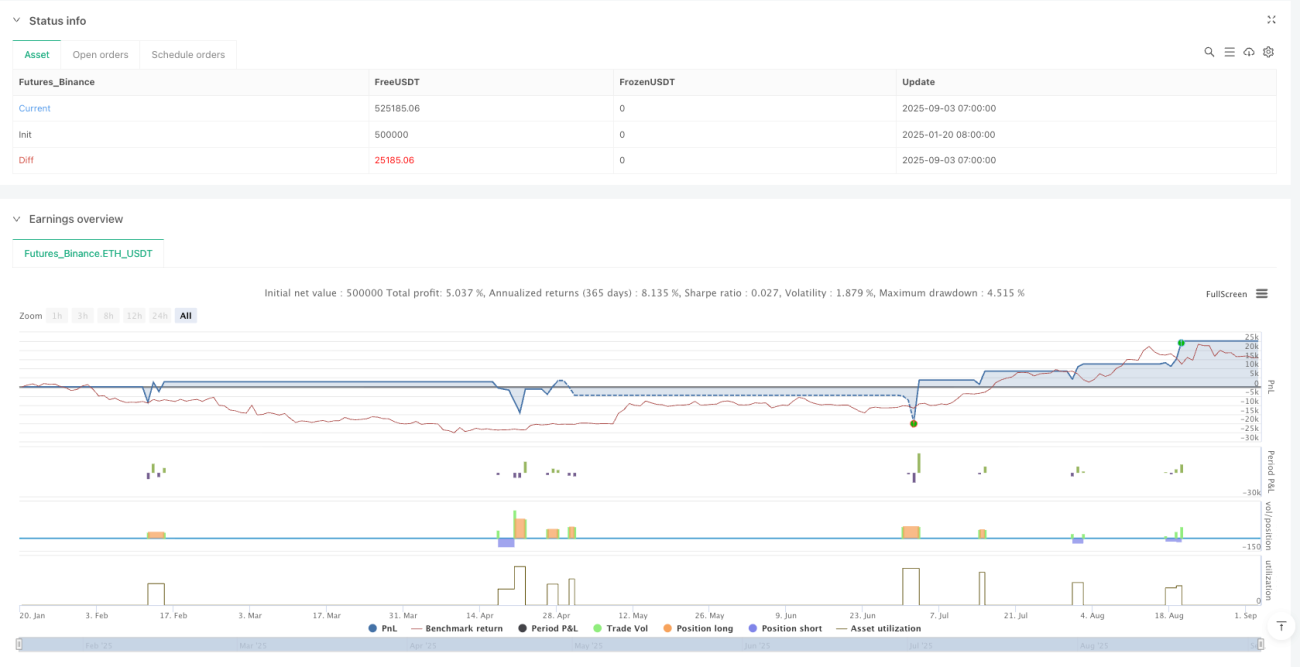
Esta estratégia é especialmente adequada para os comerciantes que desejam “ganhar de forma estável”. Não é uma estratégia de enriquecimento instantâneo, mas pode ajudá-lo a ganhar dinheiro de forma estável em uma tendência! Lembre-se: no rio do comércio, o mais importante não é nadar o mais rápido, mas o mais estável.

||

🌊 What is “Trend River”? This Analogy is Brilliant!

You know what? This strategy imagines 5 EMA lines as a “river”! Just like a real river has riverbed and surface, when 5 EMAs align properly, the area between them forms our “trend river”. Key point! When the river direction is clear (bullish: fast line above, bearish: fast line below), that’s when our money-making opportunities arrive!

It’s as simple as watching water flow direction - wherever the river flows, that’s where we profit! 💰

🎯 Core Strategy: Wait for Fish to Return Before Casting the Net

What’s the smartest part of this strategy? It doesn’t chase prices during rallies, but patiently waits for “pullbacks”!

How does it work exactly?

  • Long signal: Uptrend + RSI≥60 + Price pulls back to 40% river depth + Re-breaks above fast EMA
  • Short signal: Downtrend + RSI≤40 + Price bounces to 40% river height + Re-breaks below fast EMA

It’s like fishing - you don’t cast when fish jump highest, but wait for them to return to familiar waters! 🎣

💡 Risk Management: Only Risk 1% Capital Each Time

Here’s the pitfall guide! The most thoughtful part of this strategy is automatic position sizing:

  • Each trade risks only 1% of capital
  • Uses ATR indicator for stop loss (2x ATR)
  • Risk-reward ratio set at 2:1 (earn 2 to risk 1)
  • Plus Chandelier trailing stop to protect profits

It’s like wearing a seatbelt while driving - not because you expect an accident, but to enjoy the ride with peace of mind! 🚗

🚀 Why is This Strategy Worth Attention?

Solves three major trader pain points:

  1. FOMO trading: Wait for pullbacks instead of buying tops
  2. Position sizing confusion: Auto-calculates position size with controlled risk
  3. Exit uncertainty: Has stop loss, take profit, and trailing stop

This strategy is perfect for traders who want “steady wins”. It doesn’t promise overnight riches, but helps you profit steadily in trends! Remember: In the river of trading, the most important thing isn’t swimming fastest, but swimming most steadily 🏊‍♀️

[/trans]

Código-fonte da estratégia
/*backtest
start: 2025-01-20 08:00:00
end: 2025-09-03 08:00:00
period: 1h
basePeriod: 1h
exchanges: [{"eid":"Futures_Binance","currency":"ETH_USDT","balance":500000}]
*/

//@version=5
strategy("Trend River Pullback Strategy v1", 
     overlay=true, initial_capital=10000, commission_type=strategy.commission.percent, commission_value=0.02, 
     pyramiding=0, calc_on_order_fills=true, calc_on_every_tick=true, margin_long=1, margin_short=1)
// ===== Inputs
// EMA river
emaFastLen   = input.int(8,   "EMA1 (fast)")
ema2Len      = input.int(13,  "EMA2")
emaMidLen    = input.int(21,  "EMA3 (middle)")
ema4Len      = input.int(34,  "EMA4")
emaSlowLen   = input.int(55,  "EMA5 (slow)")
// Pullback and momentum
rsiLen       = input.int(14, "RSI length")
rsiOB        = input.int(60, "RSI trend threshold (long)")
rsiOS        = input.int(40, "RSI trend threshold (short)")
pullbackPct  = input.float(40.0, "Pullback depth % of river width", minval=0, maxval=100)
// Risk management
riskPct      = input.float(1.0, "Risk per trade % of capital", step=0.1, minval=0.1)
atrLen       = input.int(14, "ATR length (stop/trailing)")
atrMultSL    = input.float(2.0, "ATR multiplier for stop", step=0.1)
tpRR         = input.float(2.0, "Take profit R-multiple", step=0.1)
// Trailing stop
useTrail     = input.bool(true, "Enable trailing stop (Chandelier)")
trailMult    = input.float(3.0, "ATR multiplier for trailing", step=0.1)
// ===== Calculations
ema1  = ta.ema(close, emaFastLen)
ema2  = ta.ema(close, ema2Len)
ema3  = ta.ema(close, emaMidLen)
ema4  = ta.ema(close, ema4Len)
ema5  = ta.ema(close, emaSlowLen)
// River: top/bottom as envelope of averages
riverTop = math.max(math.max(ema1, ema2), math.max(ema3, math.max(ema4, ema5)))
riverBot = math.min(math.min(ema1, ema2), math.min(ema3, math.min(ema4, ema5)))
riverMid = (riverTop + riverBot) / 2.0
riverWidth = riverTop - riverBot
// Trend conditions: EMA alignment
bullAligned = ema1 > ema2 and ema2 > ema3 and ema3 > ema4 and ema4 > ema5
bearAligned = ema1 < ema2 and ema2 < ema3 and ema3 < ema4 and ema4 < ema5
// Momentum
rsi = ta.rsi(close, rsiLen)
// Pullback into river
pullbackLevelBull = riverTop - riverWidth * (pullbackPct/100.0)
pullbackLevelBear = riverBot + riverWidth * (pullbackPct/100.0)
pullbackOkBull = bullAligned and rsi >= rsiOB and low <= pullbackLevelBull
pullbackOkBear = bearAligned and rsi <= rsiOS and high >= pullbackLevelBear
// Entry trigger: return to momentum (fast EMA crossover)
longTrig  = pullbackOkBull and ta.crossover(close, ema1)
shortTrig = pullbackOkBear and ta.crossunder(close, ema1)
// ATR for stops
atr = ta.atr(atrLen)
// ===== Position sizing by risk
capital   = strategy.equity
riskMoney = capital * (riskPct/100.0)
// Preliminary stop levels
longSL  = close - atrMultSL * atr
shortSL = close + atrMultSL * atr
// Tick value and size
tickValue = syminfo.pointvalue
// Avoid division by zero
slDistLong  = math.max(close - longSL, syminfo.mintick)
slDistShort = math.max(shortSL - close, syminfo.mintick)
// Number of contracts/lots
qtyLong  = riskMoney / (slDistLong * tickValue)
qtyShort = riskMoney / (slDistShort * tickValue)
// Limit: not less than 0
qtyLong  := math.max(qtyLong, 0)
qtyShort := math.max(qtyShort, 0)
// ===== Entries
if longTrig and strategy.position_size <= 0
    strategy.entry("Long", strategy.long, qty=qtyLong)
if shortTrig and strategy.position_size >= 0
    strategy.entry("Short", strategy.short, qty=qtyShort)
// ===== Exits: fixed TP by R and stop
// Store entry price
var float entryPrice = na
if strategy.position_size != 0 and na(entryPrice)
    entryPrice := strategy.position_avg_price
if strategy.position_size == 0
    entryPrice := na
// Targets
longTP  = na(entryPrice) ? na : entryPrice + tpRR * (entryPrice - longSL)
shortTP = na(entryPrice) ? na : entryPrice - tpRR * (shortSL - entryPrice)
// Trailing: Chandelier
trailLong  = close - trailMult * atr
trailShort = close + trailMult * atr
// Final exit levels
useTrailLong  = useTrail and strategy.position_size > 0
useTrailShort = useTrail and strategy.position_size < 0
// For long
if strategy.position_size > 0
    stopL = math.max(longSL, na)
    tStop = useTrailLong ? trailLong : longSL
    strategy.exit("L-Exit", from_entry="Long", stop=tStop, limit=longTP)
// For short
if strategy.position_size < 0
    stopS = math.min(shortSL, na)
    tStopS = useTrailShort ? trailShort : shortSL
    strategy.exit("S-Exit", from_entry="Short", stop=tStopS, limit=shortTP)
// ===== Visuals
plot(ema1,  "EMA1",  display=display.all, linewidth=1)
plot(ema2,  "EMA2",  display=display.all, linewidth=1)
plot(ema3,  "EMA3",  display=display.all, linewidth=2)
plot(ema4,  "EMA4",  display=display.all, linewidth=1)
plot(ema5,  "EMA5",  display=display.all, linewidth=1)
plot(riverTop, "River Top",  style=plot.style_linebr, linewidth=1)
plot(riverBot, "River Bot",  style=plot.style_linebr, linewidth=1)
fill(plot1=plot(riverTop,  display=display.none), plot2=plot(riverBot, display=display.none), title="River Fill", transp=80)
plot(longTP,  "Long TP",  style=plot.style_linebr)
plot(shortTP, "Short TP", style=plot.style_linebr)
plot(useTrailLong  ? trailLong  : na, "Trail Long",  style=plot.style_linebr)
plot(useTrailShort ? trailShort : na, "Trail Short", style=plot.style_linebr)
// Signal markers
plotshape(longTrig,  title="Long Trigger",  style=shape.triangleup,   location=location.belowbar, size=size.tiny, text="L")
plotshape(shortTrig, title="Short Trigger", style=shape.triangledown, location=location.abovebar, size=size.tiny, text="S")
// ===== Alerts
alertcondition(longTrig,  title="Long Signal",  message="Long signal: trend aligned + pullback + momentum")
alertcondition(shortTrig, title="Short Signal", message="Short signal: trend aligned + pullback + momentum")