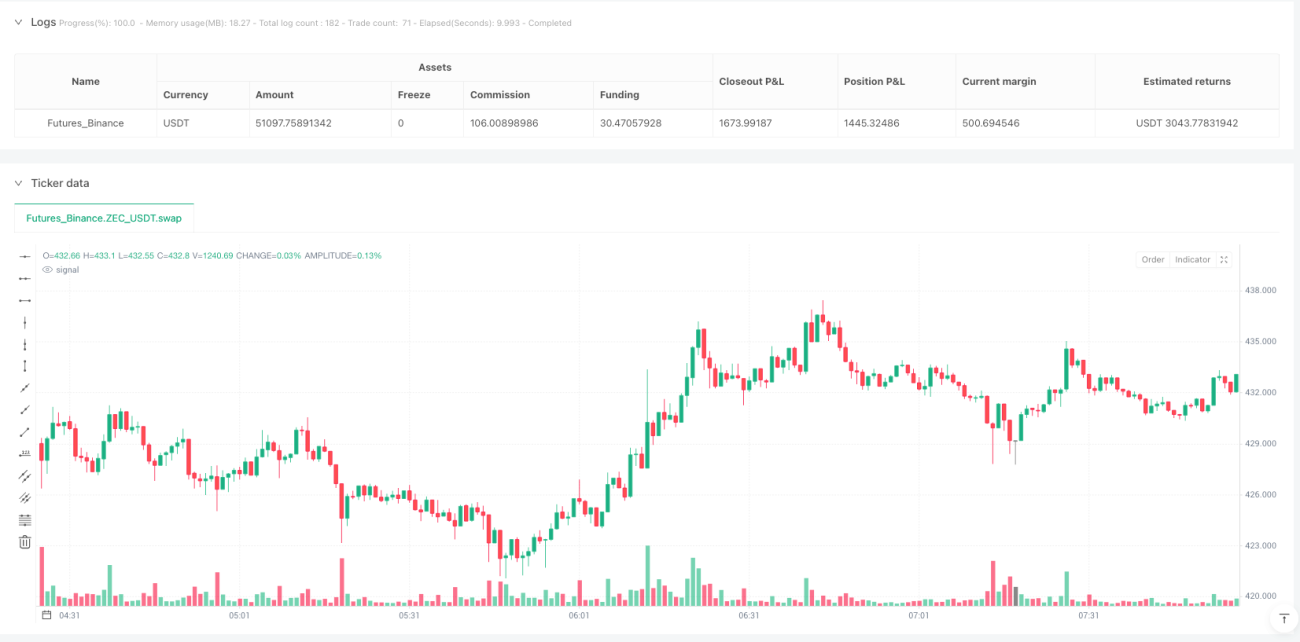
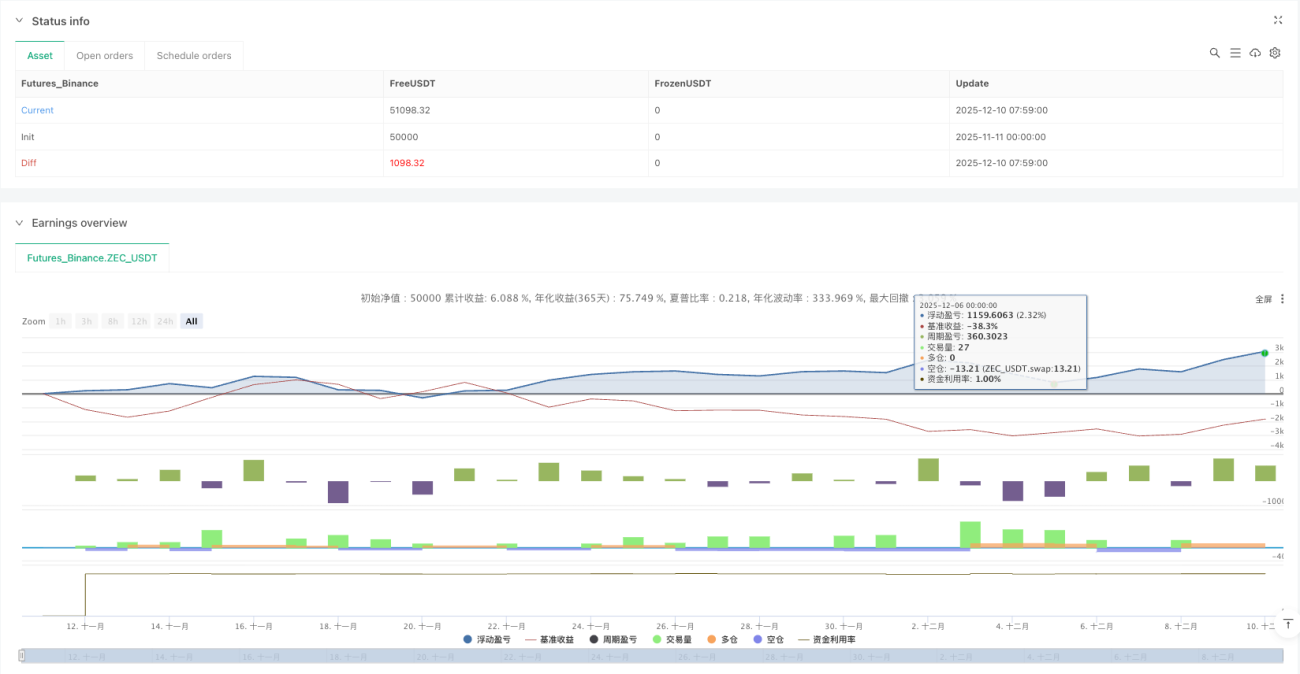
Estratégia inteligente de complementos para rastreamento de tendências ZEC

DONCHIAN ATR Pivot STRUCTURE
Data de criação: 2025-12-12 11:16:51 última modificação: 2025-12-12 11:16:51
cópia: 12 Cliques: 318
2
focar em
413
Seguidores

Estratégia inteligente de complementos para rastreamento de tendências ZEC Estratégia inteligente de complementos para rastreamento de tendências ZEC

O que está acontecendo com essa estratégia?

Você sabe? Esta estratégia é como um super cauteloso velho investidor! Ele não persegue cegamente a queda, mas primeiro observa a grande tendência com o “telescópio” (análise da estrutura do mercado em múltiplos quadros de tempo), e depois de confirmar que a direção não é um problema, ele usa a quebra do canal de Dongxian como sinal de entrada.

O que é mais interessante é que ele também “estabelece estoques” como se você estivesse comprando um prato e depois comprasse mais alguns. Quando o preço se move na direção favorável, ele aumenta o estoque de forma inteligente com base no ATR, para que o lucro possa ir mais longe!

Resolução do núcleo

O foco!A estratégia tem três pontos super-poderosos:

1. Filtragem de estrutura de múltiplos quadros de tempo 🕐 Assim como a navegação confirma a direção principal antes de conduzir, a estratégia analisa a estrutura do mercado em um ciclo maior. Apenas faça mais quando a tendência principal for alta e nada quando a tendência principal for baixa. Assim, você pode evitar ser confrontado em mercados turbulentos!

2. Sistema de aceleração dinâmica ATR 📊 A estratégia tradicional é uma pegada ou uma posição fixa. Esta estratégia é mais inteligente! Ela decide o momento e o ponto de parada de uma posição de acordo com a volatilidade do mercado (ATR). Quando o mercado flutua, dá mais espaço; Quando oscila, o controle é mais rigoroso.

3. Reversão de sinal de equilíbrio 🔄 A lógica mais interessante é a da posição fechada: em vez de esperar por um ponto de parada ou um alvo fixo, você deve fechar a posição inteira quando o sinal de entrada de reversão aparece. Assim, você pode capturar a maior parte dos lucros da tendência e, ao mesmo tempo, retirar-se quando a tendência muda!

Configuração de parâmetros de barra

O guia para o poço chegou!

  • Período de passagem de entrada (20)O blogueiro é conhecido por seu estilo de vida, que inclui um estilo de vida que não é o mesmo do que você gosta.
  • Ciclo de passagem de saída (10)O que é que a China está a fazer?
  • ATR multiplicador ((2.0 para parar, 0.5 adicionar)A proporção é crucial, o stop loss deve dar espaço e o acréscimo deve ser moderado
  • Número máximo de unidadesO blogueiro é um dos principais responsáveis por esta situação.

Aplicações em combate

Quando é a melhor estratégia?

Melhores cenários de uso:

  • Variedades de tendência (como criptomoedas e futuros de mercadorias)
  • Um ambiente de mercado claramente orientado
  • Quando você tem paciência suficiente para esperar por um sinal de alta qualidade

Não é apropriado:

  • O que é que você está a fazer?
  • Períodos de frequentes mudanças de notícias
  • Quando você quer negociar em alta frequência

Lembre-se: esta é uma estratégia de “trabalhar devagar e viver devagar”, não é uma ferramenta para se tornar rico de repente, mas sim um bom ajudante para manter o seu dinheiro dentro da tendência!

Código-fonte da estratégia
/*backtest
start: 2025-11-11 00:00:00
end: 2025-12-10 08:00:00
period: 1m
basePeriod: 1m
exchanges: [{"eid":"Futures_Binance","currency":"ZEC_USDT"}]
*/

//@version=6
strategy("Trend $ZEC", shorttitle="$ZEC 1/15m", overlay=true, 
         initial_capital=10000, 
         default_qty_type=strategy.cash, 
         default_qty_value=5000, 
         commission_type=strategy.commission.percent, 
         commission_value=0.06,
         slippage=0,
         max_lines_count=500,
         max_labels_count=500)

// ========== 參數設定 ==========
// 唐奇安通道參數
entry_period = input.int(20, "進場通道週期", minval=1, group="通道設定")
exit_period = input.int(10, "出場通道週期", minval=1, group="通道設定")

// ATR 參數
atr_period = input.int(20, "ATR 週期", minval=1, group="ATR 設定")
atr_stop_mult = input.float(2.0, "止損 ATR 倍數", minval=0.1, step=0.1, group="ATR 設定")
atr_add_mult = input.float(0.5, "加倉 ATR 倍數", minval=0.1, step=0.1, group="ATR 設定")

// 多空結構參數 - 加入多時間框架
swing_length = input.int(160, "結構擺動長度", minval=1, group="📊 多空結構過濾")
structure_timeframe = input.timeframe("1", "結構時間框架", group="📊 多空結構過濾", tooltip="選擇結構判斷的時間週期,空白=當前圖表,D=日線,W=週線")
show_structure_lines = input.bool(false, "顯示結構線", group="📊 多空結構過濾")
show_structure_labels = input.bool(false, "顯示結構標籤", group="📊 多空結構過濾")

// 加倉設定
max_units = input.int(2, "最大單位數(含首次)", minval=1, maxval=10, group="倉位管理")
position_size = input.int(5000, "每單位資金(USD)", minval=100, group="倉位管理", tooltip="10000U本金分2次進場,每次5000U")

// 顯示設定
show_channels = input.bool(false, "顯示通道", group="顯示設定")
show_atr_lines = input.bool(false, "顯示 ATR 線", group="顯示設定")
show_labels = input.bool(true, "顯示標籤", group="顯示設定")
show_table = input.bool(false, "顯示資訊面板", group="顯示設定")
label_distance = input.float(2.5, "標籤距離 K 棒倍數", minval=0.1, step=0.1, group="顯示設定", tooltip="標籤距離K棒的ATR倍數")
show_label_lines = input.bool(false, "顯示標籤連線", group="顯示設定")

// ========== 計算唐奇安通道 ==========
entry_upper = ta.highest(high, entry_period)
entry_lower = ta.lowest(low, entry_period)
exit_upper = ta.highest(high, exit_period)
exit_lower = ta.lowest(low, exit_period)

// ========== 計算 ATR (N值) ==========
N = ta.atr(atr_period)

// ========== 多時間框架多空結構判斷 ==========
// 計算結構的函數
f_calculate_structure() =>
    var int trend = 0
    var float lastHigh = na
    var float lastLow = na
    
    swingHigh = ta.pivothigh(high, swing_length, swing_length)
    swingLow = ta.pivotlow(low, swing_length, swing_length)
    
    if not na(swingHigh)
        lastHigh := swingHigh
    
    if not na(swingLow)
        lastLow := swingLow
    
    if not na(lastHigh) and close > lastHigh and trend != 1
        trend := 1
    
    if not na(lastLow) and close < lastLow and trend != -1
        trend := -1
    
    [trend, lastHigh, lastLow]

// 獲取指定時間框架的結構
[structure_trend_mtf, last_structure_high_mtf, last_structure_low_mtf] = request.security(syminfo.tickerid, structure_timeframe, f_calculate_structure(), lookahead=barmerge.lookahead_off)

// 使用多時間框架的結構趨勢
structure_trend = structure_trend_mtf
last_structure_high = last_structure_high_mtf
last_structure_low = last_structure_low_mtf

// 檢測結構變化(用於繪製標籤)
var int prev_structure_trend = 0
bool bull_break = structure_trend == 1 and prev_structure_trend != 1
bool bear_break = structure_trend == -1 and prev_structure_trend != -1
prev_structure_trend := structure_trend

// 繪製結構突破標籤
if show_structure_labels
    if bull_break
        label.new(bar_index, low, "多方結構", style=label.style_label_up, color=color.new(color.green, 0), textcolor=color.white, size=size.small)
    
    if bear_break
        label.new(bar_index, high, "空方結構", style=label.style_label_down, color=color.new(color.red, 0), textcolor=color.white, size=size.small)

// ========== 持倉狀態追蹤 ==========
var float entry_price = na
var float[] add_prices = array.new_float(0)
var int position = 0
var int units = 0
var float stop_loss = na

// ========== 進場訊號 (加入結構過濾) ==========
long_entry_signal = close > entry_upper[1] and structure_trend == 1
short_entry_signal = close < entry_lower[1] and structure_trend == -1

long_entry = long_entry_signal and position != 1
short_entry = short_entry_signal and position != -1

// ========== 加倉訊號 ==========
long_add = false
short_add = false

if position == 1 and units < max_units
    if array.size(add_prices) > 0
        last_add_price = array.get(add_prices, array.size(add_prices) - 1)
        long_add := close >= last_add_price + (atr_add_mult * N)
    else
        long_add := close >= entry_price + (atr_add_mult * N)

if position == -1 and units < max_units
    if array.size(add_prices) > 0
        last_add_price = array.get(add_prices, array.size(add_prices) - 1)
        short_add := close <= last_add_price - (atr_add_mult * N)
    else
        short_add := close <= entry_price - (atr_add_mult * N)

// ========== 出場訊號 (改為反向訊號出場) ==========
// 多單出場:當空單進場訊號觸發時
long_exit = (position == 1) and short_entry_signal

// 空單出場:當多單進場訊號觸發時
short_exit = (position == -1) and long_entry_signal

// ========== 更新持倉狀態 ==========
if long_entry
    position := 1
    units := 1
    entry_price := close
    array.clear(add_prices)
    array.push(add_prices, close)
    stop_loss := close - (atr_stop_mult * N)
    alert_msg = timeframe.period + " 做多 EP:" + str.tostring(close, "#.##")
    strategy.entry("多單1", strategy.long, qty=position_size/close, comment=alert_msg, alert_message=alert_msg)
    
else if short_entry
    position := -1
    units := 1
    entry_price := close
    array.clear(add_prices)
    array.push(add_prices, close)
    stop_loss := close + (atr_stop_mult * N)
    alert_msg = timeframe.period + " 做空 EP:" + str.tostring(close, "#.##")
    strategy.entry("空單1", strategy.short, qty=position_size/close, comment=alert_msg, alert_message=alert_msg)
    
else if long_add
    units := units + 1
    array.push(add_prices, close)
    stop_loss := close - (atr_stop_mult * N)
    alert_msg = timeframe.period + " 加倉多 " + str.tostring(units) + "/" + str.tostring(max_units) + " EP:" + str.tostring(close, "#.##")
    strategy.entry("多單" + str.tostring(units), strategy.long, qty=position_size/close, comment=alert_msg, alert_message=alert_msg)
    
else if short_add
    units := units + 1
    array.push(add_prices, close)
    stop_loss := close + (atr_stop_mult * N)
    alert_msg = timeframe.period + " 加倉空 " + str.tostring(units) + "/" + str.tostring(max_units) + " EP:" + str.tostring(close, "#.##")
    strategy.entry("空單" + str.tostring(units), strategy.short, qty=position_size/close, comment=alert_msg, alert_message=alert_msg)
    
else if long_exit or short_exit
    if long_exit
        alert_msg = timeframe.period + " 平多 反向訊號"
        strategy.close_all(comment=alert_msg, alert_message=alert_msg)
    if short_exit
        alert_msg = timeframe.period + " 平空 反向訊號"
        strategy.close_all(comment=alert_msg, alert_message=alert_msg)
    
    position := 0
    units := 0
    entry_price := na
    array.clear(add_prices)
    stop_loss := na

// ========== 繪製通道 ==========
plot(show_channels ? entry_upper : na, "進場上軌", color=color.new(color.red, 0), linewidth=2)
plot(show_channels ? entry_lower : na, "進場下軌", color=color.new(color.green, 0), linewidth=2)
plot(show_channels ? exit_upper : na, "出場上軌", color=color.new(color.orange, 50), linewidth=1, style=plot.style_circles)
plot(show_channels ? exit_lower : na, "出場下軌", color=color.new(color.blue, 50), linewidth=1, style=plot.style_circles)

// 繪製結構高低點
plot(show_structure_lines ? last_structure_high : na, "結構高點", color=color.new(color.red, 70), linewidth=2, style=plot.style_stepline)
plot(show_structure_lines ? last_structure_low : na, "結構低點", color=color.new(color.green, 70), linewidth=2, style=plot.style_stepline)

// ========== 繪製 ATR 線 ==========
plot(show_atr_lines and position != 0 ? stop_loss : na, "止損線", color=color.new(color.red, 0), linewidth=2, style=plot.style_cross)

var float next_add_long = na
if position == 1 and units < max_units
    next_add_long := array.size(add_prices) > 0 ? array.get(add_prices, array.size(add_prices) - 1) + (atr_add_mult * N) : entry_price + (atr_add_mult * N)
else
    next_add_long := na

plot(show_atr_lines and position == 1 and units < max_units ? next_add_long : na, "下次加倉(多)", color=color.new(color.yellow, 30), linewidth=1, style=plot.style_stepline)

var float next_add_short = na
if position == -1 and units < max_units
    next_add_short := array.size(add_prices) > 0 ? array.get(add_prices, array.size(add_prices) - 1) - (atr_add_mult * N) : entry_price - (atr_add_mult * N)
else
    next_add_short := na

plot(show_atr_lines and position == -1 and units < max_units ? next_add_short : na, "下次加倉(空)", color=color.new(color.yellow, 30), linewidth=1, style=plot.style_stepline)