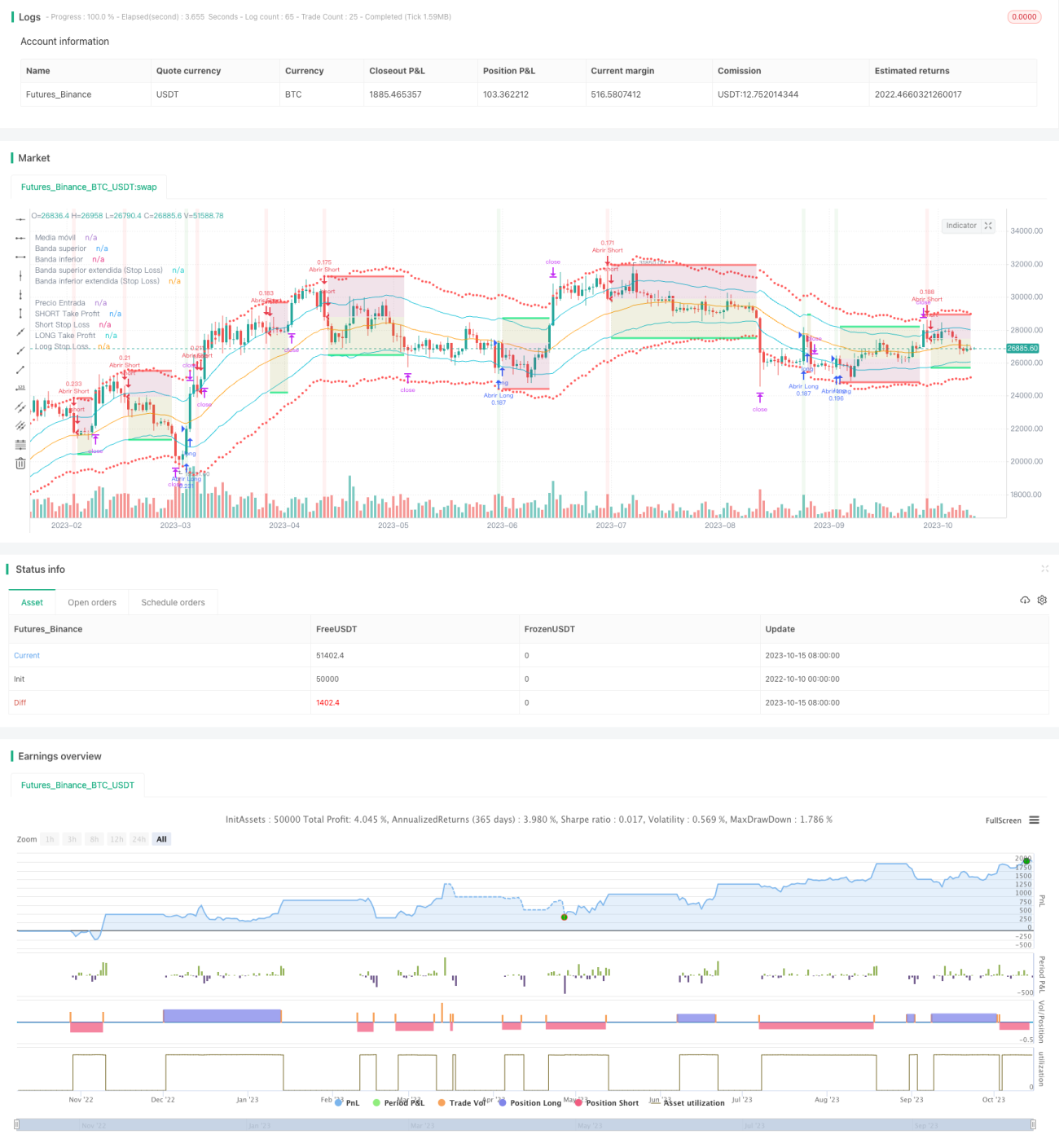
[trans]
Эта стратегия основана на торговле ценовым каналом по каналам Брин-Бенд и Кентнер. Она использует характеристики, которые идентифицируют торговые возможности внутри каналов после того, как цены прорываются через границу верхнего и нижнего каналов.
Стратегия включает в себя следующие ключевые элементы:
Выбор показателей канала“Путешествие по Брин-Бенду” или “Путешествие по Кентнеру”
Условия приема: цена пробивает границу канала, и требуется ли закрытие нижней K-линии, чтобы вернуться в канал
Стойкость: предыдущий K-линейный оттенок, расширение границ канала, ATR-остановка
Способы остановкиГраницы боковых коридоров, средняя полоса коридора, остановка ATR
Другие конфигурацииНапример: “Сделай только больше”, “Сделай только пустое”, “Динамически можно ли регулировать остановку” и т.д.
Благодаря вышеуказанному сочетанию, стратегия реализует функцию определения оптимального времени входа и выхода из игры в зависимости от динамики рыночных особенностей.
По сравнению с фиксированной мобильной стратегией остановки убытков эта стратегия имеет следующие преимущества:
Используя свойства канала, включающие в себя диапазон колебаний цен, можно более точно уловить переломные моменты рыночных тенденций.
Многочисленные способы остановки убытков можно комбинировать для оптимальной конфигурации для различных сортов и циклов.
На основе канальных показателей проводится операция по прорывному возврату, которая позволяет использовать небольшие колебания для поглощения средств противника.
ATR рассчитывает стоп-стоп-убытки, которые автоматически корректируются в зависимости от волатильности рынка.
Допускает динамическое регулирование остановки, чтобы максимально использовать возможное дополнительное пространство для движения.
Основные риски этой стратегии:
На рынках с большим трендом, канал может не работать, что приводит к активированию стоп-ложа. Стоп-ложа может быть расслаблен соответствующим образом.
При высокой волатильности рынка, расчетная дистанция ATR может привести к увеличению убытков. Можно рассмотреть возможность сокращения коэффициента ATR.
В условиях волатильности цены могут часто вызывать границы канала, что приводит к слишком частой торговле. Вход можно рассматривать только при условии прорыва закрытия.
При резком развороте событий, неподдерживаемость остановок может привести к убыткам. Рекомендуется выйти вблизи ключевых уровней поддержки/сопротивления.
Эта стратегия может быть оптимизирована в следующих аспектах:
Влияние параметров различных циклов вычисления ATR на максимальное отступление стратегии.
Тестирование включает в себя индикаторы определения тенденции, приостанавливая торговлю, если тенденция не проявляется.
Тестирование правил торговли JOIN, снижение позиций вблизи важных областей поддерживающего давления.
Увеличение количества операций, чтобы избежать чрезмерных потерь.
Оптимизация параметров для конкретных сортов, чтобы найти оптимальные комбинации параметров.
В целом, эта стратегия является стратегией прорывной регрессии, основанной на канальных показателях. Она предоставляет множество вариантов конфигурации, которые могут быть скорректированы в зависимости от различных рыночных условий. Преимущества заключаются в том, что она может удерживать рыночные моменты, обладая высокой гибкостью. ||
This strategy is based on price channel trading using Bollinger Bands and Keltner Channels. It identifies trading opportunities by the characteristic of price bouncing back after breaking through the upper or lower channel boundary lines. The strategy provides multiple customizable options to refine it for your asset and timeframe.
The key components of this strategy are:
Channel Indicator: Bollinger Bands or Keltner Channels
Entry Conditions: Price breakout of channel boundary, with option to require reversion back inside on next candle close
Stop Loss: Previous candle’s wick, extended channel bands, ATR stop loss
Take Profit: Opposite channel bands, channel midline, ATR take profit
Other Configurations: Long only, short only, dynamic take profit adjustment etc.
With the above combinations, the strategy dynamically determines optimal entry and exit points according to market conditions.
Compared to fixed moving stop/take profit strategies, this strategy has the following advantages:
Utilizes the capability of channels to contain price fluctuations, more accurately capturing trend reversal points.
Diverse stop loss and take profit options allow best configuration for different assets and timeframes.
Breakout and reversion operations based on channel indicators can leverage small range oscillations to absorb opponent’s funds.
ATR-calculated stop/take profit distances automatically adjust to market volatility.
Allowing dynamic take profit adjustment fully exploits potential additional running space.
The main risks of this strategy are:
In strong trending markets, channel failure may trigger stop loss. Stop loss distance can be loosened.
With high volatility, ATR calculated stop/take profit distances may be too wide, enlarging losses. Consider reducing ATR coefficient.
In ranging markets, frequent channel boundary touches may cause over-trading. Consider entry on close breakouts only.
Severe reversals may hit take profit before stop loss with dynamic adjustment. Exits near key S/R levels recommended.
This strategy can be further optimized by:
Testing ATR period parameters for impact on max drawdown.
Incorporating trend indicators to pause trading when trend is unclear.
Testing JOIN reversion techniques to reduce position size near key S/R zones.
Adding trading size controls to limit single trade loss.
Parameter optimization for specific assets to find optimal parameter combinations.
In summary, this is a channel breakout and reversion strategy. It provides rich configuration options for various market environments. The advantages are capturing reversal points and flexibility. But beware of stop loss invalidation in strong trends. Future optimizations on trend, risk control etc. will improve practicality.
/*backtest
start: 2022-10-10 00:00:00
end: 2023-10-16 00:00:00
period: 1d
basePeriod: 1h
exchanges: [{"eid":"Futures_Binance","currency":"BTC_USDT"}]
*/
// Copyright © 2022, José Manuel Gassin Pérez-Traverso, All rights reserved.
// © JoseMetal
//@version=5
// Ésta estrategia se basa en los rebotes de canales (ya sea Bandas de Bollinger o Keltner Channel) para entrar y salir de posiciones, tiene multitud de opciones para
// elegir el tipo de stop loss o take profit, ya sea utilizando mínimos/máximos anteriores, ATR o las propias bandas.
// La entrada de posiciones también tiene variedad de opciones, por ejemplo, se puede entrar cuando el precio salga de la banda y vuelva a entrar, o simplemente en cuanto una vela cierre fuera.
// De éste modo y con todas éstas opciones se puede realizar un backtest exhaustivo para buscar la mejor combinación según activo y temporalidad.
//== Constantes
c_verde_radiactivo = color.rgb(0, 255, 0, 0)
c_verde = color.rgb(0, 128, 0, 0)
c_verde_oscuro = color.rgb(0, 80, 0, 0)
c_rojo_radiactivo = color.rgb(255, 0, 0, 0)
c_rojo = color.rgb(128, 0, 0, 0)
c_rojo_oscuro = color.rgb(80, 0, 0, 0)
noneColor = color.new(color.white, 100)
//== Declarar estrategia y período de testeo
strategy("Estrategia de Canales [JoseMetal]", shorttitle="Estrategia de Canales [JoseMetal]", overlay=true, initial_capital=10000, pyramiding=0, default_qty_value=10, default_qty_type=strategy.percent_of_equity, commission_type=strategy.commission.percent, commission_value=0.0, max_labels_count=500, max_bars_back=1000)
fecha_inicio = input(timestamp("1 Jan 2000"), title="• Fecha de inicio", group="Período de pruebas", inline="periodo_de_pruebas")
vela_en_fecha = true
posicion_abierta = strategy.position_size != 0
LONG_abierto = strategy.position_size > 0
SHORT_abierto = strategy.position_size < 0
//== Condiciones de entrada y salida de estrategia
GRUPO_P = "Posiciones"
P_indicador = input.string("Canales de Keltner", "Indicador", ["Bandas de Bollinger", "Canales de Keltner"], "Se puede escoger entre los indicadores de Bandas de Bollinger y Canales de Keltner para las condiciones, éstos se usarán también para el Stop Loss y Take Profit y se escogen para dicha función.", group=GRUPO_P)
P_permitir_LONGS = input.bool(title="¿LONGS?", group=GRUPO_P, defval=true)
P_permitir_SHORTS = input.bool(title="¿SHORTS?", group=GRUPO_P, defval=true)
P_cond_entrada = input.string("Cierre fuera de la banda y luego cierre dentro", "Condición de entrada", ["Mecha fuera de la banda", "Mecha fuera de la banda y luego cierre dentro", "Cierre fuera de la banda", "Cierre fuera de la banda y luego cierre dentro"], "Se puede escoger (en orden) que el precio haya salido de la banda, que además la siguiente vela cierre de nuevo dentro de la misma, que el precio tenga que cerrar fuera, y que además la siguiente vela tenga que cerrar dentro de nuevo.", group=GRUPO_P)
GRUPO_TPSL = "Stop Loss y Take Profit"
TP_SL_tipo_SL = input.string("Banda extendida", "Tipo de Stop Loss", options=["Mecha anterior", "Banda extendida", "ATR"], group=GRUPO_TPSL)
TP_SL_tipo_TP = input.string("Banda contraria", "Tipo de Take Profit", options=["Banda contraria", "Media móvil", "ATR"], group=GRUPO_TPSL)
TPSL_SL_ATR_mult = input.float(title="• (Solo ATR) Multiplicador Stop Loss / Take Profit", group=GRUPO_TPSL, defval=1, minval=0.1, step=0.1, inline="tp_sl", tooltip="Éstos son los multiplicadores al ATR para calcular STOP LOSS y TAKE PROFIT en caso de seleccionarse como tales.")
TPSL_TP_ATR_mult = input.float(title="", group=GRUPO_TPSL, defval=1.8, minval=0.1, step=0.1, inline="tp_sl")
TPSL_SL_BB_dev = input.float(title="• (Solo STOP LOSS con BB) Desviación estándar", group=GRUPO_TPSL, defval=4.0, minval=0.01, step=0.5, tooltip="En caso de usar las Bandas de Bollinger como STOP LOSS, éste será el valor de su desviación estándar.")
TPSL_SL_KC_mult = input.float(title="• (Solo STOP LOSS con KC) Multiplicador", group=GRUPO_TPSL, defval=3, minval=0.01, step=0.5, tooltip="En caso de usar los canales de Keltner como STOP LOSS, éste será el valor de su multiplicador de ATR.")
TP_SL_TP_dinamico = input.bool(title="Take Profit dinámico", group=GRUPO_TPSL, defval=false, tooltip="Ésto hará que el Take Profit se ajuste vela a vela en lugar de quedarse fijo en su valor inicial.")
//== Inputs de indicadores
// ATR
GRUPO_ATR = "ATR"
ATR_referencia = input.source(title="• Referencia / Longitud", group=GRUPO_ATR, defval=close, inline="atr_calc") // La fuente no se aplica al cálculo del ATR, es para el posicionamiento respecto al precio en el gráfico
ATR_length = input.int(title="", group=GRUPO_ATR, defval=7, minval=1, inline="atr_calc")
ATR = ta.atr(ATR_length)
ATR_sl = ATR * TPSL_SL_ATR_mult
ATR_tp = ATR * TPSL_TP_ATR_mult
ATR_LONG_sl = ATR_referencia - ATR_sl // De forma contraria el inferior se puede usar como STOP LOSS o TRAILING STOP
ATR_LONG_tp = ATR_referencia + ATR_tp // El ATR sobre las velas se puede usar como TAKE PROFIT
ATR_SHORT_sl = ATR_referencia + ATR_sl // ""
ATR_SHORT_tp = ATR_referencia - ATR_tp // Para Shorts es al revés
GRUPO_BB = "Bollinger Bands"
BB_length = input.int(title="• Long. / Desv. ", group=GRUPO_BB, defval=20, minval=1, inline="bb")
BB_dev = input.float(title="", group=GRUPO_BB, defval=2.0, minval=0.01, step=0.5, inline="bb")
[BB_mid, BB_upper, BB_lower] = ta.bb(close, BB_length, BB_dev)
[_, BB_upper_SL, BB_lower_SL] = ta.bb(close, BB_length, TPSL_SL_BB_dev)
GRUPO_KC = "Keltner Channel"
KC_length = input.int(title="• Long. / Mult. ", group=GRUPO_KC, defval=35, minval=1, inline="kc")
KC_mult = input.float(title="", group=GRUPO_KC, defval=1.5, minval=0.01, step=0.5, inline="kc")
[KC_mid, KC_upper, KC_lower] = ta.kc(close, KC_length, KC_mult, true)
[_, KC_upper_SL, KC_lower_SL] = ta.kc(close, KC_length, TPSL_SL_KC_mult, true)
//== Cálculo de condiciones
// Asignar variables comunes en función del indicador seleccionado
banda_superior = BB_upper
media_movil = BB_mid
banda_inferior = BB_lower
banda_extendida_sup_SL = BB_upper_SL
banda_extendida_inf_SL = BB_lower_SL
if (P_indicador == "Canales de Keltner")
banda_superior := KC_upper
media_movil := KC_mid
banda_inferior := KC_lower
banda_extendida_sup_SL := KC_upper_SL
banda_extendida_inf_SL := KC_lower_SL
// Calcular condiciones de entrada
longCondition1 = false
shortCondition1 = false
if (P_cond_entrada == "Mecha fuera de la banda")
longCondition1 := low < banda_inferior
shortCondition1 := high > banda_superior
else if (P_cond_entrada == "Mecha fuera de la banda y luego cierre dentro")
longCondition1 := low[1] < banda_inferior and close > banda_inferior
shortCondition1 := high[1] > banda_superior and close < banda_superior
else if (P_cond_entrada == "Cierre fuera de la banda")
longCondition1 := close < banda_inferior
shortCondition1 := close > banda_superior
else // Cierre fuera de la banda y luego cierre dentro
longCondition1 := close[1] < banda_inferior and close > banda_inferior
shortCondition1 := close[1] > banda_superior and close < banda_superior
//== Entrada (deben cumplirse todas para entrar)
longCondition2 = true
longCondition3 = true
long_conditions = longCondition1 and longCondition2 and longCondition3
entrar_en_LONG = P_permitir_LONGS and long_conditions and vela_en_fecha and not posicion_abierta and ATR > 0.0 // Lo del ATR > 0.0 es por seguridad ya que puede darse una entrada donde aún no es calculable el ATR porque no existan velas y nunca cerrar posición pues no se creó correctamente // Solo permitir 1 posición al mismo tiempo
shortCondition2 = true
shortCondition3 = true
short_conditions = shortCondition1 and shortCondition2 and shortCondition3
entrar_en_SHORT = P_permitir_SHORTS and short_conditions and vela_en_fecha and not posicion_abierta and ATR > 0.0 // Lo del ATR > 0.0 es por seguridad ya que puede darse una entrada donde aún no es calculable el ATR porque no existan velas y nunca cerrar posición pues no se creó correctamente // Solo permitir 1 posición al mismo tiempo
var LONG_take_profit = 0.0
var LONG_stop_loss = 0.0
var SHORT_take_profit = 0.0
var SHORT_stop_loss = 0.0
if (entrar_en_LONG)
LONG_stop_loss := TP_SL_tipo_SL == "Mecha anterior" ? (P_cond_entrada == "Mecha fuera de la banda" or P_cond_entrada == "Cierre fuera de la banda" ? low[1] : low) : TP_SL_tipo_SL == "Banda extendida" ? banda_extendida_inf_SL : ATR_LONG_sl
LONG_take_profit := TP_SL_tipo_TP == "Banda contraria" ? banda_superior : TP_SL_tipo_TP == "Media móvil" ? media_movil : ATR_LONG_tp
strategy.entry("Abrir Long", strategy.long)
strategy.exit("Cerrar Long", "Abrir Long", limit=LONG_take_profit, stop=LONG_stop_loss)
else if (entrar_en_SHORT)
SHORT_stop_loss := TP_SL_tipo_SL == "Mecha anterior" ? (P_cond_entrada == "Mecha fuera de la banda" or P_cond_entrada == "Cierre fuera de la banda" ? high[1] : high) : TP_SL_tipo_SL == "Banda extendida" ? banda_extendida_sup_SL : ATR_SHORT_sl
SHORT_take_profit := TP_SL_tipo_TP == "Banda contraria" ? banda_inferior : TP_SL_tipo_TP == "Media móvil" ? media_movil : ATR_SHORT_tp
strategy.entry("Abrir Short", strategy.short)
strategy.exit("Cerrar Short", "Abrir Short", limit=SHORT_take_profit, stop=SHORT_stop_loss)
if (posicion_abierta and TP_SL_TP_dinamico)
if (LONG_abierto)
LONG_take_profit := TP_SL_tipo_TP == "Banda contraria" ? banda_superior : TP_SL_tipo_TP == "Media móvil" ? media_movil : ATR_LONG_tp
strategy.exit("Cerrar Long", "Abrir Long", limit=LONG_take_profit, stop=LONG_stop_loss)
else
SHORT_take_profit := TP_SL_tipo_TP == "Banda contraria" ? banda_inferior : TP_SL_tipo_TP == "Media móvil" ? media_movil : ATR_SHORT_tp
strategy.exit("Cerrar Short", "Abrir Short", limit=SHORT_take_profit, stop=SHORT_stop_loss)
//== Ploteo en pantalla
bgcolor(entrar_en_LONG ? color.new(color.green, 90) : entrar_en_SHORT ? color.new(color.red, 90) : noneColor)
// ATR
plot(TP_SL_tipo_TP == "ATR" ? ATR_LONG_tp : na, style=plot.style_stepline, color=color.new(color.green, 80), linewidth=1)
plot(TP_SL_tipo_SL == "ATR" ? ATR_LONG_sl : na, style=plot.style_stepline, color=color.new(color.red, 80), linewidth=1)
plot(TP_SL_tipo_TP == "ATR" ? ATR_SHORT_tp : na, style=plot.style_stepline, color=color.new(color.green, 80), linewidth=1)
plot(TP_SL_tipo_SL == "ATR" ? ATR_SHORT_sl : na, style=plot.style_stepline, color=color.new(color.red, 80), linewidth=1)
// Canal y media
plot(banda_superior, "Banda superior", color.aqua)
plot(media_movil, "Media móvil", color.orange)
plot(banda_inferior, "Banda inferior", color.aqua)
// Bandas extendidas
plot(TP_SL_tipo_SL == "Banda extendida" ? banda_extendida_sup_SL : na, "Banda superior extendida (Stop Loss)", color.red, style=plot.style_circles)
plot(TP_SL_tipo_SL == "Banda extendida" ? banda_extendida_inf_SL : na, "Banda inferior extendida (Stop Loss)", color.red, style=plot.style_circles)
// Precio de compra, Take Profit, Stop Loss y relleno
avg_position_price_plot = plot(series=posicion_abierta ? strategy.position_avg_price : na, color=color.new(color.white, 25), style=plot.style_linebr, linewidth=2, title="Precio Entrada")
LONG_tp_plot = plot(LONG_abierto and LONG_take_profit > 0.0 ? LONG_take_profit : na, color=color.new(color.lime, 25), style=plot.style_linebr, linewidth=3, title="LONG Take Profit")
LONG_sl_plot = plot(LONG_abierto and LONG_stop_loss > 0.0? LONG_stop_loss : na, color=color.new(color.red, 25), style=plot.style_linebr, linewidth=3, title="Long Stop Loss")
fill(avg_position_price_plot, LONG_tp_plot, color=color.new(color.olive, 85))
fill(avg_position_price_plot, LONG_sl_plot, color=color.new(color.maroon, 85))
SHORT_tp_plot = plot(SHORT_abierto and SHORT_take_profit > 0.0 ? SHORT_take_profit : na, color=color.new(color.lime, 25), style=plot.style_linebr, linewidth=3, title="SHORT Take Profit")
SHORT_sl_plot = plot(SHORT_abierto and SHORT_stop_loss > 0.0 ? SHORT_stop_loss : na, color=color.new(color.red, 25), style=plot.style_linebr, linewidth=3, title="Short Stop Loss")
fill(avg_position_price_plot, SHORT_tp_plot, color=color.new(color.olive, 85))
fill(avg_position_price_plot, SHORT_sl_plot, color=color.new(color.maroon, 85))