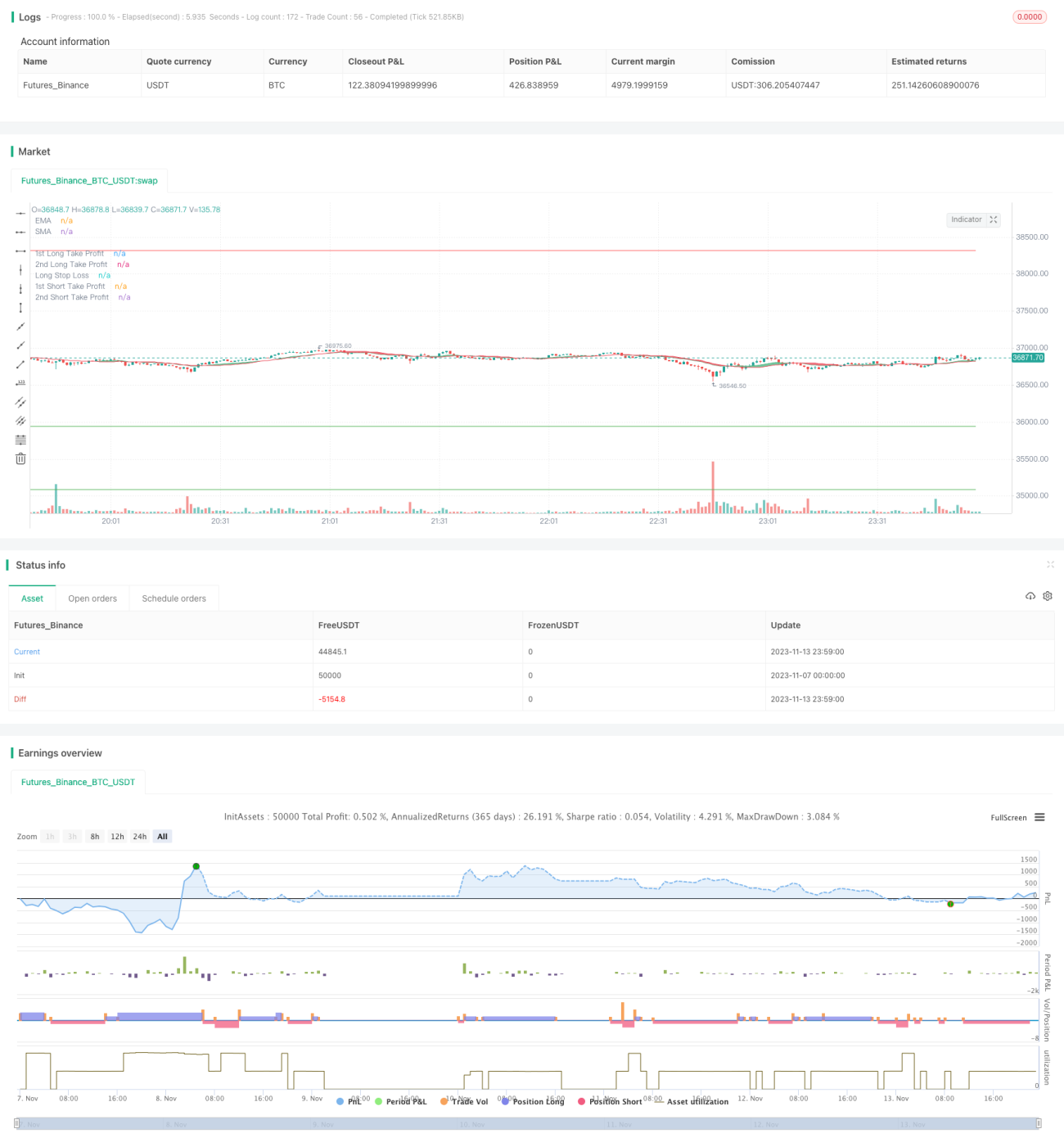
Эта стратегия использует двойной RSI для длительных и коротких двунаправленных сделок, а также в сочетании с равнолинейной системой для определения направления тенденции, входит в число двух RSI количественных стратегий. Стратегия сначала использует RSI для определения пустого сигнала, а затем в сочетании с равнолинейной для определения направления тенденции для принятия решения о дополнительном дисконтировании, входит в число типичных стратегий отслеживания тенденции.
Двойная RSI количественная стратегия в основном использует двухмесячный RSI для определения торговых сигналов. Сначала стратегия устанавливает два параметра RSI, один из которых является основным торговым суждением, а другой - вспомогательным фильтром.
Чтобы отфильтровать ложные сигналы, стратегия также вводит средние значения SMA и EMA для определения тренда. Только при прохождении длинной линии EMA по коротким линиям SMA следует учитывать RSI, только при прохождении длинной линии EMA по коротким линиям SMA следует учитывать RSI, чтобы гарантировать, что сигнал RSI совпадает с направлением тренда, и избегать торговли против тренда.
Кроме того, стратегия также устанавливает логику стоп-стоп. После открытия позиции одновременно выпускается два различных количества стоп-кода и устанавливается стоп-стоп.
Двойная стратегия количественного RSI имеет следующие преимущества:
Двойной временной период RSI позволяет более точно определить полярный сигнал. Длинный и короткий период RSI перекрестные комбинации, можно отфильтровать некоторые ложные сигналы, повысить качество сигнала.
Система равнолинейной торговли помогает определить направление тенденции, избежать торговли против тенденции, фильтровать большую часть шума и повышать шансы на победу.
Гибкий механизм остановки убытков, который позволяет получить более высокую прибыль с помощью различных установок остановки, а также ограничить убытки для управления рисками.
Стратегическая логика торговли проста и понятна, легко понятна и оптимизирована, подходит для обучения количественным трейдерам.
Несмотря на определенные преимущества двойной стратегии количественного RSI, существуют следующие риски:
RSI сам по себе не влияет на оценку шокирующих событий и обратных тенденций, и стратегия может оказаться неэффективной для торговли на этих рынках.
Несмотря на то, что среднелинейная система может фильтровать небольшой диапазон шума, она не очень эффективна в определении изменений среднециклического тренда и может пропустить поворотный момент тренда.
Неправильная настройка стоп-убытков может привести к тому, что стоп-убытки станут слишком широкими или стоп-убытки станут слишком маленькими, снижая эффективность стратегии.
Масштабный дисконтированный рынок может привести к увеличению убытков, поэтому необходимо контролировать размер позиции.
Для этих рисков можно снизить риск, скорректировав параметры RSI, внедрив более продвинутые трендовые и обратные индикаторы, оптимизировав логику стоп-стоп-лосс и контролируя позиции.
Стратегия количественного измерения двойного RSI может быть дополнительно оптимизирована в следующих направлениях:
Попробуйте различные комбинации параметров, оптимизируйте циклические параметры RSI и найдите оптимальную комбинацию RSI для длинных и коротких периодов.
Тестирование различных среднелинейных показателей, введение таких показателей, как MACD, для определения тенденции и возможности обратного пути.
Оптимизация стратегии стоп-стоп, установка стоп-трека или перемещение стоп-стоп, чтобы сделать стоп-стоп более гибким.
Добавление модуля контроля позиций, контроль позиций на различных этапах большого циклического тренда.
Добавление модели машинного обучения повышает точность входов и выходов.
Проведите обратную связь и оптимизируйте, чтобы найти оптимальный вариант сделки и временной цикл.
Двойная RSI - это типичная стратегия для отслеживания тенденций. Она сочетает в себе два RSI-индикатора, которые определяют торговые сигналы и фильтруют шум в равномерной системе.
/*backtest
start: 2023-11-07 00:00:00
end: 2023-11-14 00:00:00
period: 1m
basePeriod: 1m
exchanges: [{"eid":"Futures_Binance","currency":"BTC_USDT"}]
*/
//@version=4
strategy("Growth Producer", overlay=true, initial_capital = 1000, currency = "USD", pyramiding = 2, commission_type=strategy.commission.percent, commission_value=0.07, default_qty_type = strategy.percent_of_equity, default_qty_value = 100)
//Functions
Atr(p) =>
atr = 0.
Tr = max(high - low, max(abs(high - close[1]), abs(low - close[1])))
atr := nz(atr[1] + (Tr - atr[1])/p,Tr)
/// TREND
ribbon_period = input(19, "Period", step=1)
leadLine1 = ema(close, ribbon_period)
leadLine2 = sma(close, ribbon_period)
p1 = plot(leadLine1, color= #53b987, title="EMA", transp = 50, linewidth = 1)
p2 = plot(leadLine2, color= #eb4d5c, title="SMA", transp = 50, linewidth = 1)
fill(p1, p2, transp = 60, color = leadLine1 > leadLine2 ? #53b987 : #eb4d5c)
// Relative volatility index
length = input(120,"RVI period", minval=1), src = close
len = 14
stddev = stdev(src, length)
upper = ema(change(src) <= 0 ? 0 : stddev, len)
lower = ema(change(src) > 0 ? 0 : stddev, len)
rvi = upper / (upper + lower) * 100
benchmark = input(35, "RVI benchmark", minval=10, maxval=100, step=0.1)
// Plot RVI
// h0 = hline(80, "Upper Band", color=#C0C0C0)
// h1 = hline(20, "Lower Band", color=#C0C0C0)
// fill(h0, h1, color=#996A15, title="Background")
// offset = input(0, "Offset", type = input.integer, minval = -500, maxval = 500)
// plot(rvi, title="RVI", color=#008000, offset = offset)
/// MFI input
mfi_source = hlc3
mfi_length = input(19, "MFI Length", minval=1)
mfi_lower = input(15, "MFI Lower level", minval=0, maxval=50)
mfi_upper = input(90, "MFI Higher level", minval=50, maxval=100)
// MFI
upper_s = sum(volume * (change(mfi_source) <= 0 ? 0 : mfi_source), mfi_length)
lower_s = sum(volume * (change(mfi_source) >= 0 ? 0 : mfi_source), mfi_length)
mf = rsi(upper_s, lower_s)
// mfp = plot(mf, color=color.new(color.gray,0), linewidth=1)
// top = hline(mfi_upper, color=color.new(color.gray, 100), linewidth=1, editable=false)
// bottom = hline(mfi_lower, color=color.new(color.gray,100), linewidth=1, editable=false)
// hline(0, color=color.new(color.black,100), editable=false)
// hline(100, color=color.new(color.black,100), editable=false)
// Breaches
// b_color = (mf > mfi_upper) ? color.new(color.red,70) : (mf < mfi_lower) ? color.new(color.green,60) : na
// bgcolor(HighlightBreaches ? b_color : na)
// fill(top, bottom, color=color.gray, transp=75)
// Initial inputs
Act_RSI_VWAP_long = input(true, "RSI VOLUME WEIGHTED AVERAGE PRICE LONG")
RSI_VWAP_length_long = input(16, "RSI-VWAP LENGTH LONG")
RSI_VWAP_overSold_long = input(13, "RSI-VWAP OVERSOLD LONG", type=input.float)
RSI_VWAP_overBought_long = input(68, "RSI-VWAP OVERBOUGHT LONG", type=input.float)
Act_RSI_VWAP_short = input(true, "RSI VOLUME WEIGHTED AVERAGE PRICE SHORT")
RSI_VWAP_length_short = input(14, "RSI-VWAP LENGTH SHORT")
RSI_VWAP_overSold_short = input(7, "RSI-VWAP OVERSOLD SHORT", type=input.float)
RSI_VWAP_overBought_short = input(68, "RSI-VWAP OVERBOUGHT SHORT", type=input.float)
// RSI with VWAP as source
RSI_VWAP_long = rsi(vwap(close), RSI_VWAP_length_long)
RSI_VWAP_short = rsi(vwap(close), RSI_VWAP_length_short)
// Plot Them Separately.
// Plotting LONG, Put overlay=false
// r=plot(RSI_VWAP_long, color = RSI_VWAP_long > RSI_VWAP_overBought_long ? color.red : RSI_VWAP_lnog < RSI_VWAP_overSold_long ? color.lime : color.blue, title="rsi", linewidth=2, style=plot.style_line)
// h1=plot(RSI_VWAP_overBought_long, color = color.gray, style=plot.style_stepline)
// h2=plot(RSI_VWAP_overSold_long, color = color.gray, style=plot.style_stepline)
// fill(r,h1, color = RSI_VWAP_long > RSI_VWAP_overBought_long ? color.red : na, transp = 60)
// fill(r,h2, color = RSI_VWAP_long < RSI_VWAP_overSold_long ? color.lime : na, transp = 60)
// Plotting SHORT, Put overlay=false
// r=plot(RSI_VWAP_short, color = RSI_VWAP_short > RSI_VWAP_overBought_short ? color.red : RSI_VWAP_short < RSI_VWAP_overSold_short ? color.lime : color.blue, title="rsi", linewidth=2, style=plot.style_line)
// h1=plot(RSI_VWAP_overBought_short, color = color.gray, style=plot.style_stepline)
// h2=plot(RSI_VWAP_overSold_short, color = color.gray, style=plot.style_stepline)
// fill(r,h1, color = RSI_VWAP_short > RSI_VWAP_overBought_short ? color.red : na, transp = 60)
// fill(r,h2, color = RSI_VWAP_short < RSI_VWAP_overSold_short ? color.lime : na, transp = 60)
/////// STRATEGY Take Profit / Stop Loss ////////
////// LONG //////
long_tp1_inp = input(3.3, title='Long Take Profit 1 %', step=0.1)/100
long_tp1_qty = input(15, title="Long Take Profit 1 Qty", step=1)
long_tp2_inp = input(12, title='Long Take Profit 2%', step=0.1)/100
long_tp2_qty = input(100, title="Long Take Profit 2 Qty", step=1)
long_sl_inp = input(3.3, title='Long Stop Loss %', step=0.1)/100
long_take_level_1 = strategy.position_avg_price * (1 + long_tp1_inp)
long_take_level_2 = strategy.position_avg_price * (1 + long_tp2_inp)
long_stop_level = strategy.position_avg_price * (1 - long_sl_inp)
////// SHORT //////
short_tp1_inp = input(3.2, title='Short Take Profit 1 %', step=0.1)/100
short_tp1_qty = input(20, title="Short Take Profit 1 Qty", step=1)
short_tp2_inp = input(5.5, title='Short Take Profit 2%', step=0.1)/100
short_tp2_qty = input(100, title="Short Take Profit 2 Qty", step=1)
short_sl_inp = input(3.2, title='Short Stop Loss %', step=0.1)/100
short_take_level_1 = strategy.position_avg_price * (1 - short_tp1_inp)
short_take_level_2 = strategy.position_avg_price * (1 - short_tp2_inp)
short_stop_level = strategy.position_avg_price * (1 + short_sl_inp)
///Strategy_Conditions
/// LONG ///
entry_long =(crossover(RSI_VWAP_long, RSI_VWAP_overSold_long) and leadLine2<leadLine1) or (crossunder(mf,mfi_lower) and leadLine2<leadLine1)
entry_price_long=valuewhen(entry_long,close,0)
exit_long =crossunder(RSI_VWAP_long, RSI_VWAP_overBought_long)
/// SHORT ///
entry_short =crossunder(RSI_VWAP_short, RSI_VWAP_overBought_short) and leadLine2>leadLine1 or (crossover(mf,mfi_upper) and leadLine2>leadLine1)
entry_price_short=valuewhen(entry_short,close,0)
exit_short =crossover(RSI_VWAP_short, RSI_VWAP_overSold_short)
////// BACKTEST PERIOD ///////
testStartYear = input(2019, "Backtest Start Year")
testStartMonth = input(1, "Backtest Start Month")
testStartDay = input(1, "Backtest Start Day")
testPeriodStart = timestamp(testStartYear,testStartMonth,testStartDay,0,0)
testStopYear = input(2020, "Backtest Stop Year")
testStopMonth = input(12, "Backtest Stop Month")
testStopDay = input(31, "Backtest Stop Day")
testPeriodStop = timestamp(testStopYear,testStopMonth,testStopDay,0,0)
testPeriod() => true
if testPeriod()
if strategy.position_size == 0 or strategy.position_size > 0 and rvi>benchmark
strategy.entry("long", true, when = entry_long, comment="Insert Enter Long Comment")
strategy.exit("TP1","long", qty_percent=long_tp1_qty, limit=long_take_level_1, stop=long_stop_level)
strategy.exit("TP2","long", qty_percent=long_tp2_qty, limit=long_take_level_2, stop=long_stop_level)
strategy.close("long", when=exit_long, comment = "Insert Exit Long Comment")
if strategy.position_size == 0 or strategy.position_size < 0 and rvi>benchmark
strategy.entry("short", false, when = entry_short, comment="Insert Enter Short Comment")
strategy.exit("TP1","short", qty_percent=short_tp1_qty, limit=short_take_level_1, stop=short_stop_level)
strategy.exit("TP2","short", qty_percent=short_tp2_qty, limit=short_take_level_2, stop=short_stop_level)
strategy.close("short", when=exit_short, comment = "Insert Exit Short Comment")
// LONG POSITION
plot(strategy.position_size > 0 ? long_take_level_1 : na, style=plot.style_linebr, color=color.green, linewidth=1, title="1st Long Take Profit")
plot(strategy.position_size > 0 ? long_take_level_2 : na, style=plot.style_linebr, color=color.green, linewidth=1, title="2nd Long Take Profit")
plot(strategy.position_size > 0 ? long_stop_level : na, style=plot.style_linebr, color=color.red, linewidth=1, title="Long Stop Loss")
// SHORT POSITION
plot(strategy.position_size < 0 ? short_take_level_1 : na, style=plot.style_linebr, color=color.green, linewidth=1, title="1st Short Take Profit")
plot(strategy.position_size < 0 ? short_take_level_2 : na, style=plot.style_linebr, color=color.green, linewidth=1, title="2nd Short Take Profit")
plot(strategy.position_size < 0 ? short_stop_level : na, style=plot.style_linebr, color=color.red, linewidth=1, title="Long Stop Loss")