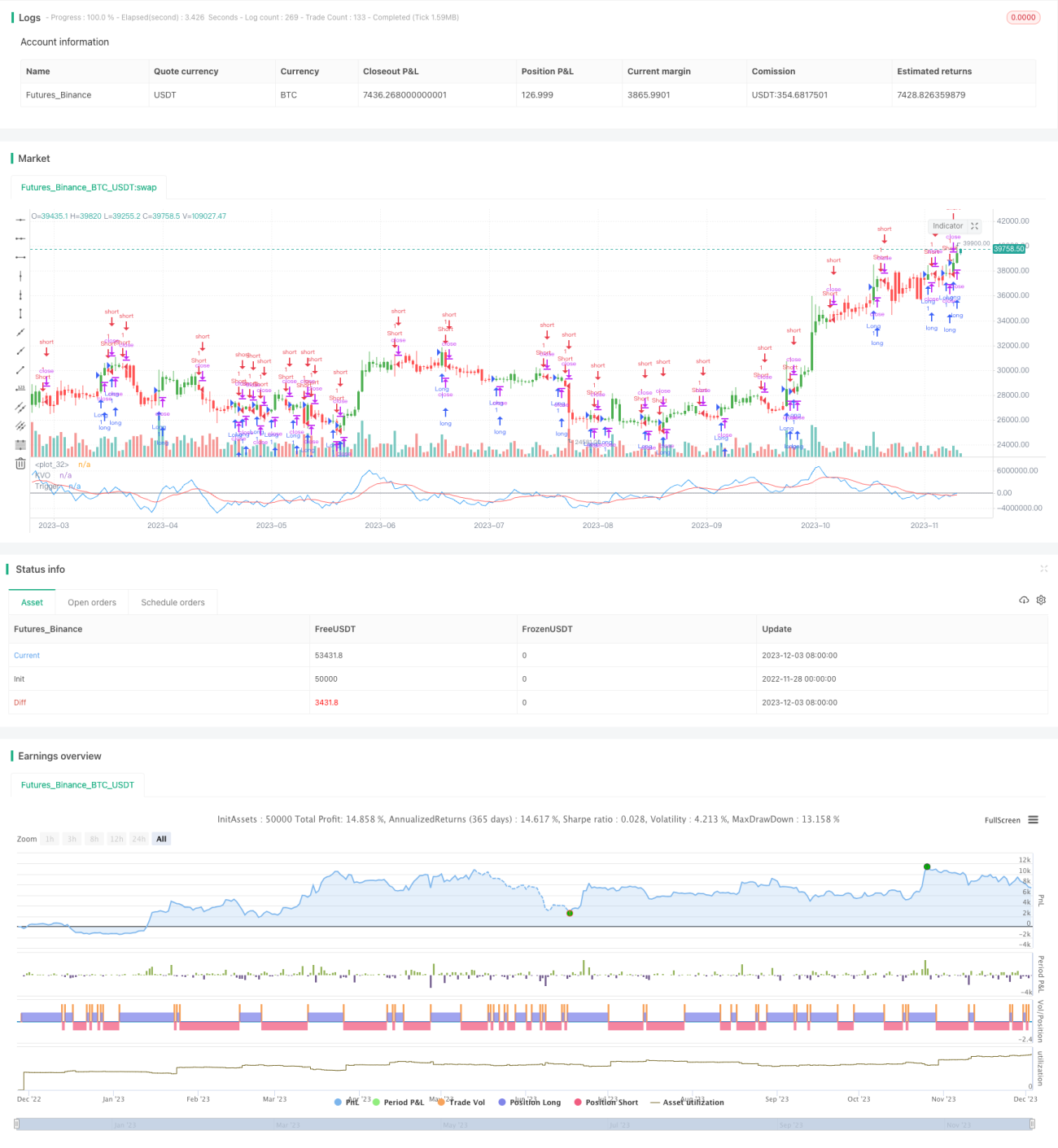
Количественная стратегия с колеблющимся трафиком


Дата создания: 2023-12-05 11:35:50 Последнее изменение: 2023-12-05 11:35:50
Копировать: 0 Количество просмотров: 763
1
Подписаться
1619
Подписчики

Количественная стратегия с колеблющимся трафиком

Это торговая стратегия, основанная на количественных показателях Клингера. Эта стратегия захватывает изменения в силе купли-продажи в ценовых колебаниях, чтобы обнаружить поворотные точки в рыночных тенденциях. Ее преимущества в том, что она чувствительна и точна, и может применяться как для краткосрочного, так и для долгосрочного анализа.

Стратегический принцип

Эта стратегия основана на следующих принципах:

  1. Ценовой диапазон ((высшая цена - низшая цена) отражает величину колебаний цен, а объем сделок является движущей силой колебаний цен.
  2. Сумма максимальной цены + минимальной цены + цены закрытия + сумма цены закрытия на день ранее - характеристика усиления и накопления покупательской силы; наоборот - характеристика распределения.
  3. Продолжающееся изменение объемов сделок отражает изменения в силе покупателей и продавцов.

Согласно этим теориям, стратегия рассчитывает количественный показатель Клингера, сравнивая сумму цен на закрытие с величиной на предыдущий день, синтезируя изменение объема оборота. Когда показатель пересекает свою собственную среднюю линию, делайте больше, а когда пересекаете, делайте пустое.

В частности, стратегия включает в себя три показателя:

  1. xTrend: отражает силу тенденции колебаний цен, основанную на совокупности цен на закрытие дня и сравнении с предыдущим днем.
  2. xFast: средняя скорость xTrend с параметром 34 дня.
  3. xSlow: средняя медленная скорость xTrend, параметр 55 дней.

Затем рассчитывается разница xKVO в качестве торгового показателя. Когда она превышает 13-дневную среднюю линию xTrigger, она становится больше, а когда она превышает ее, она становится пустой.

Стратегические преимущества

Самым большим преимуществом этой стратегии является то, что она подходит как для краткосрочного, так и для долгосрочного анализа. Параметры, установленные на медленно-медленном среднем, позволяют ей чувствительно улавливать изменения в краткосрочных тенденциях. В то же время, она также может отфильтровывать краткосрочный рыночный шум и улавливать долгосрочные тенденции.

Кроме того, эта стратегия основана только на расчете цены и объема сделок. Не требуется вычислять сложные математические показатели, вычислительная эффективность высока и подходит для практических приложений.

Риски и противодействие

Наибольший риск этой стратегии заключается в том, что индикатор объема торговли имеет слабую способность распознавать ложные прорывы. Эта стратегия может подавать ошибочные сигналы, когда в краткосрочной перспективе цена поменяется вверх, чтобы преодолеть среднюю линию. В этом случае необходимо объединить другие факторы для определения тенденции.

Кроме того, стратегия чувствительна к параметрам. Параметры для быстрого и медленного среднего и среднего торгового среднего должны быть повторно протестированы и оптимизированы для оптимальной работы.

Оптимизация стратегии

На основе анализа рисков мы можем оптимизировать эту стратегию в следующих аспектах:

  1. Увеличение механизма сдерживания убытков. Сдерживание убытков, когда цена падает на определенную пропорцию, может уменьшить помехи шума краткосрочной корректировки.

  2. Добавление фильтров на тренды. В сочетании с MACD и другими индикаторами для определения общего движения рынка, чтобы избежать ошибки во время колебаний.

  3. Оптимизация параметров. Поиск оптимальных комбинаций параметров с помощью исторических данных для повышения стабильности стратегии.

  4. Оптимизация управления капиталом на предстоящий период. Например, динамическая корректировка позиции в зависимости от ситуации с остановкой выигрыша и убытков.

Подвести итог

Эта стратегия позволяет получить хорошую производительность, сравнивая соотношение суммарной цены и объема торгов, улавливая изменения в рыночной силе купли-продажи, одновременно учитывая чувствительность и стабильность. При условии установки параметров оптимизации и в сочетании с оценкой тенденции, можно получить хорошую производительность.

||

This is a trading strategy based on the Klinger Volume Oscillator. It captures the shifts in buying and selling forces during price fluctuations to identify turning points in market trends. The advantages are sensitivity and accuracy for both short-term and long-term analysis. However, some risks need to be noticed.

Strategy Logic

The strategy is built on the following assumptions:

  1. The price range (high-low) reflects the amplitude of price swings, while volume is the driving force behind price movements.
  2. If today’s sum of high + low + close is greater than yesterday’s, it indicates strengthened buying forces and accumulation; the opposite suggests distribution.
  3. Continuous changes in volume reflect shifts in the forces of buyers and sellers.

Based on the theories, the strategy calculates the Klinger Volume Oscillator by comparing the relationship between today’s sum of closing prices and yesterday’s, combined with changes in volume. It goes long when the indicator crosses above its moving average line, and goes short on crosses below.

Specifically, there are three main indicators involved:

  1. xTrend: reflects the force of price trend based on comparison of sum of prices between days.
  2. xFast: fast EMA of xTrend with period of 34.
  3. xSlow: slow EMA of xTrend with period of 55.

The difference xKVO is then calculated as the trading indicator. Go long on crossing above 13-day EMA xTrigger, and short on crossing below.

Advantages

The greatest advantage is being suitable for both short-term and long-term analysis simultaneously. The fast and slow EMA settings make it sensitive to catch short-term swings, while also filtering out market noise and capturing long-term trends, which most price-based indicators struggle with.

In addition, it is purely based on price and volume data without complex math. This makes it highly efficient for actual trading applications.

Risks & Solutions

The main risk is weaker ability to distinguish false breakouts. Short-term price adjustments may generate wrong long signals. Other factors should be considered to determine the trend.

Also, the strategy is sensitive towards parameter tuning. Optimization is required on the EMAs and trigger line to find best performance.

Strategy Optimization

Some aspects that could further optimize the strategy according to the risks:

  1. Add stop loss mechanisms. Exiting at some percentage retracement reduces noise interference.

  2. Add trend filtering with indicators like MACD to avoid directional mistakes in ranging markets.

  3. Optimize parameter sets through backtests to improve robustness.

  4. Capital management optimization such as dynamic position sizing based on stop loss/take profit levels.

Conclusion

Overall, the strategy captures shifts in market forces by comparing price quantities and volumes for both sensitivity and stability. It can perform well given optimized parameters and trend validation, but inherent limitations of volume indicators can still pose risks for traders.

[/trans]

Исходный код стратегии
/*backtest
start: 2022-11-28 00:00:00
end: 2023-12-04 00:00:00
period: 1d
basePeriod: 1h
exchanges: [{"eid":"Futures_Binance","currency":"BTC_USDT"}]
*/

//@version=2
////////////////////////////////////////////////////////////
//  Copyright by HPotter v1.0 30/08/2017
// The Klinger Oscillator (KO) was developed by Stephen J. Klinger. Learning 
// from prior research on volume by such well-known technicians as Joseph Granville, 
// Larry Williams, and Marc Chaikin, Mr. Klinger set out to develop a volume-based 
// indicator to help in both short- and long-term analysis.
// The KO was developed with two seemingly opposite goals in mind: to be sensitive 
// enough to signal short-term tops and bottoms, yet accurate enough to reflect the 
// long-term flow of money into and out of a security.
// The KO is based on the following tenets:
// Price range (i.e. High - Low) is a measure of movement and volume is the force behind 
// the movement. The sum of High + Low + Close defines a trend. Accumulation occurs when 
// today's sum is greater than the previous day's. Conversely, distribution occurs when 
// today's sum is less than the previous day's. When the sums are equal, the existing trend 
// is maintained.
// Volume produces continuous intra-day changes in price reflecting buying and selling pressure. 
// The KO quantifies the difference between the number of shares being accumulated and distributed 
// each day as "volume force". A strong, rising volume force should accompany an uptrend and then 
// gradually contract over time during the latter stages of the uptrend and the early stages of 
// the following downtrend. This should be followed by a rising volume force reflecting some 
// accumulation before a bottom develops.
//
// You can change long to short in the Input Settings
// Please, use it only for learning or paper trading. 
////////////////////////////////////////////////////////////
strategy(title="Klinger Volume Oscillator (KVO)", shorttitle="KVO")
TrigLen = input(13, minval=1)
FastX = input(34, minval=1)
SlowX = input(55, minval=1)
reverse = input(false, title="Trade reverse")
hline(0, color=gray, linestyle=line)
xTrend = iff(hlc3 > hlc3[1], volume * 100, -volume * 100)
xFast = ema(xTrend, FastX)
xSlow = ema(xTrend, SlowX)
xKVO = xFast - xSlow
xTrigger = ema(xKVO, TrigLen)
pos = iff(xKVO > xTrigger, 1,
	   iff(xKVO < xTrigger, -1, nz(pos[1], 0))) 
possig = iff(reverse and pos == 1, -1,
          iff(reverse and pos == -1, 1, pos))	   
if (possig == 1) 
    strategy.entry("Long", strategy.long)
if (possig == -1)
    strategy.entry("Short", strategy.short)	   	    
barcolor(possig == -1 ? red: possig == 1 ? green : blue )  
plot(xKVO, color=blue, title="KVO")
plot(xTrigger, color=red, title="Trigger")