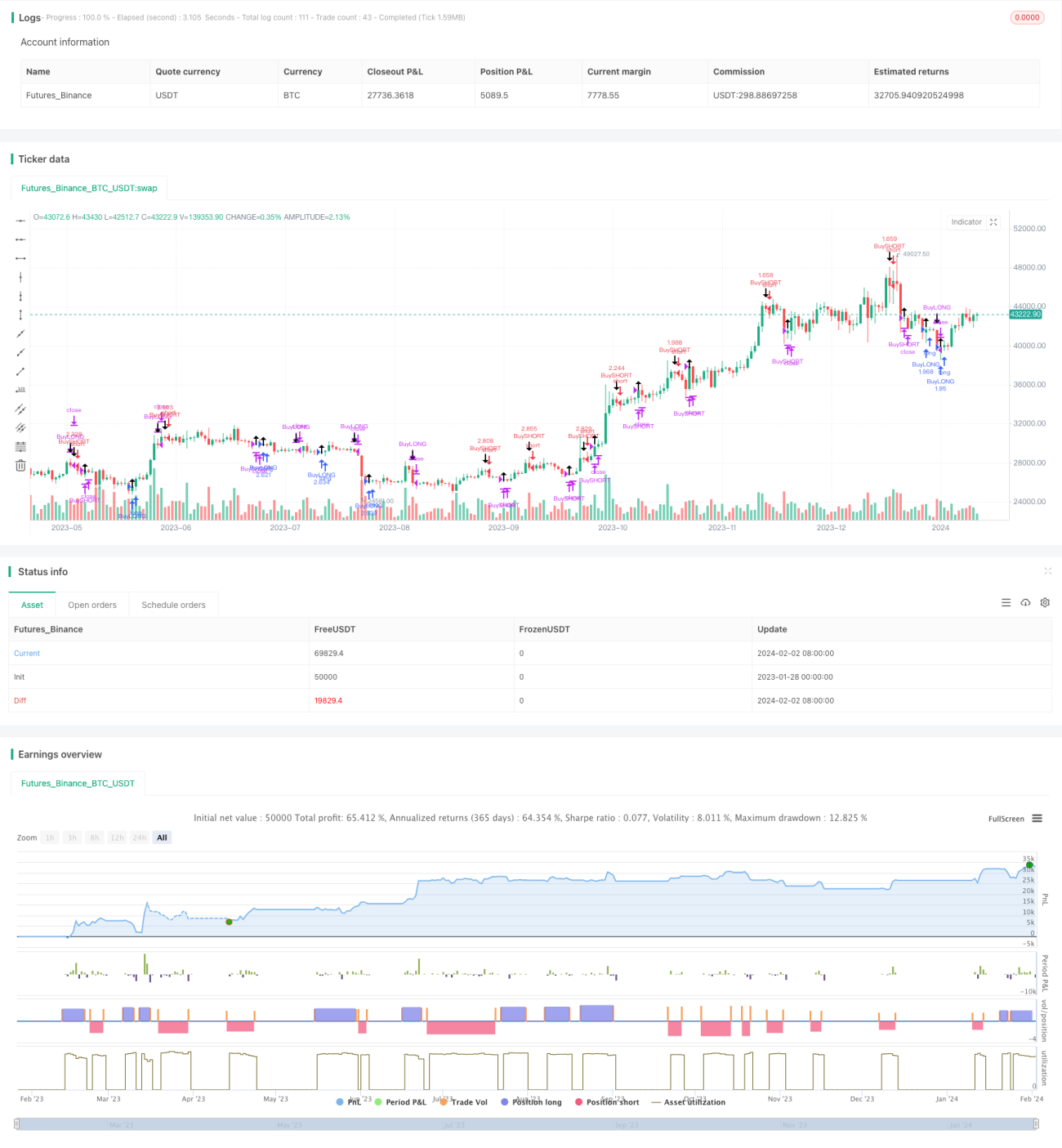
Стратегия импульсной торговли, основанная на многофакторной модели


Дата создания: 2024-02-04 15:34:49 Последнее изменение: 2024-02-04 15:34:49
Копировать: 0 Количество просмотров: 661
1
Подписаться
1617
Подписчики

Стратегия импульсной торговли, основанная на многофакторной модели

Обзор

Стратегия является динамической торговой стратегией, основанной на нескольких технических показателях. Стратегия использует несколько технических показателей, таких как ленты Брин, RSI, ATR, реализует многофакторную модель, которая позволяет быстро оценивать вход в тренд. В то же время стратегия использует средства контроля риска, такие как остановка убытков и продвинутые остановки, чтобы эффективно контролировать риск.

Стратегический принцип

Торговые сигналы для этой стратегии в основном исходят из буринской зоны. Когда цена приближается к понижению буринской зоны, она смотрит вверх, а когда цена приближается к повышению буринской зоны, она смотрит вниз. Чтобы отфильтровать ложные прорывы, в стратегию дополнительно добавлены правила суждения RSI. Торговый сигнал производится только тогда, когда RSI также подтверждает, что текущая зона является сверхпокупной и сверхпродажной.

Кроме того, в стратегии также используется индикатор ATR для реализации стоп-стоп. В частности, при открытии позиции записывается цена покупки, после чего на основе значения индикатора ATR делается trailing stop, что позволяет блокировать прибыль и эффективно контролировать риск.

Анализ преимуществ стратегии

Наибольшее преимущество этой стратегии заключается в том, что комплексный анализ рынка с использованием многофакторной модели позволяет эффективно оценивать структурные возможности рынка. Это позволяет избежать ложных сигналов, вызванных одним показателем. В то же время, встроенные в стратегию механизмы остановки и продвинутого остановки также позволяют эффективно контролировать риск и избегать чрезмерных потерь.

Анализ рисков

Наибольший риск этой стратегии заключается в том, что в случае резкого рыночного переворота вероятность того, что несколько индикаторов одновременно получат ошибочные сигналы, будет относительно высокой. Это может привести к большим убыткам стратегии. Кроме того, когда технические индикаторы посылают сигналы, это может быть общее согласие на рынке, что может привести к формированию эффекта пастбища.

Чтобы снизить эти риски, мы можем корректировать параметры, выбирая более четкие сигналы. В то же время мы можем добавить больше фильтрующих условий, чтобы избежать ошибочных сделок вблизи верхней части рынка.

Направление оптимизации

Эта стратегия может быть оптимизирована в следующих направлениях:

  1. Добавление большего количества технических показателей, формирование более трехмерной многофакторной модели, повышение точности суждения

  2. Оптимизация логики стоп-лорда, выбор различных стоп-стратегий в зависимости от стадии рынка

  3. Комбинирование технологий, таких как машинное обучение, динамическая оптимизация параметров и оценка надежности сигналов

  4. Добавление информации о отраслях, концепциях и т. д. в многофакторную модель

Подвести итог

Эта стратегия хорошо понимает направление тенденций, разумно применяя идеи многофакторной модели. В то же время, научные средства контроля риска также позволяют стратегии получать контролируемую прибыль.

Исходный код стратегии
/*backtest
start: 2023-01-28 00:00:00
end: 2024-02-03 00:00:00
period: 1d
basePeriod: 1h
exchanges: [{"eid":"Futures_Binance","currency":"BTC_USDT"}]
*/

//@version=3
// THIS SCRIPT IS MEANT TO ACCOMPANY COMMAND EXECUTION BOTS
// THE INCLUDED STRATEGY IS NOT MEANT FOR LIVE TRADING
// THIS STRATEGY IS PURELY AN EXAMLE TO START EXPERIMENTATING WITH YOUR OWN IDEAS
/////////////////////////////////////////////////////////////////////////////////

// comment out the next line to use this script as an alert script
strategy(title="Dragon Bot - Default Script", overlay=true, default_qty_type=strategy.percent_of_equity, default_qty_value=100)
// remove the // in the next line to use this script as an alert script
// study(title="Dragon Bot - Default Script", overlay=true)

// Dragon-Bot default script version 2.0
// This can also be used with bot that reacts to tradingview alerts.
// Use the script as "strategy" for backtesting
// Comment out line 8 and de-comment line 10 to be able to set tradingview alerts.
// You should also comment out (place // before it) the lines 360, 364, 368 and 372 (strategy.entry and strategy.close) to be able to set the alerts.
/////////////////////////////////////////////////////////////////////////////////////////////////////////////////////////////
// In this first part of the script we setup variables and make sure the script keeps all information it used in the past. //
/////////////////////////////////////////////////////////////////////////////////////////////////////////////////////////////
longs = 0
longs := nz(longs[1])

shorts = 0
shorts := nz(shorts[1])

buyprice = 0.0
buyprice := buyprice[1]

sellprice = 0.0
sellprice := sellprice[1]

scaler = 0.0
scaler := scaler[1]

sellprofit = input(1.0, minval=0.0, step=0.1, title="main strat profit")
sellproffinal = sellprofit/100

enable_shorts = input(1, minval=0, maxval=1, title="Shorts on/off")

enable_flipping = input(0, minval=0, maxval=1, title="Flipping on/off -> Go directly from long -> short or short -> long without closing ")

enable_stoploss = input(0, minval=0, maxval=1, title="Stoploss on/off")
sellstoploss = input(30.0, minval=0.0, step=1.0, title="Stoploss %")
sellstoplossfinal = sellstoploss/100

enable_trailing = input(1, minval=0, maxval=1, title="Trailing on/off")
enable_trailing_ATR = input(1, minval=0, maxval=1, title="Trailing use ATR on/off")
ATR_Multi = input(1.0, minval=0.0, step=0.1, title="Multiplier for ATR")
selltrailing = input(10.0, minval=0.0, step=1.0, title="Trailing %")
selltrailingfinal = selltrailing/100

Backtestdate = input(0, minval=0, maxval=1, title="backtest date on/off")

// Component Code by pbergden - Start backtest dates
// The following code snippet is taken from an example by pbergen
// All rights to this snippet remain with pbergden
testStartYear = input(2018, "Backtest Start Year")
testStartMonth = input(1, "Backtest Start Month")
testStartDay = input(1, "Backtest Start Day")
testPeriodStart = timestamp(testStartYear,testStartMonth,testStartDay,0,0)

testStopYear = input(2019, "Backtest Stop Year")
testStopMonth = input(1, "Backtest Stop Month")
testStopDay = input(1, "Backtest Stop Day")
testPeriodStop = timestamp(testStopYear,testStopMonth,testStopDay,0,0)

// A switch to control background coloring of the test period
testPeriodBackground = input(title="Color Background?", type=bool, defval=true)
testPeriodBackgroundColor = testPeriodBackground and (time >= testPeriodStart) and (time <= testPeriodStop) ? #00FF00 : na
bgcolor(testPeriodBackgroundColor, transp=97)

testPeriod() => true

/////////////////////////////////////////////////////////////////////////////////////////////////////
// In this second part of the script we setup indicators that we can use for our actual algorithm. //
/////////////////////////////////////////////////////////////////////////////////////////////////////


//ATR
lengthtr = input(20, minval=1, title="ATR Length")
ATRsell = input(0, minval=0, title="1 for added ATR when selling")
ATR=rma(tr(true), lengthtr)
Trail_ATR=rma(tr(true), 10) * ATR_Multi
atr = 0.0
if ATRsell == 1
    atr := ATR

//OC2
lengthoc2 = input(20, minval=1, title="OC2 Length")
OC2sell = input(0, minval=0, title="1 for added OC2 when selling")
OC2mult = input(1, minval=1, title="OC2 multiplayer")
OC= abs(open[1]-close)
OC2=rma(OC, lengthoc2)
oc2 = 0.0
if OC2sell == 1
    oc2 := OC2*OC2mult

//ADX
lenadx = input(10, minval=1, title="DI Length")
lensig = input(10, title="ADX Smoothing", minval=1, maxval=50)

up = change(high)
down = -change(low)
plusDM = na(up) ? na : (up > down and up > 0 ? up : 0)
minusDM = na(down) ? na : (down > up and down > 0 ? down : 0)
trur = rma(tr, lenadx)
plus = fixnan(100 * rma(plusDM, lenadx) / trur)
minus = fixnan(100 * rma(minusDM, lenadx) / trur)
sum = plus + minus
sigadx = 100 * rma(abs(plus - minus) / (sum == 0 ? 1 : sum), lensig)

//StochRSI
smoothKRSI = input(3, minval=1)
smoothDRSI = input(3, minval=1)
lengthRSI = input(14, minval=1)
lengthStochRSI = input(14, minval=1)
srcRSI = input(close, title="RSI Source")
buyRSI = input(30, minval=1, title="RSI Buy Value")
sellRSI = input(70, minval=1, title="RSI Sell Value")
rsi1 = rsi(srcRSI, lengthRSI)
krsi = sma(stoch(rsi1, rsi1, rsi1, lengthStochRSI), smoothKRSI)
drsi = sma(krsi, smoothDRSI)

// Bollinger bands
lengthbb = input(20, minval=1)
srcbb = input(close, title="Sourcebb")
multbb = input(2.0, minval=0.001, maxval=50)
bb_buy_value = input(0.5, step=0.1, title="BB Buy Value")
bb_sell_value = input(0.5, step=0.1, title="BB Sell Value")
basisbb = sma(srcbb, lengthbb)
devbb = multbb * stdev(srcbb, lengthbb)
upperbb = basisbb + devbb
lowerbb = basisbb - devbb
bbr = (srcbb - lowerbb)/(upperbb - lowerbb)
bbbuy = basisbb - (devbb*bb_buy_value)
bbsell = basisbb + (devbb*bb_sell_value)

//ema very short
shorter = ema(close, 2)
shorterlong = ema(close, 5)

//ema short
short = ema(close, 10)
long = ema(close, 30)

//ema long
shortday = ema(close, 110)
longday = ema(close, 360)

//ema even longer
shortlongerday = ema(close, 240)
longlongerday = ema(close, 720)

//declaring extra timeframe value
profit = request.security(syminfo.tickerid, timeframe.period, close)

        
////////////////////////////////////////////////////////////////////////
// In the 3rd part of the script we define all the entries and exits //
///////// This third part is basically the acual algorithm ////////////
///////////////////////////////////////////////////////////////////////

//Declaring function with the long entries
OPENLONG_funct() =>
    // You can add more buy entries to the script
    longentry1 = false
    longentry2 = false
    longentry3 = false
    longentry4 = false
    longentry5 = false
    makelong_funct = false
    if  close<bbbuy and krsi<buyRSI // You could for instance add "and shortday > longday"
        longentry1 := close>close[1]
        // longentry2 := ...
    // if another thing we want to buy on happens
        // longentry3 := ...
    //All the buy entries go above, this last variable is what the function puts out
    // if you add more entries, add them in the following list too
    makelong_funct := longentry1 or longentry2 or longentry3 or longentry4 or longentry5

//Declaring function wit the short entries
OPENSHORT_funct() =>
    // You can add more buy entries to the script
    shortentry1 = false
    shortentry2 = false
    shortentry3 = false
    shortentry4 = false
    shortentry5 = false
    makeshort_funct = false
    if  close>bbsell and krsi>sellRSI // You could for instance add "and shortday < longday"
        shortentry1 := close<close[1]
        // shortentry2 := ...
    // if another thing we want to buy on happens
        // shortentry3 := ...
    //All the buy entries go above, this last variable is what the function puts out
    // if you add more entries, add them in the following list too
    makeshort_funct := shortentry1 or shortentry2 or shortentry3 or shortentry4 or shortentry5
    
//Declaring function with the long exits
CLOSELONG_funct() =>
    // You can add more buy entries to the script
    longexit1 = false
    longexit2 = false
    longexit3 = false
    longexit4 = false
    longexit5 = false
    closelong_funct = false
    if  close>bbsell and krsi>sellRSI
        longexit1 := close<close[1]
        // longexit2 := ...
    // if another thing we want to close on on happens you can add them here...
    // longexit3 := ...
    //All the buy entries go above, this last variable is what the function puts out
    // if you add more exits, add them in the following list too
    closelong_funct := longexit1 or longexit2 or longexit3 or longexit4 or longexit5

//Declaring function wit the short exits
CLOSESHORT_funct() =>
    // You can add more buy entries to the script
    shortexit1 = false
    shortexit2 = false
    shortexit3 = false
    shortexit4 = false
    shortexit5 = false
    closeshort_funct = false
    if  close<bbsell and krsi<sellRSI
        shortexit1 := close>close[1]
        // shortexit2 := ...
    // if another thing we want to close on on happens you can add them here...
        // shortexit3 := ...
    //All the buy entries go above, this last variable is what the function puts out
    // if you add more exits, add them in the following list too
    closeshort_funct := shortexit1 or shortexit2 or shortexit3 or shortexit4 or shortexit5

/////////////////////////////////////////////////////////////////////////////////////
////////////// End of "entries" and "exits" definition code /////////////////////////
/////////////////////////////////////////////////////////////////////////////////////
/// In the fourth part we do the actual work, as defined in the part before this ////
////////////////////// This part does not need to be changed ////////////////////////
/////////////////////////////////////////////////////////////////////////////////////

//OPEN LONG LOGIC
makelong = false
//buy with backtesting on specific dates
if Backtestdate > 0 and testPeriod()
    if (longs < 1 and shorts < 1) or (short > 0 and enable_flipping > 0 and enable_shorts > 0)
        makelong := OPENLONG_funct()

//buy without backtesting on specific dates
if Backtestdate < 1
    if (longs < 1 and shorts < 1) or (short > 0 and enable_flipping > 0 and enable_shorts > 0)
        makelong := OPENLONG_funct()
    
if makelong
    buyprice := close
    scaler := close
    longs := 1
    shorts := 0
    
//OPEN SHORT LOGIC
makeshort = false

//buy with backtesting on specific dates
if Backtestdate > 0 and testPeriod()
    if (shorts < 1 and longs < 1 and enable_shorts > 0) or (longs > 0 and enable_flipping > 0 and enable_shorts > 0)
        makeshort := OPENSHORT_funct()

//buy without backtesting on specific dates
if Backtestdate < 1
    if (shorts < 1 and longs < 1 and enable_shorts > 0) or (longs > 0 and enable_flipping > 0 and enable_shorts > 0)
        makeshort := OPENSHORT_funct()
    

if makeshort
    buyprice := close
    scaler := close
    shorts := 1
    longs := 0

//Calculating values for traling stop
if longs > 0 and enable_flipping < 1
    if close > scaler+Trail_ATR and enable_trailing_ATR > 0
        scaler := close
    if close > scaler * (1.0 + selltrailingfinal) and enable_trailing_ATR < 1
        scaler := close
if shorts > 0 and enable_flipping < 1
    if close < scaler-Trail_ATR and enable_trailing_ATR > 0
        scaler := close
    if close < scaler * (1.0 - selltrailingfinal) and enable_trailing_ATR < 1
        scaler := close
    
long_exit = false
long_security1 = false
long_security2 = false
long_security3 = false

//CLOSE LONG LOGIC
if longs > 0 and enable_flipping < 1
    if ( (buyprice + (buyprice*sellproffinal) + atr + oc2) < close) and ( (buyprice + (buyprice*sellproffinal) ) < profit)
        long_exit := CLOSELONG_funct()
//security
    if enable_stoploss > 0
        long_security1 := close < ( buyprice * (1.0 - sellstoplossfinal) )
    if enable_trailing > 0 and enable_trailing_ATR < 1
        long_security2 := close < ( scaler * (1.0 - selltrailingfinal) )
    if enable_trailing > 0 and enable_trailing_ATR > 0
        long_security2 := close < ( scaler - Trail_ATR)
        
//CLOSE LONG LOGIC
if longs > 0 and enable_flipping > 0
//security
    if enable_stoploss > 0
        long_security1 := close < ( buyprice * (1.0 - sellstoplossfinal) )
    if enable_trailing > 0 and enable_trailing_ATR < 1
        long_security2 := close < ( scaler * (1.0 - selltrailingfinal) )
    if enable_trailing > 0 and enable_trailing_ATR > 0
        long_security2 := close < ( scaler - Trail_ATR)
        
closelong = long_exit or long_security1 or long_security2 or long_security3 

short_exit = false
short_security1 = false
short_security2 = false
short_security3 = false

if closelong
    longs := 0

//CLOSE SHORT LOGIC
if shorts > 0 and enable_flipping < 1
    if ( (buyprice - (buyprice*(sellproffinal) - atr - oc2) > close) and ( (buyprice - (buyprice*sellproffinal) ) > profit) )
        short_exit := CLOSESHORT_funct()
//security
    if enable_stoploss > 0
        short_security1 := close > ( buyprice * (1.0 + sellstoplossfinal) )
    if enable_trailing > 0 and enable_trailing_ATR < 1
        short_security2 := close > ( scaler * (1.0 + selltrailingfinal) )
    if enable_trailing > 0 and enable_trailing_ATR > 0
        short_security2 := close > ( scaler + Trail_ATR)
if shorts > 0 and enable_flipping > 0
//security
    if enable_stoploss > 0
        short_security1 := close > ( buyprice * (1.0 + sellstoplossfinal) )
    if enable_trailing > 0 and enable_trailing_ATR < 1
        short_security2 := close > ( scaler * (1.0 + selltrailingfinal) )
    if enable_trailing > 0 and enable_trailing_ATR > 0
        short_security2 := close > ( scaler + Trail_ATR)
        
closeshort = short_exit or short_security1 or short_security2 or short_security3

if closeshort
    shorts := 0

///////////////////////////////////////////////////////////////////////////////////////
///////////// The last section takes care of the alerts //////////////////////////////
//////////////////////////////////////////////////////////////////////////////////////
plotshape(makelong, style=shape.arrowup)
alertcondition(makelong, title="openlong", message="openlong")
strategy.entry("BuyLONG", strategy.long, oca_name="DBCross",  when= makelong, comment="Open Long")

plotshape(makeshort, style=shape.arrowdown)
alertcondition(makeshort, title="openshort", message="openshort")
strategy.entry("BuySHORT", strategy.short, oca_name="DBCross",  when= makeshort, comment="Open Short")

plotshape(closelong, style=shape.arrowdown)
alertcondition(closelong, title="closelong", message="closelong")
strategy.close("BuyLONG", when=closelong)

plotshape(closeshort, style=shape.arrowup)
alertcondition(closeshort, title="closeshort", message="closeshort")
strategy.close("BuySHORT", when=closeshort)