Стратегия торговли на основе прорыва волатильности импульса, объединяющая фильтры тренда и импульса

ATR EMA RSI HH LL RR
Дата создания: 2025-02-20 15:13:31 Последнее изменение: 2025-02-20 15:13:31
Копировать: 1 Количество просмотров: 401
2
Подписаться
319
Подписчики

Стратегия торговли на основе прорыва волатильности импульса, объединяющая фильтры тренда и импульса Стратегия торговли на основе прорыва волатильности импульса, объединяющая фильтры тренда и импульса

Обзор

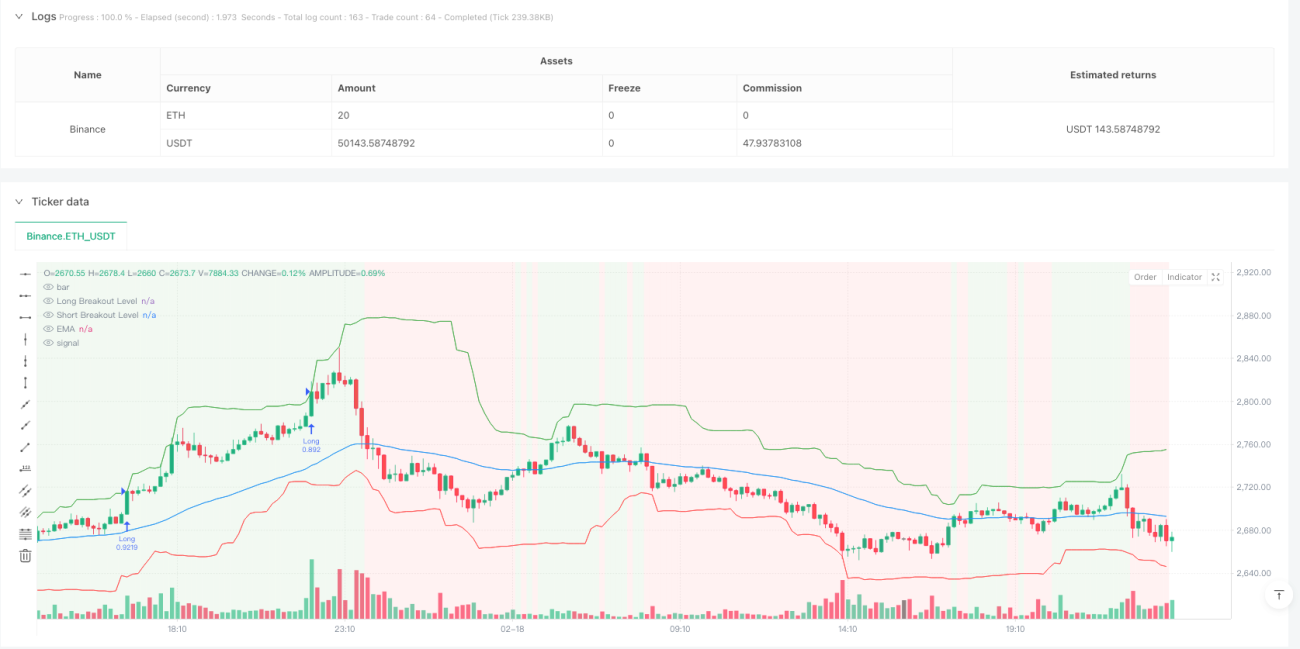
Стратегия представляет собой количественную торговую систему, которая сочетает в себе прорыв волатильности, отслеживание тенденций и подтверждение динамики. Она идентифицирует торговые возможности, рассчитывая динамические прорывные уровни на основе ATR и в сочетании с фильтрацией на тенденции EMA и динамическим индикатором RSI.

Стратегический принцип

Стратегия включает в себя три основных компонента:

  1. Расчет прорыва в волатильности: используются максимальные и минимальные цены за период ретроспекции, в сочетании с расчетом динамических прорывных порогов в ATR-множестве, чтобы избежать отклонений в прогнозе.
  2. Тренд-фильтр: используйте краткосрочную ЭМА, чтобы определить направление текущей тенденции. Откройте заказ только в том случае, если цена находится выше ЭМА, и открывайте заказ только в том случае, если цена находится ниже ЭМА.
  3. Подтверждение динамики: использование индикатора RSI для подтверждения динамики рынка, многоголовый вход требует RSI больше 50, и головной вход требует RSI меньше 50.

Стратегические преимущества

  1. Динамическая адаптивность: уровень прорыва автоматически корректируется в зависимости от рыночных колебаний, что позволяет стратегии адаптироваться к различным рыночным условиям.
  2. Множественная фильтрация: сочетание тренда и динамики снижает ложные сигналы.
  3. Строгий контроль риска: управление позициями с фиксированным процентом риска и использование динамической защиты от убытков.
  4. Сильная настраиваемость: ключевые параметры, такие как цикл ATR, прорывный кратный, цикл EMA и т. д., могут быть изменены в соответствии с конкретными потребностями.

Стратегический риск

  1. Риск отставания: использование таких показателей, как скользящая средняя, может привести к отставанию от точки входа.
  2. Риск рыночных потрясений: возможны частые ложные сигналы прорыва на рынках с горизонтальными потрясениями.
  3. Чувствительность к параметрам: эффективность стратегии чувствительна к параметрам и требует тщательного тестирования. Решение:
  • Рекомендуется оптимизировать обратную связь в различных рыночных условиях
  • Модуль для идентификации рыночной среды
  • Рекомендуется использовать более консервативный подход к управлению деньгами.

Направление оптимизации стратегии

  1. Адаптация к рыночной среде: добавление диапазона оценки колебаний, использование различных параметров в различных волатильных условиях.
  2. Оптимизация сигнала: можно рассмотреть возможность добавления подтверждения количества транзакций, чтобы повысить надежность прорывного сигнала.
  3. Оптимизация стоп-стоп-лосса: динамически корректируемая прибыль и убыток, которая может быть скорректирована в соответствии с целями волатильности рынка.
  4. Временная фильтрация: добавление фильтрации на время торгового окна, чтобы избежать торговли в неблагоприятное время.

Подвести итог

Это структурированная, логически ясная и количественная торговая стратегия. Она позволяет улавливать значительные ценовые колебания, контролируя риски, путем объединения прорывов волатильности, отслеживания тенденций и подтверждения динамики.

Исходный код стратегии
/*backtest
start: 2025-01-20 00:00:00
end: 2025-02-19 00:00:00
period: 10m
basePeriod: 10m
exchanges: [{"eid":"Binance","currency":"ETH_USDT"}]
*/

//@version=5
// Volatility Momentum Breakout Strategy
//
// Description:
// This strategy is designed to capture significant price moves by combining a volatility breakout method
// with a momentum filter. Volatility is measured by the Average True Range (ATR), which is used to set dynamic
// breakout levels. A short‑term Exponential Moving Average (EMA) is applied as a trend filter, and the Relative
// Strength Index (RSI) is used to help avoid entries when the market is overextended.
// 
// Signal Logic:
// • Long Entry: When the current close is above the highest high of the previous N bars (excluding the current bar)
//   plus a multiple of ATR, provided that the price is above the short‑term EMA and the RSI is above 50.
// • Short Entry: When the current close is below the lowest low of the previous N bars (excluding the current bar)
//   minus a multiple of ATR, provided that the price is below the short‑term EMA and the RSI is below 50.
// 
// Risk Management:
// • Trades are sized to risk 2% of account equity.
// • A stop loss is placed at a fixed ATR multiple away from the entry price.
// • A take profit target is set to achieve a 1:2 risk‑reward ratio.
// 
// Backtesting Parameters:
// • Initial Capital: $10,000
// • Commission: 0.1% per trade
// • Slippage: 1 tick per bar
//
// Disclaimer:
// Past performance is not indicative of future results. This strategy is experimental and provided solely for educational
// purposes. Always backtest and paper trade before any live deployment.
//
// Author: [Your Name]
// Date: [Date]

strategy("Volatility Momentum Breakout Strategy", overlay=true, initial_capital=10000, default_qty_type=strategy.percent_of_equity, default_qty_value=5, commission_type=strategy.commission.percent, commission_value=0.1, slippage=1)

// ─── INPUTS ─────────────────────────────────────────────────────────────
atrPeriod       = input.int(14, "ATR Period", minval=1)
atrMultiplier   = input.float(1.5, "ATR Multiplier for Breakout", step=0.1)
lookback        = input.int(20, "Breakout Lookback Period", minval=1)
emaPeriod       = input.int(50, "EMA Period", minval=1)
rsiPeriod       = input.int(14, "RSI Period", minval=1)
rsiLongThresh   = input.float(50, "RSI Long Threshold", step=0.1)
rsiShortThresh  = input.float(50, "RSI Short Threshold", step=0.1)

// Risk management inputs:
riskPercent     = input.float(2.0, "Risk Percent per Trade (%)", step=0.1) * 0.01   // 2% risk per trade
riskReward      = input.float(2.0, "Risk-Reward Ratio", step=0.1)                    // Target profit is 2x risk
atrStopMult     = input.float(1.0, "ATR Multiplier for Stop Loss", step=0.1)         // Stop loss distance in ATRs

// ─── INDICATOR CALCULATIONS ───────────────────────────────────────────────
atrVal   = ta.atr(atrPeriod)
emaVal   = ta.ema(close, emaPeriod)
rsiVal   = ta.rsi(close, rsiPeriod)

// Calculate breakout levels using the highest high and lowest low of the previous N bars,
// excluding the current bar (to avoid look-ahead bias).
highestHigh = ta.highest(high[1], lookback)
lowestLow   = ta.lowest(low[1], lookback)

// Define breakout thresholds.
longBreakoutLevel  = highestHigh + atrMultiplier * atrVal
shortBreakoutLevel = lowestLow  - atrMultiplier * atrVal

// ─── SIGNAL LOGIC ─────────────────────────────────────────────────────────
// Long Entry: Price closes above the long breakout level,
// the close is above the EMA, and RSI > 50.
longCondition = (close > longBreakoutLevel) and (close > emaVal) and (rsiVal > rsiLongThresh)
// Short Entry: Price closes below the short breakout level,
// the close is below the EMA, and RSI < 50.
shortCondition = (close < shortBreakoutLevel) and (close < emaVal) and (rsiVal < rsiShortThresh)

if (longCondition)
    strategy.entry("Long", strategy.long)
if (shortCondition)
    strategy.entry("Short", strategy.short)

// ─── RISK MANAGEMENT ──────────────────────────────────────────────────────
// For each new trade, use the entry price as the basis for stop loss and target calculations.
// We assume the entry price equals the close on the bar where the trade is triggered.
var float longEntryPrice  = na
var float shortEntryPrice = na

// Record entry prices when a trade is opened.
if (strategy.position_size > 0 and na(longEntryPrice))
    longEntryPrice := strategy.position_avg_price
if (strategy.position_size < 0 and na(shortEntryPrice))
    shortEntryPrice := strategy.position_avg_price

// Calculate stop loss and take profit levels based on ATR.
longStop   = longEntryPrice - atrStopMult * atrVal
longTarget = longEntryPrice + (longEntryPrice - longStop) * riskReward
shortStop  = shortEntryPrice + atrStopMult * atrVal
shortTarget= shortEntryPrice - (shortStop - shortEntryPrice) * riskReward

// Issue exit orders if a position is open.
if (strategy.position_size > 0 and not na(longEntryPrice))
    strategy.exit("Long Exit", from_entry="Long", stop=longStop, limit=longTarget)
if (strategy.position_size < 0 and not na(shortEntryPrice))
    strategy.exit("Short Exit", from_entry="Short", stop=shortStop, limit=shortTarget)

// Reset recorded entry prices when the position is closed.
if (strategy.position_size == 0)
    longEntryPrice  := na
    shortEntryPrice := na

// ─── CHART VISUAL AIDS ─────────────────────────────────────────────────────
// Plot the breakout levels and EMA.
plot(longBreakoutLevel, color=color.new(color.green, 0), title="Long Breakout Level", style=plot.style_linebr)
plot(shortBreakoutLevel, color=color.new(color.red, 0), title="Short Breakout Level", style=plot.style_linebr)
plot(emaVal, color=color.blue, title="EMA")

// Optionally, shade the background: green when price is above the EMA (bullish) and red when below.
bgcolor(close > emaVal ? color.new(color.green, 90) : color.new(color.red, 90), title="Trend Background")