Адаптивная стратегия количественной торговли с отслеживанием волатильности на основе пересечения скользящих средних

MA交叉 ATR EMA SMA WMA HMA VWMA 趋势过滤 波动率过滤 跟踪止损 双重止盈
Дата создания: 2025-05-14 10:49:04 Последнее изменение: 2025-05-14 10:49:04
Копировать: 0 Количество просмотров: 317
2
Подписаться
319
Подписчики

Адаптивная стратегия количественной торговли с отслеживанием волатильности на основе пересечения скользящих средних Адаптивная стратегия количественной торговли с отслеживанием волатильности на основе пересечения скользящих средних

Обзор стратегии

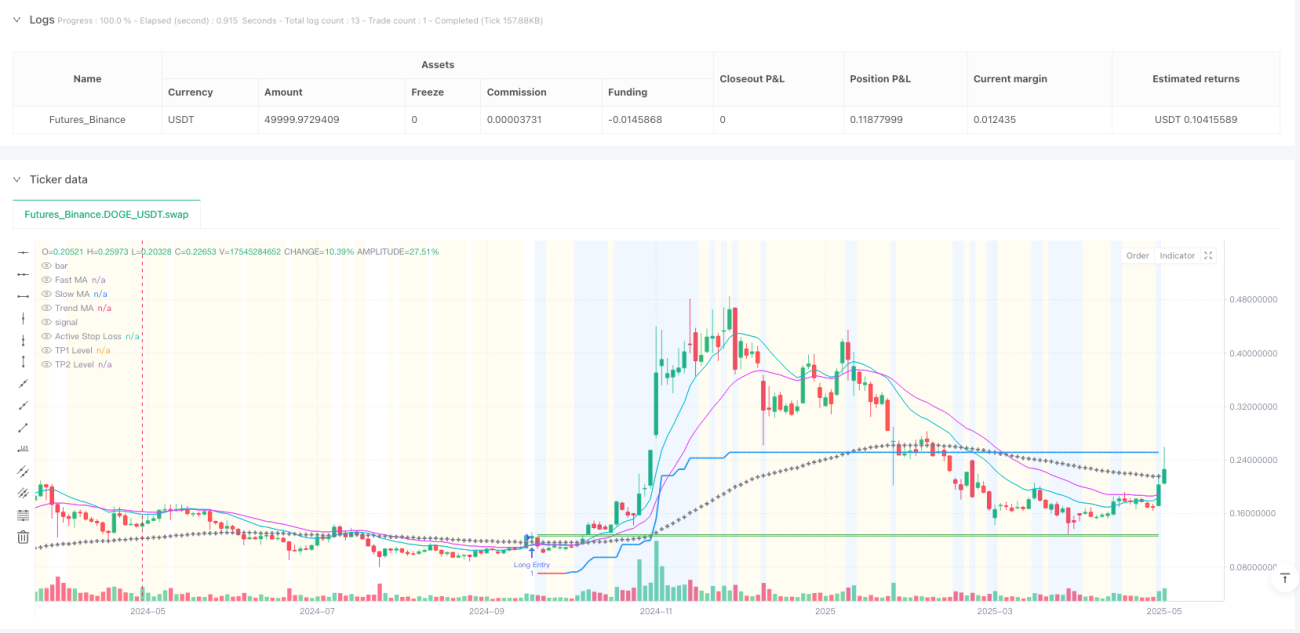
Систематизированная стратегия торговли, предназначенная для высокочастотных торгов и операций на коротких линиях. В основе стратегии лежит использование пересечения быстро движущихся средних и медленно движущихся средних в качестве основных сигнальных триггеров, а также сочетание различных ключевых фильтров и точных инструментов управления риском для захвата небольших, но быстрых колебаний цен.

Стратегический принцип

Основная логика этой стратегии состоит из следующих ключевых частей:

  1. Сигнал входа: в основном через пересечение / пересечение быстрой средней линии с медленной средней линией в качестве условия для входа. Пользователи могут гибко настраивать типы средней линии (EMA, SMA, WMA, HMA, VWMA) и длину цикла, чтобы адаптировать чувствительность сигнала к различным рыночным условиям.

  2. Фильтр трендовСтратегия: выборочно используйте долгосрочные движущиеся средние линии в качестве фильтра на большие тенденции, чтобы обеспечить торговлю только в направлении больших тенденций и избежать торговли на коротких регрессивных линиях в сильно направленных рынках.

  3. Фильтр подтвержден

    • ATR фильтр частоты колебаний: предназначен для приостановки входа на рынках с крайне плоскими или “мертвыми” рынками, где волатильность ниже динамической отметки (на основе среднего ATR), что помогает предотвратить колебания в условиях отсутствия тренда и низкой энергии.
    • Количественные фильтры: для проверки сигналов входа, требуя минимальной доли участия в рынке (сравнение объема сделок с их подвижными средними), избегая входа, основанного на пиковых или незначительных ценовых действиях с низкой ликвидностью.
  4. Пакет управления рисками

    • Прекращение первоначальной волатильностиПервоначальный стоп, основанный на ATR, обеспечивает объективную отправную точку для определения риска для каждой сделки, учитывая недавнюю волатильность.
    • Прекращение трафика ATRКрайне важно для динамичного рынка, чтобы следить за стоп-лосс-линией, которая будет корректироваться в соответствии с благоприятным ценовым движением, чтобы защитить прибыль от успешных коротких сделок, а также относительно быстро сократить потери при обратном движении.
    • Стоп-стоп на прибыли и убытки (по выбору): После достижения TP1 или движения цены на определенное расстояние ATR, можно автоматически перенести стоп-лосс на цену входа (с добавлением буфера) для риска быстрых, нейтральных и уже продемонстрированных первоначально успешных сделок.
    • Уровень двойной прибылиУстанавливается два прибыльных объекта: TP1 и TP2, TP1 предназначен для быстрого получения части прибыли (например, 50%), а TP2 для более выгодного пространства для оставшейся позиции.
  5. Управление позициейПрименение фиксированного количества размеров позиций, позволяющих точно контролировать размер позиций для каждой сделки, имеет решающее значение для единообразного применения риска и генерации команд API в высокочастотных средах.

Стратегические преимущества

При глубоком анализе кода, эта стратегия имеет следующие явные преимущества:

  1. Высокая конфигурацияПользователь может гибко настраивать различные параметры, включая типы и периоды средней линии, настройки фильтров и параметры управления риском, чтобы стратегия могла адаптироваться к различным рыночным условиям и стилям торговли.

  2. Многоуровневые фильтрыВключение фильтров тренда, волатильности и объема торгов, эффективное сокращение ошибочных сигналов и рыночного шума, повышение качества торгов.

  3. Правильное управление рискамиСтратегия включает в себя множественные механизмы остановки убытков (начальный, отслеживаемый, убыточный баланс) и двойные цели прибыли, обеспечивающие точный контроль риска и защиту прибыли.

  4. API-дружественный дизайнЯсная и четкая логика входа и выхода генерирует однозначные сигналы, что позволяет интегрироваться с внешними торговыми системами и обеспечивает почти мгновенное исполнение ордеров.

  5. Точный контроль позиций: фиксированное количество позиций упрощает нагрузку на конечные точки API, что делает автоматизацию более надежной.

  6. Высокая степень адаптацииС помощью корректировки параметров стратегия может быть изменена с высокочастотного режима торговли на более длительный режим отслеживания тенденций, адаптированный к различным рыночным условиям и индивидуальным торговым предпочтениям.

Стратегический риск

Несмотря на то, что стратегия была хорошо продумана, существуют некоторые потенциальные риски и проблемы:

  1. Риски оптимизации параметровПоскольку стратегия содержит множество конфигурируемых параметров, избыточная оптимизация может привести к хорошим результатам обратной связи, но плохой фактической производительности (сверхсоответствие), и инвесторы должны избегать этого риска, проверяя на внепримерных данных или тестируя вперед.

  2. Влияние на стоимость сделкиВысокая частота торговли означает, что большое количество сделок, накопленные комиссионные и просчеты могут существенно повлиять на чистую прибыльность, и эти затраты должны быть точно рассчитаны при настройке и отсчете до их использования.

  3. Сигнальные колебания: В разных рыночных условиях может меняться надежность равнолинейного перекрестного сигнала, особенно на рынках с высокой волатильностью или высоким колебанием.

  4. Технологическая зависимостьВ качестве готовой стратегии API, ее эффективность частично зависит от скорости выполнения и технической стабильности. Задержки или сбои в системе могут привести к потере возможности или отклонению выполнения.

  5. Ограничения по размеру средств: фиксированное количество позиций может быть не подходит для всех размеров счетов, небольшие счета могут быть подвержены чрезмерному риску, а крупные счета могут не использовать свои средства в полной мере.

Направление оптимизации стратегии

В зависимости от стратегии разработки и потенциальных рисков, можно выделить несколько возможных направлений оптимизации:

  1. Параметры адаптацииРазработка ключевых параметров (например, ATR и среднелинейный цикл) для автоматической корректировки в зависимости от рыночных условий, повышая адаптивность стратегии в разные рыночные периоды.

  2. Улучшенная фильтрацияВключение дополнительных индикаторов состояния рынка (например, структура рынка, идентификация волатильных моделей или релевантность соответствующих активов) позволяет повысить точность фильтрации.

  3. Динамическое управление позициямиВместо фиксированного количества позиций, динамические позиции, основанные на размерах счетов, текущей волатильности и недавней стратегической эффективности, используются для более интеллектуального управления деньгами.

  4. Подтверждение многократных временных рамокПроверка сигналов в разные временные рамки, чтобы убедиться, что направление торговли соответствует более широкой структуре рынка и уменьшить ненужные сделки.

  5. Интеграция машинного обучения: использование алгоритмов машинного обучения для анализа исторических характеристик сигналов, прогнозирование вероятности успеха будущих сигналов, приоритетная реализация высокоэффективных сделок.

  6. Управление торговыми сеансамиДобавление фильтров на время торговли, чтобы избежать периодов низкой ликвидности или высокой волатильности и сосредоточиться на торговых окнах с наибольшей эффективностью рынка.

  7. Фильтр релевантностиДля транзакций с несколькими активами добавляется анализ корреляции с соответствующими рынками, чтобы избежать чрезмерного воздействия на определенные факторы риска.

Подвести итог

Стратегия количественного трейдинга с отслеживанием волатильности на перекрестке равной линии является полнофункциональной системой высокочастотного трейдинга, которая запускает сигналы на перекрестке равной линии в сочетании с несколькими ключевыми фильтрами и точными инструментами управления риском, предназначенными для захвата небольших, но быстрых колебаний цен. Сила этой стратегии заключается в ее высокой настраиваемости и полноценной системе управления риском, которая позволяет трейдерам тонко настраивать торговые параметры в зависимости от индивидуальной рискованности и рыночных условий.

Для высокочастотных трейдеров эта стратегия обеспечивает четкую логику входа и выхода, а также возможность беспрепятственной интеграции с внешними платформами исполнения, что имеет решающее значение для быстрого принятия решений на быстро меняющихся рынках. Однако при использовании этой стратегии следует обращать особое внимание на риск накопления и переоптификации торговых расходов, чтобы гарантировать сохранение устойчивости и прибыльности стратегии в реальных сделках.

В конечном счете, эта стратегия представляет собой сбалансированный подход, который использует силу технических показателей и инструментов управления рисками, сохраняя при этом достаточную гибкость для адаптации к меняющимся рыночным условиям. С помощью тщательной корректировки параметров и постоянного улучшения мониторинга эта стратегия может стать ценной частью портфеля количественных сделок.

Исходный код стратегии
/*backtest
start: 2024-05-14 00:00:00
end: 2025-05-12 08:00:00
period: 2d
basePeriod: 2d
exchanges: [{"eid":"Futures_Binance","currency":"DOGE_USDT"}]
*/

//@version=5
// © ArrowTrade x:ArrowTrade

// --- STRATEGY DEFINITION ---
strategy(
     title="Arrow's Flexible MA Cross Strategy [API Ready]", // Added branding
     shorttitle="ArrowFlex",                  // Added branding
     overlay=true,
     initial_capital=1000, // Example capital, user should adjust
     commission_type=strategy.commission.percent,
     commission_value=0.036, // Example commission, user MUST adjust to their broker/exchange
     slippage=2,             // Example slippage (in ticks), user should adjust based on asset/broker
     process_orders_on_close=true, // Calculates/executes on bar close. Set to false for intrabar (use with caution & specific logic)
     pyramiding=0,           // No pyramiding allowed (one entry per direction)
     default_qty_type=strategy.fixed // Defaulting to fixed quantity
     // Removed default_qty_value from here
     )

// ================================================================================
//  Strategy Description (for TradingView Public Library & Users)
// ================================================================================
// © ArrowTrade
//
// A configurable Moving Average Crossover strategy designed for flexibility and
// API integration.
//
// Features:
// - MA Crossover Entries: Uses configurable Fast/Slow MA crossovers for signals.
// - Trend Filter: Optional longer-term MA filter to trade only with the trend.
// - Volatility Filter: Optional ATR filter to avoid low-volatility periods.
// - Volume Filter: Optional Volume filter to confirm entries with sufficient volume.
// - Stop Loss Options:
//     - Initial Volatility Stop (ATR-based)
//     - ATR Trailing Stop
//     - Break-Even Stop (activated by TP1 hit or ATR distance)
// - Take Profit Options:
//     - Two independent TP levels (percentage-based).
//     - Configurable partial close percentage at TP1.
// - Position Sizing: Fixed quantity per trade (adjustable).
//
// Intended Use:
// While configurable for various styles (scalping to trend-following by adjusting
// parameters), this strategy is built with API automation in mind. The clear
// entry and exit logic facilitates integration with external execution platforms
// via webhooks or other methods. Parameters can be tightened (shorter MAs,
// tighter stops/TPs, specific filters) for higher-frequency signals suitable
// for scalping.
//
// Disclaimer:
// Backtesting results are hypothetical and do not guarantee future performance.
// Market conditions change constantly. Always perform your own due diligence,
// forward testing, and rigorous risk management before trading live with any
// strategy. Ensure you adjust inputs like commission, slippage, and position
// size to accurately reflect your specific broker/exchange and risk profile.
// ================================================================================


// === INPUTS (Grouped and Ordered by Importance/Function) ===

// --- 1. Core Signal & Trend Filter ---
grp_signal = "1. Core Signal & Trend Filter"
signalSource   = input.source(high, title="Signal Source", group=grp_signal, tooltip="Price source for calculating the signal MAs (e.g., close, hl2, ohlc4). 'hlc3' or 'ohlc4' can provide smoother signals.")
signalMaType   = input.string("EMA", title="Signal MA Type", options=["EMA", "SMA", "WMA", "HMA", "VWMA"], group=grp_signal, tooltip="Type of Moving Average used for the fast/slow signal lines (EMA reacts faster, SMA smoother, HMA reduces lag).")
signalFastLen  = input.int(12, title="Fast MA Period", minval=2, maxval=100, step=1, group=grp_signal, tooltip="Period for the shorter-term signal MA. Shorter periods lead to more frequent signals (potentially more noise/scalping).")
signalSlowLen  = input.int(25, title="Slow MA Period", minval=3, maxval=200, step=1, group=grp_signal, tooltip="Period for the longer-term signal MA. Must be greater than Fast MA Period. Defines the crossover signal.")
useTrendFilter = input.bool(true, title="Enable Trend Filter", group=grp_signal, tooltip="If enabled, entry signals are only taken in the direction of the longer-term trend defined by the Trend MA.")
trendMaType    = input.string("EMA", title="Trend MA Type", options=["EMA", "SMA", "WMA", "HMA", "VWMA"], group=grp_signal, tooltip="Type of Moving Average used for the trend filter.")
trendMaLen     = input.int(100, title="Trend MA Period", minval=50, maxval=500, step=10, group=grp_signal, tooltip="Period for the Trend MA. Significantly longer than signal MAs typically. Higher values filter more aggressively.")
trendMaSource  = input.source(hl2, title="Trend MA Source", group=grp_signal, tooltip="Price source for the Trend MA calculation.")

// --- 2. Risk Management: Stop Loss ---
grp_stop = "2. Risk Management: Stop Loss"
useVolatilityStop    = input.bool(true, title="Enable Initial Volatility Stop", group=grp_stop, tooltip="Sets the initial stop loss based on Average True Range (ATR) at the time of entry.")
volStopAtrPeriod     = input.int(7, title="   Initial Stop ATR Period", minval=1, maxval=50, step=1, group=grp_stop, tooltip="ATR lookback period for calculating the initial stop distance.")
volStopAtrMultiplier = input.float(5, title="   Initial Stop ATR Multiplier", minval=0.5, maxval=10, step=0.1, group=grp_stop, tooltip="Multiplier for the ATR value to determine stop distance (Stop = Entry +/- ATR * Multiplier). Lower values = tighter initial stop.")
useTrailingStop      = input.bool(true, title="Enable ATR Trailing Stop", group=grp_stop, tooltip="If enabled, the stop loss will trail behind price based on current ATR, potentially locking in profits. Can override the initial/BE stop if it moves favorably.")
trailAtrPeriod       = input.int(15, title="   Trailing ATR Period", minval=1, maxval=50, step=1, group=grp_stop, tooltip="ATR lookback period for calculating the trailing distance.")
trailAtrMultiplier   = input.float(4.0, title="   Trailing ATR Multiplier", minval=0.5, maxval=10, step=0.1, group=grp_stop, tooltip="Multiplier for the current ATR to determine trailing distance. Lower values trail tighter.")
useBreakEvenStop     = input.bool(false, title="Enable Break-Even Stop", group=grp_stop, tooltip="If enabled, moves the stop loss to entry price (plus a small profit buffer) once a certain condition is met.")
beActivationChoice   = input.string("TP1 Reached", title="   BE Activation Condition", options=["TP1 Reached", "ATR Distance Moved"], group=grp_stop, tooltip="When should the Break-Even Stop activate? When TP1 is hit, or when price moves a certain ATR distance from entry?")
beActivationAtrMult  = input.float(1.5, title="   BE Activation ATR Multiplier", minval=0.1, maxval=5, step=0.1, group=grp_stop, tooltip="Used only if 'ATR Distance Moved' is selected. BE activates if price moves (Entry +/- ATR * Multiplier). Uses 'Initial Stop ATR Period'.")
beProfitTicks        = input.int(2, title="   BE Profit Buffer (Ticks)", minval=0, maxval=50, step=1, group=grp_stop, tooltip="Moves the stop to Entry Price +/- this many ticks (e.g., to cover commissions). Set to 0 for exact entry price.")

// --- 3. Risk Management: Take Profit ---
grp_tp = "3. Risk Management: Take Profit (TP)"
useTp1        = input.bool(true, title="Enable TP1", group=grp_tp, tooltip="Enable the first Take Profit level.")
tp1Pct        = input.float(1.5, title="   TP1 Target (%)", minval=0.1, maxval=20, step=0.1, group=grp_tp, tooltip="First TP target as a percentage distance from the entry price. Should be less than TP2 %.")
tp1QtyPercent = input.int(50, title="   TP1 Close Quantity (%)", minval=1, maxval=100, step=5, group=grp_tp, tooltip="Percentage of the original position size to close when TP1 is hit.")
useTp2        = input.bool(true, title="Enable TP2", group=grp_tp, tooltip="Enable the second (final) Take Profit level.")
tp2Pct        = input.float(3.0, title="   TP2 Target (%)", minval=0.2, maxval=30, step=0.1, group=grp_tp, tooltip="Second TP target as a percentage distance from the entry price. Closes the remaining position.")

// --- 4. Additional Filters ---
grp_filters = "4. Additional Filters"
useAtrFilter        = input.bool(true, title="Enable ATR Volatility Filter", group=grp_filters, tooltip="If enabled, avoids entries during periods of very low volatility (ATR below a moving average of ATR). Helps filter choppy/sideways markets.")
atrFilterPeriod     = input.int(14, title="   ATR Filter Period", minval=1, maxval=50, step=1, group=grp_filters, tooltip="Lookback period for calculating the current ATR and its average for the filter.")
atrFilterMultiplier = input.float(0.5, title="   ATR Filter Threshold Multiplier", minval=0.1, maxval=5, step=0.1, group=grp_filters, tooltip="Entry requires current ATR to be >= (Average ATR * Multiplier). Lower values filter more aggressively.")
useVolumeFilter     = input.bool(true, title="Enable Volume Filter", group=grp_filters, tooltip="If enabled, requires the volume of the entry bar to be above a moving average of volume. Acts as confirmation.")
volumeLookback      = input.int(30, title="   Volume MA Period", minval=2, maxval=100, step=1, group=grp_filters, tooltip="Lookback period for calculating the average volume.")
volumeMultiplier    = input.float(1.0, title="   Min Volume Ratio (vs Avg)", minval=0.1, maxval=5, step=0.1, group=grp_filters, tooltip="Entry requires current volume to be >= (Average Volume * Multiplier). Values >= 1 require above-average volume.")

// --- 5. Position Sizing ---
grp_size = "5. Position Sizing"
// Define the quantity input with its own default value
qtyValue = input.float(0.01, title="Position Size (Fixed Qty)", minval=0.0001, step=0.0001, group=grp_size, tooltip="Fixed quantity (contracts/shares/lots) per trade. Adjust based on your account size, risk tolerance, and the asset being traded. Can be overridden by API.")


// === FUNCTIONS ===
f_ma(maType, src, len) =>
    float result = na
    if maType == "SMA"
        result := ta.sma(src, len)
    else if maType == "EMA"
        result := ta.ema(src, len)
    else if maType == "WMA"
        result := ta.wma(src, len)
    else if maType == "HMA"
        result := ta.hma(src, len)
    else if maType == "VWMA"
        result := ta.vwma(src, len)
    result

// === CORE CALCULATIONS ===

// Parameter Sanity Check
if signalSlowLen <= signalFastLen and barstate.islast
    runtime.error("Signal Slow MA Period must be greater than Fast MA Period!")

// 1. Moving Averages
float fastMA = f_ma(signalMaType, signalSource, signalFastLen)
float slowMA = f_ma(signalMaType, signalSource, signalSlowLen)
float trendMA = useTrendFilter ? f_ma(trendMaType, trendMaSource, trendMaLen) : na

// 2. ATR Values
float atrValueStop = ta.atr(volStopAtrPeriod)
float atrValueTrail = ta.atr(trailAtrPeriod)
float atrValueFilter = ta.atr(atrFilterPeriod)
float atrValueBE = ta.atr(volStopAtrPeriod)

// 3. Filter Conditions
bool trendFilterOK_L = not useTrendFilter or (not na(trendMA) and signalSource > trendMA)
bool trendFilterOK_S = not useTrendFilter or (not na(trendMA) and signalSource < trendMA)
float avgAtrFilter = ta.sma(atrValueFilter, atrFilterPeriod)
bool volatilityFilterOK = not useAtrFilter or (not na(atrValueFilter) and not na(avgAtrFilter) and atrValueFilter >= avgAtrFilter * atrFilterMultiplier)
float avgVolume = ta.sma(volume, volumeLookback)
bool volumeFilterOK = not useVolumeFilter or (not na(volume) and not na(avgVolume) and volume >= avgVolume * volumeMultiplier)
bool finalFilterOK_L = trendFilterOK_L and volatilityFilterOK and volumeFilterOK
bool finalFilterOK_S = trendFilterOK_S and volatilityFilterOK and volumeFilterOK

// 4. Entry Signals
bool longCross = not na(fastMA) and not na(slowMA) and ta.crossover(fastMA, slowMA)
bool shortCross = not na(fastMA) and not na(slowMA) and ta.crossunder(fastMA, slowMA)
bool longEntrySignal = longCross and finalFilterOK_L
bool shortEntrySignal = shortCross and finalFilterOK_S

// === STRATEGY EXECUTION LOGIC ===

// --- State Variables (persisted between bars) ---
var float entryPriceVar = na
var float initialStopPrice = na
var float currentStopPrice = na
var float trailStopLevel = na
var bool isBEActive = false
var bool tp1Reached = false
var float qtyToCloseTp1_Var = na

// --- Position Status ---
bool inLong = strategy.position_size > 0
bool inShort = strategy.position_size < 0
bool inTrade = strategy.position_size != 0

// --- Reset State Variables on Trade Exit ---
if not inTrade and inTrade[1]
    entryPriceVar := na
    initialStopPrice := na
    currentStopPrice := na
    trailStopLevel := na
    isBEActive := false
    tp1Reached := false
    qtyToCloseTp1_Var := na

// --- Handle New Entries ---
if longEntrySignal and not inTrade
    strategy.entry("Long Entry", strategy.long, qty=qtyValue) // Use qtyValue from input

if shortEntrySignal and not inTrade
    strategy.entry("Short Entry", strategy.short, qty=qtyValue) // Use qtyValue from input


// --- Manage Stops and Take Profits for Open Positions ---
if inTrade
    // Initialize state on the bar immediately AFTER entry
    if na(entryPriceVar)
        entryPriceVar := strategy.position_avg_price
        float positionQty = strategy.position_size

        if not na(positionQty) and tp1QtyPercent > 0 and useTp1
            qtyToCloseTp1_Var := math.abs(positionQty * tp1QtyPercent / 100)
        else
            qtyToCloseTp1_Var := 0.0

        if useVolatilityStop and not na(atrValueStop)
            initialStopPrice := entryPriceVar + (inLong ? -1 : 1) * atrValueStop * volStopAtrMultiplier
            currentStopPrice := initialStopPrice
        else
            initialStopPrice := na
            currentStopPrice := na

        if useTrailingStop and not na(atrValueTrail)
            trailStopLevel := entryPriceVar + (inLong ? -1 : 1) * atrValueTrail * trailAtrMultiplier
        else
            trailStopLevel := na

        isBEActive := false
        tp1Reached := false

    // --- Calculations within the trade (if entry price is set) ---
    if not na(entryPriceVar)

        // 1. Calculate TP Levels for the current bar
        float tp1LevelL = na, float tp2LevelL = na, float tp1LevelS = na, float tp2LevelS = na
        if useTp1
            tp1LevelL := entryPriceVar * (1 + tp1Pct / 100)
            tp1LevelS := entryPriceVar * (1 - tp1Pct / 100)
        if useTp2
            tp2LevelL := entryPriceVar * (1 + tp2Pct / 100)
            tp2LevelS := entryPriceVar * (1 - tp2Pct / 100)

        // 2. Check and Activate Break-Even Stop
        if useBreakEvenStop and not isBEActive and not na(currentStopPrice)
            float beTriggerL = na, float beTriggerS = na
            if beActivationChoice == "TP1 Reached" and useTp1
                if not na(tp1LevelL)
                    beTriggerL := tp1LevelL
                if not na(tp1LevelS)
                    beTriggerS := tp1LevelS
            else if beActivationChoice == "ATR Distance Moved" and not na(atrValueBE)
                beTriggerL := entryPriceVar + atrValueBE * beActivationAtrMult
                beTriggerS := entryPriceVar - atrValueBE * beActivationAtrMult

            float beTargetLevel = entryPriceVar + (inLong ? 1 : -1) * beProfitTicks * syminfo.mintick

            if not na(beTriggerL) and not na(beTargetLevel) and inLong and high >= beTriggerL and beTargetLevel > currentStopPrice
                currentStopPrice := beTargetLevel
                isBEActive := true
            if not na(beTriggerS) and not na(beTargetLevel) and inShort and low <= beTriggerS and beTargetLevel < currentStopPrice
                currentStopPrice := beTargetLevel
                isBEActive := true

        // 3. Update Trailing Stop
        if useTrailingStop and not na(currentStopPrice) and not na(atrValueTrail)
            float newTrailStopL = low - atrValueTrail * trailAtrMultiplier
            float newTrailStopS = high + atrValueTrail * trailAtrMultiplier
            float prevTrail = trailStopLevel[1]
            float calculatedNewTrail = na

            if inLong
                calculatedNewTrail := na(prevTrail) ? newTrailStopL : math.max(prevTrail, newTrailStopL)
                if not na(calculatedNewTrail)
                    trailStopLevel := calculatedNewTrail
                if not na(trailStopLevel) and trailStopLevel > currentStopPrice
                    currentStopPrice := trailStopLevel
            if inShort
                calculatedNewTrail := na(prevTrail) ? newTrailStopS : math.min(prevTrail, newTrailStopS)
                if not na(calculatedNewTrail)
                    trailStopLevel := calculatedNewTrail
                if not na(trailStopLevel) and trailStopLevel < currentStopPrice
                    currentStopPrice := trailStopLevel

        // --- Execute Exits ---

        // 4. Apply Stop Loss Exit
        if not na(currentStopPrice)
            bool isTrailingActiveNow = useTrailingStop and not na(trailStopLevel) and currentStopPrice == trailStopLevel
            string stop_comment = isBEActive ? "BE Stop" : (isTrailingActiveNow ? "Trail Stop" : "Vol Stop")
            if inLong
                strategy.exit("SL Exit L", from_entry="Long Entry", stop=currentStopPrice, comment=stop_comment + " L")
            if inShort
                strategy.exit("SL Exit S", from_entry="Short Entry", stop=currentStopPrice, comment=stop_comment + " S")

        // 5. Apply Take Profit Exits
        // TP1 Exit (Partial Quantity)
        if useTp1 and not tp1Reached and not na(qtyToCloseTp1_Var) and qtyToCloseTp1_Var > 0
            if inLong and not na(tp1LevelL)
                strategy.exit("TP1 Exit L", from_entry="Long Entry", qty=qtyToCloseTp1_Var, limit=tp1LevelL, comment="TP1 Hit L")
                if high >= tp1LevelL
                    tp1Reached := true
            if inShort and not na(tp1LevelS)
                strategy.exit("TP1 Exit S", from_entry="Short Entry", qty=qtyToCloseTp1_Var, limit=tp1LevelS, comment="TP1 Hit S")
                if low <= tp1LevelS
                    tp1Reached := true

        // TP2 Exit (Remaining Quantity)
        if useTp2
            if inLong and not na(tp2LevelL)
                strategy.exit("TP2 Exit L", from_entry="Long Entry", limit=tp2LevelL, comment="TP2 Hit L")
            if inShort and not na(tp2LevelS)
                strategy.exit("TP2 Exit S", from_entry="Short Entry", limit=tp2LevelS, comment="TP2 Hit S")


// === PLOTTING ===

// 1. Moving Averages
plot(fastMA, "Fast MA", color=color.new(color.aqua, 0), linewidth=1)
plot(slowMA, "Slow MA", color=color.new(color.fuchsia, 0), linewidth=1)
plot(useTrendFilter and not na(trendMA) ? trendMA : na, "Trend MA", color=color.new(color.gray, 0), linewidth=2, style=plot.style_cross)

// 2. Active Stop Loss Level
color stopColor = color.new(color.red, 0)
bool isTrailingActivePlot = useTrailingStop and not na(trailStopLevel) and not na(currentStopPrice) and currentStopPrice == trailStopLevel
if isBEActive
    stopColor := color.new(color.orange, 0)
else if isTrailingActivePlot
    stopColor := color.new(color.blue, 0)
plot(inTrade and not na(currentStopPrice) ? currentStopPrice : na, "Active Stop Loss", stopColor, style=plot.style_linebr, linewidth=2)

// 3. Take Profit Levels
float plot_tp1LevelL = na, float plot_tp1LevelS = na, float plot_tp2LevelL = na, float plot_tp2LevelS = na
if not na(entryPriceVar)
    if useTp1
        plot_tp1LevelL := entryPriceVar * (1 + tp1Pct / 100)
        plot_tp1LevelS := entryPriceVar * (1 - tp1Pct / 100)
    if useTp2
        plot_tp2LevelL := entryPriceVar * (1 + tp2Pct / 100)
        plot_tp2LevelS := entryPriceVar * (1 - tp2Pct / 100)
plot(inTrade and useTp1 and not na(inLong ? plot_tp1LevelL : plot_tp1LevelS) ? (inLong ? plot_tp1LevelL : plot_tp1LevelS) : na, "TP1 Level", color=color.new(color.green, 30), style=plot.style_linebr, linewidth=1)
plot(inTrade and useTp2 and not na(inLong ? plot_tp2LevelL : plot_tp2LevelS) ? (inLong ? plot_tp2LevelL : plot_tp2LevelS) : na, "TP2 Level", color=color.new(color.green, 0), style=plot.style_linebr, linewidth=1)

// 4. Entry Signal Markers
plotshape(longEntrySignal, title="Long Entry Signal", location=location.belowbar, color=color.new(color.green, 0), style=shape.triangleup, size=size.small)
plotshape(shortEntrySignal, title="Short Entry Signal", location=location.abovebar, color=color.new(color.red, 0), style=shape.triangledown, size=size.small)

// 5. Background Color Filters
bgcolor(useTrendFilter and not na(trendMA) and inTrade ? (inLong ? color.new(color.blue, 90) : color.new(color.red, 90)) : na, title="Trend Filter Active")
bgcolor(useAtrFilter and not volatilityFilterOK ? color.new(color.gray, 85) : na, title="Low Volatility Filter Active")
bgcolor(useVolumeFilter and not volumeFilterOK ? color.new(color.yellow, 90) : na, title="Low Volume Filter Active")