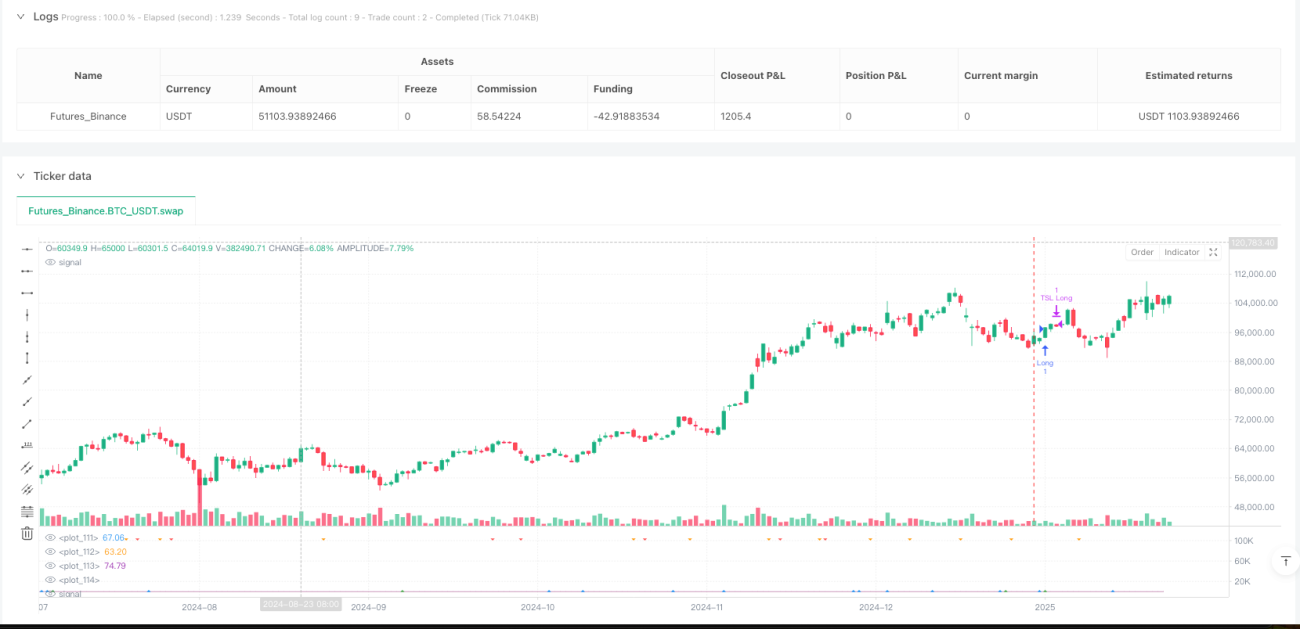
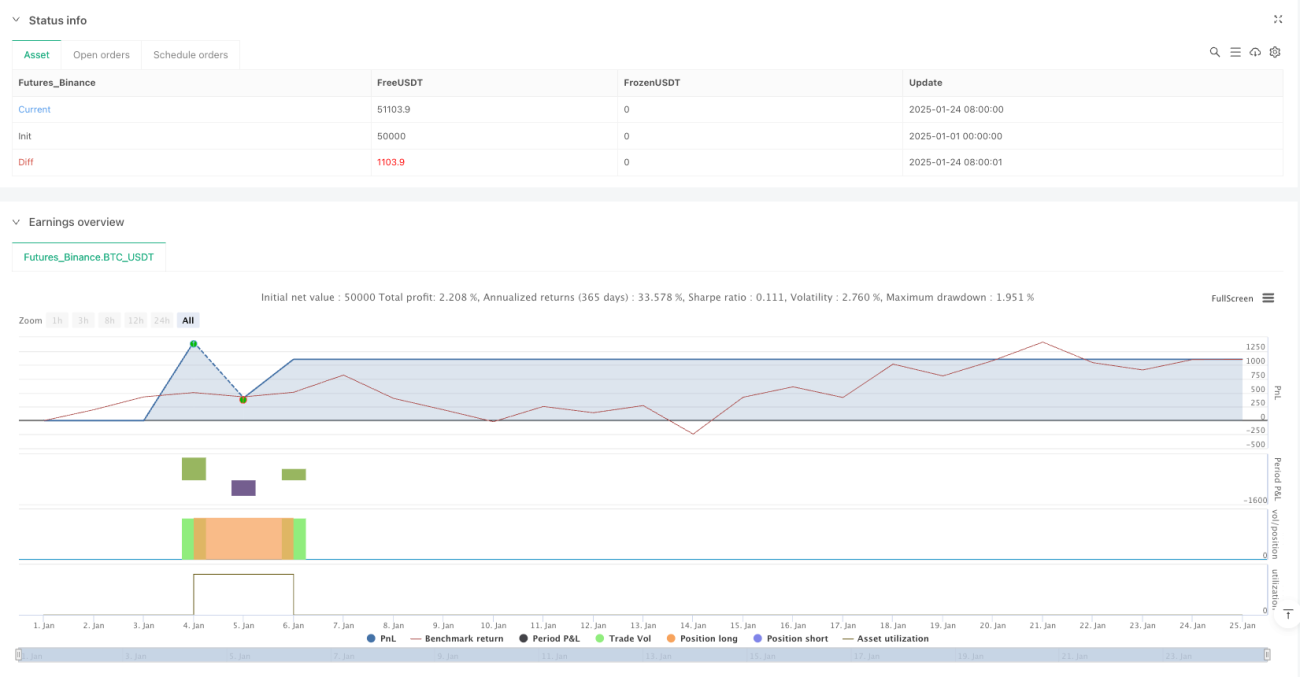
یہ ایک جدید کثیر ٹائم فریم خود کو اپنانے والی کے ڈی جے جھٹکا اشارے کی حکمت عملی ہے جس کا مقصد مارکیٹ کے رجحانات کو متحرک طور پر ایڈجسٹ کرنے والے اشارے کے پیرامیٹرز اور کثیر ٹائم فریموں کے تجزیہ کے ذریعہ زیادہ درست اور لچکدار تجارتی سگنل فراہم کرنا ہے۔ یہ حکمت عملی ، اتار چڑھاؤ پر مبنی لمبائی کے حساب کتاب ، کثیر ٹائم فریموں میں وزن کی تقسیم اور خود کو اپنانے والے رجحانات کے فیصلے کے ساتھ مل کر ، تاجروں کو ایک پیچیدہ اور طاقتور تجزیاتی ٹول مہیا کرتی ہے۔
اس حکمت عملی کے بنیادی اصولوں میں درج ذیل کلیدی ٹیکنالوجیز شامل ہیں۔
کثیر ٹائم فریم ورک نے جدید ڈیزائن کے ذریعہ کے ڈی جے کے جھٹکے کے اشارے کی حکمت عملی کو اپنایا ، تاجر کو ایک لچکدار ، متحرک اور کثیر جہتی مارکیٹ تجزیہ کا آلہ فراہم کیا ، جس میں نمایاں تکنیکی فوائد اور ممکنہ کارکردگی کو بہتر بنانے کی گنجائش ہے۔
/*backtest
start: 2025-01-01 00:00:00
end: 2025-01-25 00:00:00
period: 1d
basePeriod: 1d
exchanges: [{"eid":"Futures_Binance","currency":"BTC_USDT"}]
*/
// This Pine Script™ is subject to the Mozilla Public License 2.0 (https://mozilla.org/MPL/2.0/)
// © Lausekopf
//@version=5
strategy("Adaptive KDJ (MTF)", overlay=false)
// Dropdown for the swing length calculation method
method = input.int(1, title="Calculation Method", options=[1, 2, 3], tooltip="1: Volatility Based\n2: Inverse Volatility\n3: Fixed Length")
// Fixed length for method 3
fixedLength = input.int(9, title="Fixed KDJ Length", minval=3, maxval=15)
// Timeframes
tf1 = input.timeframe("1", title="Timeframe 1")
tf2 = input.timeframe("5", title="Timeframe 2")
tf3 = input.timeframe("15", title="Timeframe 3")
// Timeframe weighting
weightOption = input.int(1, title="Timeframe Weighting", options=[1, 2, 3, 4, 5])
weightTF1 = weightOption == 1 ? 0.5 : weightOption == 2 ? 0.4 : weightOption == 3 ? 0.33 : weightOption == 4 ? 0.2 : 0.1
weightTF2 = 0.33
weightTF3 = 1.0 - (weightTF1 + weightTF2)
// EMA smoothing length
smoothingLength = input.int(5, title="EMA Smoothing Length", minval=1, maxval=50)
// Trend calculation period
trendLength = input.int(40, title="Trend Calculation Period", minval=5, maxval=50)
// KDJ function
f_kdj(len, srcHigh, srcLow, srcClose) =>
roundedLen = int(math.round(len))
high_max = ta.highest(srcHigh, roundedLen)
low_min = ta.lowest(srcLow, roundedLen)
rsv = 100 * (srcClose - low_min) / (high_max - low_min)
k = ta.sma(rsv, 3)
d = ta.sma(k, 3)
j = 3 * k - 2 * d
[k, d, j]
// Swing length function
f_swingLength(tf) =>
atrLen = 14
volatility = request.security(syminfo.tickerid, tf, ta.atr(atrLen) / close)
var float length = na
if method == 1
length := volatility > 0.03 ? 3 : volatility > 0.002 ? 14 : 15
if method == 2
length := 18
if method == 3
length := fixedLength
length
// Calculate swing lengths for each timeframe
swingLength1 = f_swingLength(tf1)
swingLength2 = f_swingLength(tf2)
swingLength3 = f_swingLength(tf3)
// Calculate KDJ values
[k1, d1, j1] = f_kdj(swingLength1, request.security(syminfo.tickerid, tf1, high), request.security(syminfo.tickerid, tf1, low), request.security(syminfo.tickerid, tf1, close))
[k2, d2, j2] = f_kdj(swingLength2, request.security(syminfo.tickerid, tf2, high), request.security(syminfo.tickerid, tf2, low), request.security(syminfo.tickerid, tf2, close))
[k3, d3, j3] = f_kdj(swingLength3, request.security(syminfo.tickerid, tf3, high), request.security(syminfo.tickerid, tf3, low), request.security(syminfo.tickerid, tf3, close))
// Weighted averages
avgK = (k1 * weightTF1 + k2 * weightTF2 + k3 * weightTF3)
avgD = (d1 * weightTF1 + d2 * weightTF2 + d3 * weightTF3)
avgJ = (j1 * weightTF1 + j2 * weightTF2 + j3 * weightTF3)
smoothAvgK = ta.ema(avgK, smoothingLength)
smoothAvgD = ta.ema(avgD, smoothingLength)
smoothAvgJ = ta.ema(avgJ, smoothingLength)
smoothAvgTotal = ta.ema((avgK + avgD + avgJ) / 3, smoothingLength)
// Trend determination
trendAvg = ta.sma(smoothAvgTotal, trendLength)
isUptrend = trendAvg > 60
isDowntrend = trendAvg < 40
// Dynamic signal thresholds
buyLevel = isUptrend ? 40 : isDowntrend ? 15 : 25
sellLevel = isUptrend ? 85 : isDowntrend ? 60 : 75
// Buy/Sell signals
buySignal = smoothAvgJ < buyLevel and ta.crossover(smoothAvgK, smoothAvgD)
sellSignal = smoothAvgJ > sellLevel and ta.crossunder(smoothAvgK, smoothAvgD)
// Anticipated signals
anticipateBuy = (smoothAvgK - smoothAvgK[1]) > 0 and (smoothAvgD - smoothAvgD[1]) < 0 and math.abs(smoothAvgK - smoothAvgD) < 5
anticipateSell = (smoothAvgK - smoothAvgK[1]) < 0 and (smoothAvgD - smoothAvgD[1]) > 0 and math.abs(smoothAvgK - smoothAvgD) < 5
// Entry conditions
longEntryCondition = (buySignal or anticipateBuy) and smoothAvgTotal < 22
shortEntryCondition = (sellSignal or anticipateSell) and smoothAvgTotal > 78
// Entry orders
strategy.entry("Long", strategy.long, when=longEntryCondition)
strategy.entry("Short", strategy.short, when=shortEntryCondition)
// Trailing Stop-Loss
atrMultiplierTSL = 2.5
atrValueTSL = ta.atr(12) * atrMultiplierTSL
strategy.exit("TSL Long", from_entry="Long", trail_points=atrValueTSL / syminfo.mintick, stop=open * 0.9972)
strategy.exit("TSL Short", from_entry="Short", trail_points=atrValueTSL / syminfo.mintick, stop=open * 1.0028)
// Plot signals
plotshape(series=buySignal, location=location.bottom, style=shape.triangleup, color=color.green, size=size.small)
plotshape(series=sellSignal, location=location.top, style=shape.triangledown, color=color.red, size=size.small)
plotshape(series=anticipateBuy, location=location.bottom, style=shape.triangleup, color=color.blue, size=size.tiny, offset=-1)
plotshape(series=anticipateSell, location=location.top, style=shape.triangledown, color=color.orange, size=size.tiny, offset=-1)
// Plot KDJ lines
plot(smoothAvgK, color=color.blue, linewidth=1)
plot(smoothAvgD, color=color.orange, linewidth=1)
plot(smoothAvgJ, color=color.purple, linewidth=1)
plot(smoothAvgTotal, color=color.white, linewidth=1)
// Alert for impending signals
alertcondition(anticipateBuy or anticipateSell, title='Impending KDJ Crossover', message='Possible KDJ crossover detected!')
// This Pine Script™ code is subject to the terms of the Mozilla Public License 2.0 at https://mozilla.org/MPL/2.0/
// © Lausekopf