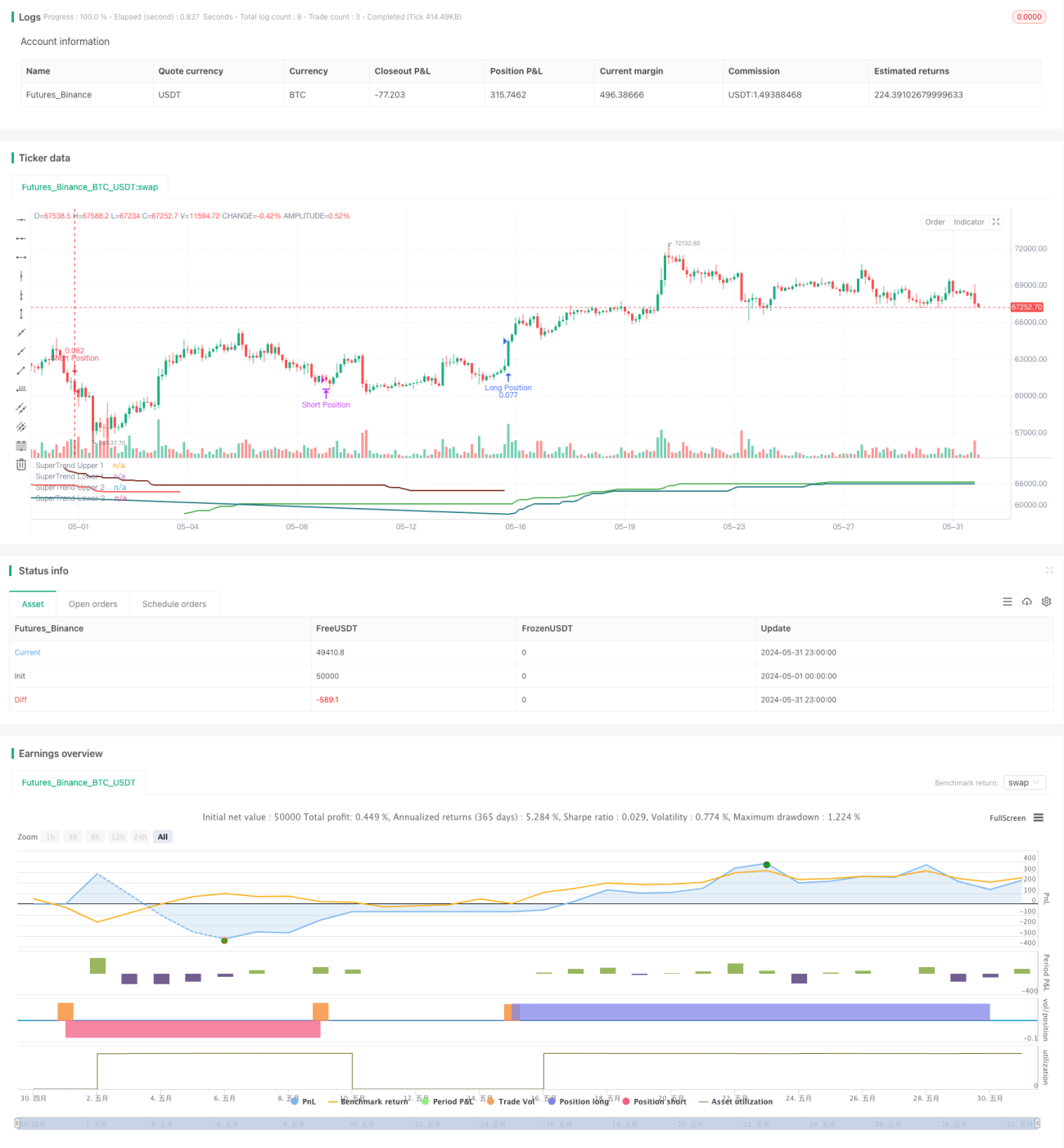
Chiến lược giao dịch định lượng SuperTrend điều chỉnh độ biến động của kênh Double Vegas

ATR SMA STD HLC3
Ngày tạo: 2024-06-03 11:16:38 sửa đổi lần cuối: 2024-06-03 11:16:38
sao chép: 0 Số nhấp chuột: 709
1
tập trung vào
1617
Người theo dõi

Chiến lược giao dịch định lượng SuperTrend điều chỉnh độ biến động của kênh Double Vegas

Tổng quan

Chiến lược giao dịch định lượng SuperTrend điều chỉnh biến động của kênh Vegas kép là một hệ thống giao dịch định lượng cao cấp kết hợp hai chỉ số SuperTrend điều chỉnh biến động của kênh Vegas với các tham số khác nhau để nắm bắt xu hướng thị trường chính xác hơn và tạo ra tín hiệu giao dịch phù hợp với hướng của thị trường tổng thể. Chiến lược này tạo thành một hệ thống giao dịch phản ứng động bằng cách tích hợp điều chỉnh biến động và sử dụng chiều rộng của kênh Vegas để tối ưu hóa tính toán SuperTrend.

Nguyên tắc chiến lược

Chiến lược này đầu tiên tính toán kênh Vegas, được lấy từ đường trung bình di chuyển đơn giản (SMA) và chênh lệch tiêu chuẩn (STD) của giá đóng cửa trong một khoảng thời gian cửa sổ nhất định. Nó giúp đo lường sự biến động của thị trường và đặt nền tảng cho việc điều chỉnh chỉ số SuperTrend. Tiếp theo, sử dụng phạm vi trung bình thực tế (ATR) và nhân điều chỉnh để xác định xu hướng tăng hoặc giảm của SuperTrend.

Lợi thế chiến lược

Ưu điểm chính của chiến lược định lượng SuperTrend điều chỉnh biến động SuperTrend là nó có thể điều chỉnh các chỉ số SuperTrend một cách động để thích ứng với các điều kiện thị trường thay đổi. Bằng cách tích hợp chiều rộng của kênh Vegas, chiến lược có thể đáp ứng tốt hơn với biến động thị trường và tăng độ chính xác trong nhận dạng xu hướng. Ngoài ra, việc sử dụng hai chỉ số SuperTrend với các tham số khác nhau có thể cung cấp tầm nhìn toàn diện hơn về thị trường, giúp xác định xu hướng và lọc các tín hiệu sai.

Rủi ro chiến lược

Mặc dù chiến lược này được thiết kế để cải thiện độ chính xác trong việc xác định xu hướng, nhưng vẫn có một số rủi ro. Thứ nhất, chiến lược này có thể tạo ra tín hiệu giao dịch sai trong trường hợp có biến động rất cao hoặc không rõ ràng về xu hướng thị trường. Thứ hai, giao dịch quá thường xuyên có thể dẫn đến chi phí giao dịch cao, ảnh hưởng đến hiệu suất tổng thể của chiến lược. Để giảm thiểu những rủi ro này, các nhà giao dịch có thể xem xét tối ưu hóa các tham số chiến lược, chẳng hạn như điều chỉnh chu kỳ ATR, chiều dài cửa sổ kênh Vegas và nhân số SuperTrend để phù hợp với các điều kiện thị trường cụ thể.

Hướng tối ưu hóa chiến lược

Chiến lược giao dịch định lượng SuperTrend có thể được tối ưu hóa bằng nhiều cách. Một hướng tối ưu hóa tiềm năng là kết hợp với các chỉ số kỹ thuật khác như chỉ số tương đối yếu ((RSI) hoặc phân tán kết hợp trung bình di chuyển ((MACD) để tăng độ tin cậy xác nhận xu hướng. Một hướng tối ưu hóa khác là giới thiệu cơ chế tự thích ứng, điều chỉnh các tham số chiến lược theo tình hình thị trường động. Điều này có thể được thực hiện bằng cách sử dụng các thuật toán học máy hoặc các phương pháp dựa trên quy tắc.

Tóm tắt

Nhìn chung, chiến lược SuperTrend định lượng giao dịch điều chỉnh biến động của kênh Vegas kép là một hệ thống giao dịch mạnh mẽ để cải thiện độ chính xác nhận định xu hướng bằng cách tích hợp điều chỉnh biến động và sử dụng chiều rộng của kênh Vegas. Chiến lược sử dụng hai chỉ số SuperTrend với các thiết lập tham số khác nhau để có được tầm nhìn toàn diện hơn về thị trường. Mặc dù chiến lược này có tiềm năng to lớn, nhưng cần thận trọng với rủi ro vốn có của nó.

Mã nguồn chiến lược
/*backtest
start: 2024-05-01 00:00:00
end: 2024-05-31 23:59:59
period: 3h
basePeriod: 15m
exchanges: [{"eid":"Futures_Binance","currency":"BTC_USDT"}]
*/

// This Pine Script™ code is subject to the terms of the Mozilla Public License 2.0 at https://mozilla.org/MPL/2.0/
// © PresentTrading

// The "Double Vegas SuperTrend Enhanced" strategy uses two SuperTrend indicators with different ATR and Vegas Channel settings 
// to identify market trends and generate trades. Trades are executed only when both SuperTrends align in the same direction. 
// The strategy includes configurable take-profit and stop-loss levels, and plots the SuperTrend levels on the chart.

//@version=5
strategy("Double Vegas SuperTrend Enhanced - Strategy [presentTrading]", shorttitle="Double Vegas SuperTrend Enhanced - Strategy [presentTrading]", overlay=true, overlay = false, 
 precision=3, commission_value= 0.1, commission_type=strategy.commission.percent, slippage= 1, currency=currency.USD, default_qty_type = strategy.percent_of_equity, 
 default_qty_value = 10, initial_capital= 10000)


// Input settings allow the user to customize the strategy's parameters.
tradeDirectionChoice = input.string(title="Trade Direction", defval="Both", options=["Long", "Short", "Both"]) // Option to select the trading direction

// Settings for the first Vegas SuperTrend
atrPeriod1 = input(10, "ATR Period for SuperTrend 1") // Length of the ATR for volatility measurement
vegasWindow1 = input(100, "Vegas Window Length 1") // Length of the moving average for the Vegas Channel
superTrendMultiplier1 = input(5, "SuperTrend Multiplier Base 1") // Base multiplier for the SuperTrend calculation
volatilityAdjustment1 = input.float(5, "Volatility Adjustment Factor 1") // Factor to adjust the SuperTrend sensitivity to the Vegas Channel width

// Settings for the second Vegas SuperTrend
atrPeriod2 = input(5, "ATR Period for SuperTrend 2") // Length of the ATR for volatility measurement
vegasWindow2 = input(200, "Vegas Window Length 2") // Length of the moving average for the Vegas Channel
superTrendMultiplier2 = input(7, "SuperTrend Multiplier Base 2") // Base multiplier for the SuperTrend calculation
volatilityAdjustment2 = input.float(7, "Volatility Adjustment Factor 2") // Factor to adjust the SuperTrend sensitivity to the Vegas Channel width

// Settings for Hold Days and TPSL Conditions
useHoldDays = input.bool(true, title="Use Hold Days")
holdDays = input.int(5, title="Hold Days", minval=1, maxval=60, step=1)
TPSLCondition = input.string("None", "TPSL Condition", options=["TP", "SL", "Both", "None"])
takeProfitPerc = input(30.0, title="Take Profit (%)")
stopLossPerc = input(20.0, title="Stop Loss (%)")

// Calculate the first Vegas Channel using a simple moving average and standard deviation.
vegasMovingAverage1 = ta.sma(close, vegasWindow1)
vegasChannelStdDev1 = ta.stdev(close, vegasWindow1)
vegasChannelUpper1 = vegasMovingAverage1 + vegasChannelStdDev1
vegasChannelLower1 = vegasMovingAverage1 - vegasChannelStdDev1

// Adjust the first SuperTrend multiplier based on the width of the Vegas Channel.
channelVolatilityWidth1 = vegasChannelUpper1 - vegasChannelLower1
adjustedMultiplier1 = superTrendMultiplier1 + volatilityAdjustment1 * (channelVolatilityWidth1 / vegasMovingAverage1)

// Calculate the first SuperTrend indicator values.
averageTrueRange1 = ta.atr(atrPeriod1)
superTrendUpper1 = hlc3 - (adjustedMultiplier1 * averageTrueRange1)
superTrendLower1 = hlc3 + (adjustedMultiplier1 * averageTrueRange1)
var float superTrendPrevUpper1 = na
var float superTrendPrevLower1 = na
var int marketTrend1 = 1

// Update SuperTrend values and determine the current trend direction for the first SuperTrend.
superTrendPrevUpper1 := nz(superTrendPrevUpper1[1], superTrendUpper1)
superTrendPrevLower1 := nz(superTrendPrevLower1[1], superTrendLower1)
marketTrend1 := close > superTrendPrevLower1 ? 1 : close < superTrendPrevUpper1 ? -1 : nz(marketTrend1[1], 1)
superTrendUpper1 := marketTrend1 == 1 ? math.max(superTrendUpper1, superTrendPrevUpper1) : superTrendUpper1
superTrendLower1 := marketTrend1 == -1 ? math.min(superTrendLower1, superTrendPrevLower1) : superTrendLower1
superTrendPrevUpper1 := superTrendUpper1
superTrendPrevLower1 := superTrendLower1

// Calculate the second Vegas Channel using a simple moving average and standard deviation.
vegasMovingAverage2 = ta.sma(close, vegasWindow2)
vegasChannelStdDev2 = ta.stdev(close, vegasWindow2)
vegasChannelUpper2 = vegasMovingAverage2 + vegasChannelStdDev2
vegasChannelLower2 = vegasMovingAverage2 - vegasChannelStdDev2

// Adjust the second SuperTrend multiplier based on the width of the Vegas Channel.
channelVolatilityWidth2 = vegasChannelUpper2 - vegasChannelLower2
adjustedMultiplier2 = superTrendMultiplier2 + volatilityAdjustment2 * (channelVolatilityWidth2 / vegasMovingAverage2)

// Calculate the second SuperTrend indicator values.
averageTrueRange2 = ta.atr(atrPeriod2)
superTrendUpper2 = hlc3 - (adjustedMultiplier2 * averageTrueRange2)
superTrendLower2 = hlc3 + (adjustedMultiplier2 * averageTrueRange2)
var float superTrendPrevUpper2 = na
var float superTrendPrevLower2 = na
var int marketTrend2 = 1

// Update SuperTrend values and determine the current trend direction for the second SuperTrend.
superTrendPrevUpper2 := nz(superTrendPrevUpper2[1], superTrendUpper2)
superTrendPrevLower2 := nz(superTrendPrevLower2[1], superTrendLower2)
marketTrend2 := close > superTrendPrevLower2 ? 1 : close < superTrendPrevUpper2 ? -1 : nz(marketTrend2[1], 1)
superTrendUpper2 := marketTrend2 == 1 ? math.max(superTrendUpper2, superTrendPrevUpper2) : superTrendUpper2
superTrendLower2 := marketTrend2 == -1 ? math.min(superTrendLower2, superTrendPrevLower2) : superTrendLower2
superTrendPrevUpper2 := superTrendUpper2
superTrendPrevLower2 := superTrendLower2

// Enhanced Visualization
// Plot the SuperTrend and Vegas Channel for visual analysis for both lengths.
plot(marketTrend1 == 1 ? superTrendUpper1 : na, "SuperTrend Upper 1", color=color.green, linewidth=2)
plot(marketTrend1 == -1 ? superTrendLower1 : na, "SuperTrend Lower 1", color=color.red, linewidth=2)

plot(marketTrend2 == 1 ? superTrendUpper2 : na, "SuperTrend Upper 2", color=color.rgb(31, 119, 130), linewidth=2)
plot(marketTrend2 == -1 ? superTrendLower2 : na, "SuperTrend Lower 2", color=color.rgb(120, 42, 26), linewidth=2)

// Detect trend direction changes and plot entry/exit signals for both lengths.
trendShiftToBullish1 = marketTrend1 == 1 and marketTrend1[1] == -1
trendShiftToBearish1 = marketTrend1 == -1 and marketTrend1[1] == 1

trendShiftToBullish2 = marketTrend2 == 1 and marketTrend2[1] == -1
trendShiftToBearish2 = marketTrend2 == -1 and marketTrend2[1] == 1

// Define conditions for entering long or short positions, and execute trades based on these conditions for both lengths.
enterLongCondition1 = marketTrend1 == 1
enterShortCondition1 = marketTrend1 == -1

enterLongCondition2 = marketTrend2 == 1
enterShortCondition2 = marketTrend2 == -1

// Entry conditions: Both conditions must be met for a trade to be executed.
enterLongCondition = enterLongCondition1 and enterLongCondition2 and not na(superTrendPrevUpper1[1]) and not na(superTrendPrevUpper2[1])
enterShortCondition = enterShortCondition1 and enterShortCondition2 and not na(superTrendPrevLower1[1]) and not na(superTrendPrevLower2[1])

// Variables to track entry times
var float longEntryTime = na
var float shortEntryTime = na

// Variables to track whether we have recently exited a trade to prevent re-entry in the same trend
var bool recentlyExitedLong = false
var bool recentlyExitedShort = false

// Check trade direction choice before executing trade entries.
if (enterLongCondition and (tradeDirectionChoice == "Long" or tradeDirectionChoice == "Both"))
    if (strategy.position_size < 0)
        strategy.close("Short Position")
    strategy.entry("Long Position", strategy.long)
    longEntryTime := time
    recentlyExitedLong := false
    recentlyExitedShort := false

if (enterShortCondition and (tradeDirectionChoice == "Short" or tradeDirectionChoice == "Both"))
    if (strategy.position_size > 0)
        strategy.close("Long Position")
    strategy.entry("Short Position", strategy.short)
    shortEntryTime := time
    recentlyExitedShort := false
    recentlyExitedLong := false

// Exit conditions: Either condition being met will trigger an exit.
exitLongCondition = marketTrend1 == -1 or marketTrend2 == -1
exitShortCondition = marketTrend1 == 1 or marketTrend2 == 1

// Close positions based on exit conditions or hold days.
if (useHoldDays and not na(longEntryTime) and (time >= longEntryTime + holdDays * 86400000) and strategy.position_size > 0)
    strategy.close("Long Position")
    longEntryTime := na
    recentlyExitedLong := true

if (useHoldDays and not na(shortEntryTime) and (time >= shortEntryTime + holdDays * 86400000) and strategy.position_size < 0)
    strategy.close("Short Position")
    shortEntryTime := na
    recentlyExitedShort := true

if (not useHoldDays and exitLongCondition and strategy.position_size > 0)
    strategy.close("Long Position")
    longEntryTime := na
    recentlyExitedLong := true

if (not useHoldDays and exitShortCondition and strategy.position_size < 0)
    strategy.close("Short Position")
    shortEntryTime := na
    recentlyExitedShort := true

// Reset recently exited flags on trend change to allow re-entry on a new trend
if (trendShiftToBullish1 or trendShiftToBullish2)
    recentlyExitedLong := false

if (trendShiftToBearish1 or trendShiftToBearish2)
    recentlyExitedShort := false

// Conditional Profit and Loss Management
if (TPSLCondition == "TP" or TPSLCondition == "Both") 
    // Apply take profit conditions
    strategy.exit("TakeProfit_Long", "Long Position", limit=close * (1 + takeProfitPerc / 100))
    strategy.exit("TakeProfit_Short", "Short Position", limit=close * (1 - takeProfitPerc / 100))

if (TPSLCondition == "SL" or TPSLCondition == "Both") 
    // Apply stop loss conditions
    strategy.exit("StopLoss_Long", "Long Position", stop=close * (1 - stopLossPerc / 100))
    strategy.exit("StopLoss_Short", "Short Position", stop=close * (1 + stopLossPerc / 100))

// Ensure that new entry signals can override the hold days condition
if (enterLongCondition and (tradeDirectionChoice == "Long" or tradeDirectionChoice == "Both"))
    if (strategy.position_size < 0)
        strategy.close("Short Position")
    strategy.entry("Long Position", strategy.long)
    longEntryTime := time
    recentlyExitedLong := false
    recentlyExitedShort := false

if (enterShortCondition and (tradeDirectionChoice == "Short" or tradeDirectionChoice == "Both"))
    if (strategy.position_size > 0)
        strategy.close("Long Position")
    strategy.entry("Short Position", strategy.short)
    shortEntryTime := time
    recentlyExitedShort := false
    recentlyExitedLong := false