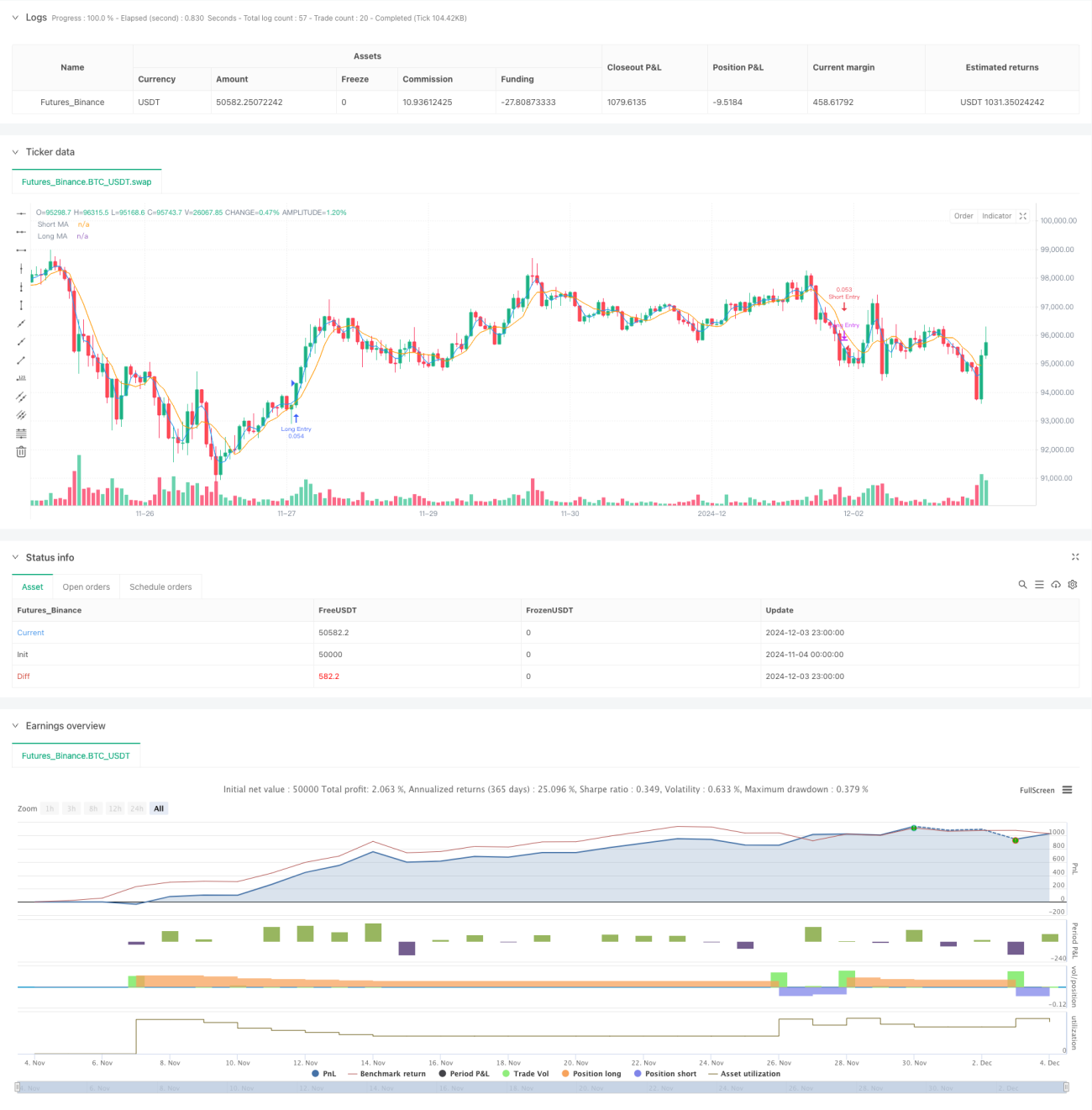
Chiến lược giao dịch lợi nhuận động ATR đa cấp

ATR SMA TR MF TP SL MA AATR
Ngày tạo: 2024-12-05 16:49:57 sửa đổi lần cuối: 2024-12-05 16:49:57
sao chép: 2 Số nhấp chuột: 477
1
tập trung vào
1617
Người theo dõi

Chiến lược giao dịch lợi nhuận động ATR đa cấp

Tổng quan

Đây là một chiến lược giao dịch đa tầng kết hợp tính toán ATR tự điều chỉnh và phát hiện xu hướng dựa trên động lực. Đặc điểm nổi bật nhất của chiến lược này là cơ chế kiếm lợi nhuận 7 bước độc đáo của nó, kết hợp 4 mức thoát dựa trên ATR và 3 mức phần trăm cố định. Phương pháp hỗn hợp này cho phép các nhà giao dịch điều chỉnh động theo biến động của thị trường, đồng thời thu lợi nhuận một cách có hệ thống trong thị trường đa tầng.

Nguyên tắc chiến lược

Nền tảng của chiến lược hoạt động thông qua các thành phần quan trọng sau:

  1. Tính toán real amplitude tăng cường: đo lường sự biến động của thị trường bằng cách xem xét các biến động giá đáng chú ý nhất.
  2. Tích hợp yếu tố động lực: Điều chỉnh ATR dựa trên biến động giá gần đây để nó thích ứng hơn.
  3. Tính toán ATR tự điều chỉnh: Điều chỉnh ATR truyền thống theo yếu tố động lượng để nó nhạy cảm hơn trong thời gian dao động.
  4. Tính số lượng cường độ xu hướng: Đánh giá cường độ của xu hướng bằng thuật toán phức tạp.
  5. Cơ chế lợi nhuận bảy bước: bao gồm bốn mức thoát dựa trên ATR và ba mức phần trăm cố định.

Lợi thế chiến lược

  1. Khả năng thích ứng: thích ứng với các điều kiện thị trường khác nhau thông qua tính toán ATR động.
  2. Quản lý rủi ro tốt: Cơ chế thu lợi nhuận đa tầng cung cấp kiểm soát rủi ro có hệ thống.
  3. Tính linh hoạt cao: có thể hoạt động hiệu quả như nhau trong các thị trường không gian.
  4. Các tham số có thể điều chỉnh: cung cấp nhiều tham số có thể điều chỉnh để phù hợp với phong cách giao dịch khác nhau.
  5. Thực thi có hệ thống: quy định rõ ràng về lối vào và lối ra để giảm bớt các giao dịch cảm xúc.

Rủi ro chiến lược

  1. Tính nhạy cảm của tham số: Thiết lập tham số không đúng có thể dẫn đến giao dịch quá mức hoặc mất cơ hội.
  2. Tùy thuộc vào điều kiện thị trường: có thể không hoạt động tốt trong thị trường biến động mạnh hoặc thị trường ngang.
  3. Rủi ro về tính phức tạp: Các cơ chế lợi nhuận đa tầng có thể gây khó khăn cho việc thực hiện.
  4. Tác động của điểm trượt: Nhiều người được hưởng lợi có thể bị ảnh hưởng đáng kể bởi điểm trượt.
  5. Yêu cầu quản lý tài chính: Cần đủ tiền để thực hiện chiến lược lợi nhuận đa cấp.

Hướng tối ưu hóa chiến lược

  1. Điều chỉnh tham số động: Điều chỉnh tham số tự động theo tình trạng thị trường.
  2. Bộ lọc môi trường thị trường: Thêm cơ chế nhận diện môi trường thị trường.
  3. Tăng cường quản lý rủi ro: giới thiệu cơ chế dừng lỗ động.
  4. Tối ưu hóa thực hiện: Tích hợp cơ chế thu lợi nhuận để giảm tác động của điểm trượt.
  5. Khung phản hồi được cải thiện: thêm các yếu tố giao dịch thực tế.

Tóm tắt

Chiến lược này cung cấp cho các nhà giao dịch một hệ thống giao dịch toàn diện bằng cách kết hợp ATR tự điều chỉnh và cơ chế lợi nhuận nhiều cấp. Ưu điểm của nó là có thể thích ứng với các điều kiện thị trường khác nhau trong khi quản lý rủi ro thông qua một phương pháp có hệ thống. Mặc dù có một số rủi ro tiềm ẩn, chiến lược này có thể trở thành một công cụ giao dịch hiệu quả với việc tối ưu hóa và quản lý rủi ro thích hợp.

Mã nguồn chiến lược
/*backtest
start: 2024-11-04 00:00:00
end: 2024-12-04 00:00:00
period: 1h
basePeriod: 1h
exchanges: [{"eid":"Futures_Binance","currency":"BTC_USDT"}]
*/

// This Pine Script™ code is subject to the terms of the Mozilla Public License 2.0 at https://mozilla.org/MPL/2.0/
// © PresentTrading

// The SuperATR 7-Step Profit Strategy is a multi-layered trading strategy that combines adaptive ATR and momentum-based trend detection 
// with a sophisticated 7-step take-profit mechanism. This approach utilizes four ATR-based exit levels and three fixed percentage levels, 
// enabling flexible and dynamic profit-taking in both long and short market positions.

//@version=5
strategy("SuperATR 7-Step Profit - Strategy [presentTrading] ", overlay=true, precision=3, commission_value= 0.1, commission_type=strategy.commission.percent, slippage= 1, currency=currency.USD, default_qty_type = strategy.percent_of_equity, default_qty_value = 10, initial_capital=10000)

// ————————
// User Inputs
// ————————
short_period = input.int(3, minval=1, title="Short Period")
long_period = input.int(7, minval=1, title="Long Period")
momentum_period = input.int(7, minval=1, title="Momentum Period")
atr_sma_period = input.int(7, minval=1, title="ATR SMA Period for Confirmation")
trend_strength_threshold = input.float(1.618, minval=0.0, title="Trend Strength Threshold", step=0.1)

// ————————
// Take Profit Inputs
// ————————
useMultiStepTP = input.bool(true, title="Enable Multi-Step Take Profit")

// ATR-based Take Profit Inputs
atrLengthTP = input.int(14, minval=1, title="ATR Length for Take Profit")
atrMultiplierTP1 = input.float(2.618, minval=0.1, title="ATR Multiplier for TP Level 1")
atrMultiplierTP2 = input.float(5.0, minval=0.1, title="ATR Multiplier for TP Level 2")
atrMultiplierTP3 = input.float(10.0, minval=0.1, title="ATR Multiplier for TP Level 3")
atrMultiplierTP4 = input.float(13.82, minval=0.1, title="ATR Multiplier for TP Level 4")

// Fixed Percentage Take Profit Inputs
tp_level_percent1 = input.float(3.0, minval=0.1, title="Fixed TP Level 1 (%)")
tp_level_percent2 = input.float(8.0, minval=0.1, title="Fixed TP Level 2 (%)")
tp_level_percent3 = input.float(17.0, minval=0.1, title="Fixed TP Level 3 (%)")

// Take Profit Percentages for Each Level
tp_percent_atr = input.float(10.0, minval=0.1, maxval=100, title="Percentage to Exit at Each ATR TP Level")
tp_percent_fixed = input.float(10.0, minval=0.1, maxval=100, title="Percentage to Exit at Each Fixed TP Level")


// —————————————
// Helper Functions
// —————————————

// Function to calculate True Range with enhanced volatility detection
calculate_true_range() =>
    prev_close = close[1]
    tr1 = high - low
    tr2 = math.abs(high - prev_close)
    tr3 = math.abs(low - prev_close)
    true_range = math.max(tr1, tr2, tr3)
    true_range

// ———————————————
// Indicator Calculations
// ———————————————

// Calculate True Range
true_range = calculate_true_range()

// Calculate Momentum Factor
momentum = close - close[momentum_period]
stdev_close = ta.stdev(close, momentum_period)
normalized_momentum = stdev_close != 0 ? (momentum / stdev_close) : 0
momentum_factor = math.abs(normalized_momentum)

// Calculate Short and Long ATRs
short_atr = ta.sma(true_range, short_period)
long_atr = ta.sma(true_range, long_period)

// Calculate Adaptive ATR
adaptive_atr = (short_atr * momentum_factor + long_atr) / (1 + momentum_factor)

// Calculate Trend Strength
price_change = close - close[momentum_period]
atr_multiple = adaptive_atr != 0 ? (price_change / adaptive_atr) : 0
trend_strength = ta.sma(atr_multiple, momentum_period)

// Calculate Moving Averages
short_ma = ta.sma(close, short_period)
long_ma = ta.sma(close, long_period)

// Determine Trend Signal
trend_signal = (short_ma > long_ma and trend_strength > trend_strength_threshold) ? 1 :
               (short_ma < long_ma and trend_strength < -trend_strength_threshold) ? -1 : 0

// Calculate Adaptive ATR SMA for Confirmation
adaptive_atr_sma = ta.sma(adaptive_atr, atr_sma_period)

// Determine if Trend is Confirmed with Price Action
trend_confirmed = (trend_signal == 1 and close > short_ma and adaptive_atr > adaptive_atr_sma) or (trend_signal == -1 and close < short_ma and adaptive_atr > adaptive_atr_sma)

// —————————————
// Trading Logic
// —————————————

// Entry Conditions
long_entry = trend_confirmed and trend_signal == 1
short_entry = trend_confirmed and trend_signal == -1

// Exit Conditions
long_exit = strategy.position_size > 0 and short_entry
short_exit = strategy.position_size < 0 and long_entry


// Execute Long Trades
if long_entry
    strategy.entry("Long Entry", strategy.long)
if long_exit
    strategy.close("Long Entry")

// Execute Short Trades
if short_entry
    strategy.entry("Short Entry", strategy.short)
if short_exit
    strategy.close("Short Entry")

// ————————————————
// Multi-Step Take Profit Logic
// ————————————————

if useMultiStepTP
    // Calculate ATR for Take Profit Levels
    atrValueTP = ta.atr(atrLengthTP)

    // Long Position Take Profit Levels
    if strategy.position_size > 0
        // ATR-based Take Profit Prices
        tp_priceATR1_long = strategy.position_avg_price + atrMultiplierTP1 * atrValueTP
        tp_priceATR2_long = strategy.position_avg_price + atrMultiplierTP2 * atrValueTP
        tp_priceATR3_long = strategy.position_avg_price + atrMultiplierTP3 * atrValueTP
        tp_priceATR4_long = strategy.position_avg_price + atrMultiplierTP4 * atrValueTP

        // Fixed Percentage Take Profit Prices
        tp_pricePercent1_long = strategy.position_avg_price * (1 + tp_level_percent1 / 100)
        tp_pricePercent2_long = strategy.position_avg_price * (1 + tp_level_percent2 / 100)
        tp_pricePercent3_long = strategy.position_avg_price * (1 + tp_level_percent3 / 100)

        // Set ATR-based Take Profit Exits
        strategy.exit("TP ATR 1 Long", from_entry="Long Entry", qty_percent=tp_percent_atr, limit=tp_priceATR1_long)
        strategy.exit("TP ATR 2 Long", from_entry="Long Entry", qty_percent=tp_percent_atr, limit=tp_priceATR2_long)
        strategy.exit("TP ATR 3 Long", from_entry="Long Entry", qty_percent=tp_percent_atr, limit=tp_priceATR3_long)
        strategy.exit("TP ATR 4 Long", from_entry="Long Entry", qty_percent=tp_percent_atr, limit=tp_priceATR4_long)

        // Set Fixed Percentage Take Profit Exits
        strategy.exit("TP Percent 1 Long", from_entry="Long Entry", qty_percent=tp_percent_fixed, limit=tp_pricePercent1_long)
        strategy.exit("TP Percent 2 Long", from_entry="Long Entry", qty_percent=tp_percent_fixed, limit=tp_pricePercent2_long)
        strategy.exit("TP Percent 3 Long", from_entry="Long Entry", qty_percent=tp_percent_fixed, limit=tp_pricePercent3_long)

    // Short Position Take Profit Levels
    if strategy.position_size < 0
        // ATR-based Take Profit Prices
        tp_priceATR1_short = strategy.position_avg_price - atrMultiplierTP1 * atrValueTP
        tp_priceATR2_short = strategy.position_avg_price - atrMultiplierTP2 * atrValueTP
        tp_priceATR3_short = strategy.position_avg_price - atrMultiplierTP3 * atrValueTP
        tp_priceATR4_short = strategy.position_avg_price - atrMultiplierTP4 * atrValueTP

        // Fixed Percentage Take Profit Prices
        tp_pricePercent1_short = strategy.position_avg_price * (1 - tp_level_percent1 / 100)
        tp_pricePercent2_short = strategy.position_avg_price * (1 - tp_level_percent2 / 100)
        tp_pricePercent3_short = strategy.position_avg_price * (1 - tp_level_percent3 / 100)

        // Set ATR-based Take Profit Exits
        strategy.exit("TP ATR 1 Short", from_entry="Short Entry", qty_percent=tp_percent_atr, limit=tp_priceATR1_short)
        strategy.exit("TP ATR 2 Short", from_entry="Short Entry", qty_percent=tp_percent_atr, limit=tp_priceATR2_short)
        strategy.exit("TP ATR 3 Short", from_entry="Short Entry", qty_percent=tp_percent_atr, limit=tp_priceATR3_short)
        strategy.exit("TP ATR 4 Short", from_entry="Short Entry", qty_percent=tp_percent_atr, limit=tp_priceATR4_short)

        // Set Fixed Percentage Take Profit Exits
        strategy.exit("TP Percent 1 Short", from_entry="Short Entry", qty_percent=tp_percent_fixed, limit=tp_pricePercent1_short)
        strategy.exit("TP Percent 2 Short", from_entry="Short Entry", qty_percent=tp_percent_fixed, limit=tp_pricePercent2_short)
        strategy.exit("TP Percent 3 Short", from_entry="Short Entry", qty_percent=tp_percent_fixed, limit=tp_pricePercent3_short)


// ——————————
// Plotting
// ——————————

plot(short_ma, color=color.blue, title="Short MA")
plot(long_ma, color=color.orange, title="Long MA")

// Plot Buy and Sell Signals
//plotshape(long_entry, title="Long Entry", style=shape.triangleup, location=location.belowbar, color=color.green, size=size.small, text="Buy")
//plotshape(short_entry, title="Short Entry", style=shape.triangledown, location=location.abovebar, color=color.red, size=size.small, text="Sell")

// Optional: Plot Trend Strength for analysis
// Uncomment the lines below to display Trend Strength on a separate chart pane
// plot(trend_strength, title="Trend Strength", color=color.gray)
// hline(trend_strength_threshold, title="Trend Strength Threshold", color=color.gray, linestyle=hline.style_dashed)
// hline(-trend_strength_threshold, title="Trend Strength Threshold", color=color.gray, linestyle=hline.style_dashed)