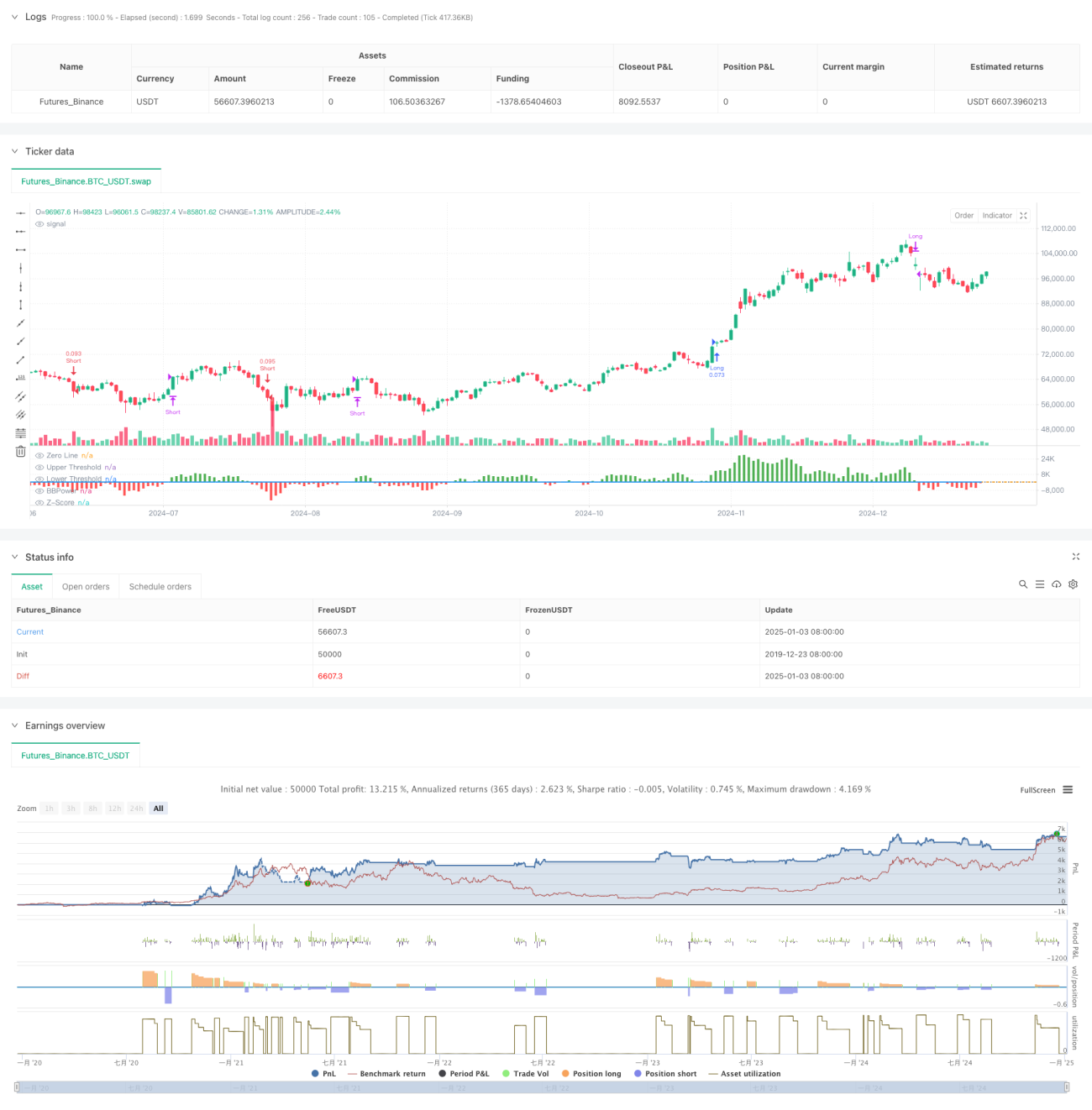
Chiến lược giao dịch dừng lỗ động đa cấp dựa trên chỉ báo Bolber và lọc phân vị khối lượng

BBP EMA ATR TP
Ngày tạo: 2025-01-06 16:16:04 sửa đổi lần cuối: 2025-01-06 16:16:04
sao chép: 1 Số nhấp chuột: 436
1
tập trung vào
1617
Người theo dõi

Chiến lược giao dịch dừng lỗ động đa cấp dựa trên chỉ báo Bolber và lọc phân vị khối lượng

Tổng quan

Chiến lược này là chiến lược giao dịch định lượng kết hợp chỉ báo Bull Bear Power và hệ thống chốt lời động nhiều cấp dựa trên phần trăm khối lượng. Chiến lược này xây dựng một hệ thống giao dịch có khả năng thích ứng cao và kiểm soát rủi ro bằng cách phân tích dữ liệu đa chiều như giá, khối lượng và động lượng. Logic cốt lõi bao gồm việc sử dụng giá trị chuẩn hóa Z-Score của chỉ báo BBP làm điều kiện kích hoạt cho các tín hiệu giao dịch và kết hợp phân tích phần trăm khối lượng để điều chỉnh động mức chốt lời, do đó nắm bắt chính xác các trạng thái biến động khác nhau của thị trường.

Nguyên tắc chiến lược

Tính toán cốt lõi của chiến lược bao gồm các phần chính sau:

  1. Tính toán chỉ báo BBP: Đo lường sự so sánh sức mạnh thị trường bằng cách tính tổng chênh lệch giữa giá cao nhất và EMA (sức mạnh tăng giá) và chênh lệch giữa giá thấp nhất và EMA (sức mạnh giảm giá).
  2. Chuẩn hóa điểm Z: Giá trị BBP được chuẩn hóa để xác định mức độ lệch chuẩn của sức mạnh thị trường hiện tại.
  3. Phân tích khối lượng: Tính toán khối lượng hiện tại so với đường trung bình động để xác định hoạt động thị trường.
  4. Phân tích phân vị: Tính toán các phân vị lịch sử của giá và khối lượng cho phân phối xác suất của các điều kiện thị trường.
  5. Chốt lời động: Điều chỉnh khoảng cách chốt lời động dựa trên điểm tổng hợp của ATR, phần trăm khối lượng và phần trăm giá.

Lợi thế chiến lược

  1. Phân tích đa chiều: Xem xét toàn diện động lực giá, khối lượng và vị thế thị trường để cung cấp góc nhìn toàn diện hơn về thị trường.
  2. Khả năng thích ứng mạnh mẽ: Thông qua cơ chế chốt lời được điều chỉnh linh hoạt, có thể thích ứng với nhiều môi trường thị trường khác nhau.
  3. Phân tán rủi ro: áp dụng chiến lược chốt lời nhiều cấp để nhận được lợi nhuận ở nhiều mức giá khác nhau.
  4. Ưu điểm về xác suất: Thông qua điểm Z và phân tích phân vị, nó có lợi thế có ý nghĩa thống kê.
  5. Khả năng mở rộng: Khung chính sách có khả năng mở rộng tốt và có thể thêm các chiều phân tích mới khi cần thiết.

Rủi ro chiến lược

  1. Độ nhạy của tham số: Các chiến lược chứa nhiều tham số và cần được tối ưu hóa cho các môi trường thị trường khác nhau.
  2. Phụ thuộc vào môi trường thị trường: Có thể hoạt động kém trong thời kỳ biến động mạnh hoặc thay đổi xu hướng.
  3. Trượt giá khi thực hiện: Lệnh chốt lời nhiều cấp có thể bị trượt giá khi thực hiện, ảnh hưởng đến lợi nhuận thực tế.
  4. Độ phức tạp về mặt tính toán: Việc tính toán nhiều chỉ số theo thời gian thực có thể gây ra tải hệ thống nhất định.
  5. Rủi ro tín hiệu sai: Tín hiệu giao dịch sai có thể được tạo ra trong thị trường đi ngang.

Hướng tối ưu hóa

  1. Điều chỉnh tham số: Giới thiệu các phương pháp học máy để đạt được sự tối ưu hóa tự động các tham số.
  2. Dự đoán thị trường: Thêm mô-đun phân loại môi trường thị trường để xác định trước các môi trường giao dịch bất lợi.
  3. Tối ưu hóa dừng lỗ: Giới thiệu cơ chế dừng lỗ động để cải thiện độ chính xác của việc kiểm soát rủi ro.
  4. Lọc tín hiệu: Thêm bộ lọc cường độ xu hướng để giảm tín hiệu sai.
  5. Quản lý vị trí: tối ưu hóa thuật toán phân bổ vị trí và nâng cao hiệu quả sử dụng vốn.

Tóm tắt

Chiến lược này kết hợp chỉ báo BBP truyền thống với các phương pháp phân tích định lượng hiện đại để xây dựng một hệ thống giao dịch có nền tảng lý thuyết vững chắc và tính thực tiễn cao. Thông qua cơ chế điều chỉnh động và chốt lời nhiều cấp, lợi nhuận và rủi ro sẽ được cân bằng tốt hơn. Mặc dù có một số khó khăn nhất định trong việc tối ưu hóa tham số, khả năng mở rộng của khuôn khổ chiến lược cung cấp đủ không gian cho việc tối ưu hóa tiếp theo. Trong ứng dụng thực tế, các nhà giao dịch được khuyên nên thực hiện các điều chỉnh có mục tiêu dựa trên đặc điểm thị trường cụ thể và mức độ chấp nhận rủi ro của riêng họ.

Mã nguồn chiến lược
/*backtest
start: 2019-12-23 08:00:00
end: 2025-01-04 08:00:00
period: 1d
basePeriod: 1d
exchanges: [{"eid":"Futures_Binance","currency":"BTC_USDT"}]
*/

// This Pine Script™ code is subject to the terms of the Mozilla Public License 2.0 at https://mozilla.org/MPL/2.0/
// © PresentTrading

// The BBP Strategy with Volume-Percentile TP by PresentTrading emerges as a sophisticated approach that integrates multiple analytical layers to enhance trading precision and profitability. 
// Unlike traditional strategies that rely solely on price movements or volume indicators, this strategy synergizes Bollinger Bands Power (BBP) with volume percentile analysis to determine optimal entry and exit points. Additionally, it employs a dynamic take-profit mechanism based on ATR (Average True Range) multipliers adjusted by volume and percentile factors, ensuring adaptability to varying market conditions. 
// This multi-faceted approach not only enhances signal accuracy but also optimizes risk management, setting it apart from conventional trading methodologies.

//@version=5
strategy("BBP Strategy with Volume-Percentile TP - Strategy [presentTrading] ", overlay=false, precision=3, commission_value= 0.1, commission_type=strategy.commission.percent, slippage= 1, currency=currency.USD, default_qty_type = strategy.percent_of_equity, default_qty_value = 10, initial_capital=10000)


// ————————
// Bull Bear Power Strategy Settings
// ————————
lengthInput = input.int(21, "EMA Length")
zLength     = input.int(252, "Z-Score Length")
zThreshold  = input.float(1.618, "Z-Score Threshold")

// ————————
// Take Profit Settings
// ————————
tp_group = "Take Profit Settings"
// Enable/disable take profit function
useTP = input.bool(true, "Use Take Profit", group=tp_group)

// === ATR Base Settings ===
// ATR calculation period for determining base price movement range
baseAtrLength = input.int(20, "ATR Period", minval=1, group=tp_group, tooltip="ATR period for calculating base price movement range. Shorter periods are more sensitive to recent volatility")

// === Take Profit Multiplier Settings ===
// First take profit ATR multiplier, usually the most conservative target
atrMult1 = input.float(1.618, "TP1 ATR Multiplier", minval=0.1, step=0.1, group=tp_group, tooltip="First take profit level ATR multiplier, recommended 1.5-2.0")
// Second take profit ATR multiplier, medium profit target
atrMult2 = input.float(2.382, "TP2 ATR Multiplier", minval=0.1, step=0.1, group=tp_group, tooltip="Second take profit level ATR multiplier, recommended 2.5-3.0")
// Third take profit ATR multiplier, most aggressive target
atrMult3 = input.float(3.618, "TP3 ATR Multiplier", minval=0.1, step=0.1, group=tp_group, tooltip="Third take profit level ATR multiplier, recommended 4.0-5.0")

// === Position Size Allocation ===
// First take profit position size, usually larger for securing basic profits
tp1_size = input.float(13, "TP1 Position %", minval=1, maxval=100, group=tp_group, tooltip="Position size percentage for first take profit, recommended 30-40%")
// Second take profit position size, medium allocation
tp2_size = input.float(13, "TP2 Position %", minval=1, maxval=100, group=tp_group, tooltip="Position size percentage for second take profit, recommended 30-40%")
// Third take profit position size, usually smaller for catching larger moves
tp3_size = input.float(13, "TP3 Position %", minval=1, maxval=100, group=tp_group, tooltip="Position size percentage for third take profit, recommended 20-30%")

// ————————
// Volume Analysis Settings
// ————————
vol_group = "Volume Analysis Settings"
// Volume MA period for determining relative volume levels
vol_period = input.int(100, "Volume MA Period", minval=1, group=vol_group, tooltip="Period for calculating volume moving average, recommended 20-30")

// === Volume Level Thresholds ===
// High volume threshold relative to MA
vol_high = input.float(2.0, "High Volume Multiplier", minval=1.0, step=0.1, group=vol_group, tooltip="High volume threshold multiplier, typically 2x MA or above")
// Medium volume threshold
vol_med = input.float(1.5, "Medium Volume Multiplier", minval=1.0, step=0.1, group=vol_group, tooltip="Medium volume threshold multiplier, typically around 1.5x MA")
// Low volume threshold
vol_low = input.float(1.0, "Low Volume Multiplier", minval=0.5, step=0.1, group=vol_group, tooltip="Low volume threshold multiplier, typically around 1x MA")

// === Volume Adjustment Factors ===
// High volume adjustment factor, usually extends take profit targets
vol_high_mult = input.float(1.5, "High Volume Factor", minval=0.1, step=0.1, group=vol_group, tooltip="Take profit adjustment factor for high volume")
// Medium volume adjustment factor
vol_med_mult = input.float(1.3, "Medium Volume Factor", minval=0.1, step=0.1, group=vol_group, tooltip="Take profit adjustment factor for medium volume")
// Low volume adjustment factor
vol_low_mult = input.float(1.0, "Low Volume Factor", minval=0.1, step=0.1, group=vol_group, tooltip="Take profit adjustment factor for low volume")

// ————————
// Percentile Analysis Settings
// ————————
perc_group = "Percentile Analysis Settings"
// Percentile calculation period for evaluating price position
perc_period = input.int(100, "Percentile Period", minval=20, group=perc_group, tooltip="Historical period for percentile calculations, recommended 100-200")

// === Percentile Thresholds ===
// High percentile threshold, typically indicates relative high levels
perc_high = input.float(90, "High Percentile", minval=50, maxval=100, group=perc_group, tooltip="High level percentile threshold, typically above 90")
// Medium percentile threshold
perc_med = input.float(80, "Medium Percentile", minval=50, maxval=100, group=perc_group, tooltip="Medium level percentile threshold, typically around 80")
// Low percentile threshold
perc_low = input.float(70, "Low Percentile", minval=0, maxval=100, group=perc_group, tooltip="Low level percentile threshold, typically around 70")

// === Percentile Adjustment Factors ===
// High percentile adjustment factor
perc_high_mult = input.float(1.5, "High Percentile Factor", minval=0.1, step=0.1, group=perc_group, tooltip="Take profit adjustment factor for high percentile levels")
// Medium percentile adjustment factor
perc_med_mult = input.float(1.3, "Medium Percentile Factor", minval=0.1, step=0.1, group=perc_group, tooltip="Take profit adjustment factor for medium percentile levels")
// Low percentile adjustment factor
perc_low_mult = input.float(1.0, "Low Percentile Factor", minval=0.1, step=0.1, group=perc_group, tooltip="Take profit adjustment factor for low percentile levels")


// ————————
// Core Bull Bear Power Calculations
// ————————
emaClose  = ta.ema(close, lengthInput)
bullPower = high - emaClose
bearPower = low  - emaClose
bbp       = bullPower + bearPower

bbp_mean  = ta.sma(bbp, zLength)
bbp_std   = ta.stdev(bbp, zLength)
zscore    = (bbp - bbp_mean) / bbp_std

// ————————
// Volume & Percentile Analysis
// ————————
// 成交量分析
vol_sma = ta.sma(volume, vol_period)
vol_mult = volume / vol_sma

// 百分位數計算
calcPercentile(src) =>
    var values = array.new_float(0)
    array.unshift(values, src)
    if array.size(values) > perc_period
        array.pop(values)
    array.size(values) > 0 ? array.percentrank(values, array.size(values)-1) * 100 : 50

price_perc = calcPercentile(close)
vol_perc = calcPercentile(volume)

// 止盈動態調整系數計算
getTpFactor() =>
    vol_score = vol_mult > vol_high ? vol_high_mult : vol_mult > vol_med ? vol_med_mult : vol_mult > vol_low ? vol_low_mult : 0.8
    price_score = price_perc > perc_high ? perc_high_mult :price_perc > perc_med ? perc_med_mult :price_perc > perc_low ? perc_low_mult : 0.8 
    math.avg(vol_score, price_score)

// ————————
// Entry/Exit Logic
// ————————
longCondition  = ta.crossover(zscore,  zThreshold)
shortCondition = ta.crossunder(zscore, -zThreshold)
exitLongCondition  = ta.crossunder(zscore, 0)
exitShortCondition = ta.crossover(zscore,  0)

if (barstate.isconfirmed)
    if longCondition
        strategy.entry("Long", strategy.long)
    if shortCondition
        strategy.entry("Short", strategy.short)
    if exitLongCondition
        strategy.close("Long")
    if exitShortCondition
        strategy.close("Short")

// ————————
// Take Profit Execution
// ————————
if useTP and strategy.position_size != 0
    base_move = ta.atr(baseAtrLength)
    tp_factor = getTpFactor()
    is_long = strategy.position_size > 0
    entry_price = strategy.position_avg_price
    
    if is_long
        tp1_price = entry_price + (base_move * atrMult1 * tp_factor)
        tp2_price = entry_price + (base_move * atrMult2 * tp_factor)
        tp3_price = entry_price + (base_move * atrMult3 * tp_factor)
        
        strategy.exit("TP1", "Long", qty_percent=tp1_size, limit=tp1_price)
        strategy.exit("TP2", "Long", qty_percent=tp2_size, limit=tp2_price)
        strategy.exit("TP3", "Long", qty_percent=tp3_size, limit=tp3_price)
    else
        tp1_price = entry_price - (base_move * atrMult1 * tp_factor)
        tp2_price = entry_price - (base_move * atrMult2 * tp_factor)
        tp3_price = entry_price - (base_move * atrMult3 * tp_factor)
        
        strategy.exit("TP1", "Short", qty_percent=tp1_size, limit=tp1_price)
        strategy.exit("TP2", "Short", qty_percent=tp2_size, limit=tp2_price)
        strategy.exit("TP3", "Short", qty_percent=tp3_size, limit=tp3_price)

// ————————
// Plotting
// ————————
plot(bbp, color=bbp >= 0 ? color.new(color.green, 0) : color.new(color.red, 0), 
     title="BBPower", style=plot.style_columns)
hline(0, "Zero Line", color=color.gray, linestyle=hline.style_dotted)
plot(zscore, title="Z-Score", color=color.blue, linewidth=2)
hline(zThreshold, "Upper Threshold", color=color.orange, linestyle=hline.style_dashed)
hline(-zThreshold, "Lower Threshold", color=color.orange, linestyle=hline.style_dashed)