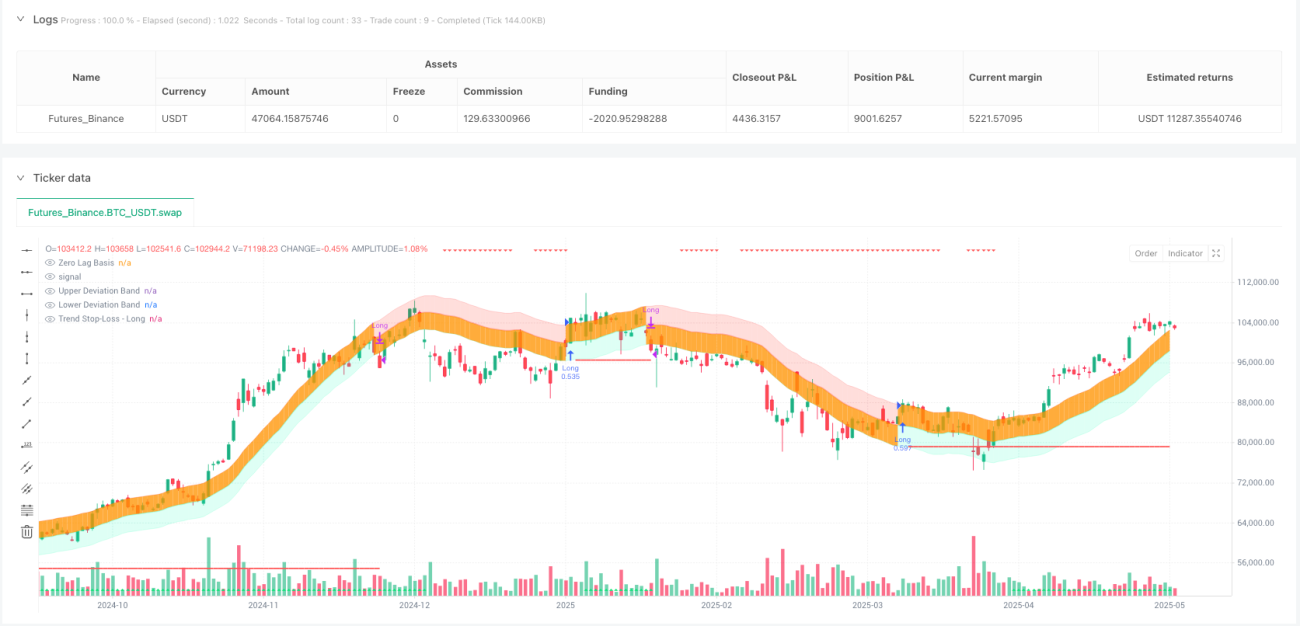
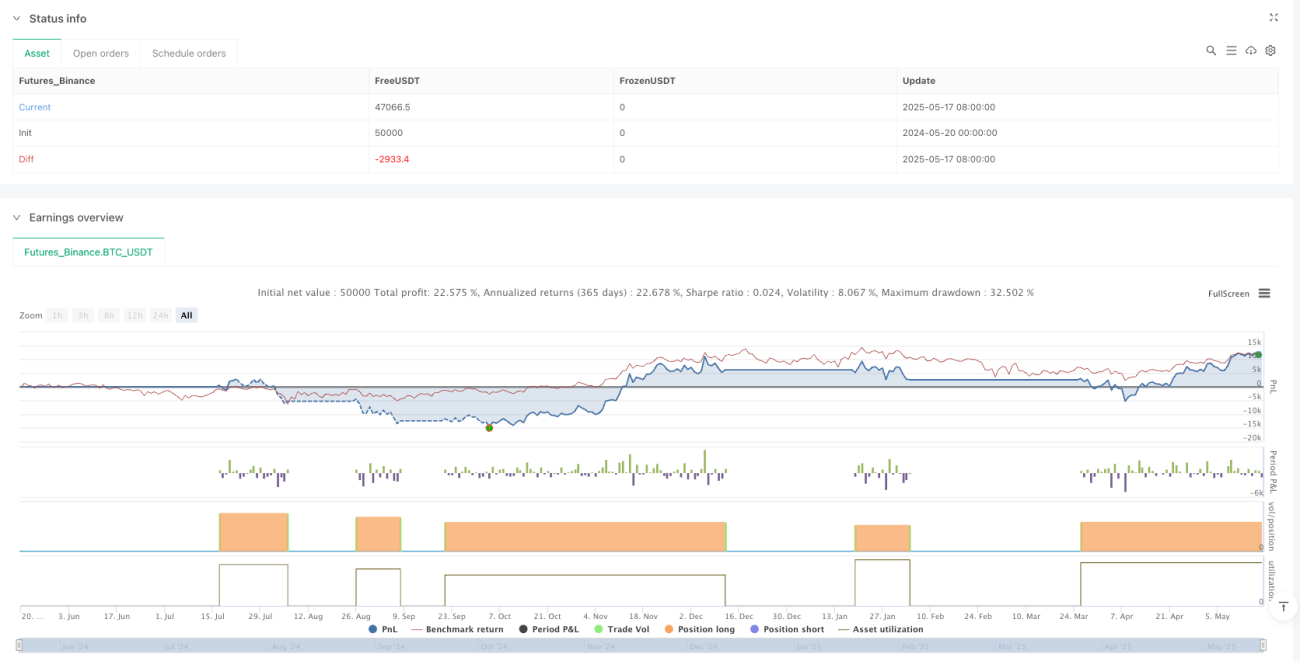
Chiến lược giao dịch tín hiệu xu hướng chậm trễ không khung thời gian đa dạng là một hệ thống giao dịch định lượng dựa trên chỉ số di chuyển trung bình chậm trễ không ((ZLEMA) nhằm giảm độ trễ của các đường trung bình di chuyển truyền thống và cung cấp tín hiệu nhận dạng xu hướng chính xác hơn. Chiến lược này không chỉ kết hợp các kênh biến động để nhận biết sự thay đổi của xu hướng, mà còn tích hợp nhiều cơ chế xuất phát linh hoạt, bao gồm báo cáo rủi ro, so sánh mục tiêu xuất phát lợi nhuận, dừng và dừng dựa trên ATR, theo dõi động thái dừng lỗ và đường đều đi qua xuất phát.
Nguyên tắc cốt lõi của chiến lược này dựa trên chỉ số di chuyển trung bình với độ trễ không (ZLEMA), một chỉ số kỹ thuật để tăng tốc độ phản ứng trung bình di chuyển bằng cách loại bỏ hoặc giảm độ trễ dữ liệu giá. Các bước thực hiện cụ thể như sau:
Tính toán không trễChiến lược đầu tiên là tính ZLEMA, bằng công thức:zlema = ta.ema(src + (src - src[lag]), length)trong đó có:lagPhương pháp này có hiệu quả trong việc giảm sự chậm trễ trong EMA truyền thống.
Cơ chế nhận diện xu hướng:
zlemaUpTrendVàzlemaDownTrendThực hiện biếnĐiều kiện nhập học đa dạng:
Hệ thống ra sân động tổng hợp:
Các chiến lược giao dịch tín hiệu xu hướng có độ trễ 0 trong nhiều khung thời gian có những lợi thế đáng kể:
Giảm độ trễ tín hiệuZLEMA giúp giảm độ trễ của các đường trung bình di chuyển truyền thống, giúp nhận diện xu hướng kịp thời hơn và bắt đầu xu hướng sớm hơn.
Hệ thống quản lý rủi ro toàn diệnTích hợp các cơ chế kiểm soát rủi ro đa cấp, từ dừng cố định, dừng động ATR, dừng theo dõi đến dừng cân bằng lỗ hổng, cung cấp sự bảo vệ hoàn hảo cho các môi trường thị trường khác nhau.
Lựa chọn giao dịch linh hoạt: Có thể được cấu hình để chỉ làm nhiều chiến lược hoặc chiến lược giao dịch hai chiều, thích ứng với sở thích thị trường và môi trường quản lý khác nhau.
Cơ chế tái nhập họcZLEMA: Chức năng quay trở lại bằng đường số 0, cho phép quay trở lại sau khi điều chỉnh ngắn hạn trong xu hướng mạnh, để tối đa hóa lợi nhuận xu hướng.
Chiến lược rút khỏi đa dạng: Cung cấp nhiều lựa chọn rút lui cho các tình trạng thị trường khác nhau, có thể khóa lợi nhuận bằng cách đặt mục tiêu lợi nhuận hoặc có thể chạy lợi nhuận bằng cách theo dõi dừng lỗ.
Hỗ trợ hình ảnh: Hiển thị trực quan tín hiệu giao dịch và vị trí quản lý rủi ro thông qua các yếu tố trực quan như bóng xu hướng, đường dừng, đường dừng và chỉ số xu hướng.
Thống kê chi tiết về hiệu suất: Một bảng thống kê giao dịch tích hợp, hiển thị các chỉ số quan trọng như tỷ lệ thắng, lợi nhuận ròng, rút tiền tối đa, để đánh giá và tối ưu hóa chiến lược.
Mặc dù chiến lược này được thiết kế hợp lý, nhưng vẫn có một số rủi ro tiềm ẩn cần lưu ý:
Độ nhạy tham sốCác tham số cốt lõi như độ dài ZLEMA và ATR có ảnh hưởng đáng kể đến hiệu suất chiến lược, thiết lập không đúng có thể dẫn đến quá nhiều hoặc quá ít tín hiệu.
Dấu hiệu sai lầm của thị trườngTrong một thị trường bất ổn mà không có xu hướng rõ ràng, có thể tạo ra các tín hiệu sai lệch thường xuyên, dẫn đến tổn thất liên tục.
Rủi ro đảo ngược xu hướngMặc dù chiến lược đã thiết kế nhiều cơ chế thoát ra, nhưng trong một sự đảo ngược mạnh mẽ của xu hướng, có thể sẽ không có thời gian thoát ra và chịu tổn thất lớn hơn.
Rủi ro quá phù hợpSự kết hợp của nhiều tham số có thể dẫn đến quá phù hợp với dữ liệu lịch sử và không hoạt động tốt trong môi trường thị trường tương lai.
Tín hiệu chu kỳ dài rất hiếm: Khi sử dụng độ dài ZLEMA dài hơn, chiến lược có thể tạo ra ít tín hiệu giao dịch hơn, ảnh hưởng đến hiệu quả sử dụng vốn.
Thách thức ngăn chặn độ rộngLệnh dừng dựa trên ATR có thể quá rộng trong thị trường biến động cao, dẫn đến tổn thất đơn lẻ quá lớn; trong khi thị trường biến động thấp có thể quá hẹp, dẫn đến việc kích hoạt thường xuyên.
Các phương pháp để giảm thiểu những rủi ro này bao gồm: kiểm tra lại các tham số nghiêm ngặt và xác minh về phía trước, tránh giao dịch trong thị trường biến động kết hợp với chỉ số trạng thái thị trường, thực hiện các quy tắc quản lý tiền nghiêm ngặt và thường xuyên tối ưu lại các tham số chiến lược để thích ứng với sự thay đổi của thị trường.
Chiến lược này còn có nhiều khả năng tối ưu hóa, có thể nâng cao hiệu suất hơn nữa theo các hướng sau:
Các tham số động tự điều chỉnhPhát triển cơ chế thích ứng tự động điều chỉnh độ dài ZLEMA và ATR theo biến động thị trường, nâng cao khả năng thích ứng của chiến lược trong các môi trường thị trường khác nhau.
Trình lọc tình trạng thị trườngNhập các chỉ số trạng thái thị trường (như ADX, chỉ số biến động), chỉ giao dịch trong điều kiện thị trường thuận lợi, tránh giao dịch thường xuyên trong thị trường biến động kém hiệu quả.
Xác nhận khung thời gian đa dạngTỷ lệ thành công cao hơn khi tham gia chỉ khi xu hướng phù hợp với xu hướng của khung thời gian cao hơn
Giao dịch xác nhận: Kết hợp các chỉ số khối lượng giao dịch như xác nhận phụ trợ, ví dụ, chỉ xác nhận tín hiệu thay đổi xu hướng khi khối lượng giao dịch tăng.
Tối ưu hóa học máy: Sử dụng các thuật toán học máy để tìm các tham số và thời gian nhập cảnh tối ưu nhất, đặc biệt là có thể huấn luyện mô hình dự đoán các tín hiệu nào có khả năng thành công hơn.
Bộ lọc theo mùa và thời gianThêm bộ lọc thời gian giao dịch và lịch để tránh thời gian giao dịch kém hiệu quả hoặc rủi ro cao.
Phân tích liên quan đến tài sản: giới thiệu phân tích liên quan của các tài sản liên quan, tăng cường tín hiệu tin cậy khi xác nhận đồng hướng nhiều tài sản.
Những hướng tối ưu hóa này không chỉ làm tăng sự ổn định và lợi nhuận của chiến lược, mà còn làm giảm rủi ro, làm cho nó phù hợp hơn với các môi trường thị trường khác nhau và sở thích rủi ro cá nhân.
Chiến lược giao dịch tín hiệu xu hướng chậm trễ không khung thời gian đa dạng là một hệ thống giao dịch định lượng toàn diện và linh hoạt, nhận dạng xu hướng nhanh và chính xác thông qua công nghệ ZLEMA và kênh biến động, kết hợp với cơ chế quản lý rủi ro động nhiều tầng để bảo vệ an toàn tài chính. Chiến lược này có thể nắm bắt cơ hội nhập cảnh ban đầu của xu hướng và tối đa hóa lợi nhuận thông qua cơ chế nhập cảnh trở lại trong quá trình phát triển của xu hướng, đồng thời cung cấp nhiều chiến lược thoát cảnh phù hợp với môi trường thị trường khác nhau.
Ưu điểm chính của chiến lược là giảm độ trễ tín hiệu, cung cấp hệ thống quản lý rủi ro toàn diện và tùy chọn cấu hình giao dịch linh hoạt. Tuy nhiên, người dùng cần chú ý đến các rủi ro tiềm ẩn như độ nhạy cảm của tham số, tín hiệu giả của thị trường xung đột và quá phù hợp.
Là một hệ thống giao dịch định lượng dựa trên các chỉ số kỹ thuật, chiến lược này đặc biệt phù hợp với giao dịch theo xu hướng trung và dài hạn, áp dụng cho các thị trường tài chính khác nhau. Tuy nhiên, bất kỳ chiến lược nào cũng cần điều chỉnh cá nhân dựa trên mục tiêu giao dịch cá nhân, khả năng chịu rủi ro và sở thích của thị trường, và kết hợp với các nguyên tắc quản lý tiền nghiêm ngặt được áp dụng cho giao dịch thực tế.
//@version=6
// Quant Trading Pro www.quanttradingpro.com
// #1 Strategy Optimizer on the chrome extension store Quant Trading Strategy Optimizer
strategy(title="Quant Trading Zero Lag Trend Signals (MTF) Strategy", shorttitle="QT0️⃣Zero Lag Signals Strategy", overlay=true,
commission_type=strategy.commission.percent,
commission_value=0.1,
slippage=3,
default_qty_type=strategy.percent_of_equity,
default_qty_value=100,
initial_capital=1000,
margin_long=0,
margin_short=0)
// === INPUT PARAMETERS ===
// 📌 1️⃣ Main Calculations
length = input.int(70, title="Length", minval=70, maxval=7000)
mult = input.float(1.2, "Band Multiplier", group="Main Calculations")
// === 📊 Trade Data Toggles ===
showFloatingTable = input.bool(true, "Show Floating Stats Table?", group="Trade Data")
showTradeLog = input.bool(false, "Show Trade Log Labels on Chart?", group="Trade Data")
enableCSVExport = input.bool(false, "Enable CSV Export", group="Trade Data")
// 📌 ZLEMA Trend Confirmation for Entries
useZlemaTrendConfirm = input.bool(false, "Use ZLEMA Trend Confirmation for entry?", group="Entry Conditions")
reEnterOnLongTrend = input.bool(false, "Re-Enter on Long Trend continuation", group="Entry Conditions")
// 📌 2️⃣ Short Trades
allowShortTrades = input.bool(false, "Allow Short Trades?", group="Short Trades")
// 📌 Performance Settings
useProfitTarget = input.bool(false, "Use Profit Target?", group="Performance Settings")
profitTargetRR = input.float(2.0, "Profit Target (Risk-Reward Ratio)", group="Performance Settings")
// 📌 4️⃣ Dynamic TP/SL (Each Setting with Its Parameters Directly Below)
useATRStopTP = input.bool(false, "Use ATR-Based Stop-Loss & Take-Profit?", group="Dynamic TP/SL")
atrLength = input.int(14, "ATR Length", group="Dynamic TP/SL")
atrMultiplier = input.float(1.5, "Stop-Loss ATR Multiplier", group="Dynamic TP/SL")
profitATRMultiplier = input.float(2.5, "Profit Target ATR Multiplier", group="Dynamic TP/SL")
useTrailingStop = input.bool(false, "Use ATR Trailing Stop?", group="Dynamic TP/SL")
trailStopMultiplier = input.float(1.5, "Trailing Stop ATR Multiplier", group="Dynamic TP/SL")
useBreakEven = input.bool(false, "Use Break-Even Stop-Loss?", group="Dynamic TP/SL")
breakEvenRR = input.float(1.5, "Move SL to Break-Even After RR", group="Dynamic TP/SL")
useTrendExit = input.bool(false, "Use Trend-Based Take Profit (EMA Exit)?", group="Dynamic TP/SL")
emaExitLength = input.int(9, "EMA Exit Length", group="Dynamic TP/SL")
// 📌 Debug Options
showZlemaDebug = input.bool(false, "Show ZLEMA Trend Debug?", group="Debug")
// ============================================================
// === 1️⃣ CALCULATIONS (Indicators, Trend, ATR, Stop/TP) ===
// ============================================================
src = close
lag = math.floor((length - 1) / 2)
zlema = ta.ema(src + (src - src[lag]), length)
volatility = ta.highest(ta.atr(length), length * 3) * mult
var trend = 0
if ta.crossover(close, zlema + volatility)
trend := 1
if ta.crossunder(close, zlema - volatility)
trend := -1
atrValue = ta.atr(atrLength)
emaExit = ta.ema(close, emaExitLength)
var float stopLossLongLevel = na
var float profitTargetLongLevel = na
var float stopLossShortLevel = na
var float profitTargetShortLevel = na
var int lastEntryBarIndex = na
var float lastEntryPrice = na
// ✅ Corrected ZLEMA DownTrend Logic: Ensure ZLEMA has decreased for 5 consecutive bars
// ✅ ZLEMA Increasing for 5 Bars → Bullish Trend (Green Triangle Up at the Bottom)
zlemaUpTrend = zlema > zlema[1] and zlema[1] > zlema[2] and zlema[2] > zlema[3] and zlema[3] > zlema[4]
// ✅ ZLEMA Decreasing for 5 Bars → Bearish Trend (Red Triangle Down at the Top)
zlemaDownTrend = zlema < zlema[1] and zlema[1] < zlema[2] and zlema[2] < zlema[3] and zlema[3] < zlema[4]
if ta.crossover(trend, 0) // Long Entry
stopLossLongLevel := useATRStopTP ? close - (atrValue * atrMultiplier) : zlema - volatility
profitTargetLongLevel := useProfitTarget ? (close + ((close - stopLossLongLevel) * profitTargetRR)) : na
if ta.crossunder(trend, 0) // Short Entry
stopLossShortLevel := useATRStopTP ? close + (atrValue * atrMultiplier) : zlema + volatility
profitTargetShortLevel := useProfitTarget ? (close - ((stopLossShortLevel - close) * profitTargetRR)) : na
// ATR-Based Stop-Loss Levels for Trade Exits
var float atrStopLossLong = na
var float atrStopLossShort = na
if useATRStopTP
if strategy.position_size > 0 // Long Position
atrStopLossLong := na(atrStopLossLong) or strategy.position_size[1] == 0 ? close - (atrValue * atrMultiplier) : math.max(nz(atrStopLossLong[1]), close - (atrValue * atrMultiplier)) // Prevents SL from decreasing
if strategy.position_size < 0 // Short Position
atrStopLossShort := na(atrStopLossShort) or strategy.position_size[1] == 0 ? close + (atrValue * atrMultiplier) : math.min(nz(atrStopLossShort[1]), close + (atrValue * atrMultiplier)) // Prevents SL from increasing
// ATR-Based Take-Profit Levels
var float atrTakeProfitLong = na
var float atrTakeProfitShort = na
if useATRStopTP
if strategy.position_size > 0 // Long Position
atrTakeProfitLong := strategy.position_avg_price + (atrValue * profitATRMultiplier) // Dynamic TP Based on ATR
if strategy.position_size < 0 // Short Position
atrTakeProfitShort := strategy.position_avg_price - (atrValue * profitATRMultiplier) // Dynamic TP Based on ATR
// ATR Trailing Stop Levels for Trade Exits and Visualization
var float trailStopLongLine = na
var float trailStopShortLine = na
if useTrailingStop
if strategy.position_size > 0 // Long Position
trailStopLongLine := na(trailStopLongLine) or strategy.position_size[1] == 0 ? close - (atrValue * trailStopMultiplier) :
math.max(nz(trailStopLongLine[1]), close - (atrValue * trailStopMultiplier))
if strategy.position_size < 0 // Short Position
trailStopShortLine := na(trailStopShortLine) or strategy.position_size[1] == 0 ? close + (atrValue * trailStopMultiplier) :
math.min(nz(trailStopShortLine[1]), close + (atrValue * trailStopMultiplier))
// ============================================================
// === 2️⃣ ENTRY & EXIT LOGIC (Conditions for Trading) ===
// ============================================================
// ✅ Entry Conditions for Long Trades
longCondition = ta.crossover(trend, 0) and close > zlema + volatility
canEnterLong = strategy.position_size == 0 or strategy.position_size[1] < 0 // Allows long entry right after short exit
if useZlemaTrendConfirm
longCondition := longCondition and zlemaUpTrend // Ensure ZLEMA Uptrend is true for long entries
// 🔥 Enforce that `longCondition` CANNOT be true if `zlemaUpTrend` is false
if useZlemaTrendConfirm and not zlemaUpTrend
longCondition := false
// ✅ Entry Conditions for Short Trades
shortCondition = allowShortTrades and ta.crossunder(trend, 0) and close < zlema - volatility
canEnterShort = strategy.position_size == 0 or strategy.position_size[1] > 0 // Allows short entry right after long exit
if useZlemaTrendConfirm
shortCondition := shortCondition and zlemaDownTrend // Ensure ZLEMA Downtrend is true for short entries
// ✅ Long Re-Entry Condition: ZLEMA is green, position is flat, price closed below and now above ZLEMA
reEntryLongCondition = reEnterOnLongTrend and
trend == 1 and
trend[1] == 1 and // ✅ Previous bar must also be in bullish trend (prevents triggering on trend change)
strategy.position_size == 0 and
close[1] < zlema[1] and
close > zlema
// ✅ Debugging: Display `longCondition` and `zlemaUpTrend` values only if the checkbox is checked
if showZlemaDebug and ta.crossover(trend, 0)
label.new(x=bar_index, y=low,
text="LongCondition: " + str.tostring(longCondition) +
"\nZLEMA UpTrend: " + str.tostring(zlemaUpTrend),
color=color.white, textcolor=color.black, size=size.small, style=label.style_label_down)
// ============================================================
// === 3️⃣ TRADE EXECUTIONS (Entries, ATR SL/TP, Trailing Stop, Trend Exit) ===
// ============================================================
// 📌 Entry Conditions
if (canEnterLong and longCondition) or reEntryLongCondition
lastEntryBarIndex := bar_index
lastEntryPrice := close
// 🛠️ Reset all SL/TP levels on Long Entry or Re-Entry
if reEntryLongCondition
// Trend-Based SL/TP
stopLossLongLevel := useATRStopTP ? na : zlema - volatility
profitTargetLongLevel := useProfitTarget and not useATRStopTP ? (close + ((close - stopLossLongLevel) * profitTargetRR)) : na
// ATR-Based SL/TP
atrStopLossLong := useATRStopTP ? close - (atrValue * atrMultiplier) : na
atrTakeProfitLong := useATRStopTP ? close + (atrValue * profitATRMultiplier) : na
// Trailing Stop
trailStopLongLine := useTrailingStop ? close - (atrValue * trailStopMultiplier) : na
strategy.entry(id="Long", direction=strategy.long, comment=reEntryLongCondition ? "Re-Entry Long" : "Bullish Trend Change")
if canEnterShort and shortCondition
lastEntryBarIndex := bar_index
lastEntryPrice := close
strategy.entry(id="Short", direction=strategy.short, comment="Bearish Trend Change")
// 📌 ATR-Based Stop-Loss Exits (Ensures SL Always Triggers Correctly)
if useATRStopTP and strategy.position_size > 0
if low <= atrStopLossLong
strategy.close("Long", comment="ATR SL Hit - Long")
if useATRStopTP and strategy.position_size < 0
if high >= atrStopLossShort
strategy.close("Short", comment="ATR SL Hit - Short")
// 📌 ATR-Based Stop-Loss & Take-Profit Exits (Ensures TP Always Executes)
if useATRStopTP and strategy.position_size > 0 and high >= atrTakeProfitLong
strategy.close("Long", comment="ATR TP Hit - Long")
if useATRStopTP and strategy.position_size < 0 and low <= atrTakeProfitShort
strategy.close("Short", comment="ATR TP Hit - Short")
// 📌 Profit Target Exits (Ensures TP Always Executes Independently)
if useProfitTarget and strategy.position_size > 0 and high >= profitTargetLongLevel
strategy.close("Long", comment="Profit Target Hit - Long")
if useProfitTarget and strategy.position_size < 0 and low <= profitTargetShortLevel
strategy.close("Short", comment="Profit Target Hit - Short")
// 📌 Stop-Loss for Profit Target Trades (Ensures Stop-Loss Works with TP)
if useProfitTarget and strategy.position_size > 0 and low <= stopLossLongLevel
strategy.close("Long", comment="Stop-Loss Hit - Long")
if useProfitTarget and strategy.position_size < 0 and high >= stopLossShortLevel
strategy.close("Short", comment="Stop-Loss Hit - Short")
// 📌 ATR Trailing Stop Loss (Ensures It Works Alongside Other Exits)
if useTrailingStop and strategy.position_size > 0 and low <= trailStopLongLine
strategy.close("Long", comment="Trailing Stop Hit - Long")
if useTrailingStop and strategy.position_size < 0 and high >= trailStopShortLine
strategy.close("Short", comment="Trailing Stop Hit - Short")
// 📌 Trend-Based Exit (Closes Position When Trend Reverses)
if strategy.position_size > 0 and ta.crossunder(trend, 0)
strategy.close("Long", comment="Trend Change to Bearish")
if strategy.position_size < 0 and ta.crossover(trend, 0)
strategy.close("Short", comment="Trend Change to Bullish")
// 📌 Break-Even Stop-Loss (Adjusts Stop to Entry Price at Set Risk-Reward Ratio)
if useBreakEven and strategy.position_size > 0 and high >= strategy.position_avg_price + (strategy.position_avg_price - atrStopLossLong) * breakEvenRR
atrStopLossLong := strategy.position_avg_price
if useBreakEven and strategy.position_size < 0 and low <= strategy.position_avg_price - (atrStopLossShort - strategy.position_avg_price) * breakEvenRR
atrStopLossShort := strategy.position_avg_price
// 📌 EMA Exit (Closes Position if Price Crosses EMA)
if useTrendExit and strategy.position_size > 0 and low < emaExit
strategy.close("Long", comment="Exit on EMA")
if useTrendExit and strategy.position_size < 0 and high > emaExit
strategy.close("Short", comment="Exit on EMA")
// ============================================================
// === 4️⃣ VISUALIZATIONS (Trend Shading, Stop-Loss, TP, ATR TS) ===
// ============================================================
// 🟢🔴 Restore Bullish/Bearish Trend Shading
zlemaColor = trend == 1 ? color.new(#00ffbb, 70) : color.new(#ff1100, 70)
m = plot(series=zlema, title="Zero Lag Basis", linewidth=2, color=zlemaColor)
upper = plot(zlema + volatility, style=plot.style_linebr, color=color.new(#ff1100, 90), title="Upper Deviation Band")
lower = plot(zlema - volatility, style=plot.style_linebr, color=color.new(#00ffbb, 90), title="Lower Deviation Band")
fill(plot1=m, plot2=upper, color=(trend == -1 ? color.new(#ff1100, 80) : na), title="Bearish Fill")
fill(plot1=m, plot2=lower, color=(trend == 1 ? color.new(#00ffbb, 80) : na), title="Bullish Fill")
// ✅ Plot a lime green TriangleUp at the bottom when ZLEMA has been going UP for 5 bars
plotshape(series=zlemaUpTrend ? low - ta.atr(5) * 0.5 : na,
location=location.bottom, style=shape.triangleup,
color=color.lime, title="ZLEMA Uptrend Detected")
// ✅ Plot a red TriangleDown at the top when ZLEMA has been going DOWN for 5 bars
plotshape(series=zlemaDownTrend ? high + ta.atr(5) * 0.5 : na,
location=location.top, style=shape.triangledown,
color=color.red, title="ZLEMA Downtrend Detected")
// 🔴 Default Stop-Loss Lines (Red) - Only Show If ATR SL/TP Is Not Used
plot(series=(not useATRStopTP and strategy.position_size > 0) ? stopLossLongLevel : na,
style=plot.style_linebr, color=color.red, linewidth=2, title="Trend Stop-Loss - Long")
plot(series=(not useATRStopTP and strategy.position_size < 0) ? stopLossShortLevel : na,
style=plot.style_linebr, color=color.red, linewidth=2, title="Trend Stop-Loss - Short")
// 🟠 ATR Trailing Stop Loss Line (Thin Orange Line) - Only Draw When Checkbox is Checked
plot(series=(useTrailingStop and strategy.position_size > 0) ? trailStopLongLine : na,
style=plot.style_linebr, color=color.new(color.orange, 70), linewidth=1, title="ATR Trailing Stop - Long")
plot(series=(useTrailingStop and strategy.position_size < 0) ? trailStopShortLine : na,
style=plot.style_linebr, color=color.new(color.orange, 70), linewidth=1, title="ATR Trailing Stop - Short")
// ✅ ATR-Based Stop-Loss Visualization (Ensures Line Stays Until Trade Closes)
plot(series=(useATRStopTP and strategy.position_size > 0) ? atrStopLossLong : na,
style=plot.style_linebr, color=color.new(color.red, 50), linewidth=2, title="ATR-Based Stop-Loss - Long")
plot(series=(useATRStopTP and strategy.position_size < 0) ? atrStopLossShort : na,
style=plot.style_linebr, color=color.new(color.red, 50), linewidth=2, title="ATR-Based Stop-Loss - Short")
// ✅ ATR-Based Take-Profit Visualization (Ensures Line Stays Until Trade Closes)
plot(series=(useATRStopTP and strategy.position_size > 0) ? atrTakeProfitLong : na,
style=plot.style_linebr, color=color.new(color.green, 50), linewidth=2, title="ATR-Based Take-Profit - Long")
plot(series=(useATRStopTP and strategy.position_size < 0) ? atrTakeProfitShort : na,
style=plot.style_linebr, color=color.new(color.green, 50), linewidth=2, title="ATR-Based Take-Profit - Short")
// ✅ Standard Profit Target Visualization (Only Active if ATR SL/TP is NOT Used)
plot(series=(useProfitTarget and not useATRStopTP and strategy.position_size > 0) ? profitTargetLongLevel : na,
style=plot.style_linebr, color=color.green, linewidth=2, title="Profit Target - Long")
plot(series=(useProfitTarget and not useATRStopTP and strategy.position_size < 0) ? profitTargetShortLevel : na,
style=plot.style_linebr, color=color.green, linewidth=2, title="Profit Target - Short")
// === 📋 FLOATING TABLE: STRATEGY PERFORMANCE & SETTINGS ===
// === Track first and last trade times ===
var int firstTradeTime = na
var int lastTradeTime = na
if strategy.opentrades > 0 and na(firstTradeTime)
firstTradeTime := time
if strategy.closedtrades > 0
lastTradeTime := time
// === Format trade date strings safely ===
firstDateStr = "N/A"
lastDateStr = "N/A"
if not na(firstTradeTime)
firstDateStr := str.tostring(month(firstTradeTime)) + "/" + str.tostring(dayofmonth(firstTradeTime)) + "/" + str.tostring(year(firstTradeTime) % 100)
if not na(lastTradeTime)
lastDateStr := str.tostring(month(lastTradeTime)) + "/" + str.tostring(dayofmonth(lastTradeTime)) + "/" + str.tostring(year(lastTradeTime) % 100)