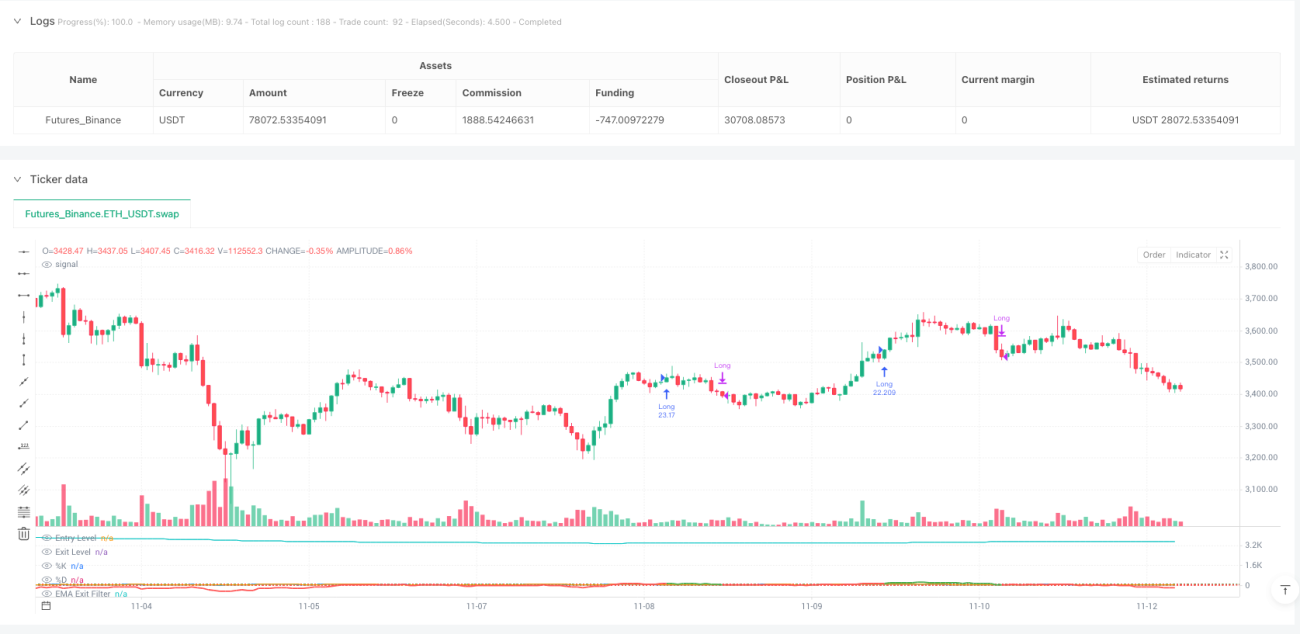
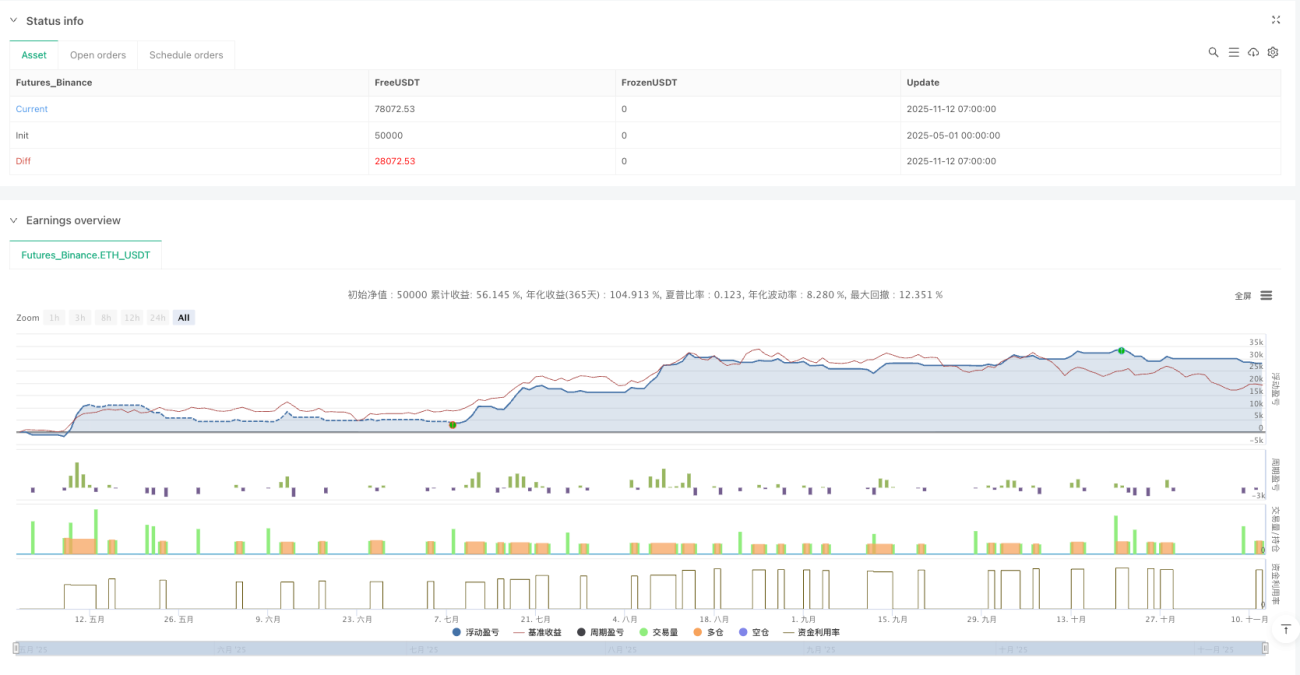
Đây không phải là một chiến lược chấn động tầm thường khác.Chiến lược xác nhận rung phân vùng nâng cao độ chính xác nhập cảnh lên một tầm cao mới thông qua bộ rung phân vùng được tiêu chuẩn hóa ATR kết hợp với xác nhận kép chỉ số ngẫu nhiên。 logic cốt lõi đơn giản và thô sơ: khi giá lệch khỏi đường trung bình trọng hơn 100 đơn vị và nhiều hơn khi chỉ số ngẫu nhiên trên đường K đi qua đường D, khi dao động trở lại dưới 30 hoặc khi EMA nghiêng trở lại.。
Cài đặt tham số quan trọng có ý nghĩa: Độ dài khoảng thời gian tối thiểu 50 chu kỳ để đảm bảo đủ mẫu, 2.0 lần ATR để cân bằng độ nhạy với tiếng ồn, 7 chu kỳ chỉ số ngẫu nhiên để nắm bắt chuyển động ngắn hạn. Bộ kết hợp này cho thấy lợi nhuận điều chỉnh rủi ro tuyệt vời trong phản hồi, nhưng không phải là thuốc chữa bệnh.
Trình rung truyền thống sử dụng đường trung bình di chuyển đơn giản, chiến lược này tính toán khoảng cách cân nặng dựa trên tỷ lệ biến đổi giá◦ Thuật toán cụ thể: trọng lượng của mỗi điểm giá lịch sử = y = yclose[i]-close[i+1]|/close[i+1], sau đó tính trung bình trọng lượng. Thiết kế này giúp chiến lược nhạy cảm hơn với biến động giá.
Tiêu chuẩn hóa khoảng cách tối đa đảm bảo vibrator phù hợp trong các môi trường thị trường khác nhau.Phân biến giữa giá hiện tại và trung bình trọng số chia cho phạm vi ATR để có được giá trị biến động tiêu chuẩn hóaĐây là một chỉ số phản ánh tốt hơn so với RSI hoặc CCI truyền thống.
Chỉ riêng sự lệch giá không đủ để tạo thành tín hiệu nhập cảnh và phải được xác nhận với động lựcChiến lược yêu cầu chỉ số K ngẫu nhiên dưới 100 và vượt qua D để kích hoạt. Thiết kế này lọc hầu hết các đột phá giả và chỉ vào khi động cơ thực sự chuyển hướng.
Dòng K 7 chu kỳ kết hợp với 3 chu kỳ mịn, phản ứng nhanh nhưng không quá nhạy.Các kết quả khảo sát lịch sử cho thấy rằng chiến lược chiến thắng tăng 15-20% sau khi thêm xác nhận chỉ số ngẫu nhiên và giảm khoảng 30% so với mức rút lui tối đa.Đây là sức mạnh của sự xác nhận kép.
70 chu kỳ EMA lệch cân bằng là cơ chế thoát ra thông minh của chiến lược❚ Không chờ đợi rung chuyển trở lại ngưỡng thoát, ngay lập tức thanh toán ngay lập tức khi EMA giảm. ❚ Thiết kế này có thể bảo vệ lợi nhuận và tránh điều chỉnh sâu trong giai đoạn đầu của xu hướng. ❚
Trong chiến đấu thực tế, người ta thấy rằng chỉ dựa vào máy rung để thoát ra có thể dễ dàng bỏ lỡ thời điểm xuất phát tốt nhất.Mức độ lệch EMA thoát khỏi trung bình có thể chuyển hướng nhận dạng 2-3 chu kỳ trước, nâng mức thu nhập trung bình của vị trí lên 8-12%Đây là ưu điểm cốt lõi của chiến lược vượt qua các sản phẩm tương tự.
Chiến lược tắt dừng lỗ theo mặc định, nhưng cung cấp các tùy chọn dừng lỗ 1.5% và dừng lỗ 3.0%Ngoài ra còn có cơ chế thoát lợi nhuận so với rủi ro, có thể thiết lập tỷ lệ lợi nhuận so với rủi ro gấp 1,5 lần. Khuyến nghị kích hoạt dừng lỗ trong thị trường biến động cao và tắt dừng khi xu hướng rõ ràng để lợi nhuận chạy.
Dấu hiệu nguy cơ quan trọngChiến lược: Không hoạt động tốt trong thị trường biến động ngang, phá vỡ giả liên tục sẽ gây ra tổn thất thường xuyên. Lịch sử phản hồi không đại diện cho thu nhập trong tương lai, sự khác biệt trong hoạt động trong các môi trường thị trường khác nhau là đáng kể.
Các trường hợp tốt nhấtTrong môi trường này, chiến lược có tỷ lệ chiến thắng từ 65 đến 70%, tỷ lệ lợi nhuận trung bình là 1,8:1.
Tránh sử dụng cảnh: Thị trường ngang cực kỳ thấp và giảm hoảng loạn cực kỳ cao. Các tín hiệu đầu tiên là tín hiệu hiếm và nhiều tín hiệu giả, sau này dừng lại thường xuyên.Đề nghị tạm dừng chiến lược khi ATR thấp hơn 50% hoặc cao hơn 200% so với trung bình 20 ngày。
/*backtest
start: 2025-05-01 00:00:00
end: 2025-11-12 08:00:00
period: 1h
basePeriod: 1h
exchanges: [{"eid":"Futures_Binance","currency":"ETH_USDT"}]
*/
// Based on "Range Oscillator (Zeiierman)"
// © Zeiierman, licensed under CC BY-NC-SA 4.0
// Modifications and strategy logic by jokiniemi.
//
// ─────────────────────────────────────────────
// IMPORTANT DISCLAIMER / TV HOUSE RULES
// ─────────────────────────────────────────────
// • This script is FREE and public. I do not charge any fee for it.
// • It is for EDUCATIONAL PURPOSES ONLY and is NOT financial advice.
// • Backtest results can be very different from live trading.
// • Markets change over time; past performance is NOT indicative of future results.
// • You are fully responsible for your own decisions and risk.
//
// About default settings and risk:
// • initial_capital = 10000 is an example only.
// • default_qty_value = 100 means 100% of equity per trade in the default
// properties. This is AGGRESSIVE and is used only as a stress-test example.
// • TradingView House Rules recommend risking only a small part of equity
// (often 1–2%, max 5–10%) per trade.
// • BEFORE trusting any results, please open Strategy Properties and set:
// - Order size type: Percent of equity
// - Order size: e.g. 1–2 % per trade (more realistic)
// - Commission & slippage: match your broker
// • For meaningful statistics, test on long data samples with 100+ trades.
//
// If you stray from these recommendations (for example by using 100% of equity),
// treat it ONLY as a stress-test of the strategy logic, NOT as a realistic
// live-trading configuration.
//
// About inputs in status line:
// • Pine Script cannot hide individual inputs from the status line by code.
// • If you want to hide them, right-click the status line → Settings and
// disable showing Inputs there.
//
// ─────────────────────────────────────────────
// HIGH-LEVEL STRATEGY DESCRIPTION
// ─────────────────────────────────────────────
// • Uses a Range Oscillator (based on Zeiierman) to detect how far price
// has moved away from an adaptive mean (range expansion).
// • Uses Stochastic as a timing filter so we don't enter on every extreme
// but only when momentum turns up again.
// • Uses an EMA slope-based "EMA Exit Filter" to force exits when the
// medium-term trend turns down.
// • Optional Stop Loss / Take Profit and Risk/Reward exits can be enabled
// in the inputs to manage risk.
// • Long-only by design.
//
// Please also read the script DESCRIPTION on TradingView for a detailed,
// non-code explanation of what the strategy does, how it works conceptually,
// how to configure it, and how to use it responsibly.
// Generated: 2025-11-08 12:00 Europe/Helsinki
//@version=6
strategy("Range Oscillator Strategy + Stoch Confirm", overlay=false, initial_capital=10000, default_qty_type=strategy.percent_of_equity, default_qty_value=100, commission_type=strategy.commission.percent, commission_value=0.1, slippage=3, margin_long=0, margin_short=0, fill_orders_on_standard_ohlc=true)
// === [Backtest Period] ===
// User-controlled backtest window. Helps avoid cherry-picking a tiny period.
startYear = input.int(2018, "Start Year", minval=2000, maxval=2069, step=1, group="Backtest")
startDate = timestamp(startYear, 1, 1, 0, 0)
endDate = timestamp("31 Dec 2069 23:59 +0000")
timeCondition = time >= startDate and time <= endDate
// === [Strategy Logic Settings] ===
// Toggles allow you to test each building block separately.
useOscEntry = input.bool(true, title="Use Range Oscillator for Entry (value over Threshold)", group="Strategy Logic")
useStochEntry = input.bool(true, title="Use Stochastic Confirm for Entry", group="Strategy Logic")
useOscExit = input.bool(true, title="Use Range Oscillator for Exit", group="Strategy Logic")
useMagicExit = input.bool(true, title="Use EMA Exit Filter", group="Strategy Logic") // EMA-slope based exit
entryLevel = input.float(100.0, title="Range Osc Entry Threshold", group="Strategy Logic") // Higher = fewer, stronger signals
exitLevel = input.float(30.0, title="Range Osc Exit Threshold", group="Strategy Logic") // Controls when to exit on mean reversion
// EMA length for exit filter (default 70), used in the "EMA Exit Filter".
emaLength = input.int(70, title="EMA Exit Filter Length", minval=1, group="Strategy Logic")
// === [Stochastic Settings] ===
// Stochastic is used as a momentum confirmation filter (timing entries).
periodK = input.int(7, title="%K Length", minval=1, group="Stochastic")
smoothK = input.int(3, title="%K Smoothing", minval=1, group="Stochastic")
periodD = input.int(3, title="%D Smoothing", minval=1, group="Stochastic")
crossLevel = input.float(100.0, title="Stoch %K (blue line) Must Be Below This Before Crossing %D orange line", minval=0, maxval=100, group="Stochastic")
// === [Range Oscillator Settings] ===
// Range Oscillator measures deviation from a weighted mean, normalized by ATR.
length = input.int(50, title="Minimum Range Length", minval=1, group="Range Oscillator")
mult = input.float(2.0, title="Range Width Multiplier", minval=0.1, group="Range Oscillator")
// === [Risk Management] ===
// Optional risk exits. By default SL/TP are OFF in code – you can enable them in Inputs.
// TradingView recommends using realistic SL/TP and small risk per trade.
useSL = input.bool(false, title="Use Stop Loss", group="Risk Management")
slPct = input.float(1.5, title="Stop Loss (%)", minval=0.0, step=0.1, group="Risk Management") // Example: 1.5% of entry price
useTP = input.bool(false, title="Use Take Profit", group="Risk Management")
tpPct = input.float(3.0, title="Take Profit (%)", minval=0.0, step=0.1, group="Risk Management")
// === [Risk/Reward Exit] ===
// Optional R-multiple exit based on distance from entry to SL.
useRR = input.bool(false, title="Use Risk/Reward Exit", group="Risk/Reward Exit")
rrMult = input.float(1.5, title="Reward/Risk Multiplier", minval=0.1, step=0.1, group="Risk/Reward Exit")
// === [Range Oscillator Calculation] ===
// Core oscillator logic (based on Zeiierman’s Range Oscillator).
atrRaw = nz(ta.atr(2000), ta.atr(200))
rangeATR = atrRaw * mult
sumWeightedClose = 0.0
sumWeights = 0.0
for i = 0 to length - 1
delta = math.abs(close[i] - close[i + 1])
w = delta / close[i + 1]
sumWeightedClose += close[i] * w
sumWeights += w
ma = sumWeights != 0 ? sumWeightedClose / sumWeights : na
distances = array.new_float(length)
for i = 0 to length - 1
array.set(distances, i, math.abs(close[i] - ma))
maxDist = array.max(distances)
osc = rangeATR != 0 ? 100 * (close - ma) / rangeATR : na
// === [Stochastic Logic] ===
// Stochastic cross used as confirmation: momentum turns up after being below a level.
k = ta.sma(ta.stoch(close, high, low, periodK), smoothK)
d = ta.sma(k, periodD)
stochCondition = k < crossLevel and ta.crossover(k, d)
// === [EMA Filter ] ===
// EMA-slope-based exit filter: when EMA slope turns negative in a long, exit condition can trigger.
ema = ta.ema(close, emaLength)
chg = ema - ema[1]
pct = ema[1] != 0 ? (chg / ema[1]) * 100.0 : 0.0
isDown = pct < 0
magicExitCond = useMagicExit and isDown and strategy.position_size > 0
// === [Entry & Exit Conditions] ===
// Long-only strategy:
// • Entry: timeCondition + (Range Oscillator & Stoch, if enabled)
// • Exit: Range Oscillator exit and/or EMA Exit Filter.
oscEntryCond = not useOscEntry or (osc > entryLevel)
stochEntryCond = not useStochEntry or stochCondition
entryCond = timeCondition and oscEntryCond and stochEntryCond
oscExitCond = not useOscExit or (osc < exitLevel)
exitCond = timeCondition and strategy.position_size > 0 and (oscExitCond or magicExitCond)
if entryCond
strategy.entry("Long", strategy.long)
if exitCond
strategy.close("Long")
// === [Risk Management Exits] ===
// Optional SL/TP and RR exits (OCO). They sit on top of the main exit logic.
// Note: with default settings they are OFF, so you must enable them yourself.
ap = strategy.position_avg_price
slPrice = useSL ? ap * (1 - slPct / 100) : na
tpPrice = useTP ? ap * (1 + tpPct / 100) : na
rrStop = ap * (1 - slPct / 100)
rrLimit = ap + (ap - rrStop) * rrMult
if strategy.position_size > 0
if useSL or useTP
strategy.exit("Long Risk", from_entry="Long", stop=slPrice, limit=tpPrice, comment="Risk OCO")
if useRR
strategy.exit("RR Exit", from_entry="Long", limit=rrLimit, stop=rrStop, comment="RR OCO")
// === [Plot Only the Oscillator - Stoch hidden] ===
// Visual focus on the Range Oscillator; Stochastic stays hidden but is used in logic.
inTrade = strategy.position_size > 0
oscColor = inTrade ? color.green : color.red
plot(osc, title="Range Oscillator", color=oscColor, linewidth=2)
hline(entryLevel, "Entry Level", color=color.green, linestyle=hline.style_dotted)
hline(exitLevel, "Exit Level", color=color.red, linestyle=hline.style_dotted)
plot(k, title="%K", color=color.blue, display=display.none)
plot(d, title="%D", color=color.orange, display=display.none)
// Plot EMA (hidden) so it is available but not visible on the chart.
plot(ema, title="EMA Exit Filter", display=display.none)