Dual Moving Average Price Leaping Strategy
Overview
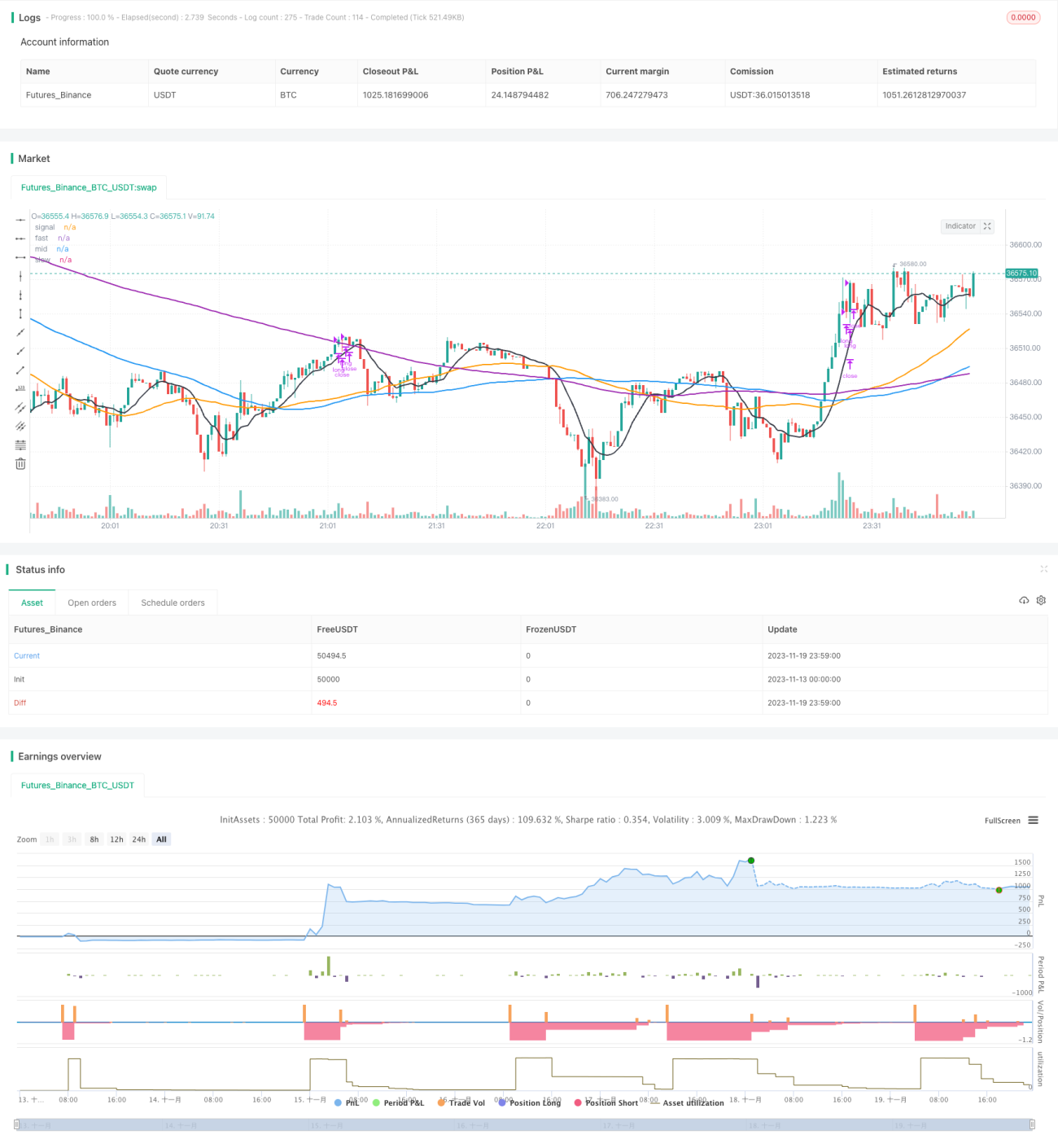
This strategy uses the RSI indicator to determine overbought and oversold conditions, combined with a trend judgment system constructed with fast, medium and slow moving average lines, to identify opportunities to open long or short positions when prices are leaping.
Strategy Principle
-
Use RSI indicator to determine overbought and oversold conditions
- RSI parameter is set to 14 periods
- Oversold line is at 30, overbought line is at 70
-
Use three SMA lines of different periods to determine the trend
- Fast line is 9-period SMA, representing short-term trend
- Medium line is 50-period SMA, representing medium-term trend
- Slow line is 200-period SMA, representing long-term trend
-
When fast line crosses above medium line, and RSI indicator shows oversold, go long
-
When fast line crosses below medium line, and RSI indicator shows overbought, go short
-
Stop loss is set at 4% of entry price
-
Profit taking is done in batches, first take profit of 20%, then take 15% as price continues to rise, exiting positions gradually
Advantage Analysis
- Using three SMA lines of different periods can judge trend changes across different time frames
- The use of RSI indicator avoids opening positions outside of overbought/oversold areas
- Batch profit taking increases holding period and average profit of the strategy
Risk Analysis
- Probability of wrong signals from the three moving average lines
- Risk of incomplete batch profit taking execution
- Need to choose suitable instruments with high price fluctuation
Optimization Directions
- Can test modifying parameters of moving averages and RSI to optimize entry and exit
- Can add other indicators to filter candle patterns etc to improve accuracy
- Can dynamically trail stop loss to further control risk
Summary
This strategy combines moving average indicators and the overbought/oversold indicator RSI. By capturing price trend changes while judging trading opportunities, it belongs to a commonly used trend tracking strategy. Further optimizations and improved win rate can be achieved through parameter testing and incorporating additional auxiliary judgment indicators.
- 1

