Rate of Change Quantitative Strategy

Overview
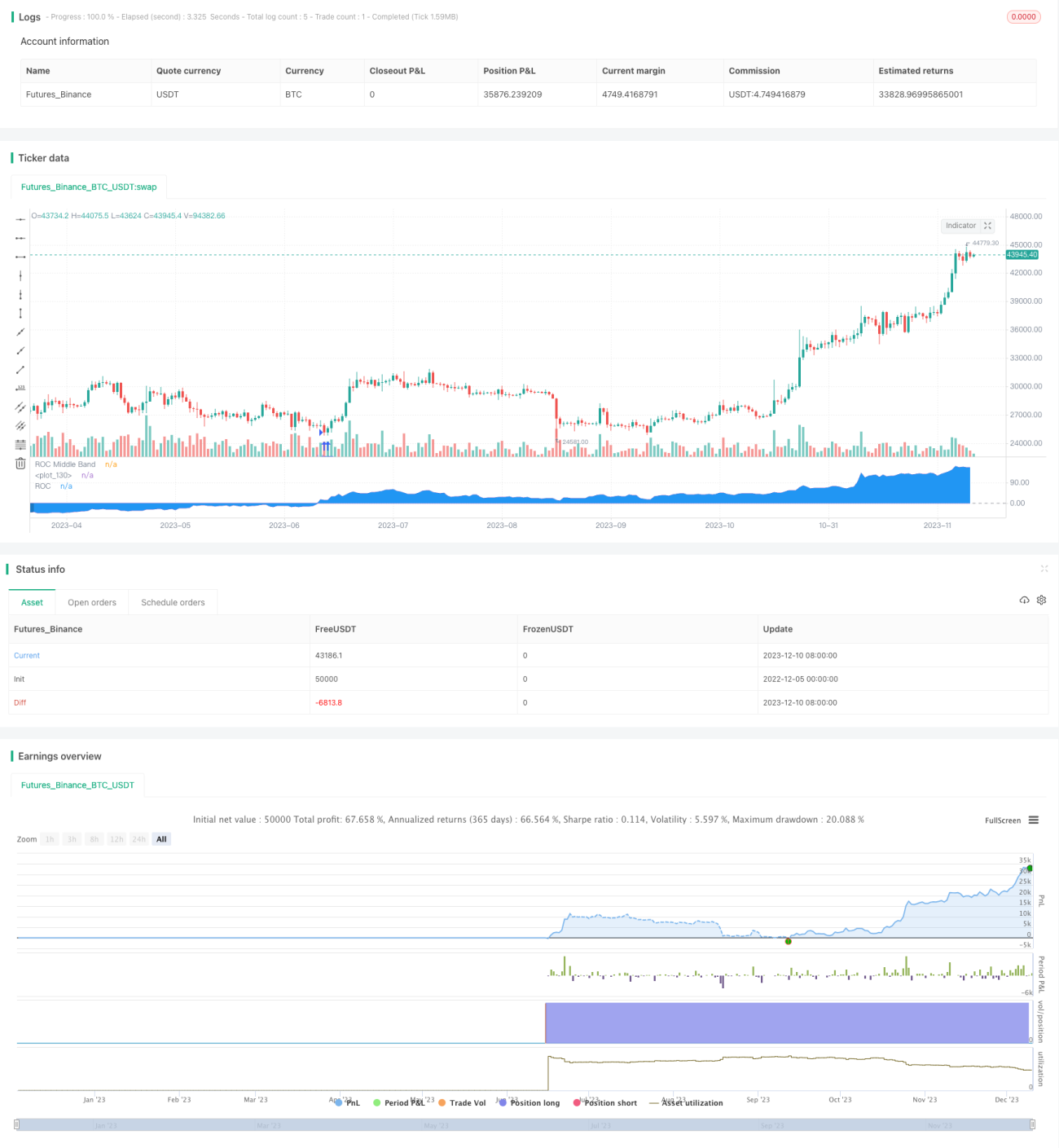
This strategy uses the Rate of Change (ROC) indicator to determine market direction and generate trading signals. The core idea of the strategy is to follow long-term trends and outperform the market by taking on greater risk.
Strategy Logic
Entry Rules
- Go long if ROC>0; go short if ROC<0. Use the positive/negative of ROC to judge market direction.
- To filter out volatility, only issue trading signals if ROC stays on the same side for two consecutive days.
Stop Loss
A 6% stop loss is set. When stop loss is triggered, reverse position. This indicates we may be on the wrong side of the market so we exit immediately.
Anti-Bubble Mechanism
If ROC goes above 200, market is considered a bubble. When ROC falls back below bubble territory, go short signal is triggered. Require the bubble persists for at least 1 week.
Money Management
Use fixed position sizing + incremental method. Increase/decrease position by $200 for every $400 gain/loss. This allows us to pyramid profits but also increases drawdown.
Advantage Analysis
Advantages of this strategy:
- Adheres to trend following philosophy so likely to produce long term positive returns.
- Use stop loss to control risk and reduce short term volatility.
- Anti-bubble mechanism avoids chasing tops.
- Fixed position + incremental method creates exponential growth in uptrends.
Risk Analysis
Some risks also exist:
- ROC indicator prone to whipsaws which generates false signals. Consider combining with other indicators for filtering.
- Trading costs not considered which lowers actual returns.
- Poor anti-bubble parameter tuning also misses trends.
- Incremental sizing increases drawdown when losing.
Optimization Directions
Some ways to optimize the strategy:
- Add other indicators to filter signals, such as MA, Volatility etc.
- Optimize anti-bubble parameters for better bubble detection.
- Adjust fixed position and incremental ratios for better risk/reward balance.
- Add automatic stop loss when large loss occurs.
- Consider trading costs and set entry rules accordingly.
Conclusion
In summary, this is a long term trend following strategy centered around the ROC indicator. It aims to generate alpha by taking on higher risk. Further optimizations can improve its viability. The key is finding suitable risk tolerance.
- 1