Dual Indicator Hybrid Quantitative Trading Strategy

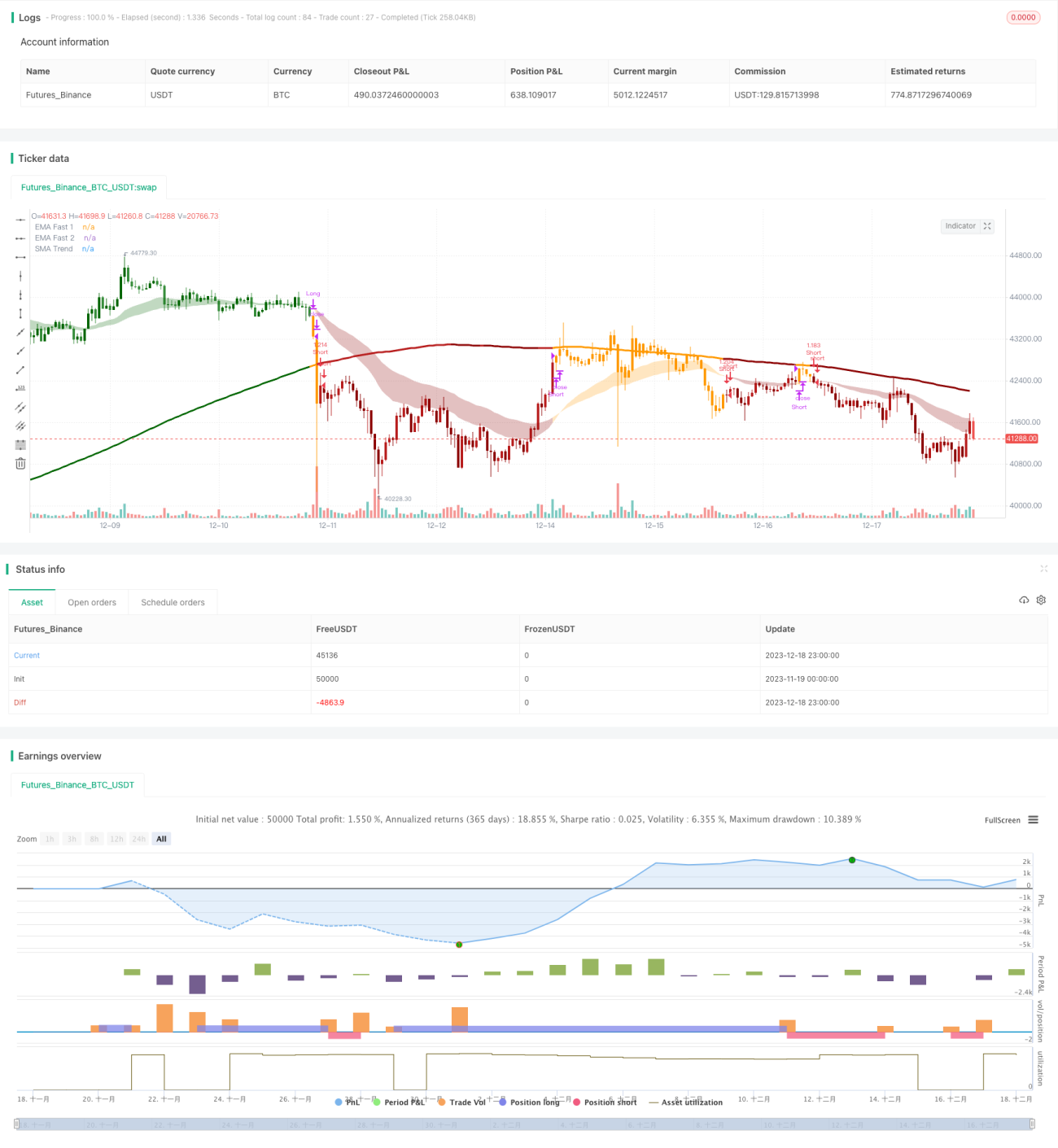
Overview
This strategy combines dual indicators to identify trend direction and make trades. Firstly, it uses the crossover of two moving averages (fast and medium) to judge short-term trend; secondly, it uses channel range and long term moving average to determine the main trend direction. Trading signals are generated only when the two judgments are consistent. The hybrid strategy using multiple indicators can effectively filter false signals and improve stability.
Strategy Principle
The strategy uses three sets of indicators for judgment. First, the golden cross and death cross of fast EMA (26 periods) and medium EMA (50 periods) to determine short-term trend; secondly, calculate the channel range to judge medium-term trend; finally, calculate long term SMA (200 periods) and compare with price to determine major trend direction. Trading signals are generated only when all three judgments are consistent.
Specifically, the logic is:
-
Crossover of fast and medium moving averages (golden cross for bullish, death cross for bearish) to determine short-term trend.
-
Whether the price breaks through the channel range to determine medium-term trend. The channel range is based on long term MA plus/minus ATR times a coefficient. Breaking upper limit signals bullish, breaking lower limit signals bearish.
-
Comparing price with long term MA to determine major trend.
Finally, trading signals are generated only when all three judgments are consistent. This hybrid mechanism can effectively filter false signals and improve stability.
Strategy Advantages
This dual indicator hybrid strategy has several advantages:
-
Effectively filter false signals and improve stability. Because trading signals need validation from multiple indicators to avoid errors from single metric.
-
High flexibility to adjust parameters for different markets. Parameters of MA and channel range can be adjusted for various environments.
-
Combine trend trading and range trading. Medium and short term indicators catch trends, long term indicator determines range. Overall possesses the merits of both trend and mean-reversion strategies.
-
High capital usage efficiency. Place orders only when multiple indicators agree, capital can be effectively utilized to avoid unnecessary trades.
Strategy Risks
There are also some risks:
-
Parameter setting risk. MA periods and channel range need proper configuration, improper settings may fail to detect trends or cause excessive false signals.
-
Increased opportunity cost from dual indicators. Compared to single indicator strategies, some trading opportunities may be missed, unable to enter and exit at the optimal points.
-
Stop loss mechanism needs prudence. The breakout stop loss here may cause unnecessary losses. Stop loss percentage needs careful configuration.
-
May underperform in highly volatile markets. This strategy works better in markets with apparent trend.
Strategy Optimization
The strategy can be improved from the following aspects:
-
Test different parameter combinations to find optimum. More backtests with historical data to locate optimal configurations.
-
Add adaptive stop loss mechanism. Dynamically tune stop loss level based on Volatility Indicator.
-
Assist with volume indicators at critical points. Judge position sizing with volume to improve capital efficiency.
-
Optimize entry logic. Consider staged entries with cost averaging to reduce single entry risk.
-
Combine machine learning models. Introduce neural networks to judge model robustness and fitness.
Summary
This strategy leverages triple time frame indicators and dual validation to suppress false signals and improve stability. Meanwhile, it possesses the merits of both trend and range trading, with high capital usage efficiency. It can be enhanced via parameter optimization, stop loss tuning, integrating with volume indicators etc. A recommended hybrid quantitative strategy.
- 1