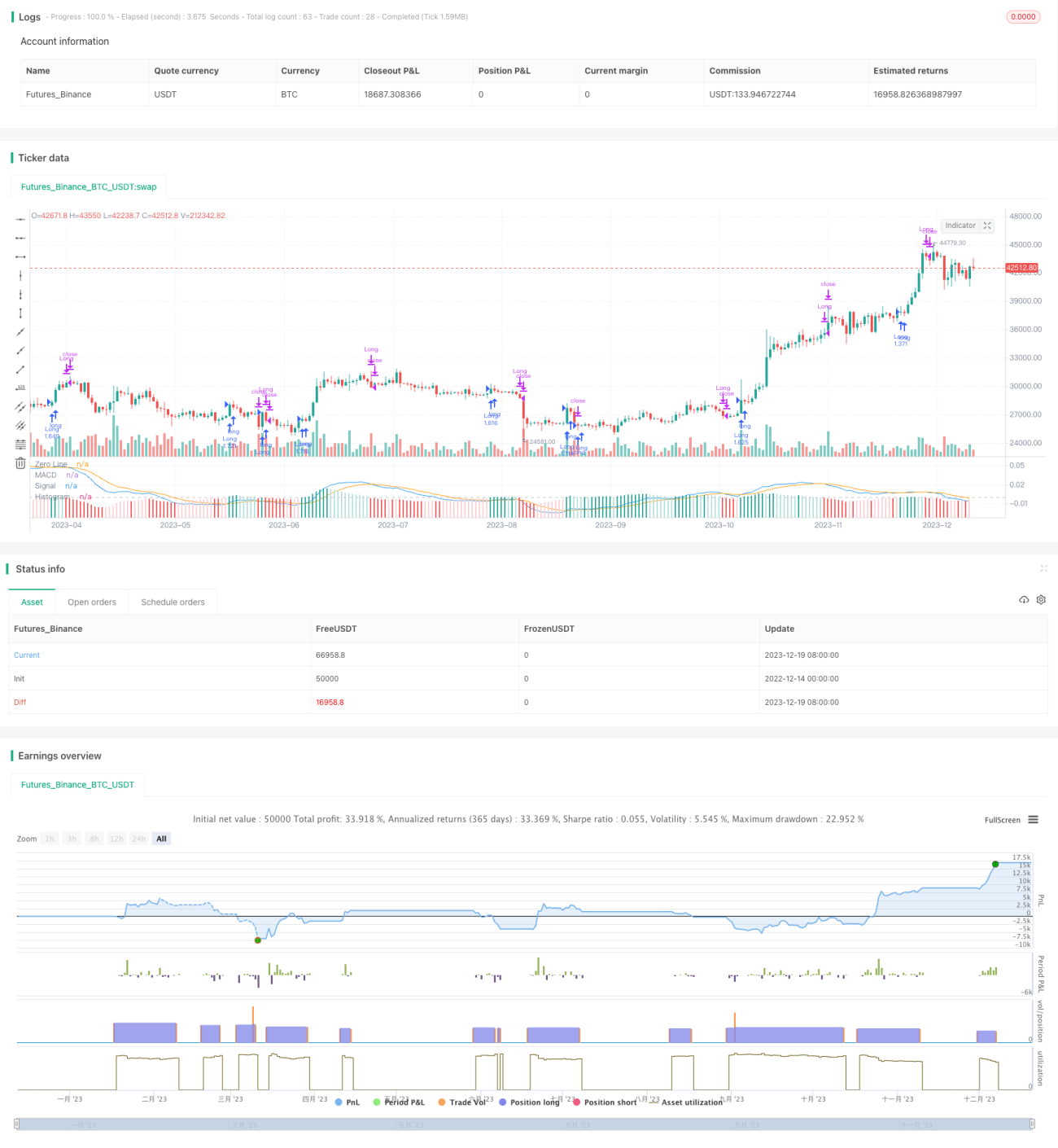
MACD of Relative Strength Strategy
Overview
This strategy is based on two well-known indicators: MACD and Relative Strength (RS). By coupling them, we obtain powerful buy signals. In fact, the special feature of this strategy is that it creates an indicator from an indicator. Thus, we construct a MACD whose source is the value of the RS. The strategy only takes buy signals, ignoring sell signals as they are mostly losers. There's also a money management method enabling us to reinvest part of the profits or reduce the size of orders in the event of substantial losses.
Strategy Logic
RS is an indicator that measures the anomaly between momentum and the assumption of market efficiency. It is used by professionals and is one of the most robust indicators. The idea is to own assets that do better than average, based on their past performance. We calculate RS using this formula:
RS = Current Price / Highest High over RS Length period
We can thus situate the current price in relation to its highest price over this user-defined period.
MACD is one of the best-known indicators, measuring the distance between two exponential moving averages: one fast and one slower. A wide distance indicates fast momentum and vice versa. We'll plot the value of this distance and call this line macdline. The MACD uses a third moving average with a lower period than the first two. This last moving average will give a signal when it crosses the macdline. It is therefore constructed using the values of the macdline as its source.
It's important to note that the first two MAs are constructed using RS values as their source. So we've just built an indicator of an indicator. This kind of method is very powerful because it is rarely used and brings value to the strategy.
Advantages Analysis
This strategy combines two individually very powerful indicators: MACD and RS. MACD is able to capture short-term trends and momentum shifts while RS reflects the robustness of medium to long term trends. Using them together considers both short-term and long-term factors, making buy signals more reliable.
Additionally, the strategy is very unique by deriving MACD from the RS indicator, creatively enhancing the strategy's effect. Such innovative design is likely to lead to alpha returns since few use this approach.
Lastly, the strategy has risk management and stop loss mechanisms that effectively control risks and limit losses per trade.
Risk Analysis
The biggest risk of this strategy is the possibility of RS and MACD indicators giving wrong signals. Even though both indicators are robust, no technical indicator can 100% predict the future and signals may occasionally fail. Also, the RS itself is biased towards medium-long term trends judgment and may produce misleading signals in the short run.
To reduce risks, parameters of RS and MACD can be tuned to better fit specific trading instruments and market environments. Also, more stringent stop loss range can be imposed. In general, using stop loss to control per trade loss is the best method to address risks of this strategy.
Enhancement Directions
Firstly, test which market (e.g. stocks, forex, crypto etc) gives the best effect of this strategy, then focus on that optimal asset.
Secondly, try utilizing machine learning algorithms to auto-optimize RS and MACD parameters instead of fixing them manually. This could greatly improve adaptiveness of the parameters.
Thirdly, consider incorporating other indicators to establish trading signals, forming a multi-factor model to improve signal accuracy. For example, adding volume indicators etc.
Conclusion
This strategy leverages MACD and RS indicators synergistically to supply strong buy signals. Its novelty lies in deriving MACD from RS indicator, realizing coupling between indicators to enhance efficacy. The strategy has clear entry, stop loss and money management mechanisms that effectively control risks. Next steps could be further improving the strategy via parameter optimization, refining signal generation, adding other factors etc.
- 1

