Multi-Period EMA Crossover Quantitative Trading Strategy
Overview
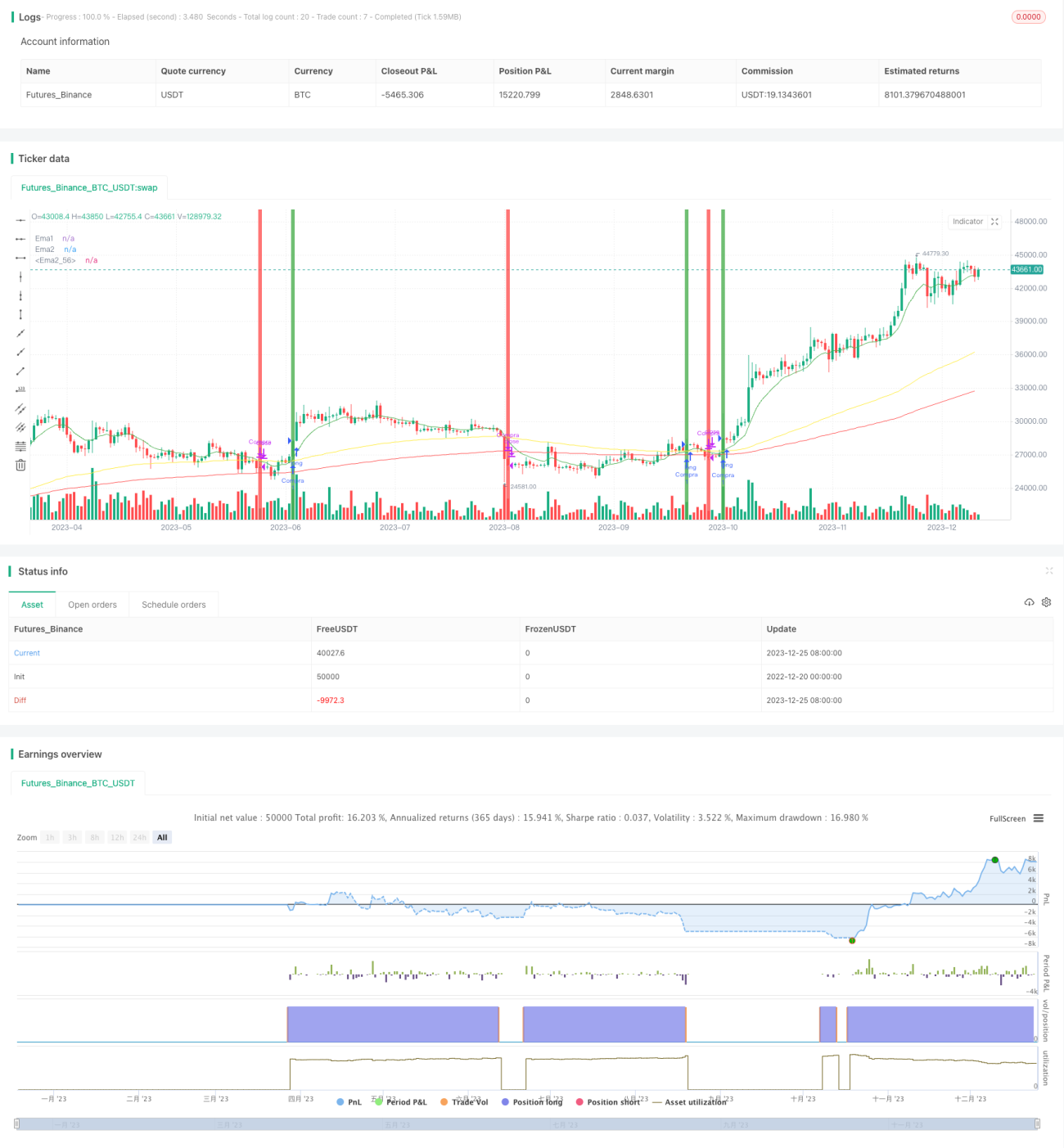
This article introduces a quantitative trading strategy based on the crossover points of Exponential Moving Averages (EMA) over three different periods. The strategy aims to utilize EMA crossovers to identify long-term and short-term trends in the stock market for effective trading decisions.
Strategy Principle
The strategy employs EMAs of three different periods: 10-day, 100-day, and 200-day. Buy or sell signals are generated based on the direction of the crossover when the short-period EMA (10-day) crosses the longer-period EMAs (100-day or 200-day). The strategy also incorporates a time filter to ensure trades are executed only within specific time frames. This combination adds flexibility and adaptability to the strategy.
Advantages Analysis
The strength of this strategy lies in its simplicity and high adaptability. Multi-period EMAs provide a multi-dimensional view of market trends, increasing the accuracy of trading decisions. Additionally, the time filter avoids instability during specific market periods, reducing potential risks.
Risk Analysis
Despite its effectiveness, the strategy carries certain risks. The primary risk is market volatility due to unforeseen events, which may lead to strategy failure. Additionally, EMAs can be lagging, delaying the reflection of market changes. Methods to mitigate these risks include real-time market monitoring and combining other technical indicators to enhance decision accuracy.
Optimization Direction
Optimization directions for the strategy include the integrated use of various technical indicators, such as the Relative Strength Index (RSI) and Bollinger Bands, to deepen and broaden market analysis. Additionally, adjusting the periods of EMAs to better suit different market conditions could be beneficial.
Conclusion
Overall, this
multi-period EMA crossover quantitative trading strategy is an effective tool that can help traders make better decisions in a volatile market. With continuous optimization and adaptation to market changes, this strategy has the potential to achieve higher returns in future trading endeavors.
- 1

