
Überblick
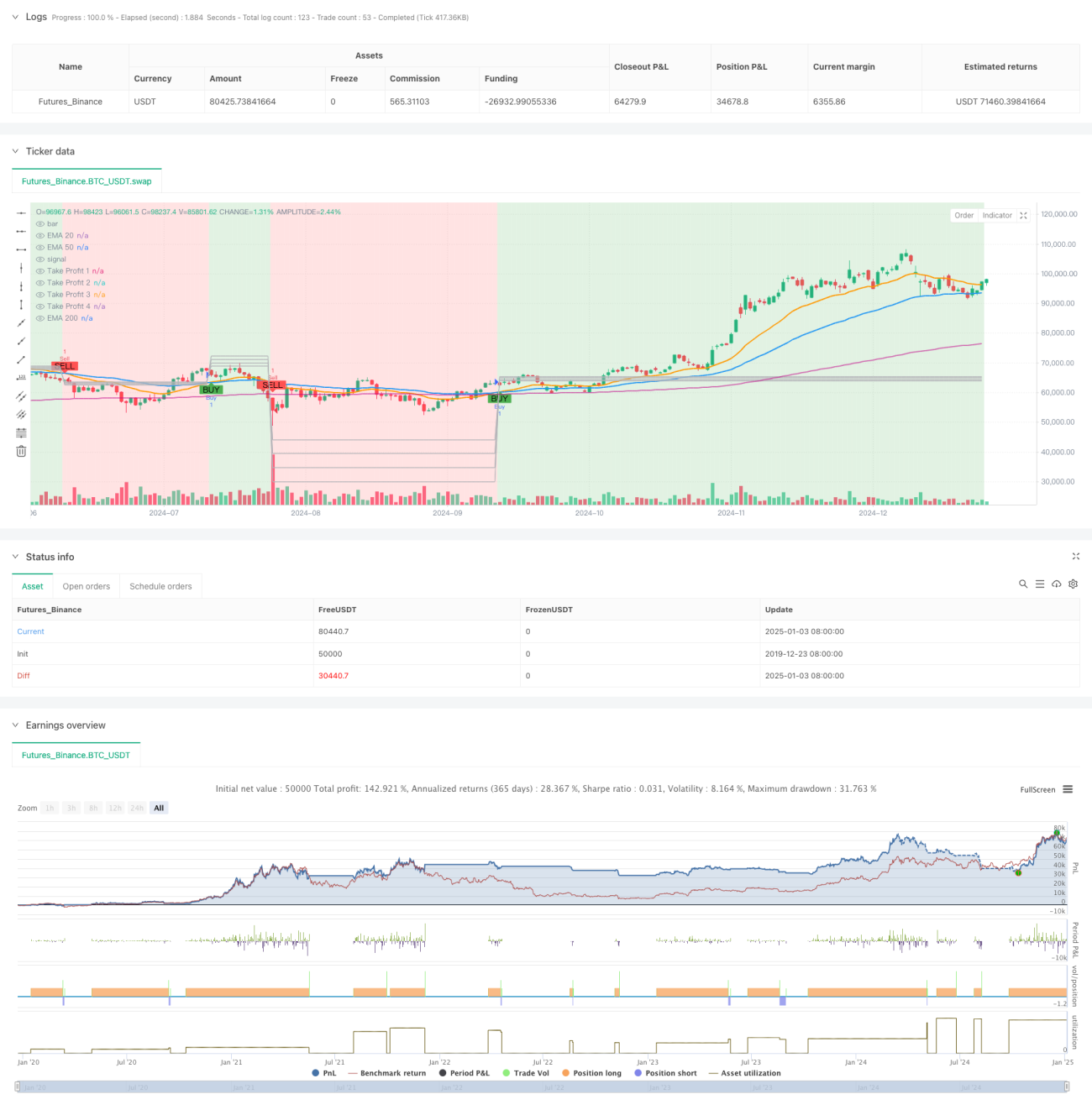
Diese Strategie ist ein Handelssystem, das auf dem exponentiellen gleitenden Durchschnitt (EMA) basiert und hauptsächlich die Kreuze von EMA20 und EMA50 nutzt, um Trendwechsel im Markt zu identifizieren. Die Strategie verfügt über dynamische, mehrstufige Gewinnziele und kombiniert einen Stop-Loss-Mechanismus zur Risikosteuerung. Das System zeigt die Richtung des Markttrends durch Farbänderungen im Hintergrund visuell an und hilft Händlern, die Marktbewegungen besser zu erfassen.
Strategieprinzip
Die Kernlogik der Strategie basiert auf folgenden Aspekten:
- Verwendung der Kreuze von EMA20 und EMA50 zur Bestimmung der Trendrichtung: Wenn EMA20 über EMA50 steigt, wird ein Kaufsignal generiert; bei einem Fall unter EMA50 entsteht ein Verkaufssignal.
- Dynamische Festlegung von vier Gewinnzielen basierend auf der Schwankungsbreite des vorherigen Kerzenstabs:
- TP1 auf das 0,5-fache der Schwankungsbreite
- TP2 auf das 1,0-fache der Schwankungsbreite
- TP3 auf das 1,5-fache der Schwankungsbreite
- TP4 auf das 2,0-fache der Schwankungsbreite
- Setzen eines Stop-Loss von 3 % zur Risikosteuerung.
- Anzeige der Trendrichtung durch Farbänderungen im Hintergrund der Kerzen: Aufwärtstrend wird in Grün dargestellt, Abwärtstrend in Rot.
Strategievorteile
- Dynamische Gewinnziele: Die Gewinnziele passen sich automatisch an die aktuelle Marktvolatilität an und sind somit anpassungsfähig.
- Mehrstufiger Gewinnmechanismus: Durch die Festlegung mehrerer Gewinnziele wird sowohl die Sicherung von Gewinnen als auch ausreichend Raum für die Trendentwicklung gewährleistet.
- Hervorragende Visualisierung: Die Trendrichtung wird durch die Hintergrundfarbe intuitiv angezeigt, was eine schnelle Beurteilung des Marktzustands ermöglicht.
- Umfassende Risikokontrolle: Ein fester Stop-Loss-Punkt wird gesetzt, um den maximalen Verlust pro Trade effektiv zu begrenzen.
- Flexible Parameter: Händler können die Multiplikatoren für Gewinnziele und den Stop-Loss-Prozentsatz je nach Marktbedingungen anpassen.
Strategierisiken
- Verzögerung durch gleitende Durchschnitte: EMA selbst hat eine inhärente Verzögerung, was zu einer späteren Signalgenerierung führen kann.
- Risiko in Seitwärtsmärkten: In schwankenden, seitwärts gerichteten Märkten können häufige Fehlsignale auftreten.
- Fester Stop-Loss: Ein prozentual festgelegter Stop-Loss ist möglicherweise nicht für alle Marktumgebungen geeignet.
- Abstände der Gewinnziele: In stark volatilen Märkten können die Abstände zwischen den Gewinnzielen zu groß oder zu klein sein.
Optimierungsmöglichkeiten
- Einführung von Hilfsindikatoren: RSI oder MACD könnten zur Bestätigung der Kreuze hinzugefügt werden.
- Optimierung des Stop-Loss-Mechanismus: ATR könnte verwendet werden, um den Stop-Loss-Abstand dynamisch zu bestimmen.
- Einführung einer Zeitfilterung: Hinzufügen eines Handelszeitfensters, um Phasen mit hoher Volatilität zu vermeiden.
- Verbesserung des Positionsmanagements: Anpassung der Positionsgröße dynamisch an die Marktvolatilität.
- Optimierung der Signalbestätigung: Volumenindikatoren könnten als zusätzliche Bestätigungsbedingungen dienen.
Zusammenfassung
Diese Strategie ist eine Trendfolgestrategie mit vollständiger Struktur und klarer Logik. Sie erfasst Trends durch Kreuzungen gleitender Durchschnitte, verwaltet Gewinne durch dynamische Ziele und kontrolliert Risiken mit einem Stop-Loss. Das visuelle Design der Strategie ist intuitiv und effektiv, die Parametereinstellungen sind flexibel anpassbar. Obwohl eine inhärente Verzögerung der gleitenden Durchschnitte besteht, kann die Stabilität und Rentabilität der Strategie durch Optimierungen und Verbesserungen weiter gesteigert werden.
- 1