EMA inFusion Pro Multi-Source-Datenfusionsstrategie

EMA ADX ATR ROC HEIKIN-ASHI VOLUME
Erstellungsdatum: 2025-09-03 14:23:19 zuletzt geändert: 2025-09-03 14:23:19
Kopie: 0 Klicks: 213
2
konzentrieren Sie sich auf
319
Anhänger

EMA inFusion Pro Multi-Source-Datenfusionsstrategie EMA inFusion Pro Multi-Source-Datenfusionsstrategie

Die EMA-Strategie, die nicht nur auf den Preis schaut

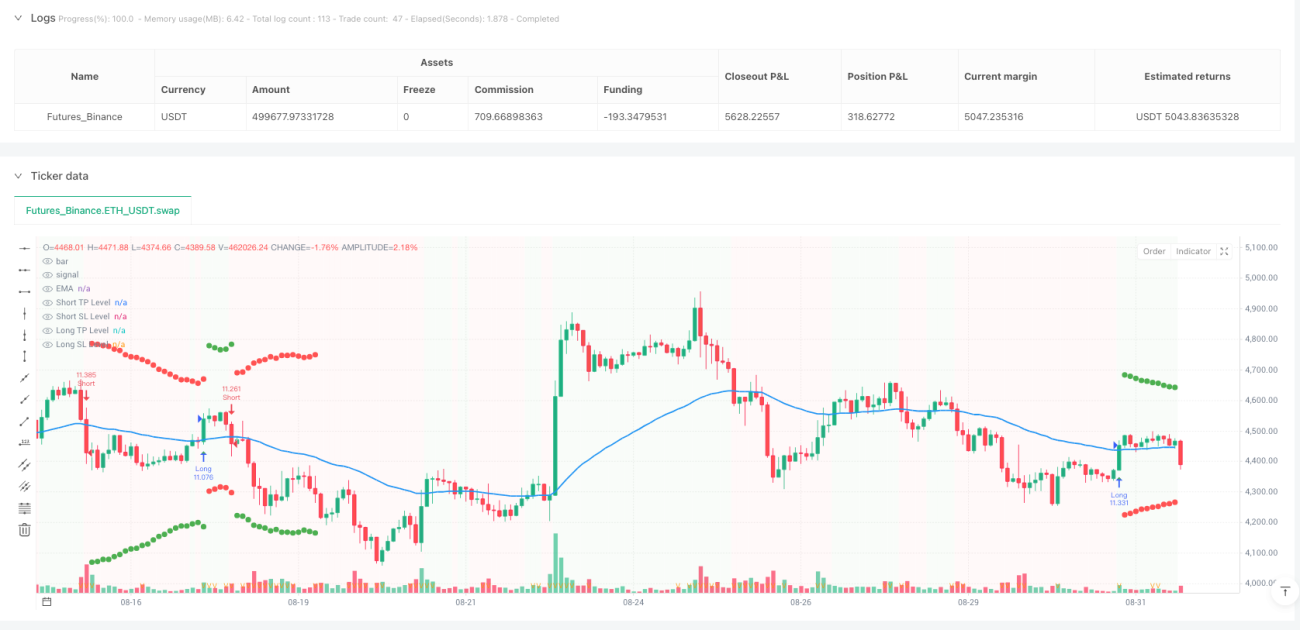
Wissen Sie, die meisten Leute, die EMAs verwenden, sehen nur nach dem Preis, aber wo ist die Stärke dieser Strategie? Es kann EMAs aus 6 verschiedenen Datenquellen berechnen! Es ist wie Kochen, das nicht nur mit Salz gewürzt wird, sondern auch mit Zucker, Kokosnuss und Kokosnussöl.

Die sechs Datenquellen sind: Durchschnittliche Preise, Umsatz, Veränderungsrate, Durchschnittliche K-Linie Preise, Durchschnittliche K-Linie Umsatz, Durchschnittliche K-Linie Veränderungsrate. Jede hat eine andere Markt-Insight!

Dreifache Filterung: Genaueres Signal

Es ist eine Strategie, die nicht zufällig signalisiert wird!

Erster Weg: Die EMA beurteilt Trends 📈 Das ist wie bei der Wettervorhersage, wenn man weiß, ob es regnen wird.

Zweiter Weg: ADX-Defizitfilter 💪
Die ADX ist wie ein Windmessgerät, das nur dann ein Signal gibt, wenn die Tendenz stark genug ist (die Standardwert ist 25 oder mehr).

Der dritte Weg ist die Bestätigung der Transaktionen. 🔊 Der Umsatzanstieg ist wie ein “laut sprechender” Aktienwert, der beweist, dass das Signal ernst gemeint ist und kein Witz.

Drei Ausstiegsmethoden: Anpassung an unterschiedliche Handelsstile

Am besten ist, dass diese Strategie drei Ausgänge bietet, so wie es bei einem Spiel mit drei Schwierigkeitsgraden gibt: einfach, gewöhnlich und schwierig:

Modus 1: Rückwärtssignal ausstieg 🔄 Das einfachste Rohr, wenn mehrere Signale kommen, ist das leere, wenn das leere Signal kommt, ist das leere.

Modus 2: ATR-Dynamik-Stopp-Stopp-Verlust 📏 Automatische Anpassung an die Marktschwankungen, Stop-Loss-Erleichterung bei hohen Schwankungen und Stretching bei geringen Schwankungen

Modus 3: Festgelegte Stop-Loss-Prozentsätze 📊 Das beste Verständnis ist, wenn man 2% gewinnt, läuft man, wenn man 1,5% verliert, gibt man auf.

Empfehlungen für Einsatz in der Praxis

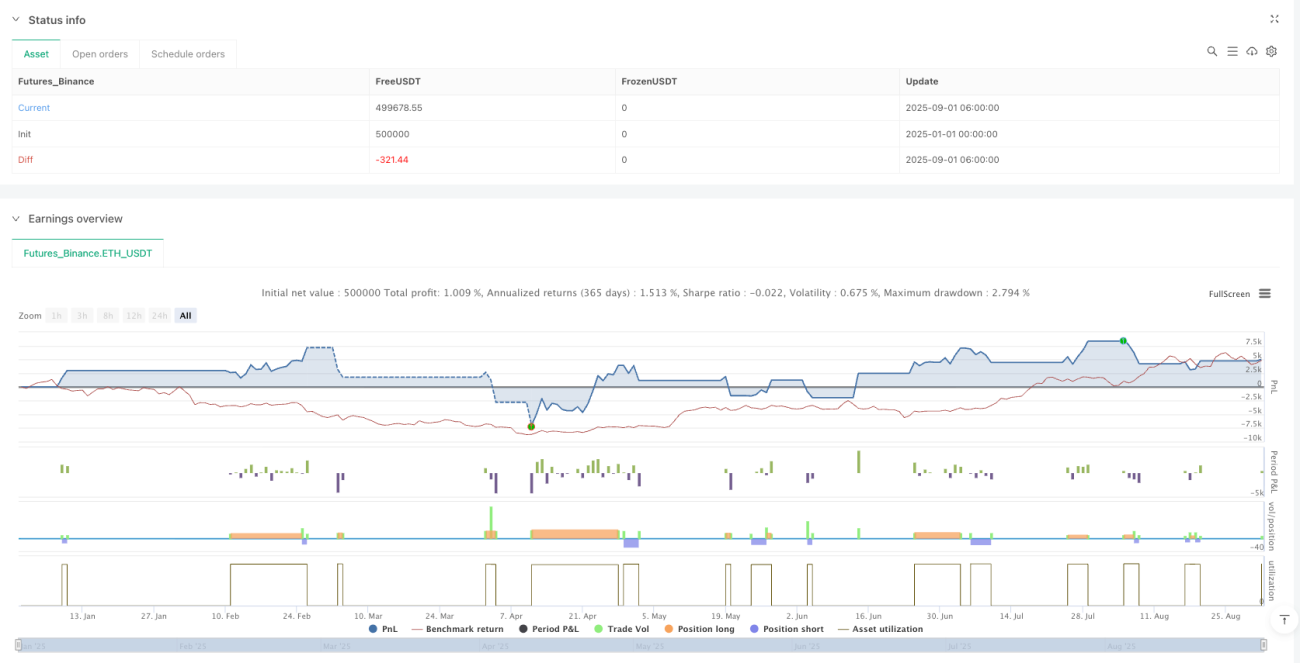
GültigkeitsdauerKurz- und mittelfristige Geschäfte, besonders für Märkte mit geringer Volatilität Ein Leitfaden für den Abgrund“Wir sind der Meinung, dass es eine gute Sache ist, wenn man sich mit dem ADX-Filter beschäftigt”. WeiterentwicklungEs gibt viele verschiedene Datenquellen, die man ausprobieren kann, und diese Quellen sind besonders effektiv, wenn es zu einem Durchbruch kommt.

Der größte Vorteil dieser Strategie ist die hohe Flexibilität, mit der Sie die am besten geeigneten Datenquellen und Ausstiegsmethoden für verschiedene Marktbedingungen auswählen können. Denken Sie daran, dass es keine perfekte Strategie gibt, sondern nur die, die am besten für den aktuellen Markt geeignet ist!

Strategiequellcode
/*backtest
start: 2025-01-01 00:00:00
end: 2025-09-01 08:00:00
period: 2h
basePeriod: 2h
exchanges: [{"eid":"Futures_Binance","currency":"ETH_USDT","balance":500000}]
*/

//@version=5
//@fenyesk
strategy("EMA inFusion Pro - Source Selection", overlay=true, initial_capital=10000, default_qty_type=strategy.percent_of_equity, default_qty_value=10)

// =============================================
// === INPUT PARAMETERS =======================
// =============================================

// Moving Average Source Selection
maSourceSelection = input.string("Price", "Moving Average Source", 
  options=["Price", "Volume", "Rate of Change", "Heikin Ashi Price", "Heikin Ashi Volume", "Heikin Ashi Rate of Change"],
  tooltip="Select data source for EMA calculation")

// EMA Settings
emaLength = input.int(50, title="EMA Length", minval=1, maxval=200)
rocLength = input.int(1, title="Rate of Change Length", minval=1, maxval=50, tooltip="Length for ROC calculation")

// ADX Filter Settings
useAdxFilter = input.bool(true, title="Use ADX Filter", group="ADX Settings")
adxLength = input.int(14, title="ADX Length", minval=1, maxval=50, group="ADX Settings")
adxThreshold = input.float(25, title="ADX Threshold", minval=10, maxval=50, step=0.5, group="ADX Settings")

// Volume Spike Settings
useVolumeFilter = input.bool(true, title="Use Volume Spike Filter", group="Volume Settings")
volumeMultiplier = input.float(1.0, title="Volume Spike Multiplier", minval=1.0, maxval=5.0, step=0.1, group="Volume Settings")
volumeSmaLength = input.int(20, title="Volume SMA Length", minval=5, maxval=100, group="Volume Settings")

// Trading Exit Mode Selector
tradingMode = input.int(2, title="Trading Exit Mode", minval=1, maxval=3, 
  tooltip="1: Exit on reverse signal\n2: ATR based TP/SL\n3: Percent based TP/SL", 
  group="Exit Strategy")

// Mode 3: Percent-Based Settings
takeProfitPercent = input.float(2.0, title="Take Profit %", minval=0.1, maxval=10.0, step=0.1, group="Percent Exit")
stopLossPercent = input.float(1.5, title="Stop Loss %", minval=0.1, maxval=10.0, step=0.1, group="Percent Exit")

// Mode 2: ATR-Based Settings
atrLength = input.int(14, title="ATR Length", minval=1, maxval=50, group="ATR Exit")
atrMultiplierTp = input.float(4.0, title="ATR Take Profit Multiplier", minval=0.1, maxval=10.0, step=0.1, group="ATR Exit")
atrMultiplierSl = input.float(4.0, title="ATR Stop Loss Multiplier", minval=0.1, maxval=10.0, step=0.1, group="ATR Exit")

// =============================================
// === SOURCE CALCULATIONS ====================
// =============================================

// Rate of Change calculation
roc(src, length) =>
    change = src - src[length]
    src[length] != 0 ? (change / src[length] * 100) : 0

// Standard Rate of Change
rocPrice = roc(close, rocLength)
rocVolume = roc(volume, rocLength)

// Heikin Ashi calculations
haClose = (open + high + low + close) / 4
var float haOpen = na
haOpen := na(haOpen[1]) ? (open + close) / 2 : (haOpen[1] + haClose[1]) / 2
haHigh = math.max(high, math.max(haOpen, haClose))
haLow = math.min(low, math.min(haOpen, haClose))

// Heikin Ashi Rate of Change
haRocPrice = roc(haClose, rocLength)
haRocVolume = roc(volume, rocLength)  // Volume remains same for HA

// Define EMA source based on selection
emaSource = switch maSourceSelection
    "Price" => close
    "Volume" => volume
    "Rate of Change" => rocPrice
    "Heikin Ashi Price" => haClose
    "Heikin Ashi Volume" => volume  // Volume doesn't change in HA
    "Heikin Ashi Rate of Change" => haRocPrice
    => close  // Default fallback

// =============================================
// === INDICATOR CALCULATIONS =================
// =============================================

// Core Indicators
emaValue = ta.ema(emaSource, emaLength)
[diPlus, diMinus, adx] = ta.dmi(adxLength, adxLength)
volumeSma = ta.sma(volume, volumeSmaLength)
volumeSpike = volume > (volumeSma * volumeMultiplier)
atrValue = ta.atr(atrLength)

// Trend Conditions (adjusted for different source types)
bullishTrend = switch maSourceSelection
    "Price" => close > emaValue
    "Heikin Ashi Price" => haClose > emaValue
    "Volume" => volume > emaValue
    "Heikin Ashi Volume" => volume > emaValue
    "Rate of Change" => rocPrice > emaValue
    "Heikin Ashi Rate of Change" => haRocPrice > emaValue
    => close > emaValue

bearishTrend = not bullishTrend

// Cross conditions (adjusted for source type)
emaCrossUp = switch maSourceSelection
    "Price" => ta.crossover(close, emaValue)
    "Heikin Ashi Price" => ta.crossover(haClose, emaValue)
    "Volume" => ta.crossover(volume, emaValue)
    "Heikin Ashi Volume" => ta.crossover(volume, emaValue)
    "Rate of Change" => ta.crossover(rocPrice, emaValue)
    "Heikin Ashi Rate of Change" => ta.crossover(haRocPrice, emaValue)
    => ta.crossover(close, emaValue)

emaCrossDown = switch maSourceSelection
    "Price" => ta.crossunder(close, emaValue)
    "Heikin Ashi Price" => ta.crossunder(haClose, emaValue)
    "Volume" => ta.crossunder(volume, emaValue)
    "Heikin Ashi Volume" => ta.crossunder(volume, emaValue)
    "Rate of Change" => ta.crossunder(rocPrice, emaValue)
    "Heikin Ashi Rate of Change" => ta.crossunder(haRocPrice, emaValue)
    => ta.crossunder(close, emaValue)

// Filters
strongTrend = useAdxFilter ? adx >= adxThreshold : true
volumeConfirm = useVolumeFilter ? volumeSpike : true

// Entry Signals
longCondition = emaCrossUp and strongTrend and volumeConfirm
shortCondition = emaCrossDown and strongTrend and volumeConfirm

// =============================================
// === STRATEGY EXECUTION WITH EXIT MODES =====
// =============================================

// MODE 1: EXIT ON REVERSE SIGNAL
if (tradingMode == 1)
    if (longCondition)
        strategy.entry("Long", strategy.long)
        strategy.close("Short")
    if (shortCondition)
        strategy.entry("Short", strategy.short)
        strategy.close("Long")

// MODE 2: ATR-BASED TAKE PROFIT & STOP LOSS
else if (tradingMode == 2)
    if (longCondition)
        strategy.entry("Long", strategy.long)
        strategy.exit("Long TP/SL", "Long", 
          profit=atrMultiplierTp * atrValue / syminfo.mintick, 
          loss=atrMultiplierSl * atrValue / syminfo.mintick)
    
    if (shortCondition)
        strategy.entry("Short", strategy.short)
        strategy.exit("Short TP/SL", "Short", 
          profit=atrMultiplierTp * atrValue / syminfo.mintick, 
          loss=atrMultiplierSl * atrValue / syminfo.mintick)

// MODE 3: PERCENT-BASED TAKE PROFIT & STOP LOSS
else if (tradingMode == 3)
    if (longCondition)
        longTpPrice = close * (1 + takeProfitPercent / 100)
        longSlPrice = close * (1 - stopLossPercent / 100)
        strategy.entry("Long", strategy.long)
        strategy.exit("Long TP/SL", "Long", limit=longTpPrice, stop=longSlPrice)
    
    if (shortCondition)
        shortTpPrice = close * (1 - takeProfitPercent / 100)
        shortSlPrice = close * (1 + stopLossPercent / 100)
        strategy.entry("Short", strategy.short)
        strategy.exit("Short TP/SL", "Short", limit=shortTpPrice, stop=shortSlPrice)

// =============================================
// === VISUALIZATIONS =========================
// =============================================

// Plot EMA with dynamic color based on source type
emaColor = switch maSourceSelection
    "Price" => color.blue
    "Volume" => color.orange
    "Rate of Change" => color.purple
    "Heikin Ashi Price" => color.green
    "Heikin Ashi Volume" => color.red
    "Heikin Ashi Rate of Change" => color.maroon
    => color.blue

plot(emaValue, title="EMA", color=emaColor, linewidth=2)

// Plot source data for reference (in separate pane when not price-based)
sourceColor = maSourceSelection == "Price" or maSourceSelection == "Heikin Ashi Price" ? na : color.gray
plot(str.contains(maSourceSelection, "Price") ? na : emaSource, title="Source Data", color=sourceColor)

// Background color based on trend
bgcolor(bullishTrend ? color.new(color.green, 95) : color.new(color.red, 95), title="Trend Background")

// Entry signals
plotshape(longCondition, title="Long Signal", style=shape.triangleup, location=location.belowbar, color=color.green, size=size.small)
plotshape(shortCondition, title="Short Signal", style=shape.triangledown, location=location.abovebar, color=color.red, size=size.small)

// Volume spikes
plotchar(useVolumeFilter and volumeSpike, title="Volume Spike", char="V", location=location.bottom, color=color.orange, size=size.tiny)

// ATR-based levels for Mode 2
plot(tradingMode == 2 and strategy.position_size > 0 ? strategy.position_avg_price + (atrMultiplierTp * atrValue) : na, 
  title="Long TP Level", color=color.green, style=plot.style_circles, linewidth=1)
plot(tradingMode == 2 and strategy.position_size > 0 ? strategy.position_avg_price - (atrMultiplierSl * atrValue) : na, 
  title="Long SL Level", color=color.red, style=plot.style_circles, linewidth=1)
plot(tradingMode == 2 and strategy.position_size < 0 ? strategy.position_avg_price - (atrMultiplierTp * atrValue) : na, 
  title="Short TP Level", color=color.green, style=plot.style_circles, linewidth=1)
plot(tradingMode == 2 and strategy.position_size < 0 ? strategy.position_avg_price + (atrMultiplierSl * atrValue) : na, 
  title="Short SL Level", color=color.red, style=plot.style_circles, linewidth=1)


// Alert conditions
alertcondition(longCondition, title="Long Entry", message="EMA Fusion Pro: Long entry signal")
alertcondition(shortCondition, title="Short Entry", message="EMA Fusion Pro: Short entry signal")