MOST Indicator Dual Position Adaptive Strategy

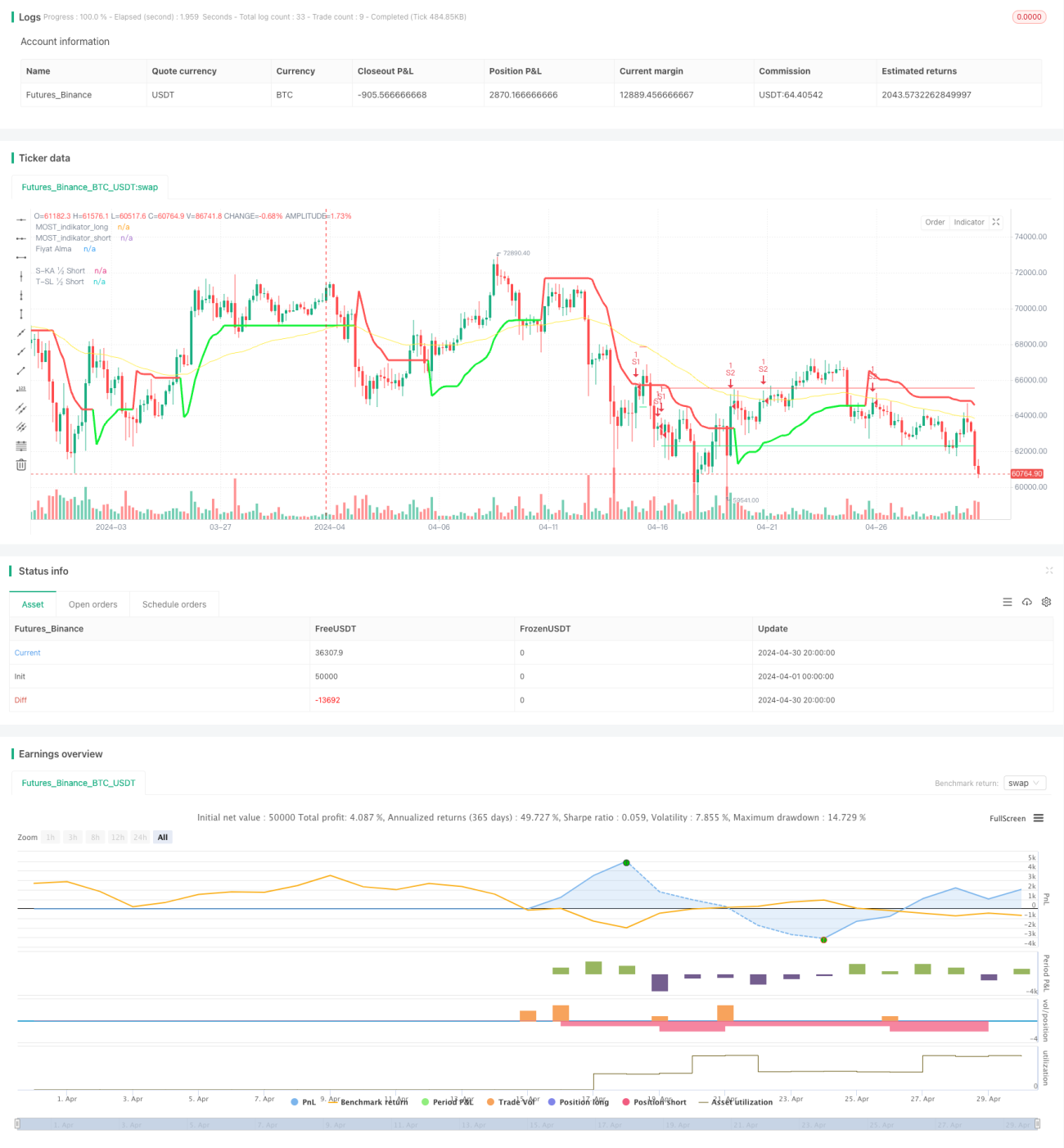
Overview
This strategy is a dual-position adaptive quantitative trading strategy based on the MOST indicator. By calculating the long and short period lines of the MOST indicator and considering factors such as price and trading volume, the strategy adaptively adjusts the opening direction, position size, take-profit and stop-loss points to obtain stable returns. The strategy takes into account both trend and oscillation market states, and adapts to different market environments by dynamically adjusting parameters.
Strategy Principle
- Calculate the long and short period lines of the MOST indicator, and determine the long and short direction by comparing the relationship between the current price and the position of the MOST indicator.
- Adaptively adjust the opening position size according to the trend direction and strength. If the trend is strong, appropriately increase the position; if the trend is weak, appropriately reduce the position.
- Set multiple take-profit and stop-loss points, and dynamically adjust the take-profit and stop-loss points according to market volatility to control risk.
- Introduce trading time windows and filters to avoid trading when market volatility is high or the trend is unclear, improving the robustness of the strategy.
- Comprehensively consider multiple indicators such as RSI and CCI to filter opening conditions and improve the accuracy of opening positions.
Strategy Advantages
- Adaptive position adjustment: Dynamically adjust the opening position size according to the trend strength and market volatility, obtain more profits when the trend is strong, and control risks when the trend is weak.
- Dynamic take-profit and stop-loss: Dynamically adjust the take-profit and stop-loss points according to market volatility, which can lock in profits in a timely manner and effectively control drawdowns.
- Multi-indicator filtering: Comprehensively consider multiple indicators such as RSI and CCI to filter opening conditions, improve the accuracy of opening positions, and reduce the risk of misjudgment.
- Strong adaptability: By setting trading time windows and filters, avoid trading when market volatility is high or the trend is unclear, improving the adaptability of the strategy.
- Parameter optimization: The strategy has multiple parameters that can be optimized, such as the MOST indicator period, take-profit and stop-loss points, position size, etc. Parameters can be optimized according to different market environments and asset characteristics to improve strategy returns.
Strategy Risks
- Parameter optimization risk: The strategy has multiple parameters that need to be optimized, and different parameter settings may lead to large differences in strategy performance, resulting in parameter optimization risk.
- Overfitting risk: If parameter optimization is too complex, it may lead to strategy overfitting and poor performance on out-of-sample data.
- Black swan event risk: The strategy is optimized based on historical data and may not be able to cope with extreme market conditions, such as black swan events.
- Market risk: The strategy may experience large drawdowns when the trend is unclear or market volatility is high.
Strategy Optimization Direction
- Introduce machine learning algorithms, such as support vector machines and random forests, to optimize opening conditions and position sizes, improving strategy returns and robustness.
- Introduce market sentiment indicators, such as the panic index, to quantify market sentiment and timely adjust positions to control risks when market sentiment is extreme.
- Introduce multi-factor models, such as fundamental factors and technical factors, to quantitatively score assets and select high-quality assets to improve strategy returns.
- Introduce a capital management module to dynamically adjust position sizes according to account profit and loss, control drawdowns, and improve strategy robustness.
- Perform parameter adaptive optimization to adaptively adjust strategy parameters according to changes in the market environment, improving strategy adaptability.
Summary
This strategy is a dual-position adaptive quantitative trading strategy based on the MOST indicator. By dynamically adjusting position sizes and take-profit and stop-loss points, it adapts to different market environments and obtains stable returns. At the same time, the strategy introduces multiple filtering conditions to improve the accuracy of opening positions and control drawdown risks. In the future, machine learning algorithms, market sentiment indicators, multi-factor models, etc. can be introduced to optimize the strategy and improve strategy returns and robustness. In summary, this strategy is a quantitative trading strategy with certain advantages and room for optimization.
/*backtest
start: 2024-04-01 00:00:00
end: 2024-04-30 23:59:59
period: 4h
basePeriod: 15m
exchanges: [{"eid":"Futures_Binance","currency":"BTC_USDT"}]
*/

//@version=5
//@strategy_alert_message {{strategy.order.alert_message}}
//bu yukardaki otomatik olarak alarma ekleniyormus, diger turlu her seferinde bunu yapistirman gerekiyordu..
//19.05.2024- 1