Multi-EMA Crossover with Fibonacci Extension Trend Following Strategy

Overview
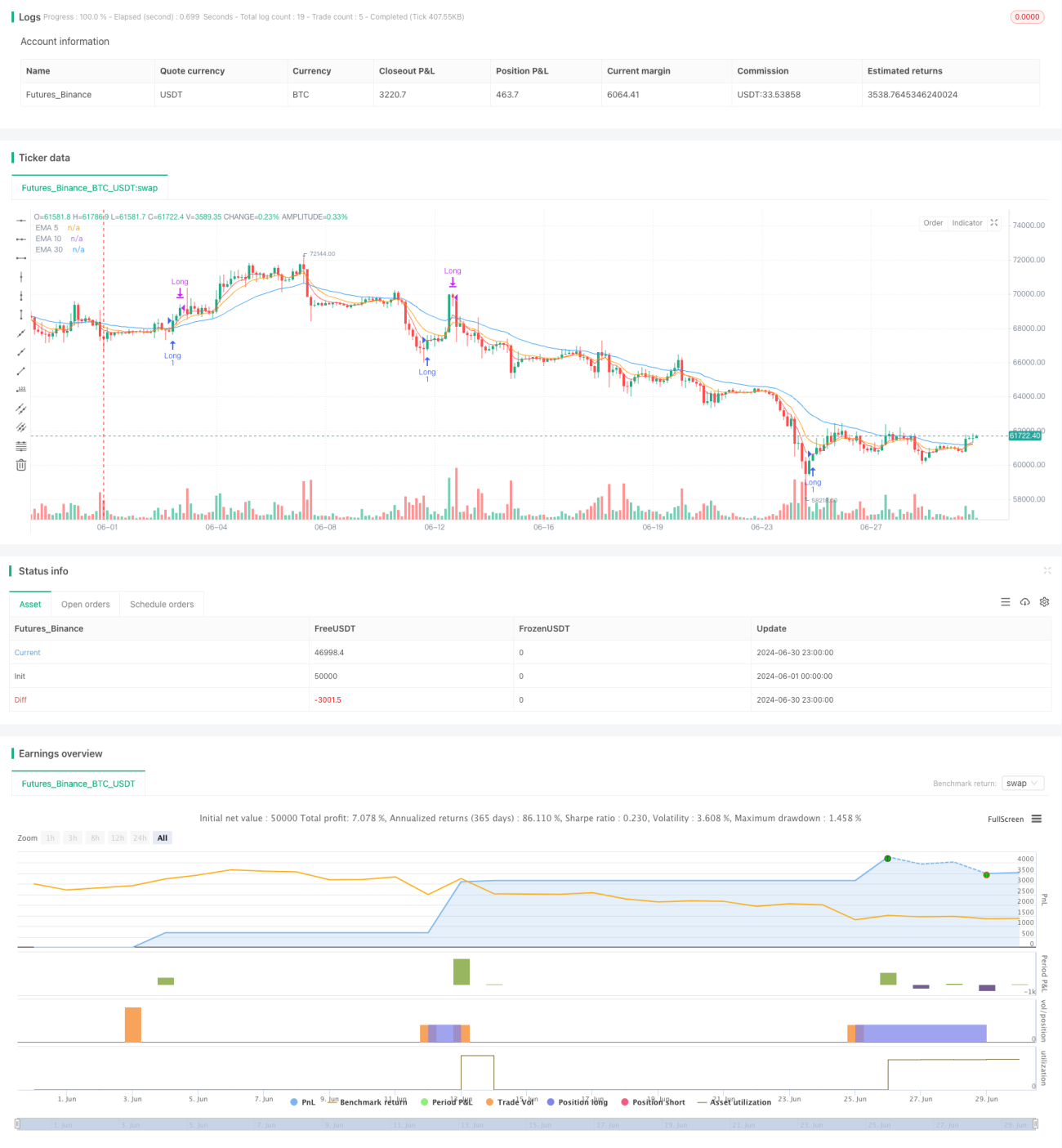
This strategy is a trend following system that combines multiple Exponential Moving Average (EMA) crossovers with Fibonacci extension levels. It utilizes the interaction between EMAs of different periods to identify potential trend beginnings and endings, while using Fibonacci extension levels to determine profit targets. The strategy also incorporates specific stop-loss rules to manage risk and protect profits.
Strategy Principles
The core of this strategy lies in using EMA crossovers across multiple timeframes to capture the initiation and termination of trends. Specifically, it employs 5-period, 10-period, and 30-period EMAs. The strategy includes four different entry conditions, each designed to capture different market scenarios:
-
The first entry condition is triggered when the price touches or falls below the 30-period EMA but subsequently closes above it, while the 10-period EMA is above the 5-period EMA, and the 30-period EMA is 1% lower than the 5-period EMA.
-
The second entry condition is triggered when the 5-period EMA crosses above the 30-period EMA, and the 30-period EMA has crossed below the 5-period EMA within the last 6 bars.
-
The third entry condition is triggered when the highs of the previous two bars are below their respective 5-period EMAs, the 5-period EMA is below the 10-period EMA, which is below the 30-period EMA, and the high of the previous bar is below the current close.
-
The fourth entry condition is triggered when the 10-period EMA crosses above the 30-period EMA, the 5-period EMA has crossed above the 30-period EMA within the last 4 bars, and both the 10-period and 5-period EMAs' current values are higher than their previous values.
For stop-loss, the strategy sets specific rules for different entry conditions:
- For the first condition, the position is closed if the 30-period EMA crosses above the 10-period EMA.
- For other conditions, the position is closed if the closing price falls below the lowest low of the previous three bars.
Profit targets are set based on Fibonacci extension levels, including 0.618, 0.786, 1.0, and 1.618 levels. The strategy closes positions when these levels are reached, according to specific rules.
Additionally, the strategy includes a profit lock condition: if the lows of the last two bars are above the 5-period EMA and the EMAs are aligned in ascending order (5 > 10 > 30), the position is closed to lock in profits.
Strategy Advantages
-
Multiple Confirmations: By using multiple EMAs and entry conditions, the strategy can more accurately identify the start and continuation of trends. This multi-confirmation mechanism can reduce false signals and improve trading accuracy.
-
High Adaptability: Four different entry conditions allow the strategy to adapt to various market environments, capturing trading opportunities whether in rapid breakouts or slow trend formations.
-
Risk Management: The strategy includes specific stop-loss rules, which helps control risk for each trade. Different entry conditions correspond to different stop-loss strategies, indicating the strategy's emphasis on risk management.
-
Clear Profit Targets: Using Fibonacci extension levels as profit targets provides traders with clear exit points. This helps avoid premature profit-taking or holding positions for too long.
-
Profit Protection: The profit lock condition helps protect gained profits when the trend might reverse, an important aspect often overlooked by many trend-following strategies.
-
Combination of Technical Indicators: The strategy combines EMAs and Fibonacci tools, leveraging the strengths of these two popular technical analysis tools.
Strategy Risks
-
Overtrading: Multiple entry conditions may lead to overtrading, especially in highly volatile markets. This could increase transaction costs and potentially lead to more false signals.
-
Parameter Sensitivity: The strategy uses multiple fixed EMA periods and percentage thresholds. These parameters may need to be adjusted for different markets and timeframes, otherwise, they might lead to poor strategy performance.
-
Trend Dependency: As a trend-following strategy, it may perform poorly in ranging or oscillating markets. In these market environments, it may generate multiple false signals and small losses.
-
Lag: EMAs are inherently lagging indicators. In rapidly changing markets, the strategy may not be able to capture trend turning points in a timely manner.
-
Complexity: The strategy's multiple conditions and rules increase its complexity, which may make it difficult to understand and maintain, and also increases the risk of overfitting.
Strategy Optimization Directions
-
Dynamic Parameter Adjustment: Consider introducing an adaptive mechanism to dynamically adjust EMA periods and other parameters based on market volatility. This can improve the strategy's adaptability in different market environments.
-
Incorporate Volume Indicators: Combining volume analysis can improve the accuracy of entry and exit decisions. For example, requiring increased volume at entry to confirm trend strength.
-
Market Environment Filtering: Introduce a market environment identification mechanism, such as using ATR (Average True Range) or volatility indicators, to pause trading in environments unsuitable for trend following.
-
Optimize Stop-Loss Mechanism: Consider using trailing stops instead of fixed stops. This can protect profits while allowing them to continue growing.
-
Add Time Filtering: Limit trading to specific time periods, avoiding highly volatile or low liquidity periods, which can improve strategy stability.
-
Introduce Machine Learning: Use machine learning algorithms to optimize parameter selection and entry decisions, which can improve the strategy's adaptability and performance.
-
Multi-Timeframe Analysis: Incorporate trend analysis from longer timeframes to improve entry decision accuracy and avoid entering against the main trend.
Conclusion
This Multi-EMA Crossover with Fibonacci Extension Trend Following Strategy demonstrates a comprehensive trading system that combines multiple technical indicators and trading concepts. By using multiple EMAs and entry conditions, the strategy attempts to strike a balance between capturing trends and reducing false signals. The use of Fibonacci extension levels provides an objective basis for setting profit targets, while specific stop-loss and profit locking rules reflect an emphasis on risk management.
Although the strategy has advantages in multiple confirmations and high adaptability, its complexity and sensitivity to parameter selection also present certain challenges. To further improve the strategy's robustness and performance, considerations can be given to introducing dynamic parameter adjustment, market environment filtering, and multi-timeframe analysis as optimization directions.
Overall, this strategy provides an interesting framework for trend following, but traders need to conduct thorough backtesting and parameter optimization when applying it in practice, and make appropriate adjustments based on specific markets and trading styles. Through continuous monitoring and optimization, this strategy has the potential to become an effective trend-following tool.
- 1