Multi-EMA and Supertrend Crossover Strategy

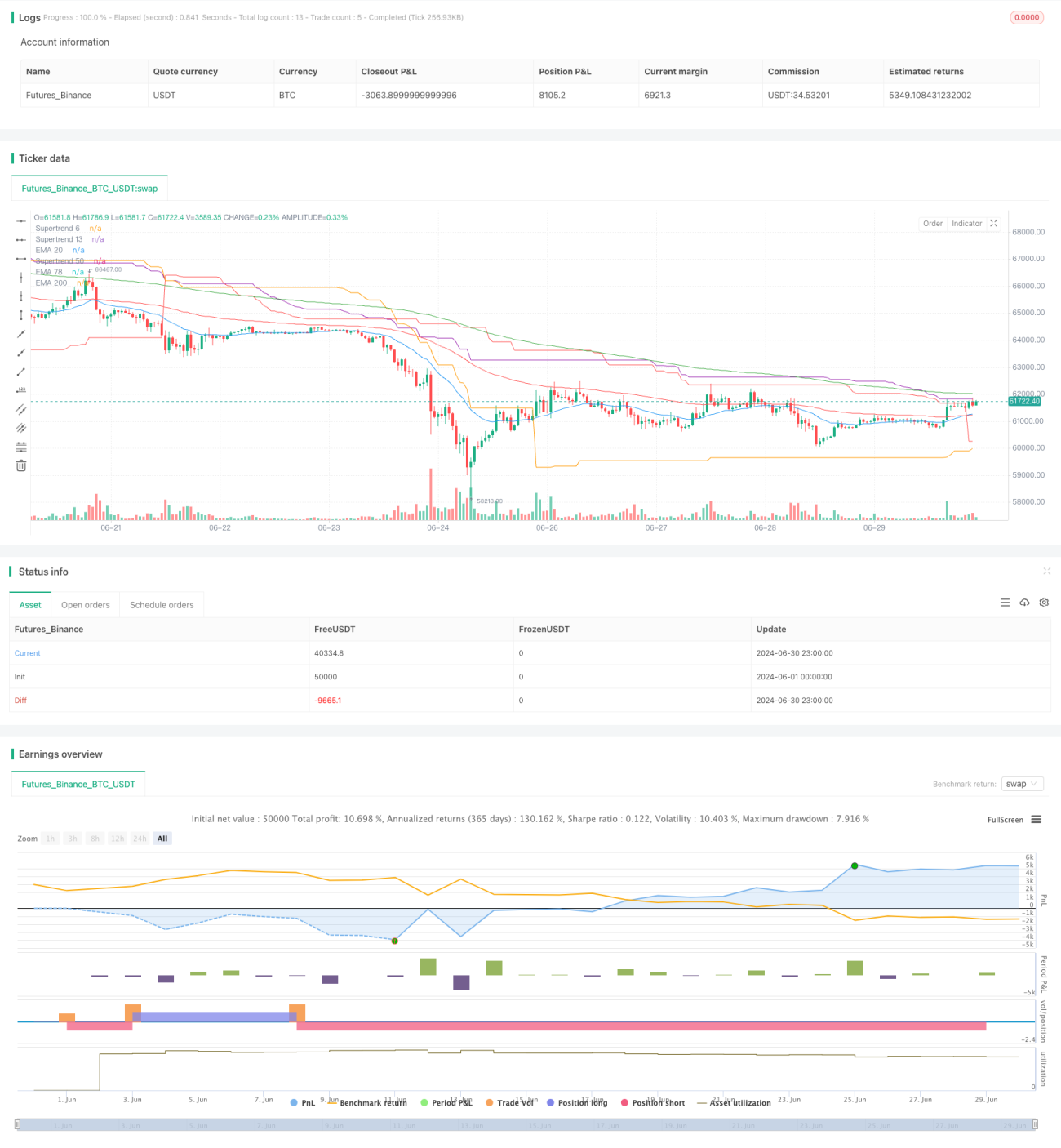
Overview
This strategy is a trading system based on multiple Exponential Moving Averages (EMAs) and Supertrend indicators. It generates buy and sell signals using crossovers of EMAs and Supertrend indicators with different periods. The strategy aims to capture market trend changes and execute trades when trends are confirmed.
Strategy Principle
The strategy employs three EMAs with different periods (22, 79, and 200) and three Supertrend indicators with different periods (50, 13, and 6). Trading signals are generated based on the following conditions:
-
Buy Signal:
- Medium-term EMA (79) is below the short-term EMA (22)
- Closing price is above the long-term EMA (200)
- Closing price is above all three Supertrend indicators
-
Sell Signal:
- Medium-term EMA (79) is above the short-term EMA (22)
- Closing price is below the long-term EMA (200)
- Closing price is below all three Supertrend indicators
When these conditions are met, the strategy opens long or short positions accordingly. It also closes existing positions when opposite signals occur.
Strategy Advantages
-
Multiple Confirmations: Using multiple indicators and timeframes provides more reliable trading signals, reducing false breakouts.
-
Trend Following: By combining EMAs and Supertrend, the strategy effectively captures medium to long-term trends.
-
Flexibility: EMA and Supertrend parameters can be adjusted for different market conditions.
-
Risk Management: Using the long-term EMA (200) as an additional filter helps avoid counter-trend trades.
-
Automation: The strategy can be easily automated, reducing emotional interference in trading decisions.
Strategy Risks
-
Lag: Both EMAs and Supertrend are lagging indicators, which may lead to late entries or exits during trend reversals.
-
Poor Performance in Ranging Markets: The strategy may generate frequent false signals in sideways or choppy markets.
-
Over-reliance on Technical Indicators: Ignoring fundamental factors and market sentiment may lead to incorrect trading decisions.
-
Parameter Sensitivity: Strategy performance highly depends on the chosen EMA and Supertrend parameters.
-
Lack of Stop-Loss Mechanism: The code does not include an explicit stop-loss strategy, which may result in significant losses.
Strategy Optimization Directions
-
Introduce Stop-Loss Mechanism: Implement ATR-based or fixed percentage stop-losses to limit maximum loss per trade.
-
Add Volume Filters: Incorporate volume indicators into the signal confirmation process to improve signal quality.
-
Optimize Parameter Selection: Backtest different combinations of EMA and Supertrend parameters using historical data to find optimal settings.
-
Add Trend Strength Filters: Introduce trend strength indicators like ADX and only trade in strong trends.
-
Implement Partial Position Management: Allow the strategy to build or reduce positions gradually based on signal strength, rather than all-or-nothing operations.
-
Incorporate Market Regime Recognition: Add logic to identify current market states (trending/ranging) and adjust trading behavior accordingly.
-
Consider Fundamental Factors: Use important economic data releases or events as additional filtering conditions.
Conclusion
The Multi-EMA and Supertrend Crossover Strategy is a comprehensive trading system that combines multiple technical indicators. By leveraging EMAs and Supertrend indicators with different periods, the strategy aims to capture strong market trends and execute trades when trends are confirmed. While the strategy has advantages in multiple confirmations and trend following, it also faces risks such as lag and poor performance in ranging markets.
To enhance the strategy's robustness and performance, consider introducing stop-loss mechanisms, optimizing parameter selection, adding additional filters, and implementing more flexible position management. Incorporating fundamental analysis into the decision-making process may also help improve the strategy's overall effectiveness.
Overall, this is a promising strategy framework that, with continuous optimization and adjustment, has the potential to achieve stable performance across various market conditions. However, before using it in live trading, it is recommended to conduct thorough backtesting and forward testing to ensure the strategy's reliability in different market environments.
- 1