Dynamic Risk-Managed EMA Crossover with Bollinger Bands Strategy

Overview
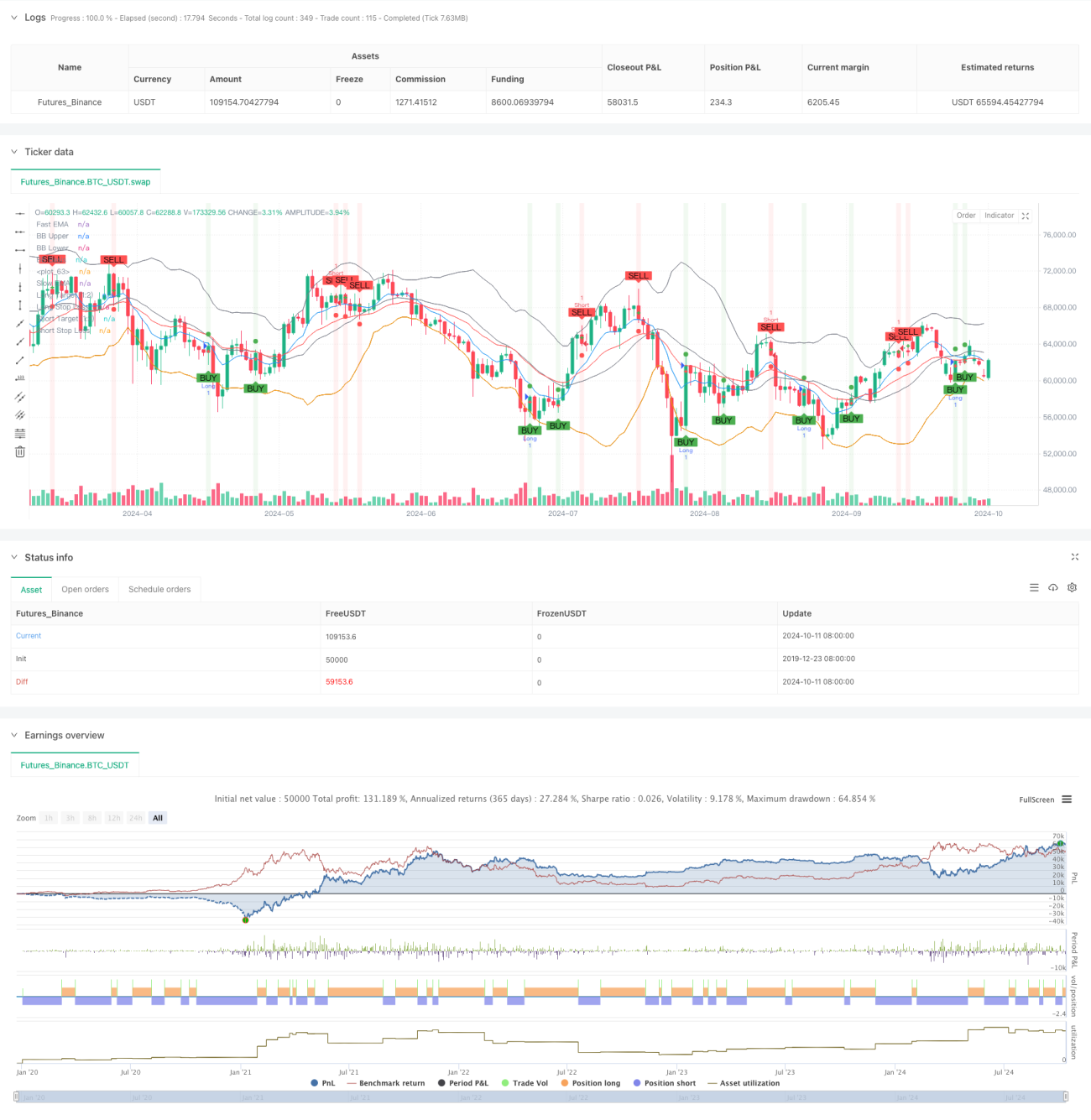
This strategy is an intraday trading system that combines multiple technical indicators, primarily utilizing EMA crossovers, RSI overbought/oversold conditions, volume confirmation, Bollinger Bands, and candlestick patterns to determine entry points. It also incorporates a fixed 1:2 risk-reward ratio and percentage-based stop loss for risk management and profit maximization.
Strategy Principles
The strategy is based on the following core principles:
-
EMA Crossover: Uses the crossover of fast (9-period) and slow (21-period) Exponential Moving Averages (EMA) to identify potential trend changes.
-
RSI Filter: Confirms trend strength by checking if the Relative Strength Index (RSI) is overbought (>70) or oversold (<30).
-
Volume Confirmation: Requires volume to exceed a set minimum threshold to ensure sufficient market participation.
-
Bollinger Bands: Utilizes Bollinger Bands to identify price volatility and potential support/resistance levels.
-
Candlestick Patterns: Incorporates bullish and bearish engulfing patterns to enhance entry signal reliability.
-
Risk Management: Employs a fixed 1:2 risk-reward ratio and percentage-based stop loss.
Trade signals are triggered when these conditions are met and price is below (for longs) or above (for shorts) the Bollinger Bands middle line.
Strategy Advantages
-
Multiple Confirmations: Combines various technical indicators and chart patterns, increasing the reliability of trade signals.
-
Dynamic Risk Management: Calculates stop loss and target levels in real-time, adapting to different market conditions.
-
Trend Following and Reversal Combination: Capable of capturing both trend continuation and potential reversal opportunities.
-
Volatility Adaptation: Uses Bollinger Bands to adjust sensitivity to market volatility.
-
Flexibility: Allows users to adjust parameters based on personal preferences and market characteristics.
Strategy Risks
-
Overtrading: May generate excessive trade signals in highly volatile markets, increasing transaction costs.
-
False Breakouts: Prone to frequent false signals in ranging markets.
-
Slippage Risk: Actual execution prices may significantly differ from signal trigger prices in fast-moving markets.
-
Parameter Sensitivity: Strategy performance may be highly sensitive to parameter settings, requiring careful optimization and backtesting.
Optimization Directions
-
Dynamic Parameter Adjustment: Consider automatically adjusting EMA periods and RSI thresholds based on market volatility.
-
Trend Strength Filter: Introduce indicators like ADX to assess trend strength and avoid trading in weak trends.
-
Time Filter: Add a time filter to avoid trading during low volatility periods.
-
Improved Stop Loss Mechanism: Consider using trailing stops or ATR-based dynamic stops for better risk management.
-
Profit Locking: Implement partial profit taking and stop loss adjustment upon reaching certain target levels.
Conclusion
This intraday trading strategy offers a comprehensive trading system by combining multiple technical indicators and risk management techniques. Its strengths lie in multiple confirmations and dynamic risk management, but it also faces challenges such as overtrading and parameter sensitivity. Through further optimization, such as dynamic parameter adjustment and improved stop loss mechanisms, the strategy has the potential to become a more robust and adaptive trading system. However, extensive backtesting and careful parameter optimization are still necessary before applying it to live trading.
- 1