Triple Moving Average Trend Following and Momentum Integration Quantitative Trading Strategy

Overview
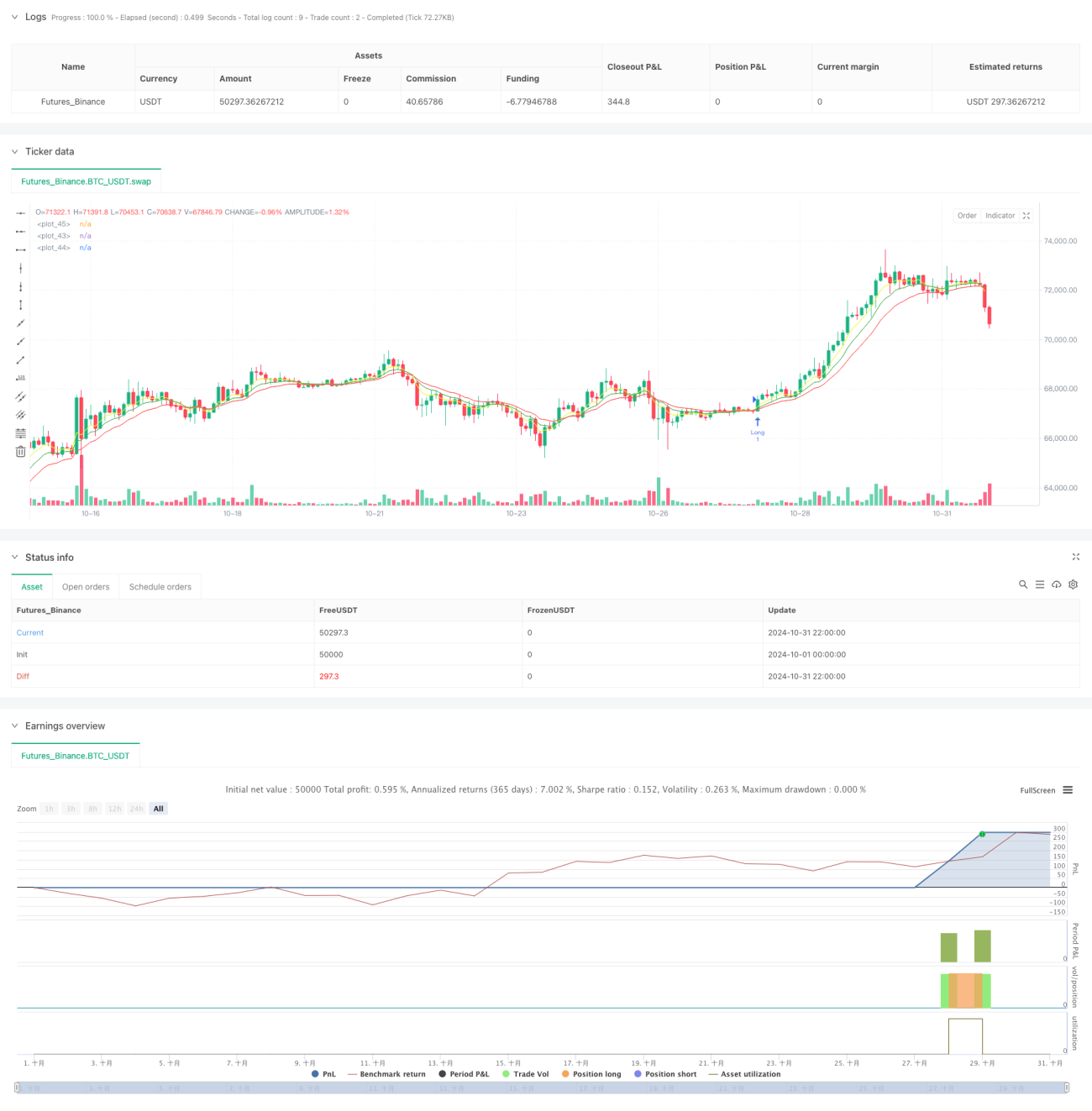
This is a quantitative trading strategy that combines trend following and momentum analysis. The strategy utilizes Triple Exponential Moving Average (TEMA), multiple moving average crossovers, and a MACD variant to identify market trends and entry points. It implements strict risk control mechanisms, including fixed stop-loss, profit targets, and trailing stops to optimize risk-reward balance.
Strategy Principles
The strategy determines trading signals through three core technical indicator systems:
- Triple Exponential Moving Average (TEMA) system confirms overall trend direction. It calculates three layers of EMA and combines their dynamic changes to judge trend strength.
- Fast/Slow MA crossover system uses 9-period and 15-period EMAs to capture medium-term trend reversal points.
- Price crossing with 5-period EMA serves as final confirmation signal for precise entry timing.
Trade signals are triggered when all conditions are met:
- MACD crosses above its signal line with upward TEMA trend
- Short-term EMA crosses above long-term EMA
- Price crosses above 5-period EMA
Strategy Advantages
- Multiple confirmation mechanisms greatly reduce false signals and improve trading accuracy.
- Combines benefits of trend following and momentum analysis to capture both major trends and short-term opportunities.
- Implements comprehensive stop-loss mechanisms including fixed stops and dynamic trailing stops for effective risk control.
- High parameter adaptability for different market environments.
- Clear entry logic that's easy to understand and execute.
Strategy Risks
- Multiple confirmation requirements may lead to delayed entries, missing opportunities in fast-moving markets.
- Fixed stop-loss points need adjustment for different market volatilities to avoid premature exits.
- May generate frequent false signals in range-bound, choppy markets.
- Trailing stops might exit quality trends too early during severe market fluctuations.
Optimization Directions
- Introduce volatility indicators for dynamic adjustment of stops and profit targets to better match market conditions.
- Add volume indicators as auxiliary confirmation to improve signal reliability.
- Implement market environment recognition for different parameter combinations in various market states.
- Develop counter-trend position building mechanism for moderate accumulation during pullbacks.
- Optimize trailing stop algorithm for better adaptation to market volatility.
Summary
The strategy builds a robust trading system by integrating multiple technical indicator systems. Its core strengths lie in multiple confirmation mechanisms and comprehensive risk control systems. While there are certain lag risks, the strategy has significant improvement potential through parameter optimization and functional expansion. Suitable for traders seeking stable returns.
- 1