
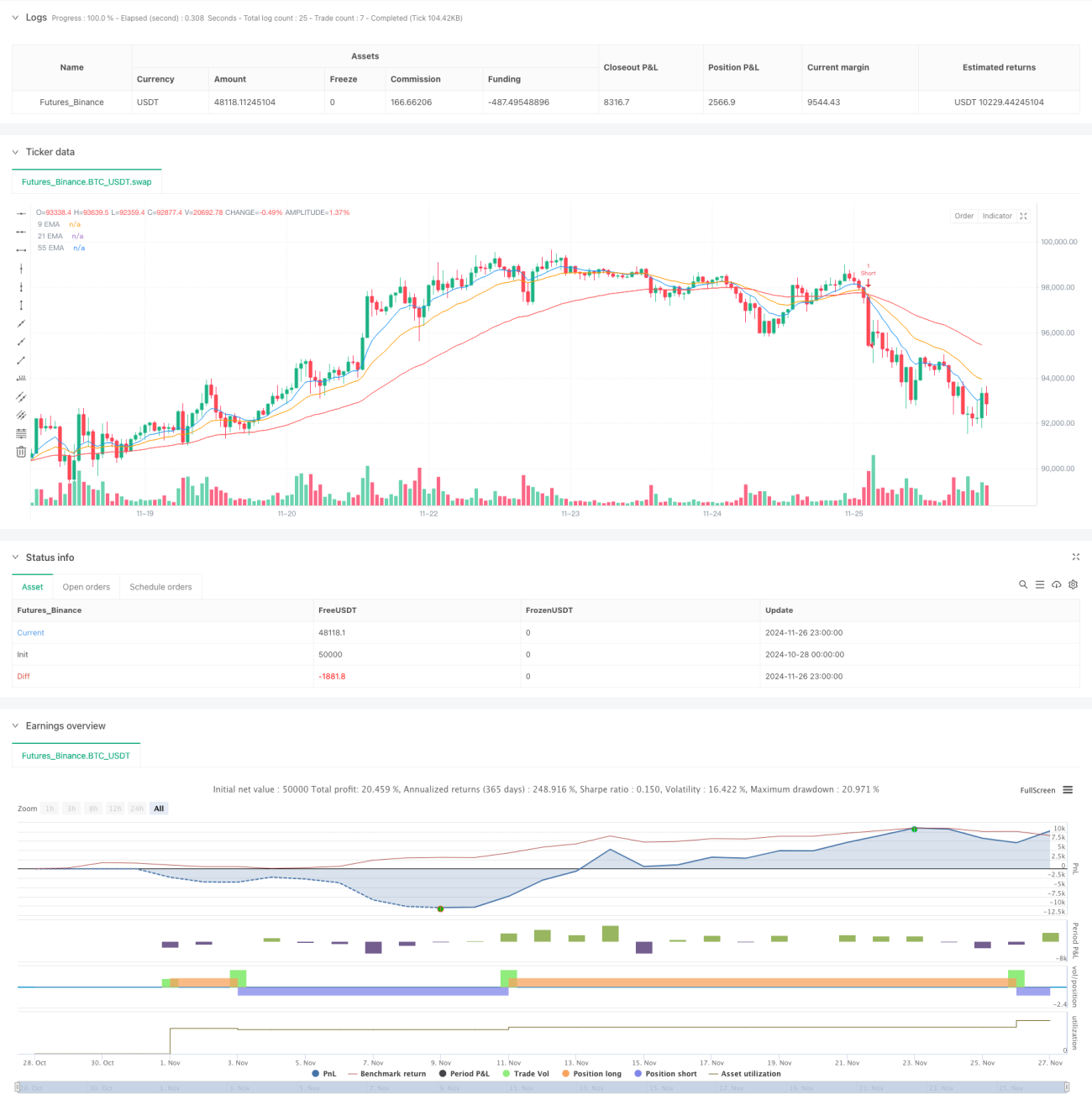
This article introduces a trend following trading strategy based on triple exponential moving averages. The strategy identifies market trends through the crossover relationships between short-term, medium-term, and long-term exponential moving averages, combined with dynamic stop-loss and take-profit mechanisms for trade management.
Strategy Overview
The strategy makes trading decisions based on three exponential moving averages (EMAs) with different periods: 9, 21, and 55. By observing the crossover relationships and relative positions between these moving averages, it determines market trend direction and strength to find suitable trading opportunities. The strategy also integrates ATR-based dynamic stop-loss and risk-reward ratio based take-profit settings for better risk management.
Strategy Principles
The core logic of the strategy is to identify trends through the crossover and position relationships of three EMAs. Specifically:
- A long signal is triggered when the short-term EMA (9-period) crosses above the medium-term EMA (21-period), and the medium-term EMA is above the long-term EMA (55-period)
- A short signal is triggered when the short-term EMA crosses below the medium-term EMA, and the medium-term EMA is below the long-term EMA
- Uses 1.5 times ATR as dynamic stop-loss distance to ensure stop-loss points adapt to market volatility
- Sets take-profit levels based on a 1.2 risk-reward ratio to ensure reasonable profit/loss ratio for each trade
Strategy Advantages
- Strong trend identification: The triple EMA combination can more accurately identify market trends and filter out market noise
- Comprehensive risk management: Through ATR dynamic stop-loss and fixed risk-reward ratio settings, ensures clear risk control for each trade
- High adaptability: The strategy can be applied to different markets and timeframes with good universality
- Clear operating rules: Entry and exit conditions are clear, reducing interference from subjective judgments
Strategy Risks
- Lag risk: EMAs as lagging indicators may lead to delayed entry timing
- Sideways market risk: May generate frequent false signals in ranging markets
- Stop-loss setting risk: ATR multiplier selection needs optimization based on different market characteristics
- Money management risk: Fixed risk-reward ratio may not be suitable for all market environments
Strategy Optimization Directions
- Trend filter optimization: Can add trend strength indicators like ADX to help filter signals in weak markets
- Dynamic parameter optimization: Can dynamically adjust EMA periods and ATR multiplier based on market volatility
- Money management optimization: Can dynamically adjust risk-reward ratio based on market environment
- Entry timing optimization: Can optimize entry timing by combining oscillators like RSI
Summary
The Triple EMA Trend Trading Strategy is a trading system with clear logic and controllable risk. Through proper parameter settings and optimization, it can obtain stable trading opportunities in different market environments. The key to strategy success lies in correctly understanding and applying the core principles of trend following while maintaining good risk management. In practical application, investors are advised to make appropriate parameter adjustments based on specific market characteristics and their own risk tolerance.
- 1