Adaptive Dual-Direction EMA Trend Trading System with Reverse Trade Optimization Strategy

Overview
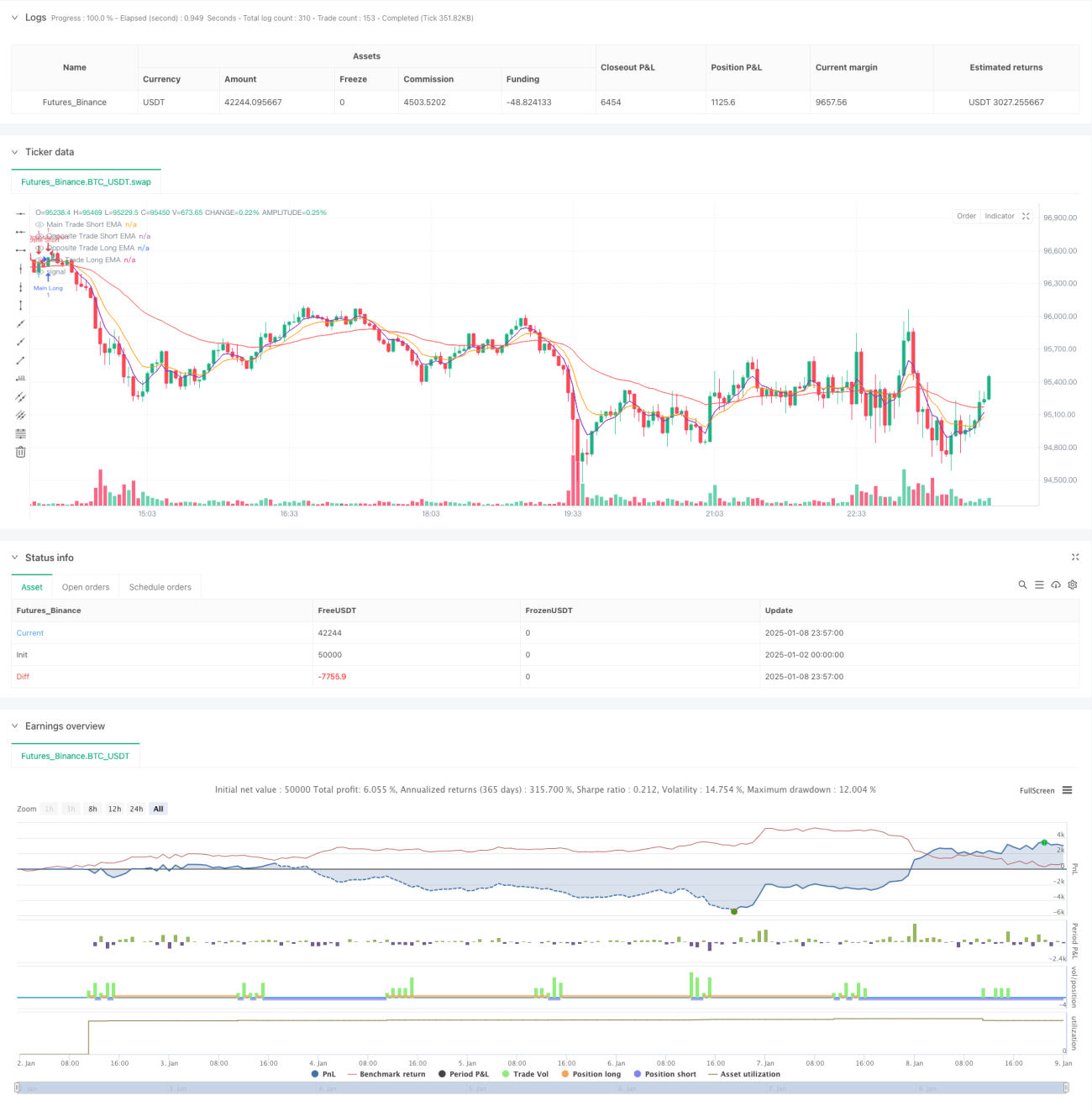
This strategy is a dual-direction trading system that combines Exponential Moving Averages (EMA) with time intervals. The system determines the main trading direction based on EMA relationships within user-defined fixed time intervals, while monitoring another set of EMA indicators for crossover signals or approaching the next trading cycle to execute reverse hedge trades, thereby capturing bi-directional trading opportunities.
Strategy Principle
The strategy operates on two core mechanisms: main trades at fixed intervals and flexible reverse trades. The main trades judge trend direction based on the relative position of 5/40-minute EMAs, executing trades at each interval (default 30 minutes). Reverse trades are triggered either by monitoring 5/10-minute EMA crossover signals or one minute before the next main trade, whichever occurs first. All trading occurs within a user-defined time window to ensure trading effectiveness.
Strategy Advantages
- Combines trend-following and mean-reversion trading approaches to capture opportunities in different market environments
- Controls trading frequency through time intervals to avoid overtrading
- Reverse trading mechanism provides risk hedging functionality to help control drawdowns
- Highly customizable parameters including EMA periods and trading intervals for strong adaptability
- Adjustable trading time windows for optimization according to different market characteristics
Strategy Risks
- EMA indicators have inherent lag, potentially generating delayed signals in volatile markets
- Fixed time interval trading might miss important market opportunities
- Reverse trades may result in unnecessary losses during strong trends
- Improper parameter selection can lead to excessive or insufficient trading signals
- Need to consider the impact of trading costs on strategy returns
Strategy Optimization Directions
- Introduce volatility indicators to dynamically adjust EMA parameters for improved adaptability
- Add volume analysis to enhance trading signal reliability
- Develop dynamic time interval mechanisms that adjust trading frequency based on market activity
- Implement stop-loss and profit target management to optimize capital management
- Consider incorporating additional technical indicators for cross-validation to improve trading accuracy
Summary
This is a comprehensive strategy that combines trend following with reverse trading, achieving bi-directional opportunity capture through the coordination of time intervals and EMA indicators. The strategy offers strong customization capabilities and good potential for risk control, but requires parameter optimization and risk management refinement based on actual market conditions. For live trading implementation, it is recommended to conduct thorough backtesting and parameter optimization, along with specific adjustments based on market characteristics.
- 1