Dynamic Risk-Managed WaveTrend with Multiple EMA Crossover Quantitative Trading Strategy

Overview
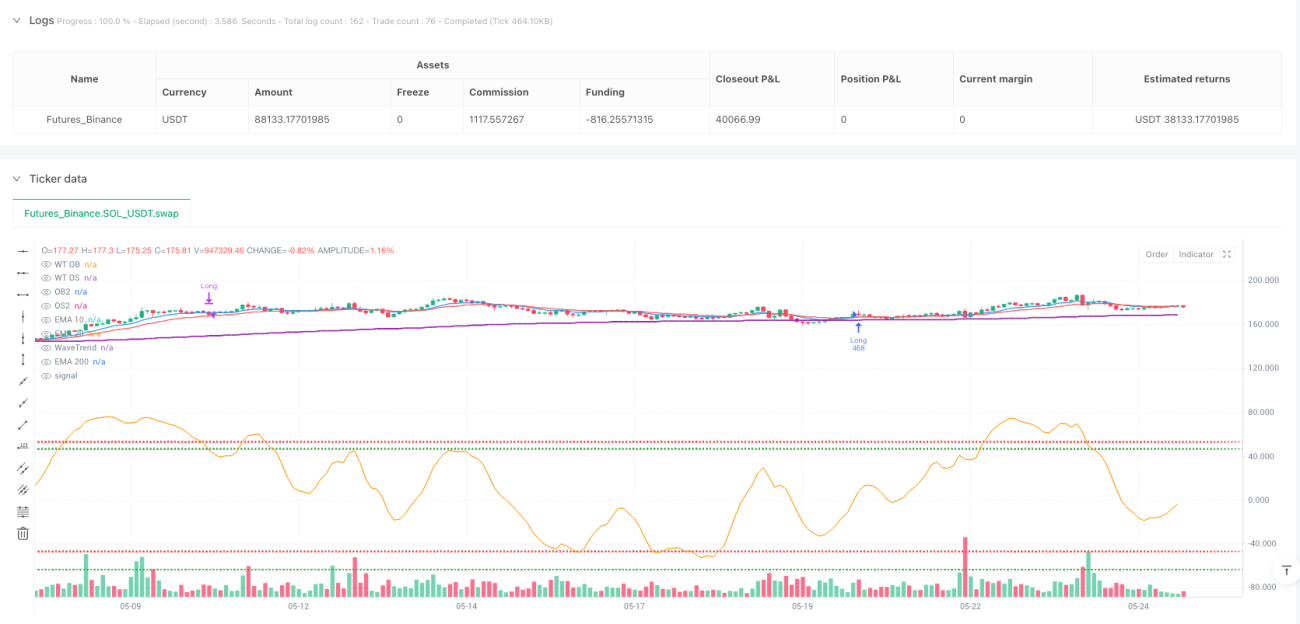
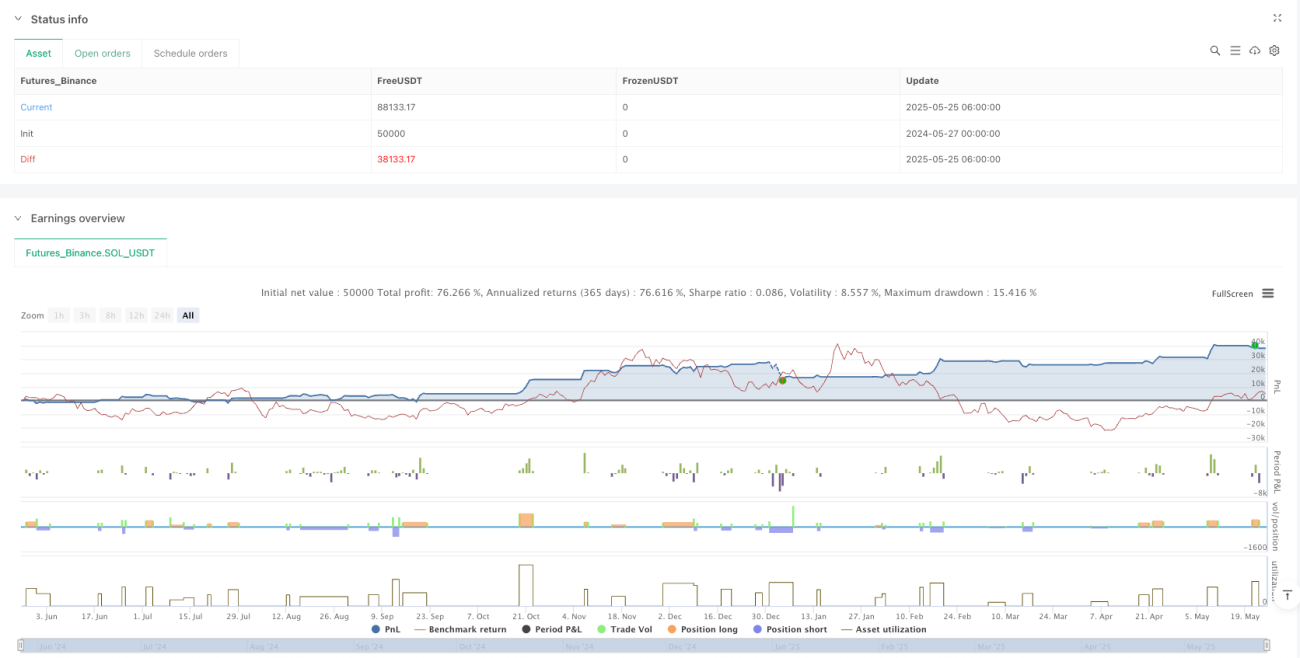
The Dynamic Risk-Managed WaveTrend with Multiple EMA Crossover Quantitative Trading Strategy is a comprehensive trading system that ingeniously combines the WaveTrend indicator, Exponential Moving Average (EMA) crossover signals, volume filter, and dynamic risk management mechanisms. This strategy optimizes trading decisions through trend confirmation and dynamic position sizing, primarily suitable for medium to long-term timeframes (4-hour or daily charts). The core of the strategy lies in using EMA crossover signals to confirm trend direction, relying on WaveTrend indicator's overbought/oversold levels to determine optimal exit points, and controlling risk exposure per trade through volatility-based dynamic risk management.
Strategy Principles
The strategy's operating mechanism involves several key components:
-
Trend Identification & Entry Signals:
- The system uses crossovers between 10-period EMA and 20-period EMA to generate initial signals
- 200-period EMA serves as a long-term trend filter, ensuring trades follow the main trend
- Long signals are generated when price is above the 200EMA and the 10EMA crosses above the 20EMA
- Short signals are generated when price is below the 200EMA and the 10EMA crosses below the 20EMA
-
Volume Confirmation:
- The strategy requires trading signals to be accompanied by increased volume (higher than the 20-period volume average)
- This requirement ensures entry only when there's sufficient market participation
-
Dynamic Position Management:
- The strategy calculates stop-loss placement based on price volatility over the last 5 periods
- Long stop-losses are set at the 5-period low, short stop-losses at the 5-period high
- Position size is dynamically calculated based on account equity, set risk percentage (default 3%), and stop-loss distance
-
WaveTrend-Based Exit Mechanism:
- Uses the WaveTrend indicator to monitor price momentum
- Primary exit signals are triggered when WaveTrend reaches ±47 levels
- Secondary exit signals trigger at more extreme +53/-63 levels, combined with EMA crossover and volume conditions
-
Fixed Risk-Reward Ratio:
- The system automatically sets profit targets at twice the stop-loss distance, ensuring a 1:2 risk-reward ratio
Strategy Advantages
After deep analysis of the strategy code, we can summarize the following advantages:
-
Multi-layered Confirmation System: By combining EMA crossovers, long-term trend direction, and volume confirmation, the strategy significantly reduces false signals and improves entry quality.
-
Precise Risk Control: The core advantage of the strategy lies in its strict risk management mechanism, limiting risk per trade to a preset percentage of the account (default 3%), which protects capital even during consecutive losses.
-
Dynamic Position Calculation: Automatically adjusts position size based on actual market volatility, avoiding the problems of excessive risk or insufficient trading that come with fixed positions.
-
Multiple Exit Strategies: Combines momentum-based exits using the WaveTrend indicator with traditional stop-loss and take-profit mechanisms, providing multi-layered protection for trades, both securing profits and limiting losses.
-
Trend Direction Filtering: Ensures trading direction aligns with the main trend through the 200EMA, significantly improving win rate.
-
Adaptation to Market Changes: The strategy automatically adjusts according to market volatility, remaining effective in different market environments.
Strategy Risks
Despite its numerous advantages, the strategy still has some potential risks:
-
Parameter Dependency: The strategy's effectiveness is highly dependent on the set levels of the WaveTrend indicator (±47, +53/-63). These parameters may need adjustment for different market conditions, and different trading instruments may require different parameter settings.
-
Moving Average Lag: While EMAs respond faster than SMAs, they still have lag, which may cause missed important turning points or delayed signals in volatile markets.
-
Volume Dependency: In some market environments, volume may not be a reliable indicator of trend strength, especially in low-liquidity markets or certain trading instruments.
-
Calculation Complexity: While dynamic position calculation is precise, it also increases the strategy's complexity, potentially leading to implementation errors.
-
Stop-Loss Triggering Risk: Stop-losses based on recent lows/highs may be easily triggered when volatility suddenly expands, leading to "stop-hunting" phenomena.
Solutions:
- Conduct backtesting optimization to find optimal parameter combinations for different market environments
- Consider adding volatility filters to avoid trading during extreme volatility periods
- Implement progressive position management rather than full position at once
- Combine fundamental analysis to avoid entering positions before major economic data releases
Strategy Optimization Directions
Based on code analysis, I believe the strategy can be optimized in the following directions:
-
Adaptive Parameters: Design the WaveTrend's overbought/oversold levels as parameters that automatically adjust based on historical volatility, rather than fixed values. This allows the strategy to better adapt to different market cycles and instrument characteristics.
-
Multi-Timeframe Analysis: Introduce multi-timeframe confirmation mechanisms, such as requiring higher timeframe trends to align with the trading direction, which can improve signal quality and win rate.
-
Market State Recognition: Add market state classification (trending, ranging, high volatility, etc.), and use different entry and exit logic for different market states.
-
Intelligent Stop-Loss Management: Implement trailing stop or moving stop-loss mechanisms to protect profits when trends develop favorably, rather than relying solely on WaveTrend indicator exit signals.
-
Machine Learning Optimization: Introduce machine learning algorithms to dynamically adjust parameters or predict which market conditions the strategy might perform better in.
-
Risk Diversification: Modify the strategy to support multi-instrument trading, implementing risk diversification through correlation analysis.
-
Signal Strength Grading: Grade signals based on the degree of fulfillment of multiple conditions, allocating larger positions to stronger signals.
These optimizations can make the strategy more robust, reduce drawdowns, and improve long-term returns while maintaining the core principles of risk management.
Summary
The Dynamic Risk-Managed WaveTrend with Multiple EMA Crossover Quantitative Trading Strategy is a well-designed trading system that integrates multiple key elements of technical analysis with strict risk management principles. Its greatest innovation lies in combining the momentum characteristics of the WaveTrend indicator with traditional trend-following techniques, and ensuring risk control within preset ranges through dynamic position calculation.
This strategy is particularly suitable for medium to long-term traders, especially those who value capital management and risk control. While no strategy can perform excellently under all market conditions, this system's multi-layered confirmation mechanism and precise risk management make it a potentially robust trading tool.
Through further optimization and adaptation, especially implementing adaptive parameter adjustment and multi-timeframe analysis, this strategy has the potential to become a comprehensive trading system capable of maintaining competitiveness in various market environments. Ultimately, this strategy reminds us that successful quantitative trading depends not only on accurate entry signals but also on strict risk management and carefully designed exit strategies.
/*backtest
start: 2024-05-27 00:00:00
end: 2025-05-25 08:00:00
period: 2h
basePeriod: 2h
exchanges: [{"eid":"Futures_Binance","currency":"SOL_USDT"}]
*/

 //@version=5
strategy("WaveTrend EMA System with 3% Risk", overlay=true,
     default_qty_type=strategy.percent_of_equity,
default_qty_value=10, // Reduced to 10% to align with risk management- 1