
Overview
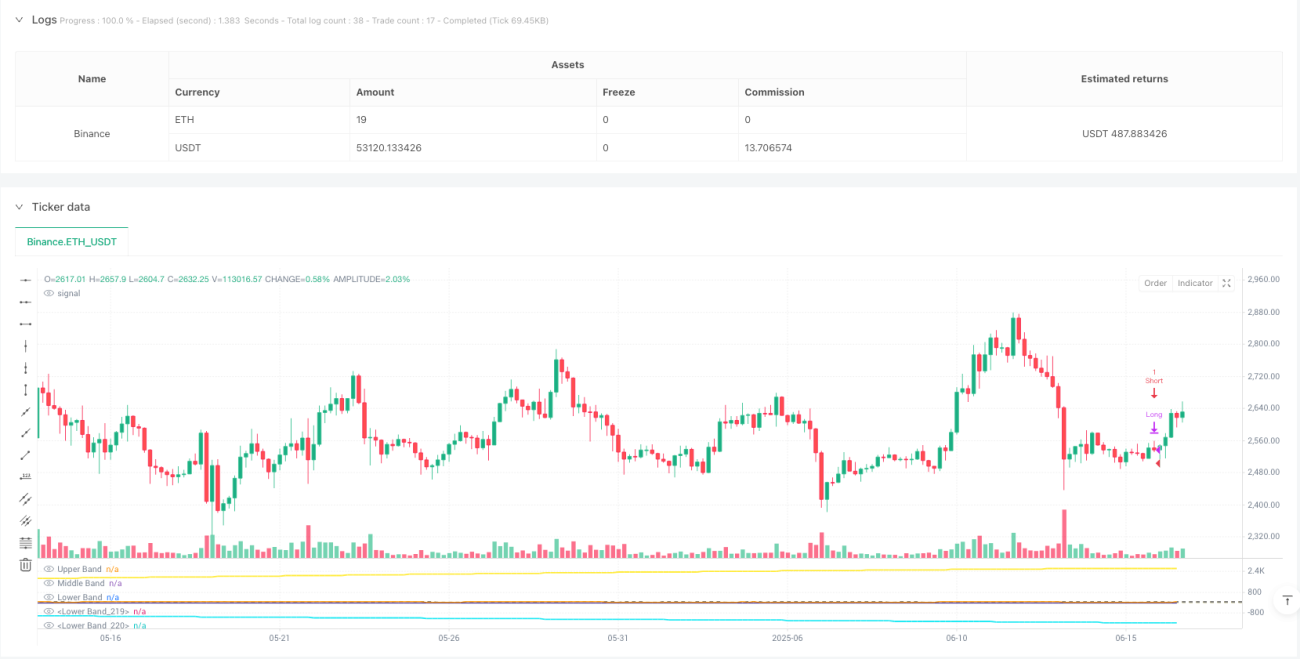
The Dual Timeframe Stochastic Oscillator Arbitrage Trading Strategy is an intraday high-frequency trading system based on the Stochastic Oscillator. This strategy utilizes two Stochastic oscillators with different parameter settings on a 15-second timeframe to generate and confirm trading signals. The core logic identifies potential entry points through crossovers between the primary Stochastic %K and %D lines, while using the secondary Stochastic's %D value as a market state filter. Combined with moving average and market hour filters, it creates a multi-layered confirmation mechanism. The strategy also incorporates pattern recognition capabilities to capture bullish and bearish continuation patterns, along with various risk control parameters to reduce false signals.
Strategy Principles
The strategy employs a dual Stochastic oscillator system, designated as Primary and Reference indicators:
-
Primary Stochastic Oscillator settings:
- Timeframe: 15 seconds
- K Length: 12
- K Smoothing: 12
- D Length: 12
-
Reference Stochastic Oscillator settings:
- Timeframe: 15 seconds
- K Length: 12
- K Smoothing: 15
- D Length: 30
Entry logic is meticulously designed with multi-layered signal validation:
-
Long Entry conditions:
- Primary %K crosses over %D, AND
- Reference %D is ≥ 50 or < 20, OR
- Primary %K is close to Reference %D (within 0.15)
- Price is above Moving Average (if MA filter enabled)
- Trading must occur during regular market hours (9:30 AM - 4:00 PM ET)
-
Short Entry conditions:
- Primary %K crosses under %D, AND
- Within tolerance of Reference %D, OR specific crossunder conditions met
- Price is below Moving Average
- Trading must occur during regular market hours
Exit logic combines time-based and technical signals:
- Time-based exits:
- At 3:30 PM ET (before the end of regular market hours)
- Technical exits:
- Long positions: When Primary %K crosses under Reference %D
- Short positions: When Primary %K crosses over Reference %D and Reference %D > 20
The strategy also integrates pattern recognition:
- Higher Low Pattern: Current crossover %K > Previous crossover %K (bullish continuation pattern)
- Lower High Pattern: Current crossunder %K < Previous crossunder %K (bearish continuation pattern)
Strategy Advantages
-
Multiple Confirmation Layers: By utilizing two differently configured Stochastic oscillators for mutual confirmation, the strategy reduces false signals from a single indicator, improving signal reliability.
-
Precise Entry and Exit Rules: The strategy defines clear entry and exit conditions, eliminating subjectivity in trading decisions and enabling fully systematic trading.
-
Pattern Recognition Capability: The ability to identify "Higher Low" and "Lower High" patterns in the market captures trend continuation opportunities, a feature many simple strategies lack.
-
Time Filters: By restricting trading to regular market hours, the strategy avoids high volatility and low liquidity periods before market open and close, reducing slippage and costs.
-
Moving Average Filter: The optional moving average filter adds a trend confirmation layer, ensuring trade direction aligns with the overall trend.
-
Price Difference and Tolerance Parameters: The strategy incorporates various parameters to control price movement magnitude and indicator difference ranges, effectively filtering noise signals from minor fluctuations.
-
Dynamic Logic Switching: The system can dynamically adjust transition conditions from long to short and short to long based on market conditions, providing greater adaptability.
-
Comprehensive Alert System: The strategy integrates rich alert conditions, facilitating real-time monitoring and trade execution.
Strategy Risks
-
High-Frequency Trading Risks in Short Timeframes: Using a 15-second timeframe may generate excessive signals, leading to frequent trading and increased transaction costs. In highly volatile markets, this could produce numerous false signals.
-
Lack of Stop-Loss Mechanism: The code lacks explicit stop-loss implementation, potentially exposing trades to significant losses during sudden trend reversals. This absence of risk control is one of the strategy's major weaknesses.
-
Parameter Sensitivity: The multiple precise parameters used (such as the 0.15 difference threshold, 0.1% maximum price difference) may be overly sensitive to different market conditions, requiring frequent adjustments.
-
Opportunity Cost of Time Restrictions: Trading only during regular market hours may miss important pre-market and after-hours opportunities, especially market reactions following major news releases.
-
Liquidity Dependency: High-frequency strategies may face slippage issues in low liquidity markets, where actual execution prices might significantly differ from signal generation prices.
-
Technical Indicator Lag: Stochastic oscillators inherently have some lag, especially in rapidly reversing markets, potentially failing to capture turning points in a timely manner.
-
Overfitting Risk: Finely tuned strategy parameters may lead to overfitting historical data, resulting in poor performance in future market environments.
Strategy Optimization Directions
-
Add Stop-Loss Mechanisms: The most critical optimization point is implementing an intelligent stop-loss system. Consider ATR-based (Average True Range) stop-loss strategies or using technical levels (like previous highs/lows) as stop points to limit maximum loss per trade.
-
Implement Position Sizing: Dynamically adjust trade size based on market volatility and account risk tolerance. Use different position allocations for varying signal strengths to optimize capital utilization and risk-reward ratios.
-
Add Volume Confirmation: Integrate volume indicators into the system, requiring significant entry signals to have sufficient volume support. This can filter out unreliable signals in low-volume environments.
-
Multi-Indicator Fusion: Consider combining RSI, MACD, or Bollinger Bands with the existing system to build a more comprehensive market perspective and improve system robustness.
-
Optimize Timeframes: Test different base timeframes, such as 1-minute or 5-minute, which might reduce noise while maintaining sufficient trading opportunities, finding the optimal balance between signal quality and quantity.
-
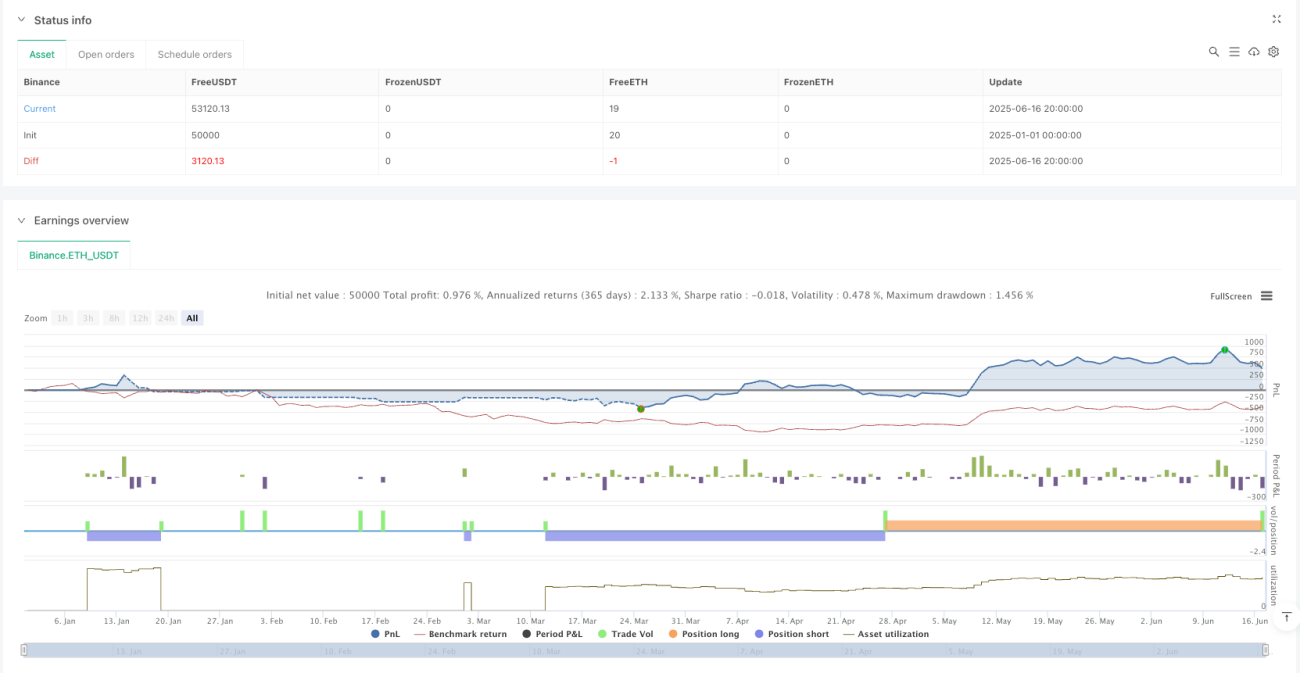
Enhance Backtesting Statistics: Implement more comprehensive backtesting performance metrics, such as maximum drawdown, Sharpe ratio, win rate, and profit factor, for more scientific strategy performance evaluation.
-
Adaptive Parameters: Transform fixed parameters into dynamic ones that adjust based on market volatility, enabling the strategy to adapt to different market environments.
-
Add Market Environment Filters: Incorporate VIX (Volatility Index) or similar indicators as market environment filters, adjusting strategy parameters or pausing trading in high-volatility environments.
Summary
The Dual Timeframe Stochastic Oscillator Arbitrage Trading Strategy is a carefully designed short-term high-frequency trading system that improves trading signal reliability through dual Stochastic oscillators, moving average filtering, and time filtering multi-layered confirmation mechanisms. The strategy identifies short-term overbought/oversold turning points and trend continuation patterns during regular market hours, suitable for markets with sufficient liquidity and moderate volatility.
Despite its well-structured design, the strategy still faces inherent risks associated with high-frequency trading and lacks critical risk management mechanisms such as stop-losses. To enhance the strategy's robustness and long-term profitability, it is recommended to add stop-loss mechanisms, position management systems, volume confirmation, and multi-indicator fusion. Additionally, transforming fixed parameters into adaptive ones and implementing comprehensive backtesting statistics tracking will help maintain stable performance across different market environments.
With traders' deepening understanding and continuous optimization of this strategy, this trading system has the potential to become an effective component in the intraday trading toolkit, particularly suitable for traders with a deep understanding of technical indicators and the ability to monitor markets in real-time.
- 1