Me topé con una interesante estrategia de Pine.
Hace unos días, estaba navegando por las estrategias en el Foro de Inventores y vi una publicación llamadaPanel Pro+ Quantum SmartPromptTras revisar el código, el concepto subyacente me pareció bastante interesante: utiliza 10 indicadores técnicos, asignando diferentes ponderaciones a cada uno según las condiciones del mercado y, finalmente, calculando una puntuación para determinar las decisiones de compra y venta. Por ejemplo, en un mercado alcista, el indicador de tendencia tiene una ponderación de 2.0 y el RSI de 1.5; en un mercado bajista, las ponderaciones son diferentes. Parece que imita la forma de pensar de la gente: centrándose en diferentes cosas en diferentes situaciones.
Si lo piensas detenidamente, esta estructura se parece mucho a una red neuronal:
- 10 indicadores técnicos al ingresar
- Clasificación del estado del mercado como capa oculta
- La matriz de peso es el peso de la conexión.
- Finalmente, se genera una puntuación
Pero el problema es que todos los pesos están codificados, por ejemplo:
pine
if marketType == "Bull"
array.set(weights, 0, 2.0) // 趋势权重固定是2.0
array.set(weights, 1, 1.5) // RSI权重固定是1.5
Estos números están completamente fijados por el autor en base a la experiencia del mercado y no han sido estudiados ni optimizados de ninguna manera.
Idea: Hacer que las pesas se puedan aprender
Dado que la estructura ya es muy similar a una red neuronal, ¿por qué no hacerla realmente capaz de aprender?
Mi idea es simple:
- Mantenga el método de cálculo de peso original y obtenga una "puntuación de peso"
- Usando esta puntuación ponderada como entrada, entrene una pequeña red neuronal
- Deje que la red aprenda a predecir rendimientos futuros a partir de puntuaciones ponderadas
- Decidir si abrir una posición en función de la tasa de rendimiento prevista
Esto no sólo conserva la estrategia original sino que también aumenta la capacidad de aprendizaje.
Comience a utilizar la Plataforma Inventor
La plataforma Inventor fue elegida principalmente porque admite Python y contiene datos en gran cantidad.
Paso 1: Reescribir los indicadores técnicos
Reescribí todos los indicadores del script Pine en Python, usando la biblioteca Talib para garantizar cálculos precisos. Esto incluye indicadores comunes como la EMA, el MACD, el RSI y el ATR, así como análisis de volumen y reconocimiento simple de patrones de velas.
Paso 2: Detección del estado del mercado
Siguiendo la lógica de la estrategia original, el tipo de mercado se determina en función de una combinación de varios indicadores: Toro, Oso, Águila, Lobo, etc. Esta parte es básicamente una combinación de lógica if-else.
Paso 3: Cálculo de la puntuación de peso
Esta es la parte principal. Establecí dos conjuntos de pesas:
- Peso básico:[2.0, 1.5, 2.0, 1.3, 1.2, ...]
- Peso del mercado: ajustado según las diferentes condiciones del mercado
Peso final = peso base × peso de mercado
Este peso se utiliza luego para ponderar las puntuaciones originales de los 10 indicadores y sumarlos para obtener la "puntuación ponderada".
Paso 4: Predictor de redes neuronales
Escribí una red muy simple:
- Entrada: 1 característica (puntuación ponderada)
- Capa oculta: 16 neuronas, activación ReLU
- Salida: tasa de rendimiento prevista, limitada a ±5 % utilizando tanh
Objetivo del entrenamiento: utilizar la puntuación de peso en el tiempo t-1 para predecir el cambio de precio en el tiempo t.
Paso 5: Lógica de la transacción
En lugar de comprar o vender directamente en función de la calificación, miramos la tasa de rendimiento prevista:
- Tasa de rendimiento prevista > 1,5 %: Abrir posición larga o cerrar posición corta
- Tasa de rendimiento prevista < -1,5 %: abrir una posición corta o cerrar una posición larga
- Otras situaciones: Mantener el status quo
Al mismo tiempo, mantenga los niveles de stop-profit y stop-loss para garantizar que los riesgos sean controlables.
Algunas observaciones sobre el funcionamiento real
Recopilación de datos
La estrategia puede recopilar datos de entrenamiento con normalidad. Cada vez que aparece una nueva vela, se utiliza el peso de la vela anterior como característica, y el aumento o la disminución de la vela actual con respecto a la anterior se utiliza como etiqueta.
Los datos probablemente sean así:
            权重评分=15.6, 收益率=+0.8%
权重评分=-8.2, 收益率=-1.2%
权重评分=22.1, 收益率=+0.3%
Entrenamiento de modelos
La red neuronal se puede entrenar con normalidad y la pérdida de MSE disminuirá gradualmente. Configure el reentrenamiento cada 4 horas para garantizar que el modelo se adapte a los cambios del mercado.
Efecto de predicción
Las predicciones del modelo tienen cierta correlación con los rendimientos reales, pero no es particularmente fuerte.
- Una sola característica es demasiado simple y puede no contener suficiente información
- Las fluctuaciones de precios a corto plazo son altamente aleatorias
- El mercado de contratos es bastante ruidoso
Rendimiento comercial
El riesgo de una sola transacción está bien controlado gracias a la protección de stop-loss y take-profit. Sin embargo, la rentabilidad general es media, principalmente debido a la falta de precisión en los pronósticos.
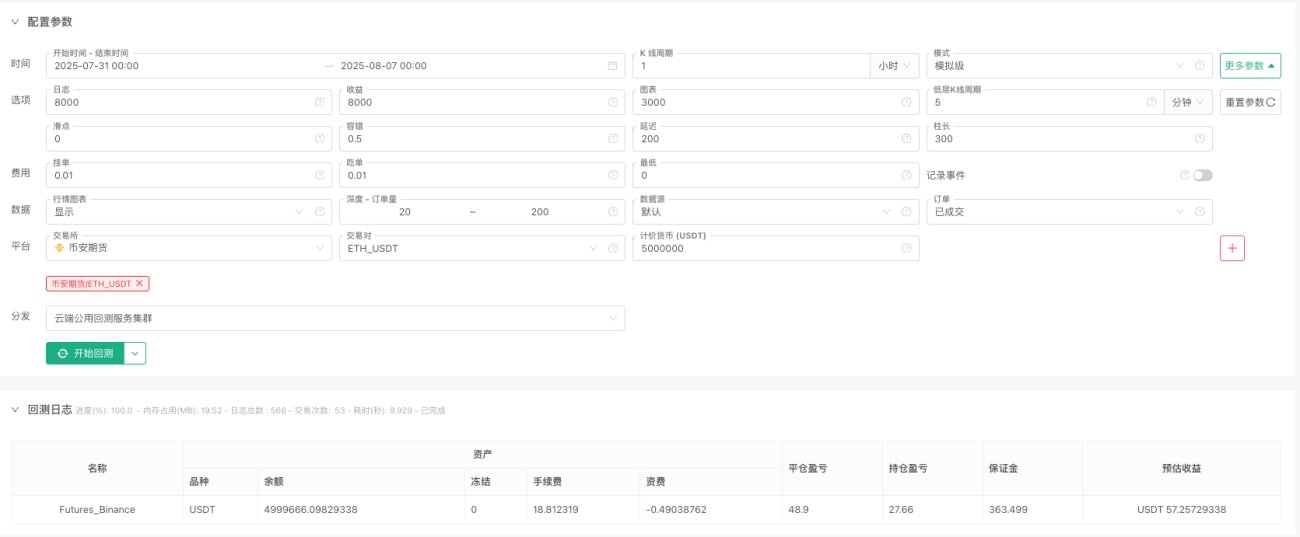
Algunos problemas encontrados
Las características son demasiado simplesUsar solo la ponderación para evaluar una sola característica es, sin duda, un poco simplista. El mercado es tan complejo que resulta difícil resumirlo completamente con una sola cifra.
Calidad de muestra inestableLos precios de los contratos fluctúan mucho en el corto plazo y, en muchos casos, las subidas y bajadas son realmente aleatorias, lo que hace que la calidad de las muestras de entrenamiento sea inestable.
Riesgo de una adaptación excesiva:Aunque la red es simple, aún puede sobreajustarse cuando el tamaño de la muestra es limitado.
Requisitos en tiempo real:El aprendizaje en línea requiere un equilibrio entre el tiempo de formación y el rendimiento en tiempo real.
Tiempo limitado y optimización insuficiente
Todavía hay muchas áreas en las que se puede mejorar esta estrategia, pero el tiempo y la energía son limitados, por lo que no podemos optimizarla en profundidad:
Características:Puede agregar más indicadores técnicos o utilizar las características estadísticas de las series de precios.
Modelo:Puede probar un modelo de secuencia como LSTM o integrar múltiples modelos.
Datos:Mejorar la calidad de la muestra y aumentar la limpieza de datos.
El control del viento:Mejore el stop loss dinámico y optimice la gestión de posiciones.
Ganancias y pensamientos
Esta exploración me enseñó una lección: ¡la clave de las buenas ideas es la implementación oportuna! Cuando vi el diseño de la matriz de ponderación en el script de Pine, pensé de inmediato en la posibilidad de mejorarlo con una red neuronal. Si solo lo hubiera pensado o lo hubiera pospuesto, probablemente la habría olvidado. Afortunadamente, la plataforma Inventor me proporcionó un entorno Python y una interfaz de datos, lo que me permitió transformar rápidamente mi idea en código ejecutable. Desde la generación de la idea hasta la implementación básica, solo me llevó un día. Si bien el rendimiento final de la estrategia fue mediocre, la implementación real al menos verificó la viabilidad de la idea. Más importante aún, el proceso de implementación generó nuevas ideas y mejoras. Sin una acción rápida, estos descubrimientos y perspectivas posteriores habrían sido imposibles. Hablar de ideas sobre el papel nunca se puede comparar con la experiencia real de escribir código, ejecutar datos y observar resultados. Esta es la naturaleza del trading cuantitativo. Hay muchas ideas, pero las verdaderamente valiosas son las que se implementan y verifican rápidamente.
python
'''backtest
start: 2025-07-31 00:00:00
end: 2025-08-07 00:00:00
period: 1h
basePeriod: 5m
exchanges: [{"eid":"Futures_Binance","currency":"ETH_USDT","balance":5000000,"fee":[0.01,0.01]}]
'''
import numpy as np
from collections import deque
import talib as TA
# ========== 异常类 ==========
class Error_noSupport(BaseException):
def __init__(self):
Log("只支持期货交易!#FF0000")
class Error_AtBeginHasPosition(BaseException):
def __init__(self):
Log("启动时有期货持仓! #FF0000")
# ========== 收益率预测神经网络 ==========
class ReturnPredictor:
def __init__(self, input_size=10, hidden_size=20, output_size=1):
"""收益率预测网络: X[t] -> y[t+1] (收益率)"""
self.W1 = np.random.randn(input_size, hidden_size) * 0.1
self.b1 = np.zeros((1, hidden_size))
self.W2 = np.random.randn(hidden_size, output_size) * 0.1
self.b2 = np.zeros((1, output_size))
self.learning_rate = 0.001
def sigmoid(self, x):
return 1 / (1 + np.exp(-np.clip(x, -250, 250)))
def tanh(self, x):
return np.tanh(x)
def forward(self, X):
self.z1 = np.dot(X, self.W1) + self.b1
self.a1 = self.sigmoid(self.z1)
self.z2 = np.dot(self.a1, self.W2) + self.b2
# 输出预测收益率,使用tanh限制在合理范围
self.a2 = self.tanh(self.z2) * 0.1 # 限制在±10%范围内
return self.a2
def backward(self, X, y, output):
m = X.shape[0]
# MSE损失的梯度
dZ2 = (output - y) / m
# tanh的导数
tanh_derivative = 1 - (output / 0.1) ** 2
dZ2 = dZ2 * 0.1 * tanh_derivative
dW2 = np.dot(self.a1.T, dZ2)
db2 = np.sum(dZ2, axis=0, keepdims=True)
dA1 = np.dot(dZ2, self.W2.T)
dZ1 = dA1 * self.a1 * (1 - self.a1) # sigmoid导数
dW1 = np.dot(X.T, dZ1)
db1 = np.sum(dZ1, axis=0, keepdims=True)
# 更新权重
self.W2 -= self.learning_rate * dW2
self.b2 -= self.learning_rate * db2
self.W1 -= self.learning_rate * dW1
self.b1 -= self.learning_rate * db1
def train(self, X, y, epochs=100):
for i in range(epochs):
output = self.forward(X)
self.backward(X, y, output)
if i % 20 == 0:
loss = np.mean((output - y) ** 2)
Log(f"收益率预测训练轮次 {i}, MSE损失: {loss:.6f}")
def predict(self, X):
return self.forward(X)
# ========== 技术指标计算类 ==========
class TechnicalIndicators:
@staticmethod
def calculate_indicators(records, use_completed_only=True):
"""计算技术指标和特征"""
if len(records) < 55:
return None, None
# 只使用已完成的K线数据
if use_completed_only and len(records) > 1:
working_records = records[:-1]
else:
working_records = records
if len(working_records) < 55:
return None, None
closes = np.array([r['Close'] for r in working_records])
highs = np.array([r['High'] for r in working_records])
lows = np.array([r['Low'] for r in working_records])
volumes = np.array([r['Volume'] for r in working_records])
opens = np.array([r['Open'] for r in working_records])
try:
# 基础指标
ema_55 = TA.EMA(closes, timeperiod=55)
sma_vol20 = TA.SMA(volumes, timeperiod=20)
macd, signal_line, _ = TA.MACD(closes)
rsi_val = TA.RSI(closes, timeperiod=14)
atr14 = TA.ATR(highs, lows, closes, timeperiod=14)
range20 = TA.STDDEV(closes, timeperiod=20)
# 计算派生指标
sma_atr20 = TA.SMA(atr14, timeperiod=20)
sma_range20 = TA.SMA(range20, timeperiod=20)
rvol = volumes / sma_vol20 if sma_vol20[-1] > 0 else np.ones_like(volumes)
delta = closes - opens
# 计算量能阈值
vol_abs_thresh = sma_vol20 * 1.2
sniper_thresh = np.percentile(volumes[-40:], 80) if len(volumes) >= 40 else sma_vol20[-1]
# 趋势
trend = np.where(closes > ema_55, 1, np.where(closes < ema_55, -1, 0))
# 简化K线形态
body_size = np.abs(closes - opens)
total_range = highs - lows
# 锤子线
is_hammer = ((total_range > 3 * body_size) &
((closes - lows) / (total_range + 0.001) > 0.6) &
((opens - lows) / (total_range + 0.001) > 0.6))
# 吞噬形态
is_engulfing = np.zeros_like(closes, dtype=bool)
if len(closes) >= 2:
is_engulfing[1:] = ((closes[1:] > opens[:-1]) &
(opens[1:] < closes[:-1]) &
(closes[1:] > opens[1:]) &
(opens[1:] < closes[1:]))
pattern = np.where(is_hammer, 1, np.where(is_engulfing, 2, 0))
# 🔥 计算标准化特征向量(用于神经网络输入)
features = []
# 1. 趋势特征
if len(ema_55) > 0 and not np.isnan(ema_55[-1]):
trend_feature = (closes[-1] - ema_55[-1]) / ema_55[-1]
features.append(np.tanh(trend_feature * 100))
else:
features.append(0)
# 2. RSI特征
if len(rsi_val) > 0 and not np.isnan(rsi_val[-1]):
rsi_feature = (rsi_val[-1] - 50) / 50
features.append(rsi_feature)
else:
features.append(0)
# 3. MACD特征
if len(macd) > 0 and not np.isnan(macd[-1]) and not np.isnan(signal_line[-1]):
macd_feature = (macd[-1] - signal_line[-1]) / closes[-1] if closes[-1] > 0 else 0
features.append(np.tanh(macd_feature * 1000))
else:
features.append(0)
# 4. 成交量特征
if len(vol_abs_thresh) > 0 and vol_abs_thresh[-1] > 0:
vol_feature = volumes[-1] / vol_abs_thresh[-1] - 1
features.append(np.tanh(vol_feature))
else:
features.append(0)
# 5. 相对成交量特征
if len(rvol) > 0 and not np.isnan(rvol[-1]):
rvol_feature = rvol[-1] - 1
features.append(np.tanh(rvol_feature))
else:
features.append(0)
# 6. Delta特征
if len(delta) > 0 and not np.isnan(delta[-1]) and closes[-1] > 0:
delta_feature = delta[-1] / closes[-1]
features.append(np.tanh(delta_feature * 100))
else:
features.append(0)
# 7. ATR特征
if len(atr14) > 0 and len(sma_atr20) > 0 and sma_atr20[-1] > 0:
atr_feature = atr14[-1] / sma_atr20[-1] - 1
features.append(np.tanh(atr_feature))
else:
features.append(0)
# 8. Blocks特征
if len(volumes) >= 10:
highest_vol = np.max(volumes[-10:])
blocks_feature = volumes[-1] / highest_vol - 0.8 if highest_vol > 0 else 0
features.append(np.tanh(blocks_feature * 5))
else:
features.append(0)
# 9. Tick特征
if len(sma_vol20) > 0 and sma_vol20[-1] > 0:
tick_feature = volumes[-1] / sma_vol20[-1] - 1
features.append(np.tanh(tick_feature))
else:
features.append(0)
# 10. 形态特征
pattern_feature = pattern[-1] / 2.0 if len(pattern) > 0 else 0
features.append(pattern_feature)
# 确保特征数量正确
while len(features) < 10:
features.append(0)
features = np.array(features[:10]).reshape(1, -1)
indicators = {
'ema_55': ema_55,
'sma_vol20': sma_vol20,
'macd': macd,
'signal_line': signal_line,
'rsi_val': rsi_val,
'atr14': atr14,
'range20': range20,
'sma_atr20': sma_atr20,
'sma_range20': sma_range20,
'rvol': rvol,
'delta': delta,
'vol_abs_thresh': vol_abs_thresh,
'sniper_thresh': sniper_thresh,
'trend': trend,
'pattern': pattern,
'volumes': volumes,
'closes': closes,
'highs': highs,
'lows': lows
}
return indicators, features
except Exception as e:
Log(f"计算技术指标异常: {str(e)}")
return None, None
# ========== 市场状态检测类 ==========
class MarketStateDetector:
@staticmethod
def detect_market_type(indicators):
"""检测市场状态"""
if indicators is None:
return "Unknown"
try:
# 获取最新值
close = indicators['closes'][-1]
ema_55 = indicators['ema_55'][-1]
macd = indicators['macd'][-1]
signal_line = indicators['signal_line'][-1]
rsi_val = indicators['rsi_val'][-1]
atr14 = indicators['atr14'][-1]
volume = indicators['volumes'][-1]
sma_vol20 = indicators['sma_vol20'][-1]
sma_atr20 = indicators['sma_atr20'][-1]
range20 = indicators['range20'][-1]
sma_range20 = indicators['sma_range20'][-1]
rvol = indicators['rvol'][-1]
delta = indicators['delta'][-1]
# 检查有效性
if (np.isnan(ema_55) or np.isnan(macd) or np.isnan(signal_line) or
np.isnan(rsi_val) or np.isnan(atr14) or np.isnan(sma_atr20)):
return "Unknown"
# 市场类型判断
is_bull = (close > ema_55 and macd > signal_line and rsi_val > 50 and rvol > 1)
is_bear = (close < ema_55 and macd < signal_line and rsi_val < 50 and volume > sma_vol20)
is_sideways = (abs(close - ema_55) < atr14 * 0.5 and atr14 < sma_atr20)
is_volatile = (atr14 > sma_atr20 * 1.2)
# 需要历史数据的判断
if len(indicators['closes']) >= 2:
price_change = indicators['closes'][-1] - indicators['closes'][-2]
is_momentum = (price_change > atr14 * 1.5 and volume > sma_vol20 * 1.5)
is_wolf = (price_change < -atr14 and close < ema_55)
else:
is_momentum = False
is_wolf = False
is_mean_rev = (rsi_val > 70 or rsi_val < 30)
is_box = (is_sideways and range20 < sma_range20 * 0.8)
is_macro = (abs(delta) > atr14 * 2) if not np.isnan(delta) else False
is_eagle = (is_bull and atr14 < sma_atr20 * 0.8)
# 优先级判断
if is_eagle:
return "Eagle"
elif is_bull:
return "Bull"
elif is_wolf:
return "Wolf"
elif is_bear:
return "Bear"
elif is_box:
return "Box"
elif is_sideways:
return "Sideways"
elif is_volatile:
return "Volatile"
elif is_momentum:
return "Momentum"
elif is_mean_rev:
return "MeanRev"
elif is_macro:
return "Macro"
else:
return "Unknown"
except Exception as e:
Log(f"市场状态检测异常: {str(e)}")
return "Unknown"
# ========== 动态权重生成器 ==========
class DynamicWeightGenerator:
@staticmethod
def generate_weights_from_predicted_return(predicted_return, market_type):
"""根据预测收益率和市场状态生成动态权重"""
# 基础权重矩阵(不同市场类型)
base_weights_matrix = {
"Bull": [2.0, 1.5, 2.0, 1.3, 1.2, 1.0, 1.2, 1.0, 1.0, 1.0],
"Bear": [2.0, 1.5, 2.0, 1.5, 1.3, 1.1, 1.2, 1.1, 1.0, 1.0],
"Eagle": [2.2, 1.4, 2.1, 1.2, 1.3, 1.1, 1.1, 1.0, 1.0, 1.1],
"Wolf": [1.8, 1.6, 1.8, 1.6, 1.2, 1.0, 1.3, 1.2, 1.0, 0.9],
"Momentum": [1.5, 1.2, 1.8, 2.0, 2.0, 1.5, 1.5, 1.3, 1.2, 1.0],
"Sideways": [1.0, 1.4, 1.0, 0.8, 0.7, 1.0, 0.9, 0.8, 1.0, 1.3],
"Volatile": [1.2, 1.5, 1.3, 1.6, 1.8, 1.2, 1.4, 1.3, 1.4, 1.0],
}
base_weights = base_weights_matrix.get(market_type, [1.0] * 10)
# 🔥 根据预测收益率动态调整权重
adjustment_factors = [1.0] * 10
# 预测收益率的强度
return_strength = abs(predicted_return)
return_direction = 1 if predicted_return > 0 else -1
if return_strength > 0.02: # 强预测信号 > 2%
if return_direction > 0: # 预测上涨
adjustment_factors[0] *= 1.3 # 增强趋势权重
adjustment_factors[2] *= 1.2 # 增强MACD权重
adjustment_factors[4] *= 1.15 # 增强相对成交量权重
adjustment_factors[1] *= 0.9 # 降低RSI权重
else: # 预测下跌
adjustment_factors[1] *= 1.3 # 增强RSI权重
adjustment_factors[3] *= 1.2 # 增强成交量权重
adjustment_factors[0] *= 0.9 # 降低趋势权重
elif return_strength > 0.01: # 中等预测信号 1%-2%
if return_direction > 0:
adjustment_factors[0] *= 1.15
adjustment_factors[2] *= 1.1
else:
adjustment_factors[1] *= 1.15
adjustment_factors[3] *= 1.1
# 波动性调整
if return_strength > 0.03: # 高波动预期 > 3%
adjustment_factors[4] *= 1.2 # 增强相对成交量权重
adjustment_factors[6] *= 1.15 # 增强sniper权重
adjustment_factors[7] *= 1.1 # 增强blocks权重
# 生成最终动态权重
dynamic_weights = [base_weights[i] * adjustment_factors[i] for i in range(10)]
# 权重标准化(可选)
# total_weight = sum(dynamic_weights)
# dynamic_weights = [w / total_weight * 10 for w in dynamic_weights]
return dynamic_weights
# ========== 智能得分计算系统 ==========
class SmartScoringSystem:
def __init__(self):
self.return_predictor = ReturnPredictor()
self.weight_generator = DynamicWeightGenerator()
self.is_model_trained = False
def calculate_score(self, indicators, market_type, features=None):
"""计算交易得分(使用预测收益率的动态权重)"""
if indicators is None:
return 50.0
try:
# 🔥 核心逻辑:使用当前指标预测下期收益率
if self.is_model_trained and features is not None:
predicted_return = self.return_predictor.predict(features)[0, 0]
else:
predicted_return = 0.0
Log(f"📊 使用基础权重计算")
# 根据预测收益率生成动态权重
dynamic_weights = self.weight_generator.generate_weights_from_predicted_return(
predicted_return, market_type)
# 获取最新指标值
trend = indicators['trend'][-1]
rsi_val = indicators['rsi_val'][-1]
macd = indicators['macd'][-1]
signal_line = indicators['signal_line'][-1]
volume = indicators['volumes'][-1]
vol_abs_thresh = indicators['vol_abs_thresh'][-1]
sma_vol20 = indicators['sma_vol20'][-1]
rvol = indicators['rvol'][-1]
delta = indicators['delta'][-1]
sniper_thresh = indicators['sniper_thresh']
pattern = indicators['pattern'][-1]
# 计算各项得分
base_score = 0.0
# 1. 趋势得分
trend_score = 20 if trend == 1 else (-20 if trend == -1 else 0)
base_score += trend_score * dynamic_weights[0]
# 2. RSI得分
rsi_score = -10 if rsi_val > 70 else (10 if rsi_val < 30 else 0)
base_score += rsi_score * dynamic_weights[1]
# 3. MACD得分
macd_score = 10 if macd > signal_line else -10
base_score += macd_score * dynamic_weights[2]
# 4. 成交量得分
vol_score = 8 if volume > vol_abs_thresh else (-8 if volume < sma_vol20 else 0)
base_score += vol_score * dynamic_weights[3]
# 5. 相对成交量得分
rvol_score = 7 if rvol > 1.5 else (-7 if rvol < 0.8 else 0)
base_score += rvol_score * dynamic_weights[4]
# 6. Delta得分
delta_score = 6 if delta > 0 else -6
base_score += delta_score * dynamic_weights[5]
# 7. Sniper得分
sniper_score = 8 if volume > sniper_thresh else (-8 if volume < sma_vol20 else 0)
base_score += sniper_score * dynamic_weights[6]
# 8. Blocks得分
if len(indicators['volumes']) >= 10:
highest_vol = np.max(indicators['volumes'][-10:])
blocks_score = 5 if volume > highest_vol * 0.8 else (-5 if volume < sma_vol20 else 0)
else:
blocks_score = 0
base_score += blocks_score * dynamic_weights[7]
# 9. Tick得分
tick_score = 5 if volume > sma_vol20 else -5
base_score += tick_score * dynamic_weights[8]
# 10. 形态得分
pattern_score = 7 if pattern == 1 else (5 if pattern == 2 else 0)
base_score += pattern_score * dynamic_weights[9]
# 转换为百分比得分
score_pct = max(0, min(100, 50 + base_score))
return score_pct
except Exception as e:
Log(f"得分计算异常: {str(e)}")
return 50.0
def train_return_predictor(self, X, y):
"""训练收益率预测器"""
if len(X) < 20:
Log("训练数据不足,跳过收益率预测器训练")
return False
X_array = np.array(X)
y_array = np.array(y).reshape(-1, 1)
Log(f"🧠 开始训练收益率预测器,样本数: {len(X_array)}")
Log(f"📊 收益率范围: [{np.min(y_array)*100:.3f}%, {np.max(y_array)*100:.3f}%]")
self.return_predictor.train(X_array, y_array, epochs=100)
self.is_model_trained = True
# 验证模型预测效果
predictions = self.return_predictor.predict(X_array)
mse = np.mean((predictions - y_array) ** 2)
correlation = np.corrcoef(predictions.flatten(), y_array.flatten())[0, 1]
Log(f"✅ 收益率预测器训练完成")
Log(f"📈 MSE: {mse:.6f}, 相关系数: {correlation:.4f}")
return True
# ========== 动态参数管理器 ==========
class DynamicParameterManager:
def __init__(self):
self.market_params = {
"Bull": {"stop_loss": 0.02, "take_profit": 0.05},
"Bear": {"stop_loss": 0.02, "take_profit": 0.05},
"Eagle": {"stop_loss": 0.015, "take_profit": 0.06},
"Wolf": {"stop_loss": 0.025, "take_profit": 0.04},
"Momentum": {"stop_loss": 0.025, "take_profit": 0.06},
"Sideways": {"stop_loss": 0.01, "take_profit": 0.02},
"Volatile": {"stop_loss": 0.03, "take_profit": 0.07},
"Unknown": {"stop_loss": 0.02, "take_profit": 0.03}
}
def get_params(self, market_type):
return self.market_params.get(market_type, self.market_params["Unknown"])
# ========== 主策略类 ==========
class PredictiveNeuralTradingStrategy:
def __init__(self):
self.data_buffer = deque(maxlen=200)
self.feature_buffer = deque(maxlen=100)
self.label_buffer = deque(maxlen=100) # 存储收益率标签
self.scoring_system = SmartScoringSystem()
self.param_manager = DynamicParameterManager()
# 训练控制
self.last_retrain_time = 0
self.retrain_interval = 3600 * 6 # 6小时重新训练
self.min_train_samples = 30
# 交易状态
self.POSITION_NONE = 0
self.POSITION_LONG = 1
self.POSITION_SHORT = 2
self.position_state = self.POSITION_NONE
# 交易记录
self.open_price = 0
self.counter = {'win': 0, 'loss': 0}
# K线数据管理
self.last_processed_time = 0
def get_current_position(self):
"""获取当前期货持仓状态"""
try:
positions = exchange.GetPosition()
if not positions:
return self.POSITION_NONE, 0
long_amount = 0
short_amount = 0
for pos in positions:
amount = pos.get('Amount', 0)
pos_type = pos.get('Type', -1)
if amount > 0:
if pos_type == 0: # 多仓
long_amount += amount
elif pos_type == 1: # 空仓
short_amount += amount
net_position = long_amount - short_amount
if net_position > 0:
return self.POSITION_LONG, net_position
elif net_position < 0:
return self.POSITION_SHORT, abs(net_position)
else:
return self.POSITION_NONE, 0
except Exception as e:
Log(f"获取持仓异常: {str(e)}")
return self.POSITION_NONE, 0
def collect_data(self, records):
"""收集数据并生成训练样本"""
if not records or len(records) < 55:
return False
# 检查是否有新的已完成K线
if len(records) > 1:
latest_completed = records[-2]
current_time = latest_completed['Time']
# 如果这根K线已经处理过,跳过
if current_time <= self.last_processed_time:
return False
self.last_processed_time = current_time
# 添加已完成的K线到缓冲区
completed_records = records[:-1] if len(records) > 1 else []
if completed_records:
self.data_buffer.extend(completed_records[-5:])
# 🔥 生成训练样本:X[t] -> y[t+1]
if len(self.data_buffer) >= 2:
# 使用倒数第二条记录作为特征,最后一条记录计算收益率标签
buffer_list = list(self.data_buffer)
# 计算t-1时刻的指标作为特征
feature_records = buffer_list[:-1] if len(buffer_list) > 1 else buffer_list
indicators, features = TechnicalIndicators.calculate_indicators(
feature_records, use_completed_only=False)
if indicators is not None and features is not None:
# 计算t时刻相对于t-1时刻的收益率作为标签
if len(buffer_list) >= 2:
current_close = buffer_list[-1]['Close']
previous_close = buffer_list[-2]['Close']
if previous_close > 0:
return_rate = (current_close - previous_close) / previous_close
# 添加到训练集
self.feature_buffer.append(features[0])
self.label_buffer.append(return_rate)
Log(f"📈 新样本: 收益率={return_rate*100:.3f}%, 特征维度={features.shape}")
return True
def should_retrain(self):
"""判断是否需要重新训练"""
import time
current_time = time.time()
return (current_time - self.last_retrain_time > self.retrain_interval and
len(self.feature_buffer) >= self.min_train_samples)
def train_model(self):
"""训练收益率预测器"""
if len(self.feature_buffer) < self.min_train_samples:
Log("训练数据不足,跳过训练")
return False
X = list(self.feature_buffer)
y = list(self.label_buffer)
success = self.scoring_system.train_return_predictor(X, y)
if success:
import time
self.last_retrain_time = time.time()
return success
def get_trading_signals(self, records):
"""获取交易信号"""
# 计算当前时刻的技术指标
indicators, features = TechnicalIndicators.calculate_indicators(
list(self.data_buffer), use_completed_only=False)
if indicators is None:
return 50.0, "Unknown"
# 检测市场类型
market_type = MarketStateDetector.detect_market_type(indicators)
# 🔥 使用预测收益率的动态权重计算得分
score = self.scoring_system.calculate_score(indicators, market_type, features)
return score, market_type
def check_entry_conditions(self, score, market_type):
"""检查开仓条件"""
# 多头条件
long_condition = ((market_type in ["Bull", "Eagle", "Momentum"]) and score > 65)
# 空头条件
short_condition = ((market_type in ["Bear", "Wolf"]) and score < 35)
return long_condition, short_condition
def open_long(self):
"""开多仓"""
try:
ticker = exchange.GetTicker()
if not ticker:
return False
buy_price = ticker['Last'] + 20
order_id = exchange.CreateOrder("", "buy", buy_price, AmountOP)
if order_id:
Sleep(2000)
order_info = exchange.GetOrder(order_id)
if order_info and order_info.get('Status') == 1:
self.open_price = order_info.get('AvgPrice', buy_price)
self.position_state = self.POSITION_LONG
Log(f"🚀 开多仓成功: 价格={self.open_price}, 数量={AmountOP}")
return True
else:
exchange.CancelOrder(order_id)
Log("开多仓订单未完全成交,已取消")
return False
except Exception as e:
Log(f"开多仓异常: {str(e)}")
return False
def open_short(self):
"""开空仓"""
try:
ticker = exchange.GetTicker()
if not ticker:
return False
sell_price = ticker['Last'] - 20
order_id = exchange.CreateOrder("", "sell", sell_price, AmountOP)
if order_id:
Sleep(2000)
order_info = exchange.GetOrder(order_id)
if order_info and order_info.get('Status') == 1:
self.open_price = order_info.get('AvgPrice', sell_price)
self.position_state = self.POSITION_SHORT
Log(f"🎯 开空仓成功: 价格={self.open_price}, 数量={AmountOP}")
return True
else:
exchange.CancelOrder(order_id)
Log("开空仓订单未完全成交,已取消")
return False
except Exception as e:
Log(f"开空仓异常: {str(e)}")
return False
def close_position(self):
"""平仓"""
try:
positions = exchange.GetPosition()
if not positions:
Log("没有持仓需要平仓")
self.position_state = self.POSITION_NONE
self.open_price = 0
return True
ticker = exchange.GetTicker()
if not ticker:
return False
close_success = True
for pos in positions:
if pos['Amount'] == 0:
continue
amount = pos['Amount']
pos_type = pos['Type']
if pos_type == 0: # 平多仓
close_price = ticker['Last'] - 20
order_id = exchange.CreateOrder("", "closebuy", close_price, amount)
Log(f"📤 平多仓: 价格={close_price}, 数量={amount}")
elif pos_type == 1: # 平空仓
close_price = ticker['Last'] + 20
order_id = exchange.CreateOrder("", "closesell", close_price, amount)
Log(f"📤 平空仓: 价格={close_price}, 数量={amount}")
if order_id:
Sleep(2000)
order_info = exchange.GetOrder(order_id)
if order_info and order_info.get('Status') == 1:
close_price = order_info.get('AvgPrice', close_price)
Log(f"✅ 平仓成功: 成交价格={close_price}")
self.update_profit_stats(close_price)
else:
exchange.CancelOrder(order_id)
close_success = False
Log(f"平仓订单未完全成交,已取消")
else:
close_success = False
Log("平仓订单创建失败")
if close_success:
self.position_state = self.POSITION_NONE
self.open_price = 0
return close_success
except Exception as e:
Log(f"平仓异常: {str(e)}")
return False
def update_profit_stats(self, close_price):
"""更新盈亏统计"""
if self.open_price == 0:
return
if self.position_state == self.POSITION_LONG:
if close_price > self.open_price:
self.counter['win'] += 1
Log("💰 多仓盈利")
else:
self.counter['loss'] += 1
Log("💸 多仓亏损")
elif self.position_state == self.POSITION_SHORT:
if close_price < self.open_price:
self.counter['win'] += 1
Log("💰 空仓盈利")
else:
self.counter['loss'] += 1
Log("💸 空仓亏损")
def check_stop_loss_take_profit(self, current_price, params):
"""检查止损止盈并执行平仓"""
if self.open_price == 0 or self.position_state == self.POSITION_NONE:
return False
stop_loss_pct = params["stop_loss"]
take_profit_pct = params["take_profit"]
if self.position_state == self.POSITION_LONG:
profit_pct = (current_price - self.open_price) / self.open_price
if profit_pct <= -stop_loss_pct:
Log(f"🔴 多仓止损触发: 开仓价={self.open_price:.2f}, 当前价={current_price:.2f}, 亏损={profit_pct:.4f}")
return self.execute_close_position("止损")
elif profit_pct >= take_profit_pct:
Log(f"🟢 多仓止盈触发: 开仓价={self.open_price:.2f}, 当前价={current_price:.2f}, 盈利={profit_pct:.4f}")
return self.execute_close_position("止盈")
elif self.position_state == self.POSITION_SHORT:
profit_pct = (self.open_price - current_price) / self.open_price
if profit_pct <= -stop_loss_pct:
Log(f"🔴 空仓止损触发: 开仓价={self.open_price:.2f}, 当前价={current_price:.2f}, 亏损={profit_pct:.4f}")
return self.execute_close_position("止损")
elif profit_pct >= take_profit_pct:
Log(f"🟢 空仓止盈触发: 开仓价={self.open_price:.2f}, 当前价={current_price:.2f}, 盈利={profit_pct:.4f}")
return self.execute_close_position("止盈")
return False
def execute_close_position(self, reason):
"""执行平仓操作(专门用于止盈止损)"""
try:
positions = exchange.GetPosition()
if not positions:
Log(f"{reason}平仓: 没有持仓")
self.position_state = self.POSITION_NONE
self.open_price = 0
return True
ticker = exchange.GetTicker()
if not ticker:
Log(f"{reason}平仓失败: 无法获取ticker")
return False
Log(f"🚨 执行{reason}平仓操作...")
close_success = True
for pos in positions:
if pos['Amount'] == 0:
continue
amount = pos['Amount']
pos_type = pos['Type']
order_id = None
if pos_type == 0: # 平多仓
close_price = ticker['Last'] - 50
order_id = exchange.CreateOrder("", "closebuy", close_price, amount)
Log(f"📤 {reason}平多仓订单: 价格={close_price}, 数量={amount}")
elif pos_type == 1: # 平空仓
close_price = ticker['Last'] + 50
order_id = exchange.CreateOrder("", "closesell", close_price, amount)
Log(f"📤 {reason}平空仓订单: 价格={close_price}, 数量={amount}")
if order_id:
Log(f"📋 {reason}平仓订单ID: {order_id}")
Sleep(1500)
for retry in range(2):
order_info = exchange.GetOrder(order_id)
if order_info:
status = order_info.get('Status', -1)
if status == 1:
close_price = order_info.get('AvgPrice', close_price)
Log(f"✅ {reason}平仓成功: 成交价格={close_price}")
self.update_profit_stats(close_price)
break
elif status == 0:
if retry == 0:
Log(f"⏳ {reason}平仓订单执行中,等待...")
Sleep(1500)
else:
Log(f"⚠️ {reason}平仓订单未完全成交,强制取消")
exchange.CancelOrder(order_id)
close_success = False
else:
Log(f"❌ {reason}平仓订单状态异常: {status}")
exchange.CancelOrder(order_id)
close_success = False
break
else:
Log(f"⚠️ 无法获取{reason}平仓订单信息,重试 {retry+1}/2")
if retry == 1:
close_success = False
else:
Log(f"❌ {reason}平仓订单创建失败")
close_success = False
if close_success:
Sleep(1000)
new_positions = exchange.GetPosition()
total_amount = sum(pos['Amount'] for pos in new_positions) if new_positions else 0
if total_amount == 0:
Log(f"✅ {reason}平仓完成,持仓已清零")
self.position_state = self.POSITION_NONE
self.open_price = 0
return True
else:
Log(f"⚠️ {reason}平仓不完全,剩余持仓: {total_amount}")
return False
else:
Log(f"❌ {reason}平仓失败")
return False
except Exception as e:
Log(f"❌ {reason}平仓异常: {str(e)}")
return False
def execute_trade_logic(self, score, market_type, current_price):
"""执行交易逻辑"""
params = self.param_manager.get_params(market_type)
# 获取当前实际持仓状态
actual_position, position_amount = self.get_current_position()
# 同步内部状态
self.position_state = actual_position
# 先检查止损止盈(最高优先级)
if self.position_state != self.POSITION_NONE:
if self.check_stop_loss_take_profit(current_price, params):
Log("🚨 触发止盈止损,已执行平仓,跳过其他交易信号")
return
# 获取开仓条件
long_condition, short_condition = self.check_entry_conditions(score, market_type)
# 执行交易逻辑
if long_condition and self.position_state <= self.POSITION_NONE:
Log(f"📈 开多仓信号: 市场={market_type}, 预测得分={score:.1f} > 65")
self.open_long()
if short_condition and self.position_state >= self.POSITION_NONE:
Log(f"📉 开空仓信号: 市场={market_type}, 预测得分={score:.1f} < 35")
self.open_short()
if not long_condition and self.position_state > self.POSITION_NONE:
Log(f"📤 平多仓信号: 市场={market_type}, 预测得分={score:.1f}")
self.close_position()
if not short_condition and self.position_state < self.POSITION_NONE:
Log(f"📤 平空仓信号: 市场={market_type}, 预测得分={score:.1f}")
self.close_position()
def CancelPendingOrders():
"""取消所有挂单"""
while True:
orders = exchange.GetOrders()
if not orders:
break
for order in orders:
exchange.CancelOrder(order['Id'])
Sleep(500)
def main():
global AmountOP, LoopInterval
# 检查初始持仓
initial_positions = exchange.GetPosition()
if initial_positions and any(pos['Amount'] > 0 for pos in initial_positions):
raise Error_AtBeginHasPosition()
# 取消所有挂单
CancelPendingOrders()
# 初始化策略
strategy = PredictiveNeuralTradingStrategy()
Log("🔮 预测型神经网络期货交易策略启动")
LogProfitReset()
# 数据预热期
Log("进入数据预热期...")
warmup_count = 0
warmup_target = 60
while warmup_count < warmup_target:
records = exchange.GetRecords()
if records and len(records) >= 55:
if strategy.collect_data(records):
warmup_count += 1
if warmup_count % 10 == 0:
Log(f"预热进度: {warmup_count}/{warmup_target}")
Sleep(5000)
Log("数据预热完成,开始首次收益率预测器训练...")
strategy.train_model()
# 主交易循环
loop_count = 0
while True:
loop_count += 1
# 获取K线数据
records = exchange.GetRecords()
if not records or len(records) < 55:
Sleep(LoopInterval * 1000)
continue
# 数据处理
data_updated = strategy.collect_data(records)
# 检查是否需要重新训练
if strategy.should_retrain():
Log("🔄 重新训练收益率预测器...")
strategy.train_model()
# 获取交易信号
score, market_type = strategy.get_trading_signals(records)
# 获取当前实时价格
ticker = exchange.GetTicker()
if ticker:
current_price = ticker['Last']
else:
current_price = records[-1]['Close']
# 获取当前参数
params = strategy.param_manager.get_params(market_type)
# 优先检查止损止盈(使用实时价格)
if strategy.position_state != strategy.POSITION_NONE:
if strategy.check_stop_loss_take_profit(current_price, params):
Log("⚡ 触发止盈止损,已执行平仓")
Sleep(LoopInterval * 1000)
continue
# 执行交易逻辑(只在有新数据时执行)
if data_updated:
strategy.execute_trade_logic(score, market_type, current_price)
# 状态显示
pos_state_name = {
strategy.POSITION_NONE: "无仓",
strategy.POSITION_LONG: "多仓",
strategy.POSITION_SHORT: "空仓"
}.get(strategy.position_state, "未知")
data_status = "📊新数据" if data_updated else "⏸️等待"
model_status = "🔮预测" if strategy.scoring_system.is_model_trained else "📊基础"
# 获取开仓条件用于显示
long_cond, short_cond = strategy.check_entry_conditions(score, market_type)
signal_status = ""
if long_cond:
signal_status = "📈多头"
elif short_cond:
signal_status = "📉空头"
else:
signal_status = "🔄观望"
# 显示训练样本数量
sample_count = len(strategy.feature_buffer)
LogStatus(f"循环: {loop_count}, 价格: {current_price:.2f}, "
f"预测得分: {score:.1f}, 市场: {market_type}, "
f"持仓: {pos_state_name}, 信号: {signal_status}, "
f"状态: {data_status}, 模式: {model_status}, "
f"样本: {sample_count}, "
f"胜: {strategy.counter['win']}, 负: {strategy.counter['loss']}")
Sleep(LoopInterval * 1000)
# ========== 参数设置 ==========
AmountOP = 1 # 期货合约数量
LoopInterval = 3 # 循环间隔(秒)
if __name__ == "__main__":
main()


- 1